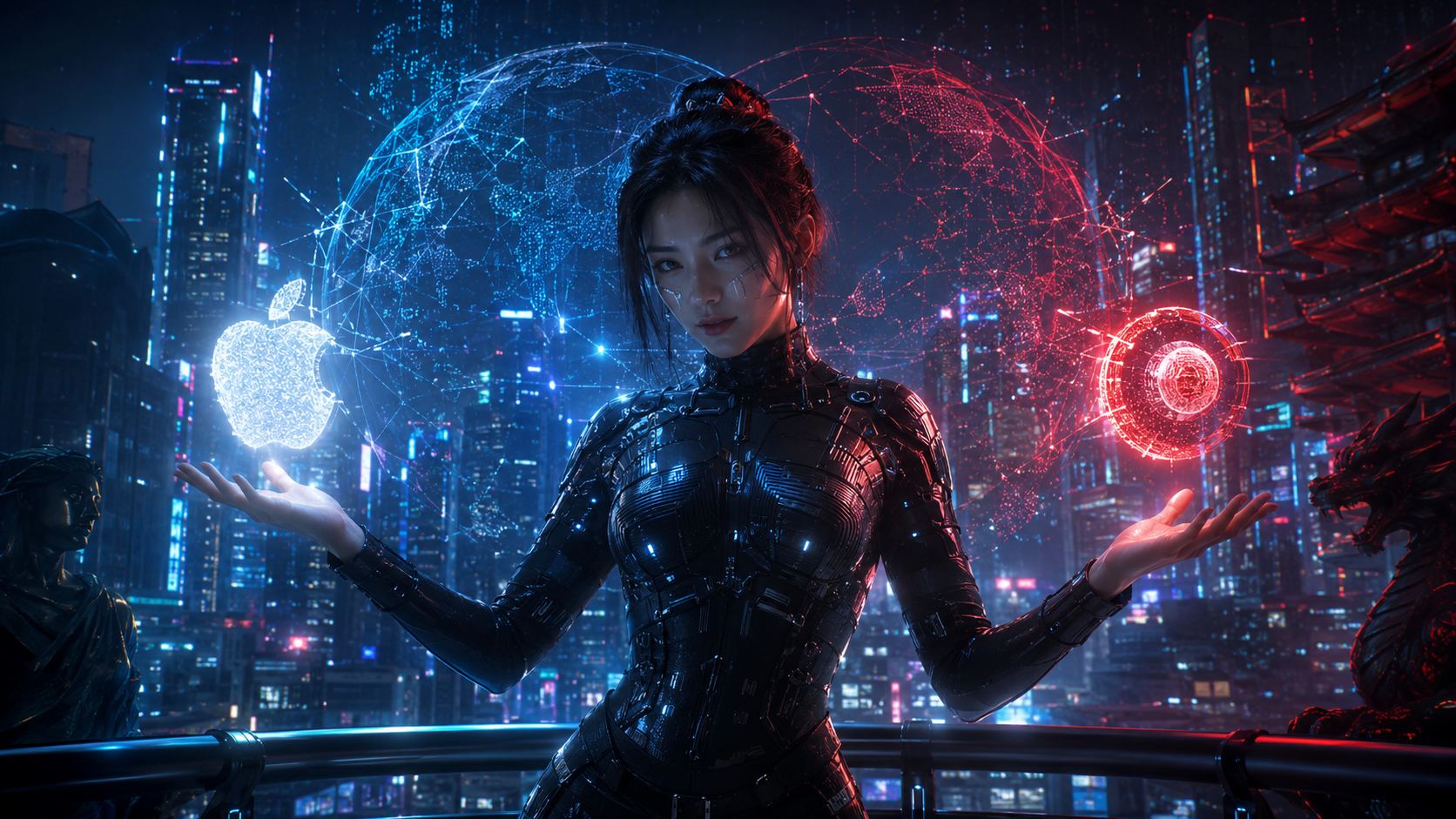
Apple rarely makes loud geopolitical statements. It prefers product launches, polished keynotes and carefully crafted slogans. Yet one of its most consequential announcements barely looked like news at all.
For Chinese users, Apple Intelligence will rely on Alibaba’s Qwen large language model rather than the AI stack available elsewhere. On paper, it is simply another regional partnership designed to satisfy local requirements. In reality, it represents something much bigger: the confirmation that artificial intelligence is no longer developing as a single global platform.
Instead, the world is drifting toward multiple AI universes—each shaped by different governments, regulations, companies and political priorities.
Apple’s Quiet Bombshell
Apple’s partnership with Alibaba initially sounds like a practical engineering decision. Chinese regulations prevent companies from simply deploying foreign AI models inside the country. Every generative AI service must pass regulatory approval, comply with data localization requirements and operate within Beijing’s content framework. As a result, Apple needed a domestic partner if Apple Intelligence was ever going to reach Chinese iPhones. Recent regulatory approval confirms that Apple Intelligence in China will integrate Alibaba’s Qwen model, alongside support from Baidu for certain features. Reuters reports that the approval clears the way for Apple’s AI rollout in its second-largest smartphone market. :contentReference[oaicite:0]{index=0}
But that explanation misses the strategic significance.
Apple has effectively accepted that one version of Apple Intelligence cannot serve the entire planet.
The same iPhone, carrying the same Apple branding, will now offer different intelligence depending on where it is used. The interface may remain familiar, but the underlying model, its knowledge base, moderation rules and capabilities will increasingly differ across borders.
That is not localization.
That is technological divergence.
The AI Cold War Gets Real
For years, analysts described artificial intelligence as a race between the United States and China. The metaphor suggested a finish line—a winner that would dominate the future.
Reality is turning out to be more complicated.
Instead of one global AI ecosystem replacing another, two parallel technology stacks are emerging.
In the West, companies such as OpenAI, Anthropic, Google, Meta and Microsoft define the frontier.
Inside China, Alibaba’s Qwen, DeepSeek, Baidu’s ERNIE, Tencent’s Hunyuan and ByteDance’s Doubao are evolving within an entirely different regulatory and commercial environment.
The models increasingly train on different datasets.
They follow different safety policies.
They connect to different cloud infrastructures.
They integrate with different payment systems, search engines and digital services.
Developers who once assumed software could scale globally now face a reality where AI applications may require regional architectures from day one.
Think less “global internet” and more console exclusives.
If the early web resembled a universal platform, tomorrow’s AI increasingly resembles competing operating systems.
Why Apple Couldn’t Ignore China
Apple had little room to maneuver.
China remains one of the company’s most important markets despite increasing competition from Huawei, Xiaomi, Oppo and Vivo. Apple executives have openly acknowledged that Apple Intelligence plays an important role in encouraging hardware upgrades, making its absence in China an increasingly expensive problem. :contentReference[oaicite:1]{index=1}
Ignoring China’s AI regulations simply was not an option.
Nor could Apple realistically convince Beijing to make an exception.
Instead, it chose adaptation.
That decision reflects an uncomfortable reality for every multinational technology company: access to China’s enormous consumer market increasingly requires technical compromise.
Some critics will inevitably frame this as surrender.
Others will see it as pragmatic business.
The truth lies somewhere in between.
Apple has spent decades balancing privacy messaging, local regulations and commercial interests across vastly different political systems. AI simply raises the stakes because intelligence itself becomes part of the product.
Once the model changes, the experience changes.
The Future Isn’t One AI—It’s Several
The most interesting consequence isn’t limited to Apple.
It’s the possibility that every global technology company will eventually ship multiple AI products under one brand.
Imagine asking identical questions to the same assistant in San Francisco, Paris and Shanghai.
You might receive three different answers—not because the language changed, but because the underlying model follows different legal obligations, different cultural assumptions and different governance rules.
This is where science fiction suddenly feels less fictional.
In Ghost in the Shell, technology connects humanity through vast digital networks while governments struggle to retain control. Identity becomes fluid, yet political borders remain stubbornly real.
Meanwhile, Cyberpunk 2077 imagines corporations operating across fractured jurisdictions, where access, power and technology depend as much on territory as innovation.
Neither vision predicted today’s AI landscape exactly.
Yet both captured an essential tension: technological progress rarely escapes politics.
Artificial intelligence was once marketed as universally accessible intelligence.
Increasingly, it resembles national infrastructure.
Countries are not simply regulating AI.
They are shaping distinct versions of it.
That fragmentation affects far more than chatbots.
Cloud providers, chip manufacturers, enterprise software vendors and smartphone makers all face the same challenge: build globally while complying locally.
Some companies will maintain parallel product lines.
Others may exit certain markets altogether.
Either way, the era of one AI serving everyone appears to be ending.
So what?
For developers, this means designing applications that can interact with multiple foundation models instead of assuming a single dominant platform.
For investors, the value of regional AI champions becomes easier to understand. Companies with strong domestic ecosystems may prove just as strategically important as those leading globally.
For consumers, the changes will be subtler but equally significant.
The logo on your smartphone may stay the same.
The intelligence behind it may not.
Apple’s Alibaba partnership is therefore not really about Alibaba.
Nor is it only about Apple.
It marks a turning point where AI stops behaving like a universal technology and starts resembling the internet itself—fragmented, localized and increasingly defined by political borders.
The next iPhone will undoubtedly receive more headlines.
History, however, may remember this quieter decision as the moment the AI multiverse became impossible to ignore.
Apple and the AI multiverse: key questions
Why is Apple partnering with Alibaba in China?
Chinese regulations require generative AI services to use locally approved technologies and comply with domestic rules. Alibaba’s Qwen model enables Apple Intelligence to meet those requirements.
Will Apple Intelligence work differently in China?
Yes. While the interface remains similar, the underlying AI models and some features differ from versions available in other markets.
What is Alibaba’s Qwen?
Qwen is Alibaba’s family of large language models used for text, coding, reasoning and multimodal AI applications.
Does this mean global AI is becoming fragmented?
Increasingly, yes. Regulatory frameworks, national security concerns and local technology ecosystems are pushing AI toward regional implementations rather than one universal platform.
Should investors see this as financial advice?
No. This article discusses industry trends and strategic developments only and should not be interpreted as investment or financial advice.