
The battle between BlackRock and Vanguard is one of the most important rivalries in modern finance. Together, the two investment giants oversee more than $25 trillion in client assets, own significant stakes in thousands of publicly traded companies, and influence everything from retirement savings to corporate governance and the AI boom.
Although they are often grouped together as passive investing leaders, the similarities largely end there. One is a publicly traded financial powerhouse with multiple revenue streams and an expanding technology business. The other remains uniquely owned by its investors and has built its reputation around relentlessly lowering costs.
Whether you’re an ETF investor, a technology enthusiast, or simply curious about who really controls the world’s money, understanding BlackRock and Vanguard helps explain how today’s financial markets work.
Table of contents
- BlackRock vs Vanguard at a glance
- Who manages the most money?
- Very different business models
- The ETF war: iShares vs Vanguard
- Technology and innovation
- Who owns BlackRock and Vanguard?
- Fees, profitability, and investment strategy
- Who is winning in 2026?
- BlackRock vs Vanguard: key questions
BlackRock vs Vanguard at a glance
BlackRock and Vanguard dominate global asset management, but they arrived there through very different paths.
BlackRock, founded in 1988, has evolved into the world’s largest asset manager. It operates across passive investing, active management, private markets, institutional advisory services, risk management software, and technology platforms.
Vanguard, founded by legendary investor John C. Bogle in 1975, pioneered the retail index fund and helped popularize passive investing. Its mission has remained remarkably consistent: lower investment costs for clients.
Both firms offer ETFs, mutual funds, retirement products, and advisory services. However, their ownership structures and strategic priorities differ dramatically.
Who manages the most money?
Assets under management (AUM) remain the easiest way to compare both firms.
As of mid-2026:
- BlackRock: approximately $15.3 trillion in AUM.
- Vanguard: approximately $10–11 trillion in global AUM.
BlackRock has widened its lead thanks to strong ETF inflows, acquisitions in private markets, and favorable equity markets. The company continues to post record inflows into its iShares ETF platform while expanding into private credit and infrastructure investing.
Vanguard remains the second-largest asset manager globally and continues to attract enormous inflows from long-term retail investors seeking low-cost index funds.
It’s important to remember that these assets belong to clients—not to BlackRock or Vanguard themselves. The firms manage the investments and collect management fees but do not own the underlying securities. Recent community discussions frequently highlight this distinction, even while acknowledging the firms’ enormous influence through proxy voting and stewardship.
Very different business models
BlackRock: diversified financial powerhouse
BlackRock generates revenue from multiple sources:
- iShares ETFs
- Active investment management
- Institutional mandates
- Private equity and infrastructure
- Private credit
- Technology subscriptions through Aladdin
Unlike traditional fund managers, BlackRock increasingly resembles both an investment company and a financial technology provider.
Its acquisition strategy has accelerated its expansion into higher-margin businesses beyond passive investing.
Vanguard: client-owned and cost-focused
Vanguard’s structure is unique.
The company is owned by its U.S. funds, which are themselves owned by fund shareholders. Because there are no outside shareholders demanding profits, Vanguard can reinvest operating efficiencies into lowering fund expenses.
This ownership model has helped Vanguard become synonymous with low-cost investing.
The ETF war: iShares vs Vanguard
The ETF market is where the rivalry becomes most visible.
BlackRock operates the iShares brand, the world’s largest ETF family. It offers hundreds of ETFs covering virtually every asset class, sector, region, factor, and investment theme.
Vanguard focuses on a more streamlined product lineup emphasizing long-term index investing rather than specialized trading strategies.
Institutional investors often favor iShares because of:
- greater liquidity
- broader product selection
- deep derivatives ecosystem
- large international footprint
Retail investors frequently choose Vanguard because of:
- extremely low expense ratios
- simple long-term portfolios
- strong reputation among buy-and-hold investors
In practice, both providers consistently rank among the largest recipients of global ETF inflows.
Technology and innovation
Technology increasingly separates these two firms.
BlackRock’s Aladdin
One of BlackRock’s biggest competitive advantages is Aladdin, its institutional portfolio and risk management platform.
Banks, insurers, pension funds, sovereign wealth funds, and investment managers worldwide use Aladdin to analyze portfolios, monitor risk, and execute investment decisions.
For many institutions, Aladdin has become critical financial infrastructure rather than simply another software product.
Vanguard’s digital investing
Vanguard has invested heavily in digital advice, online investing, and automated portfolio management.
Rather than selling enterprise software, Vanguard concentrates on improving the investor experience through low-cost digital services and financial planning tools.
The difference reflects each company’s broader philosophy: BlackRock builds institutional technology ecosystems, while Vanguard focuses on individual investors.
Who owns BlackRock and Vanguard?
This is one of the most misunderstood aspects of the industry.
BlackRock is a publicly traded company listed on the New York Stock Exchange. Institutional investors, pension funds, mutual funds, and individual shareholders own BlackRock stock.
Vanguard is different.
No public shareholders own Vanguard. Instead, the company is owned by its funds, which are ultimately owned by the investors holding those funds.
This structure removes the traditional conflict between maximizing shareholder profits and lowering customer costs.
Ironically, BlackRock and Vanguard often appear among the largest shareholders of the same public companies because their index funds hold shares on behalf of millions of investors.
Fees, profitability, and investment strategy
Passive investing has pushed management fees steadily lower over the past two decades.
Vanguard remains the industry benchmark for ultra-low-cost investing, with some index funds charging only a few basis points annually.
BlackRock competes aggressively on ETF pricing while balancing higher-margin businesses like alternatives, technology services, and institutional advisory work.
Because of this diversified business mix, BlackRock typically generates significantly higher revenues and profits despite operating in the same highly competitive ETF market.
For investors, however, fund selection should depend less on the company behind the ETF and more on the fund’s objective, cost, liquidity, and suitability for a particular investment strategy.
Who is winning in 2026?
The answer depends on how success is measured.
By assets under management, BlackRock remains the clear global leader, managing more than $15 trillion and continuing to post record inflows while expanding rapidly into private markets and technology services.
By philosophy, Vanguard continues to define low-cost passive investing. Its investor-owned model remains unique among major financial institutions and continues to attract millions of long-term investors.
Rather than replacing one another, the two firms increasingly dominate different parts of the investment ecosystem.
BlackRock is becoming a diversified financial infrastructure company serving institutions worldwide.
Vanguard remains the benchmark for cost-efficient investing designed around individual investors.
Together, they influence corporate governance, retirement systems, AI-related investments, and capital allocation across virtually every major stock market. While they do not “own the world’s money,” their scale means decisions on stewardship, proxy voting, and product innovation can ripple across global markets.
For anyone following finance, technology, or the future of capitalism, the rivalry between BlackRock and Vanguard is likely to remain one of the defining stories of the next decade.
For more information, investors can consult BlackRock’s investor relations pages and Vanguard’s corporate facts, as well as regulatory filings with the U.S. Securities and Exchange Commission.
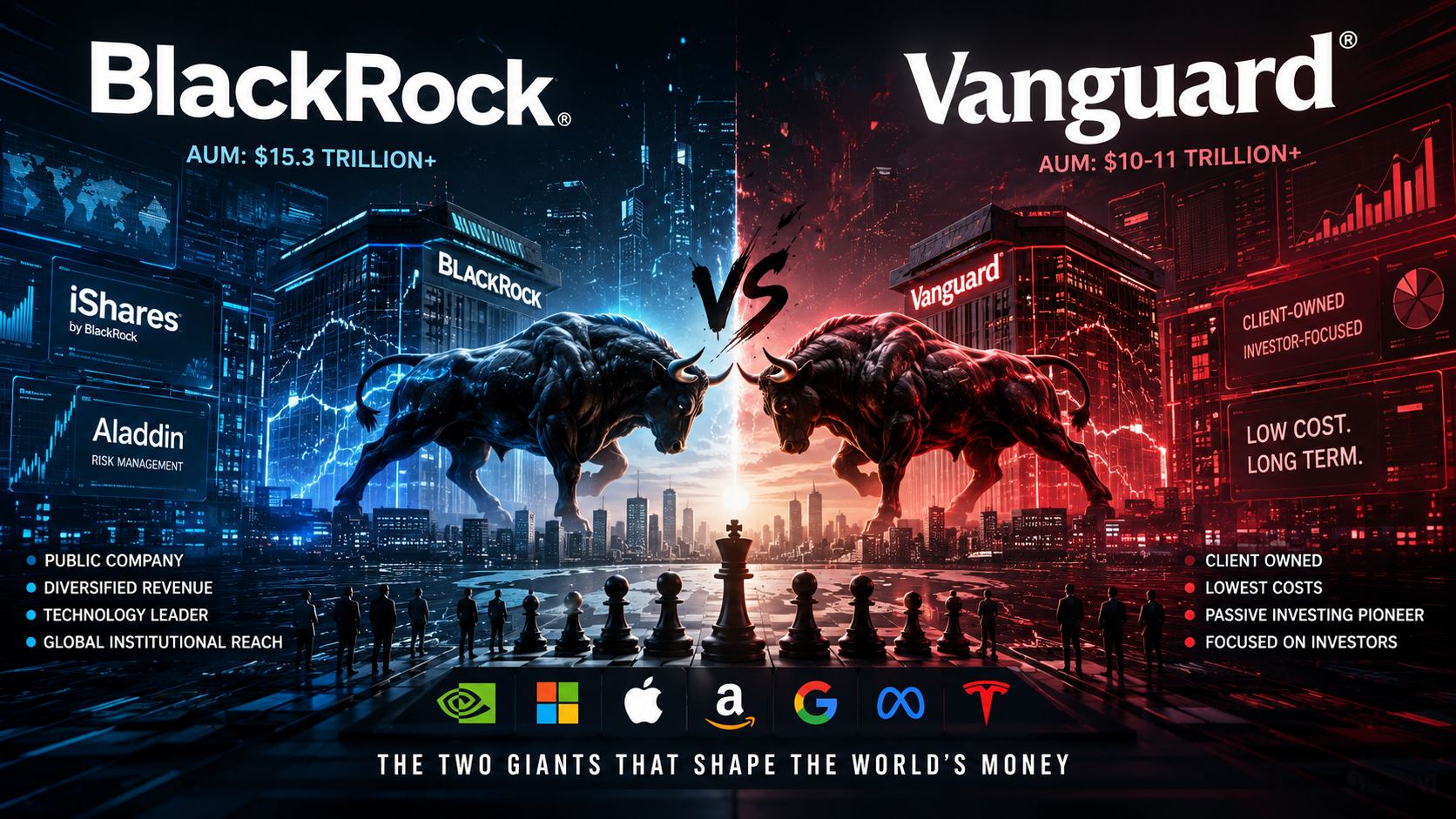
If you’re comparing ETFs, BlackRock vs Vanguard is one of the most important debates for both retail and institutional investors.
BlackRock vs Vanguard: key questions
Which is the largest asset manager in the world?
BlackRock is the world’s largest asset manager, overseeing more than $15 trillion in assets under management as of mid-2026.
Does Vanguard own BlackRock?
No. Vanguard does not own BlackRock. BlackRock is a publicly traded company, while Vanguard is owned by its funds and their investors.
Which company has lower investment fees?
Vanguard has historically led the industry in lowering fund expenses, although BlackRock also offers highly competitive ETF pricing.
Why are BlackRock and Vanguard so influential?
Their index funds hold significant stakes in thousands of public companies on behalf of millions of investors, giving them substantial influence through proxy voting and corporate stewardship.
Should investors choose BlackRock or Vanguard?
Both companies offer high-quality investment products. The best choice depends on an investor’s objectives, desired exposure, costs, liquidity needs, and overall portfolio strategy.
Is this article financial advice?
No. This article is for informational purposes only and should not be considered investment or financial advice. Investors should conduct their own research or consult a qualified financial advisor before making investment decisions.