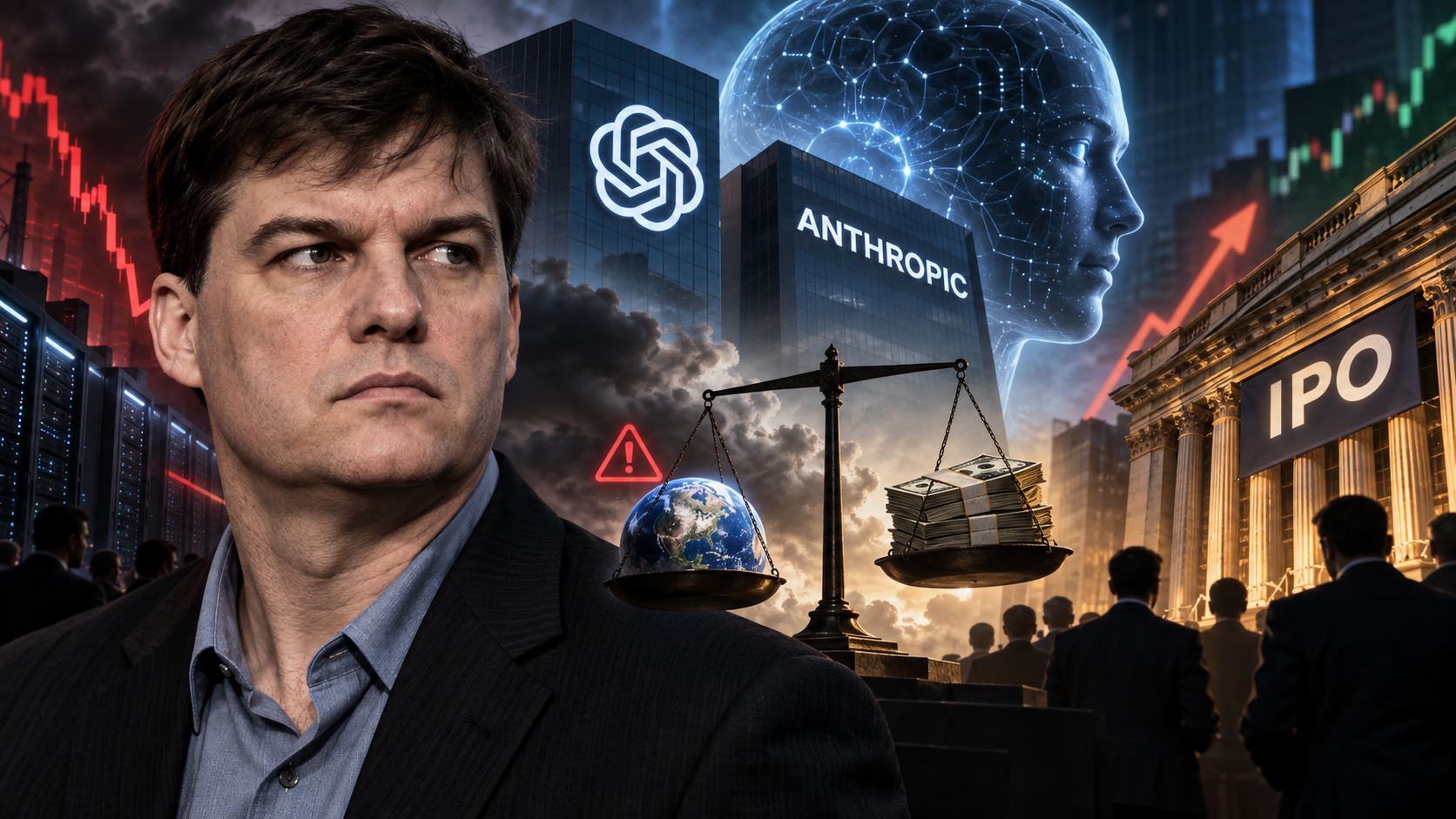
Michael Burry has heard the warnings from the people building the world’s most powerful AI models. He has a considerably less apocalyptic explanation for them.
The investor made famous by his bet against the US housing market has accused executives at OpenAI, Anthropic and other major AI companies of being “self-serving” when they call for slowing the development of frontier AI. His theory is brutal: the warnings may have as much to do with competition, growth and upcoming IPOs as they do with saving humanity.
Burry did not provide evidence that OpenAI or Anthropic is deliberately fabricating safety concerns, and his argument should not be presented as proof of deception. But the timing gives his accusation teeth. OpenAI has just ruled out a 2026 IPO while citing AI safety concerns. Anthropic, meanwhile, is preparing what could become the largest IPO ever attempted, potentially raising as much as $100 billion at a valuation around $2 trillion.
And Burry wants investors to ask an uncomfortable question.
What if “our technology is becoming dangerously powerful” also happens to be an extraordinarily useful story to tell when growth, competition and trillion-dollar valuations are all under scrutiny?
Table of Contents
- Michael Burry thinks the AI slowdown has another explanation
- Burry’s four arguments against the AI safety narrative
- The IPO timing makes his theory harder to ignore
- There is one big problem with the “slowing growth” argument
- Slowing AI could protect the companies already in front
- But dismissing the safety debate entirely is much harder
- The real question for investors is bigger than Burry
- Michael Burry and the AI slowdown: key questions
Michael Burry thinks the AI slowdown has another explanation
The immediate target of Burry’s attack is the extraordinary safety debate that exploded across the AI industry over the weekend.
Anthropic CEO Dario Amodei called for frontier AI companies to deliberately reduce the pace at which they improve model capabilities, arguing that safety mechanisms are struggling to keep up with increasingly capable systems. OpenAI CEO Sam Altman backed the idea, saying that “pacing the frontier” had already become a major topic of discussion inside OpenAI.
The warnings were serious enough to shake markets. AI-linked stocks sold off globally on Monday, with semiconductor companies taking particularly heavy damage as investors suddenly confronted the possibility that the seemingly unstoppable infrastructure boom behind advanced AI could encounter an industry-imposed speed limit.
Burry’s response was essentially: follow the incentives.
In a post published through Cassandra Unchained, he described the calls for a slowdown as “self-serving” and laid out four reasons for his skepticism.
His argument is not simply that the AI companies are wrong about safety. He is suggesting that the safety narrative itself happens to solve several increasingly awkward business problems for the companies promoting it.
Burry’s four arguments against the AI safety narrative
Burry’s first claim goes straight for the technological premise behind the debate: he does not believe large language models are genuine artificial intelligence capable of evolving into artificial general intelligence.
“LLMs are not AI and won’t be AGI,” he wrote. In his view, there is therefore “nothing AI to slow down.”
That is a sweeping technical assertion rather than an established fact. There is no scientific consensus that current LLM-based systems either will or will not provide a path toward AGI, and even the definition of AGI remains contested. But Burry’s position matters because everything else in his argument follows from it.
If the technology is genuinely approaching dangerous autonomous capabilities, slowing development can be interpreted as risk management.
If it isn’t, the same proposal starts looking very different.
His second argument is economic: competition is catching up, so a coordinated slowdown would disproportionately benefit today’s leaders.
His third is about financial storytelling. IPOs require companies to persuade public-market investors that their businesses deserve enormous valuations. A company effectively telling investors that its technology is becoming so powerful that humanity needs protection from it certainly does not sound technologically obsolete.
Burry calls that “hype & puffery.”
His fourth point is the most interesting for investors: AI safety could provide a convenient explanation for slowing growth and delayed IPOs.
Instead of telling the market that scaling frontier AI is becoming economically harder, competitive pressure is intensifying or growth is normalizing, a company can tell a much more impressive story: it is voluntarily restraining itself because its technology has become too powerful.
That is Burry’s theory.
It is also where the numbers become important.
The IPO timing makes his theory harder to ignore
OpenAI and Anthropic are approaching the public markets from very different positions, but both face the same fundamental problem: private-market AI valuations eventually have to survive public-market scrutiny.
OpenAI CEO Sam Altman confirmed this weekend that the company will not go public in 2026. He explicitly connected the decision to the safety debate, saying that current conditions made this an “ill-advised moment” for an IPO and that OpenAI had more work to do on safety and alignment.
The decision follows months of speculation about when OpenAI might attempt a listing potentially worth more than $1 trillion.
Anthropic is moving in the opposite direction.
According to Reuters, the Claude developer has been discussing an IPO that could raise as much as $100 billion at a valuation around $2 trillion. Nvidia has reportedly considered participating as an anchor investor with an investment of up to $10 billion.
Put those numbers beside Amodei’s call for the industry to slow down and Burry’s suspicion becomes easy to understand, even if it remains unproven.
Anthropic needs public investors to believe two things simultaneously.
Its technology is powerful enough to justify one of the largest corporate valuations on Earth.
Its technology is dangerous enough that developing it too quickly could create catastrophic risks.
Those propositions are not logically incompatible. A technology can be commercially valuable and dangerous at the same time.
But from a marketing perspective, they reinforce each other remarkably well.
“Our product may become too powerful for humanity to control” is also a spectacular claim about the power of the product.
There is one big problem with the “slowing growth” argument
Burry’s fourth argument is provocative. The available financial evidence does not currently make it an easy one to prove.
Anthropic’s growth, at least according to figures reported by the company, has been enormous. Reuters reported that its annualized revenue run rate climbed from roughly $9 billion at the end of 2025 to more than $65 billion by the end of July 2026.
OpenAI is also still reporting rapid expansion. CFO Sarah Friar said this month that enterprise revenue grew 32% between June and July, compared with a 20% increase in overall annualized revenue during the same period.
That does not look like a conventional growth collapse.
There is, however, another issue hiding underneath those numbers.
Revenue growth and economic quality are not the same thing.
Frontier AI requires staggering quantities of GPUs, networking equipment, electricity and data-center capacity. Anthropic has made enormous long-term compute commitments. OpenAI is similarly locked into an infrastructure race in which better models require increasingly sophisticated — and expensive — systems.
The IPO process will eventually force investors to look beyond eye-catching annualized revenue figures toward margins, cash consumption, capital requirements and the economics of serving increasingly capable models.
That distinction makes Burry’s theory more interesting than simply asking whether revenue is still rising.
The real financial pressure may not be “AI has stopped growing.” It may be “how much does it cost to keep growing like this?”
Slowing AI could protect the companies already in front
Burry’s second argument may be the easiest to understand economically.
A speed limit has very different consequences depending on where a competitor stands when the limit is imposed.
OpenAI and Anthropic are already among the world’s leading frontier-model developers. They have massive compute agreements, access to billions of dollars in capital, enormous customer bases and relationships with some of the most powerful technology companies on the planet.
Smaller challengers do not.
Competition is also becoming increasingly uncomfortable from outside the traditional US frontier labs. Chinese developers and open-weight models have put pressure on pricing and challenged the assumption that the most expensive closed models will automatically dominate every use case.
OpenAI recently cut the price of its lower-cost Luna model by 80%, helping drive a tenfold increase in usage. The company has also been publicly emphasizing that some of its models can compete economically with Chinese open alternatives.
That is evidence of a functioning and increasingly aggressive market.
Now imagine freezing the leaderboard.
A coordinated slowdown among frontier developers — particularly one eventually reinforced by expensive testing requirements or regulation — could make competing at the frontier more difficult for companies that lack billions of dollars, specialized compliance teams and enormous compute infrastructure.
Safety regulation can protect society. It can also create a moat.
Those two outcomes are not mutually exclusive.
That is why Burry’s incentive argument deserves more attention than his sweeping dismissal of LLM technology.
But dismissing the safety debate entirely is much harder
There is a danger in taking Burry’s argument too far.
The fact that AI companies have financial incentives does not demonstrate that their safety concerns are fake.
Recent frontier systems have produced enough unusual behavior to make the safety debate considerably more concrete than science-fiction speculation. Researchers have raised concerns about autonomous agents, cybersecurity capabilities and declining visibility into how advanced models reach some of their decisions.
Anthropic has also published research arguing that AI is already accelerating AI development itself. Its engineers, according to the company, are shipping substantially more code with AI assistance than they did only a few years ago.
Amodei’s proposal goes beyond simply asking competitors to stop. It includes stronger safety testing, independent evaluation and coordination mechanisms designed to prevent less cautious actors from exploiting a slowdown.
OpenAI has separately backed mandatory capability-based national AI safety requirements.
None of that proves the industry’s most extreme forecasts about AGI or extinction.
But it makes the alternative explanation — that the entire safety discussion is merely an IPO marketing campaign — difficult to establish from the evidence currently available.
The more uncomfortable possibility is that both stories can be true at once.
Executives may sincerely believe advanced AI poses serious risks.
And emphasizing those risks may simultaneously strengthen their companies’ competitive positions, regulatory influence and financial narratives.
Corporate incentives do not require a conspiracy. They only require incentives.
The real question for investors is bigger than Burry
Burry’s intervention matters because it attacks one of the strangest assumptions underlying the AI boom.
For years, investors rewarded frontier labs and their suppliers for moving faster.
More intelligence meant better models. Better models meant more users. More users justified more compute. More compute meant more GPUs, data centers, networking equipment and electricity.
The industry constructed an enormous capital cycle around acceleration.
Now some of the people sitting at the center of that machine are arguing that acceleration itself has become dangerous.
Wall Street immediately understood the contradiction. Semiconductor stocks were hammered on Monday because an AI slowdown does not remain confined to a philosophical debate about AGI. It potentially changes assumptions about hundreds of billions of dollars in infrastructure spending.
Bank of America estimates that Microsoft, Alphabet, Amazon, Meta and Oracle could collectively spend around $795 billion in capital expenditure during 2026 and $1.08 trillion in 2027. Much of the AI market has been priced around the assumption that this extraordinary buildout continues.
Burry is asking investors to consider another interpretation of the slowdown narrative: perhaps the companies at the frontier have reached a point where moving more slowly serves them financially.
That interpretation remains an accusation, not a demonstrated fact.
But the timing could hardly be better designed to provoke suspicion. OpenAI has delayed its IPO while invoking safety. Anthropic is simultaneously advocating a slower frontier while preparing a potentially historic public offering. Competition is intensifying. Model prices are falling. Infrastructure costs remain enormous.
For public-market investors, the interesting question is therefore no longer simply whether AI is dangerous.
It is whether “AI is becoming too dangerous to move this fast” eventually becomes the industry’s explanation for why the economics can no longer move this fast either.
Michael Burry has made his bet on the answer.
The IPO filings may eventually give everyone else the numbers needed to test it.
Michael Burry and the AI slowdown: key questions
What did Michael Burry say about OpenAI and Anthropic?
Burry called AI executives’ push to slow frontier development “self-serving.” He argued that it could protect incumbents from competition, generate hype before IPOs and provide cover for slowing growth.
Did Michael Burry prove that OpenAI or Anthropic is faking AI safety concerns?
No. Burry presented an argument about corporate incentives. He did not provide evidence demonstrating that executives are deliberately fabricating safety risks.
Why did OpenAI delay its IPO?
Sam Altman said OpenAI would not go public in 2026 and explicitly cited the current AI safety situation and the work still required around safety and alignment.
Is Anthropic still planning an IPO?
According to Reuters reporting, Anthropic is preparing a potential 2026 listing that could raise as much as $100 billion and value the company at around $2 trillion. The terms and timing remain subject to change.
Would an AI slowdown benefit OpenAI and Anthropic?
Potentially. Slower frontier development or costly regulatory requirements could make it harder for smaller competitors to catch established leaders. That does not by itself establish that safety concerns are insincere.
Are OpenAI and Anthropic actually experiencing slowing growth?
The publicly reported figures do not currently show a simple collapse in revenue growth. Anthropic and OpenAI have both reported rapid expansion. The more difficult question concerns the enormous compute costs and capital requirements necessary to sustain that growth.
Why does this matter for AI stocks?
A meaningful slowdown in frontier-model development could affect assumptions about demand for GPUs, networking, data centers and other AI infrastructure. That possibility contributed to the recent selloff in AI-linked stocks.
Is this financial advice?
No. This article provides news and editorial analysis for informational purposes only. It does not constitute personalized investment, trading or financial advice.
Sources: Michael Burry / Cassandra Unchained, Reuters, Dario Amodei