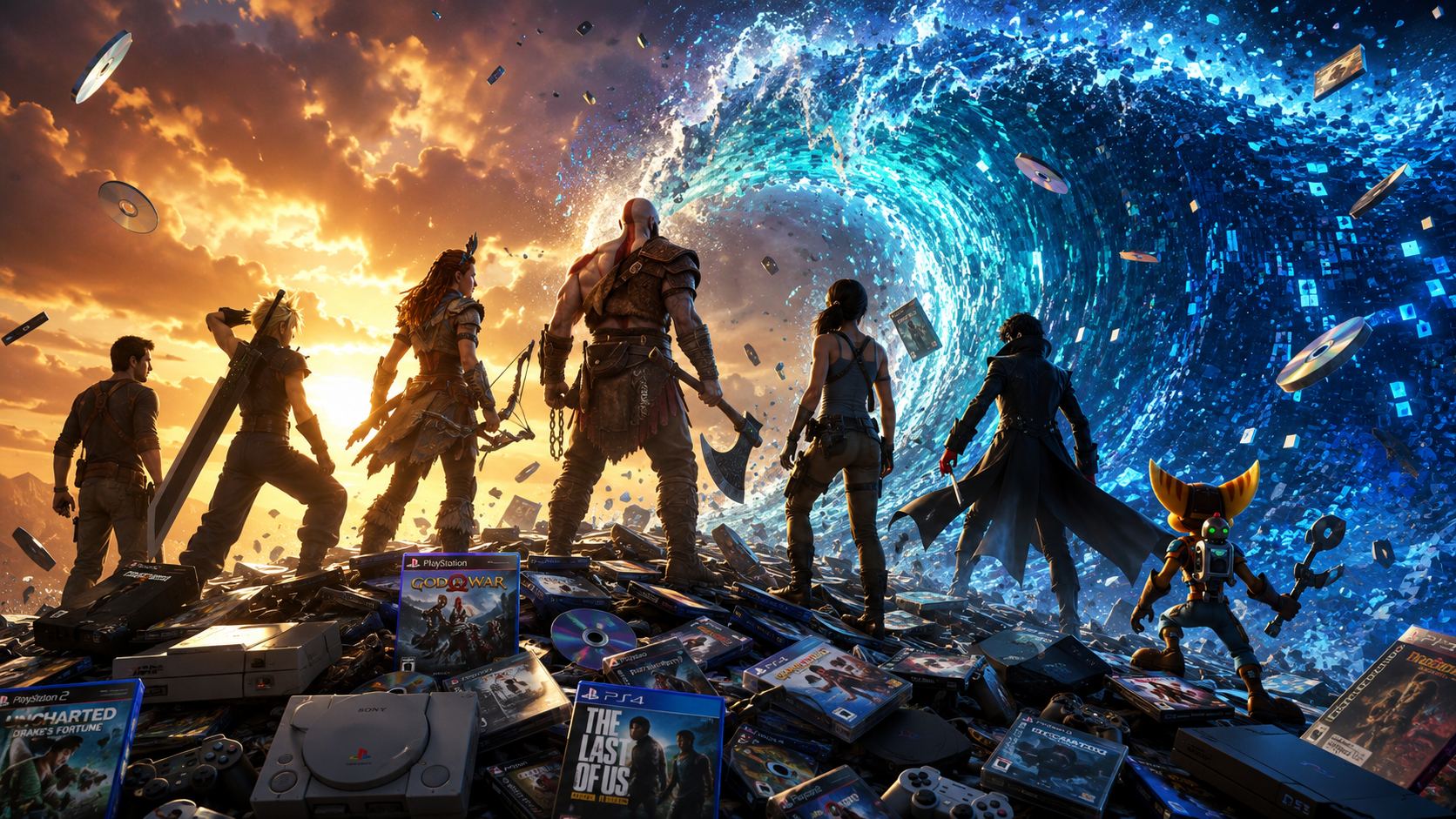
Sony has made the move the games industry has been circling for years: from January 2028, new PlayStation games will no longer be produced on physical discs.
According to Sony’s own PlayStation Blog announcement, new releases after that point will be available through the PlayStation Store and retail digital formats only. Existing disc releases are not affected. But the message is clear: the disc is being retired, and with it goes one of the last mainstream symbols of game ownership.
This is not just nostalgia for plastic boxes. It is a legal, commercial, and cultural shift. Because once games become access-only products, players lose more than shelf space. They lose resale, lending, inheritance, preservation, and a chunk of control over what they paid for.
Sony ends the PlayStation disc era
Sony’s 2028 cutoff does not delete your existing physical collection. Games already released, or scheduled to release before January 2028, can still exist on disc.
But for new PlayStation games after that date, the physical option disappears. No disc. No traditional box copy. No second-hand trade-in. Retailers may still sell digital codes, but that is not the same thing as selling a transferable object.
That distinction matters. A disc can sit on a shelf for twenty years. A code is consumed once. A digital license lives inside an account, under platform rules, attached to infrastructure the player does not control.
The industry will call this convenience. And yes, digital is convenient. No swapping discs, no shipping, no scratched Blu-rays, no midnight launch queues unless you enjoy standing outside in the rain for vibes.
But convenience is not the same as ownership.
What players actually own
The uncomfortable truth is that buying a game has always been more complicated than it looked.
When you bought a physical game, you owned the disc, the box, and the printed materials. You did not own the underlying intellectual property, the code as a creative work, or the right to copy and redistribute it.
Still, the disc gave players something powerful: practical control. You could lend it to a friend, sell it, gift it, keep it, or pass it on. That physical object created a real secondary life for the game outside the platform holder’s storefront.
Digital games weaken that control. In most cases, what you receive is a license tied to your account. It may feel like a purchase, it may be labelled like a purchase, and it may cost the same as a purchase. But legally and technically, it is closer to controlled access.
That is the ownership downgrade hiding behind the download button.
The second-hand market takes the hit
The biggest immediate casualty is the used games market.
Physical games created an ecosystem: trade-ins, lending between friends, retro collecting, local game shops, bargain bins, and entire retail chains built around the circulation of discs and cartridges.
Digital-only releases break that loop. A downloaded PlayStation game cannot be resold like a disc. It cannot be passed around a schoolyard, lent to a cousin, or discovered years later in a dusty second-hand shop.
Retailers may adapt by selling download codes, merchandise, accessories, subscriptions, and hardware. But the old model — shelves full of boxes, trade-in credit, used-game treasure hunting — gets pushed closer to the fate of video rental stores.
For publishers, this is attractive. No manufacturing costs, fewer retail intermediaries, and less second-hand competition. For players, it means fewer ways to access games cheaply and fewer ways to recover value from games they no longer play.
Digital media already showed us the warning signs
Gaming is not the first battlefield in this ownership war.
Music moved from albums to subscriptions. Films moved from discs to streaming libraries. Books moved from shelves to e-readers. Each shift offered convenience, portability, and instant access. Each shift also made ownership more fragile.
The most famous warning sign came in 2009, when Amazon remotely deleted copies of George Orwell’s 1984 from Kindle devices after a rights issue. The irony was so perfect it almost felt scripted by a dystopian novelist with a grudge against product managers.
The lesson was brutal: digital libraries can be altered from the outside.
That does not mean every digital purchase will vanish tomorrow. But it does mean the user’s control depends on contracts, servers, rights agreements, and corporate decisions. A Blu-ray on your shelf does not need a licensing server to remember it exists.
The legal grey zone of digital resale
European law has wrestled with digital resale for years, and the result is messy.
In the 2012 UsedSoft v Oracle case, the Court of Justice of the European Union held that, under certain conditions, downloaded software licenses could be resold. That sounded like a door opening for digital second-hand markets.
But later cases around e-books narrowed the dream. In Tom Kabinet, the CJEU treated e-book resale differently, making it harder to argue that every downloaded cultural product can be freely resold like a physical copy.
Video games sit in a particularly awkward place. They are software, but also audiovisual works, music, performances, online services, and platform-dependent products. In practice, players should not assume that a digital PlayStation library will ever become a clean, transferable second-hand asset.
That is the problem. The law may recognize bits of digital exhaustion in some contexts, but the consumer experience is simple: you cannot resell your downloaded console games.
Why this matters for preservation
There is also a cultural cost.
Games are not just products. They are art, software, social history, design history, and memory. Physical media has helped preserve decades of gaming culture, even when companies stopped selling titles, closed stores, lost licenses, or moved on to new hardware.
Digital-only ecosystems are more vulnerable. Games can be delisted. Online features can shut down. Licensed music can disappear. Stores can close. Accounts can be banned, hacked, or abandoned. Servers can become the graveyard of entire generations of media.
Collectors are not just hoarders with better shelving. They are part of an informal preservation network. When discs disappear, preservation depends even more on platform holders, archives, legal exceptions, and whether companies decide old games are still worth keeping alive.
Sony’s decision may make business sense. It may reflect where consumer habits already are. But it also confirms a darker trend: the future of media is increasingly rented, licensed, streamed, and permissioned.
We used to buy games and build collections. The next generation may inherit accounts, subscriptions, and catalogs that can change overnight.
Welcome to the age of digital ownership, where the word “ownership” needs an asterisk.
PlayStation continues to reshape the console market through its evolving digital ecosystem.
PlayStation digital ownership: key questions
Is Sony ending all PlayStation discs?
Sony says physical disc production for new PlayStation games will stop from January 2028. Existing and pre-2028 disc releases are not affected.
Will my current PlayStation discs still work?
Sony says the transition has no impact on games already released, or scheduled to release before January 2028, in disc format.
Can I resell a digital PlayStation game?
In normal consumer use, no. Digital PlayStation purchases are tied to an account and cannot be resold like physical discs.
Why does this matter for players?
It removes key benefits of physical media, including resale, lending, collecting, and long-term control outside a platform storefront.
Are digital games cheaper than physical games?
Not necessarily. Digital distribution can reduce costs for publishers, but those savings are not automatically passed on to players.
Is this legal advice?
No. This article is for general information and commentary only. For specific consumer rights or legal questions, consult a qualified lawyer in your jurisdiction.