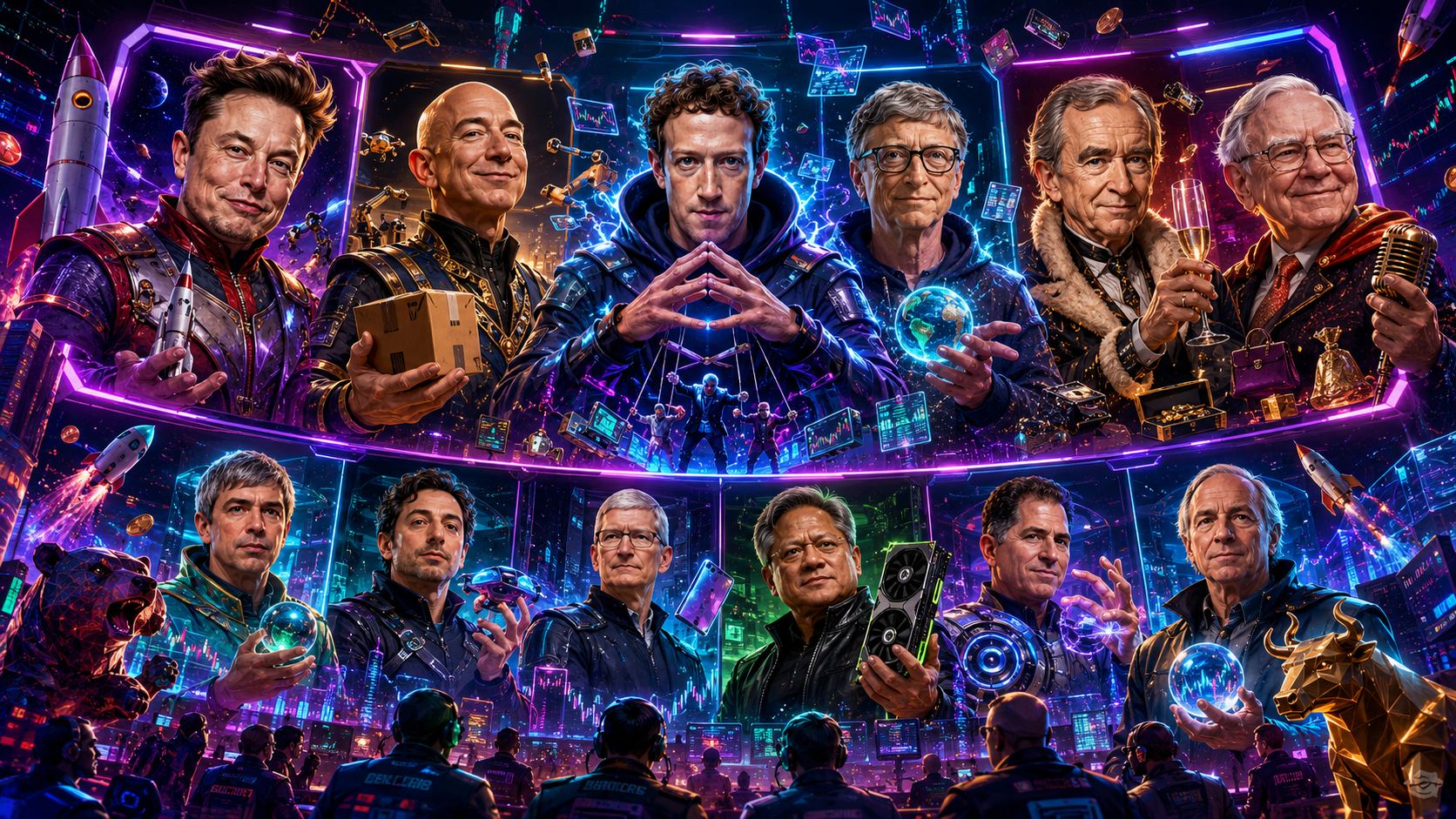
The billionaire leaderboard is no longer just a luxury-business story. It is a live scoreboard for tech monopolies, AI infrastructure, cloud empires, electric vehicles, rockets, semiconductors, and old-school capital allocation.
Based on Forbes’ Real-Time Billionaires List, last updated on June 14, 2026 at 1:30 a.m. EDT, the world’s richest people are now overwhelmingly tied to technology, public markets, and a few giant private-company valuations. These numbers are estimates, not bank balances. They move with share prices, private-market assumptions, currency swings, debt, and disclosure gaps.
Here is the current top 10, ranked by estimated net worth.
- The top 10 richest billionaires right now
- Why billionaire net worth changes so fast
- Why tech dominates the billionaire economy
- Why these numbers are estimates, not exact wealth
- Richest billionaires: key questions
The top 10 richest billionaires right now
1. Elon Musk — $1.1 trillion
Elon Musk sits at the top of the list with an estimated fortune of around $1.1 trillion. His wealth is primarily tied to Tesla and SpaceX, with additional exposure to X, xAI, Neuralink, and The Boring Company.
This is the most eye-catching number on the list because it pushes Musk into trillionaire territory, at least by Forbes’ current estimate. It also makes his ranking especially sensitive to private-company valuations and market sentiment around Tesla, AI, robotics, space infrastructure, and autonomous driving.
2. Larry Page — $294.1 billion
Google co-founder Larry Page ranks second with an estimated net worth of $294.1 billion. His fortune is largely linked to Alphabet, Google’s parent company.
Page’s position shows how durable Google’s business remains, even as the company faces pressure from AI search, antitrust scrutiny, and competition from OpenAI, Microsoft, Meta, and a growing swarm of AI-native challengers.
3. Sergey Brin — $271.3 billion
Sergey Brin, Google’s other co-founder, ranks third at an estimated $271.3 billion. Like Page, Brin’s fortune is anchored in Alphabet shares.
Brin has also been increasingly associated with Google’s AI push, a reminder that the AI boom is not only minting new fortunes. It is also reinforcing the wealth of founders who built the web’s first trillion-dollar platforms.
4. Jeff Bezos — $248.9 billion
Amazon founder Jeff Bezos ranks fourth with an estimated $248.9 billion. His wealth remains heavily tied to Amazon, even after years of stock sales and his transition away from the CEO role.
Amazon is no longer just an e-commerce company. AWS, advertising, logistics, streaming, and AI infrastructure all sit inside the Bezos wealth machine. That diversification is one reason he remains near the very top.
5. Larry Ellison — $231.5 billion
Oracle co-founder Larry Ellison ranks fifth with an estimated fortune of $231.5 billion. His net worth has climbed with investor enthusiasm around cloud computing, enterprise software, and AI infrastructure.
Oracle may not have the consumer visibility of Tesla, Google, or Amazon, but it sits deep inside the corporate tech stack. In the AI era, boring enterprise infrastructure can be extremely valuable.
6. Michael Dell — $225 billion
Michael Dell ranks sixth with an estimated net worth of $225 billion. His wealth is tied to Dell Technologies and its broader exposure to enterprise hardware, servers, storage, and AI infrastructure demand.
The AI boom has made chips famous, but those chips still need to sit inside data centers. Dell’s rise in the ranking reflects the market’s appetite for the physical backbone of AI.
7. Mark Zuckerberg — $194.8 billion
Meta CEO Mark Zuckerberg ranks seventh with an estimated $194.8 billion fortune. His wealth is tied to Meta Platforms, the company behind Facebook, Instagram, WhatsApp, Threads, Reality Labs, and a growing AI stack.
Meta’s story has shifted from social media maturity to AI distribution. The company controls massive consumer networks, a monster advertising business, and one of the most aggressive AI investment programs in Big Tech.
8. Jensen Huang — $177.4 billion
Nvidia CEO Jensen Huang ranks eighth with an estimated net worth of $177.4 billion. His rise is one of the clearest signals of the AI hardware explosion.
Nvidia has become the key supplier for the data-center arms race powering generative AI, large language models, robotics, simulation, and high-performance computing. Huang’s place in the top 10 is the billionaire equivalent of a GPU fan screaming at full speed.
9. Bernard Arnault & family — $157.6 billion
Bernard Arnault and family rank ninth with an estimated $157.6 billion fortune. Their wealth comes from LVMH, the luxury empire behind brands including Louis Vuitton, Dior, Fendi, Bulgari, and Sephora.
Arnault is the main non-tech counterweight in the top 10. While the list is dominated by software, chips, cloud, and rockets, LVMH proves that global luxury remains one of the strongest wealth engines on the planet.
10. Warren Buffett — $144.5 billion
Warren Buffett rounds out the top 10 with an estimated net worth of $144.5 billion. His fortune is tied to Berkshire Hathaway, the conglomerate built through decades of disciplined investing, insurance float, acquisitions, and patience.
Buffett’s presence is almost retro in this ranking. No AI model, no rocket company, no social graph. Just compounding, capital allocation, and one of the most famous investment machines in history.
Why billionaire net worth changes so fast
The ranking can change daily because most billionaire wealth is not held in cash. It is usually tied to shares in public companies, private equity stakes, restricted stock, family holdings, real estate, debt structures, and hard-to-price assets.
A strong day for Tesla, Alphabet, Nvidia, Meta, Oracle, Amazon, or LVMH can add billions of dollars to a founder’s estimated fortune. A market sell-off can erase the same amount just as quickly.
That is why “richest person in the world” is not a fixed title. It is a live market readout.
Why tech dominates the billionaire economy
Eight of the current top 10 are primarily tied to technology or tech-adjacent infrastructure. That includes electric vehicles, rockets, search, cloud computing, e-commerce, enterprise software, social media, AI chips, and data-center hardware.
This is not an accident. Modern tech companies scale globally, often with high margins, network effects, powerful intellectual property, and investor narratives that can drive enormous valuations.
The AI boom has only intensified that pattern. Nvidia’s rise, Oracle’s cloud momentum, Dell’s server exposure, Meta’s AI spending, Alphabet’s model race, and Musk’s AI-and-robotics narrative all point to the same thing: the world’s biggest fortunes are increasingly attached to computation.
Why these numbers are estimates, not exact wealth
No public ranking can measure billionaire wealth with perfect precision. Public stock holdings are easier to value, but private companies are more complicated. SpaceX, xAI, family trusts, debt, pledged shares, charitable vehicles, taxes, and undisclosed arrangements can all affect the real number.
Forbes and Bloomberg often differ because they use different methodologies. They may value private assets differently, update at different times, or make different assumptions about ownership stakes.
The cleanest way to read this ranking is not as an exact audit. It is a best-available market estimate of who controls the largest pools of private wealth right now.
Elon Musk: from billionaire to trillionaire!
Richest billionaires: key questions
Who is the richest person in the world right now?
Based on Forbes’ real-time ranking used here, Elon Musk is currently listed as the richest person in the world, with an estimated net worth of about $1.1 trillion.
Why is Elon Musk’s net worth so much higher than the others?
His estimated fortune is tied to major stakes in Tesla and SpaceX, plus other private ventures. Large changes in those valuations can dramatically move his net worth.
Which industry has the most billionaires in the top 10?
Technology dominates the current top 10, including AI, cloud computing, semiconductors, social media, e-commerce, enterprise software, electric vehicles, and space.
Is Bernard Arnault the only luxury billionaire in the top 10?
Yes, in this ranking Bernard Arnault and family are the only top-10 entry primarily tied to luxury goods, through LVMH.
Are these net worth figures exact?
No. They are estimates based on public holdings, private-company valuations, market prices, ownership disclosures, and methodology choices. They can change quickly.
Is this financial advice?
No. This ranking is for editorial and informational purposes only. It should not be used as investment advice or as a recommendation to buy or sell any stock, fund, cryptocurrency, or private asset.