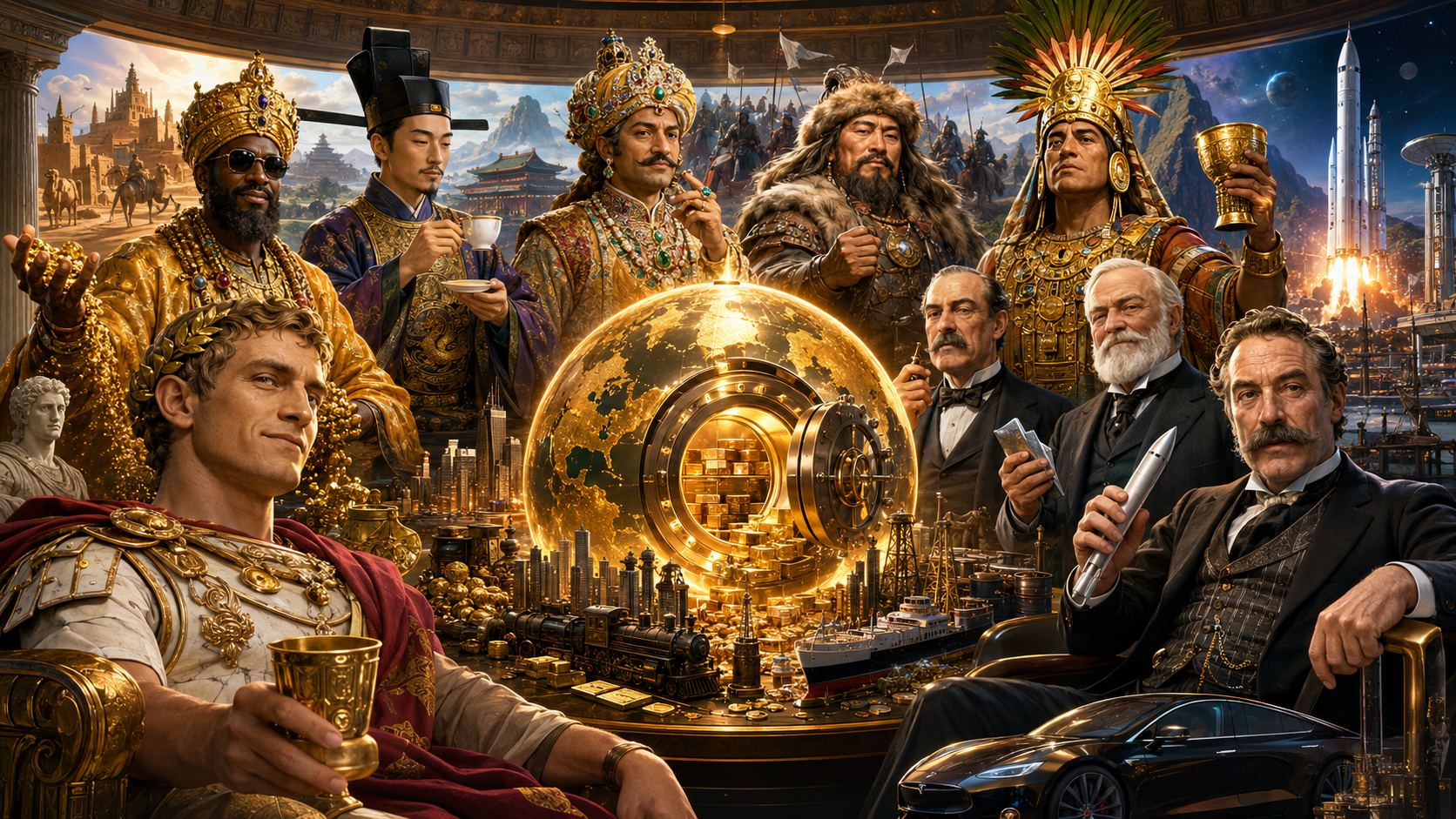
The richest-person debate usually turns into a lazy spreadsheet war: take an old fortune, adjust it for inflation, slap a giant dollar number on it, and call it history.
That method is broken.
A billionaire today can own $200 billion and still hold only a tiny slice of the global economy. A ruler in the ancient or medieval world could control land, gold, labor, taxes, armies, and food supply in a way that no modern CEO can legally touch. So for this ranking, the question is not “who had the biggest number in today’s dollars?” It is sharper: who was richest compared to the total wealth and economic power of the world around them?
There is no perfectly exact version of this list. For most of history, “net worth” did not exist in the modern sense. A king’s treasury, a ruler’s tax base, a conqueror’s tribute system, and a founder’s shares are not the same asset class. The best available method is to rank by relative economic power: personal fortune where measurable, and controlled economic resources where personal ownership is impossible to separate from state power.
Sources such as the Maddison Project Database, MeasuringWorth, Harvard Business School, Encyclopaedia Britannica, and Forbes’ real-time billionaire data help frame the comparison. But the further back we go, the wider the error bars get.
- How this ranking works
- The 10 richest people in history by relative wealth
- Why modern billionaires rank lower than ancient rulers
- Why this ranking cannot be perfectly exact
- Richest people in history: key questions
How this ranking works
This ranking uses three filters.
First, relative share matters more than absolute dollars. A fortune worth 2% of a national economy in 1901 is more historically extreme than a larger inflation-adjusted fortune worth 0.2% of global household wealth today.
Second, private wealth and sovereign control are separated where possible. John D. Rockefeller owned corporate assets. Augustus controlled imperial resources. Mansa Musa ruled a gold-rich empire. Those are not identical forms of wealth, but all represent unusual command over economic resources.
Third, global comparison is approximate. For ancient and medieval figures, the cleanest available proxy is share of world economic output or control over world-scale resources, not audited personal balance sheets. For modern figures, the numbers are more precise but less dominant relative to the size of the world economy.
The 10 richest people in history by relative wealth
1. Augustus Caesar — the emperor who blurred the line between state and personal fortune
Augustus sits at the top because his economic power was absurd even by imperial standards. The Roman Empire under Augustus represented a huge share of the world economy, and some historical comparisons argue that his personal control may have reached a significant fraction of the empire’s output.
The key point is not that Augustus had a clean “net worth” like a billionaire on a Forbes list. He did not. The point is that he controlled Egypt, imperial revenues, military power, taxation, and state resources at a scale that made him economically dominant across a large part of the known world.
Estimated relative power: possibly around 5% or more of world economic output, depending on methodology. Confidence level: medium-low, because imperial control is not the same as private wealth.
2. Mansa Musa — the gold king whose wealth broke the spreadsheet
Mansa Musa, ruler of the Mali Empire in the 14th century, is often described as the richest person in history. That claim is hard to verify numerically, but it is not hype pulled from nowhere. Mali sat at the center of major gold and salt trade networks, and Musa’s famous pilgrimage to Mecca displayed enough gold to disrupt prices in Cairo.
His wealth was not a modern portfolio. It was imperial control over gold flows, tribute, trade routes, and political authority. In terms of movable wealth that could shock foreign markets, Mansa Musa may be unmatched.
Estimated relative power: not reliably quantifiable, but likely among the highest ever recorded. Confidence level: medium for his extreme rank, low for any exact percentage.
3. Emperor Shenzong of Song — ruler of an economic superpower
Emperor Shenzong ruled China’s Song dynasty in the 11th century, one of the most advanced and economically powerful states of its time. Song China was a giant in population, agriculture, iron production, commerce, urbanization, and early paper-money systems.
Calling Shenzong “personally rich” is tricky. Much of this was state capacity, not private wealth. But if the ranking is about command over global resources relative to the world economy, a Song emperor belongs near the top.
Estimated relative power: potentially tied to a state producing a massive share of global output. Confidence level: low-medium, because state control cannot be cleanly converted into personal net worth.
4. Akbar the Great — the Mughal emperor over a huge share of world output
Akbar ruled the Mughal Empire at a time when India was one of the world’s largest economic centers. The Mughal state drew wealth from land revenue, agriculture, trade, luxury production, and a vast population base.
Again, this is not a clean CEO-style fortune. Akbar’s rank comes from sovereign control over one of the richest economies of the early modern world. In relative terms, that made him more economically powerful than almost any modern billionaire.
Estimated relative power: potentially several percentage points of world economic output through imperial control. Confidence level: medium-low.
5. Genghis Khan — the conqueror who controlled land more than liquid wealth
Genghis Khan built the foundation of the largest contiguous land empire in history. If land, tribute, military power, and control over trade routes are treated as wealth, his position is gigantic.
But there is a catch: Genghis Khan does not fit the classic “rich man hoarding treasure” model. Some accounts emphasize that he distributed spoils and did not accumulate wealth like later monarchs or industrialists. His rank here is based on command power, not liquid personal net worth.
Estimated relative power: massive territorial and tribute control, but not easily measurable as personal wealth. Confidence level: low-medium.
6. Atahualpa — the Inca ruler whose ransom revealed an empire’s treasure
Atahualpa, the last effective ruler of the Inca Empire before Spanish conquest, controlled a state where wealth was not organized around money in the European sense. Power came through land, labor, food storage, textiles, precious metals, and administrative control.
His famous ransom — rooms filled with gold and silver — revealed the scale of Inca treasure to the Spanish. But that treasure was only one visible piece of a much larger state system.
Estimated relative power: huge regional control, difficult to compare globally. Confidence level: low.
7. John D. Rockefeller — the private-sector monster of measurable wealth
Now the ranking enters the modern audited-ish world. John D. Rockefeller is the cleanest case for private wealth at extreme scale. Harvard Business School notes that his estimated $1.4 billion net worth in 1937 equaled about 1.5% of U.S. GDP.
That is insane by modern standards. Rockefeller’s wealth came from Standard Oil, which at its peak dominated U.S. oil refining before antitrust action broke it apart. Compared with the full global economy, his share was smaller than his U.S. share, but as a private individual in a modern capitalist system, he remains the benchmark.
Estimated relative power: about 1.5% of U.S. GDP; likely below 1% of world output. Confidence level: high for U.S. GDP comparison, medium for global comparison.
8. Andrew Carnegie — the steel king with near-Rockefeller economic power
Andrew Carnegie sold Carnegie Steel to J.P. Morgan in 1901 in one of the defining business deals of the industrial age. Some relative-wealth estimates place the transaction at slightly above 2% of U.S. GDP at the time.
Carnegie’s ranking is complicated because the U.S. was not yet the full global economic heavyweight it later became. Still, relative to his domestic economy, his fortune was colossal. In private wealth terms, he is one of the strongest candidates for richest American ever.
Estimated relative power: around 2% of U.S. GDP at peak by some estimates; lower as a share of world output. Confidence level: medium-high for U.S. comparison, medium-low globally.
9. Cornelius Vanderbilt — the transport titan of a smaller America
Cornelius Vanderbilt built his fortune in shipping and railroads, sectors that shaped the physical economy of the United States. When he died in 1877, his estate was commonly estimated at around $100 million to $105 million — a staggering sum in a much smaller economy.
Vanderbilt’s global share was probably below Rockefeller’s and Carnegie’s, but his domestic economic weight was extreme. In an age where transport infrastructure was destiny, Vanderbilt was not just rich. He was a private logistics platform before platforms were cool.
Estimated relative power: roughly around 1% or more of U.S. GDP by common historical comparisons; lower globally. Confidence level: medium.
10. Elon Musk — the modern billionaire who finally enters the historical conversation
Elon Musk belongs on the list because his peak wealth has reached levels no modern billionaire had touched before, driven by Tesla, SpaceX, xAI, and other holdings. Forbes’ real-time list has at times placed him around or above the trillion-dollar threshold on paper, depending on market and private-company valuations.
But relative wealth is the brutal equalizer. Even a $1 trillion fortune is only a small slice of today’s global household wealth and global economic output. Musk is historically massive in absolute dollars, but the world economy is now so enormous that he does not dominate it like an emperor or Gilded Age monopolist dominated his own context.
Estimated relative power: roughly around 0.2% of global household wealth if measured against a world wealth base in the hundreds of trillions. Confidence level: medium, because private-company valuations move fast.
Why modern billionaires rank lower than ancient rulers
Modern billionaires look richer because the numbers are bigger. But the denominator is also bigger.
Today’s global economy is enormous, diversified, financialized, and legally structured. Elon Musk, Larry Page, Jeff Bezos, Larry Ellison, Bernard Arnault, Mark Zuckerberg, and Jensen Huang can own gigantic fortunes, but they do not directly control national tax systems, armies, agricultural labor, imperial tribute, or the gold supply of a medieval trade network.
That is why relative wealth produces a weird result: the richest modern people may be less economically dominant than ancient and medieval rulers. Their fortunes are more measurable, more liquid in some ways, and more tied to public markets. But they are less sovereign.
Why this ranking cannot be perfectly exact
This ranking should be read as a best-effort historical hierarchy, not a mathematical final boss.
The biggest problem is that “wealth” changes meaning across time. A Roman emperor, a Mongol conqueror, a Mali mansa, an Inca ruler, and an American industrialist operated in completely different systems. Some owned assets. Some controlled states. Some extracted tribute. Some commanded labor. Some held shares.
There is also a data problem. Global household wealth estimates are modern. Ancient and medieval world wealth must be inferred from output, land, population, precious metals, tax records, and fragmentary accounts. That makes exact percentages impossible.
The safest conclusion is this: Augustus, Mansa Musa, major Chinese and Mughal emperors, Genghis Khan, and Atahualpa represent sovereign-scale wealth; Rockefeller, Carnegie, Vanderbilt, and Musk represent the most extreme private fortunes in more measurable capitalist systems.
Richest people in history: key questions
Who was the richest person in history compared to the world around them?
The strongest candidate is Augustus Caesar if sovereign control is counted, because his command over Roman imperial resources may have represented several percent of world economic output. If the focus is movable treasure and gold-based wealth, Mansa Musa is the strongest candidate.
Was Mansa Musa richer than Elon Musk?
In absolute modern dollar terms, estimates vary wildly and are often speculative. In relative economic impact, Mansa Musa likely had a stronger effect on the markets he touched, especially because his gold spending reportedly affected prices in Cairo.
Why is John D. Rockefeller ranked below ancient rulers?
Rockefeller was probably the richest private businessman in modern history relative to the U.S. economy, with wealth around 1.5% of U.S. GDP. But ancient and medieval rulers could control far larger shares of world resources through state power.
Is Elon Musk one of the richest people ever?
Yes, in absolute dollar terms. In relative terms, he ranks lower because the modern world economy and global wealth base are vastly larger than in previous eras.
Why not rank only by inflation-adjusted dollars?
Inflation-adjusted dollars are useful for modern comparisons, but they fail across deep history. They cannot capture land control, tribute, forced labor, gold supply shocks, or imperial taxation.
Is this financial advice?
No. This article is for historical and editorial purposes only. It is not investment advice, and it should not be used to make decisions about stocks, funds, crypto, private companies, or any financial asset.