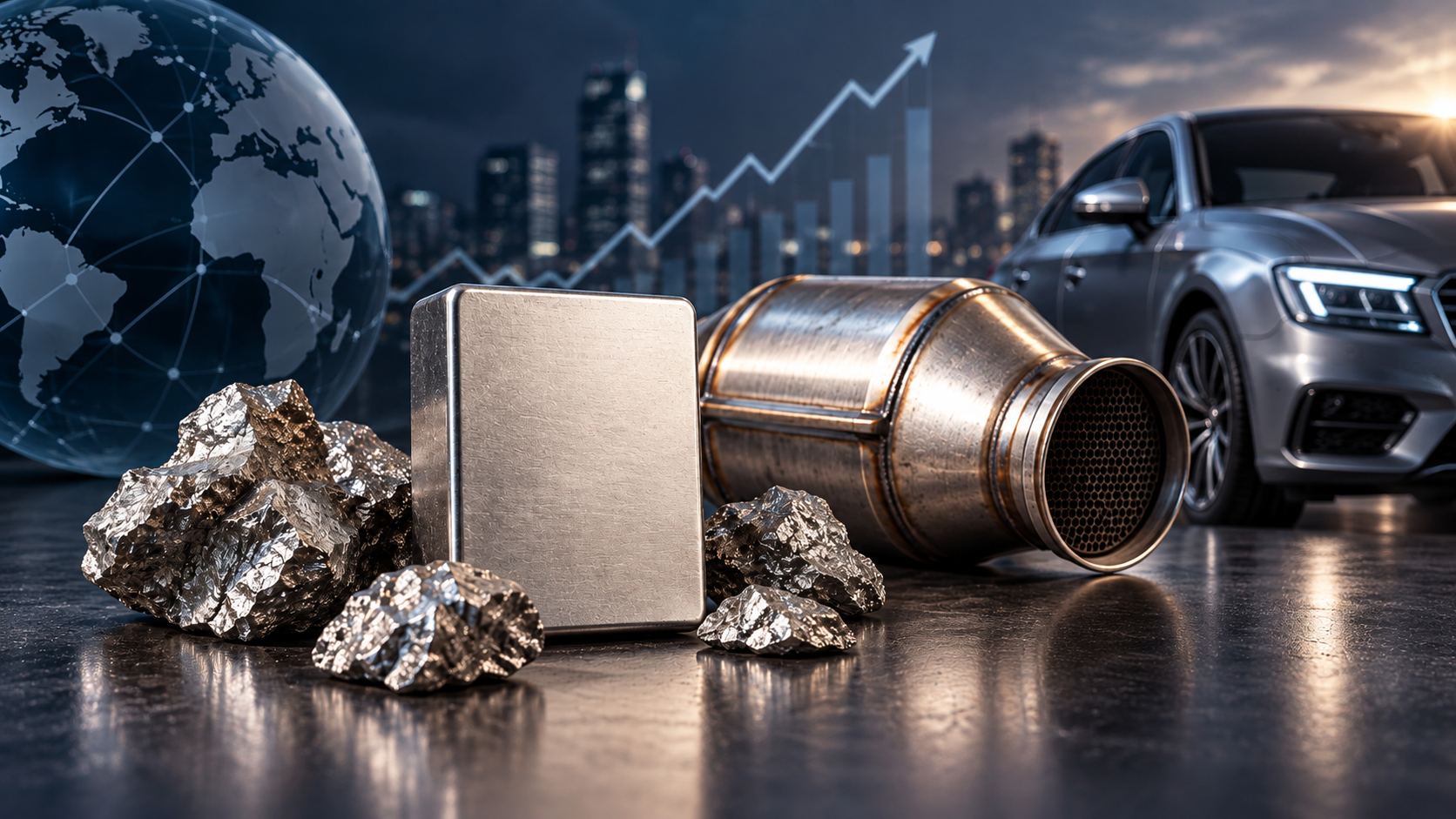
Palladium rarely gets the attention commanded by gold, silver or even platinum. Yet this obscure-looking precious metal sits at the center of a surprisingly important industrial supply chain — and that makes its investment story worth watching.
The basic bull case is straightforward: palladium is scarce, global production is geographically concentrated, and the automotive industry still consumes large quantities of it. A disruption to supply can therefore have an outsized impact on an already relatively small market.
But there is a catch. Palladium is not gold. Its price is heavily influenced by industrial demand, particularly gasoline-powered vehicles, while recycling, electric vehicles and substitution with platinum could progressively reshape the market.
So, should investors buy palladium? There are legitimate reasons to consider exposure, but the thesis is considerably more complicated than simply betting on another precious-metal rally.
Table of Contents
- What makes palladium different?
- Palladium has a concentrated supply problem
- The auto industry remains the key demand engine
- Why a supply shock could matter
- Palladium offers a different precious-metals trade
- The big risks behind the palladium thesis
- The case for buying palladium in 2026
- Palladium investing: key questions
What makes palladium different?
Palladium belongs to the platinum-group metals, or PGMs, alongside platinum, rhodium, ruthenium, iridium and osmium.
Its importance comes largely from its catalytic properties. According to the U.S. Geological Survey, the automotive industry has been the principal consumer of platinum-group metals since 1979, with palladium, platinum and rhodium used in catalytic converters to reduce vehicle exhaust emissions.
That industrial role separates palladium from the traditional narrative surrounding gold.
Gold demand is strongly influenced by investment, central banks, jewelry and its role as a monetary asset. Palladium is much more closely tied to physical industrial consumption.
That can make palladium more cyclical — but it can also make shortages considerably more explosive.
When manufacturers need palladium, they cannot simply postpone every purchase because the metal has become expensive.
Palladium has a concentrated supply problem
One of the strongest arguments for palladium is not demand. It is geography.
Global palladium production is heavily concentrated in a small number of countries, particularly Russia and South Africa.
USGS data indicates that Russia accounted for roughly 41% of global palladium mine production in 2024, making it the world’s largest producer.
South Africa is another critical source of platinum-group metals. Historically, Russia and South Africa together have dominated global PGM production.
This concentration creates an obvious vulnerability.
Political instability, sanctions, mining disruptions, electricity shortages, operational problems or declining production in either country can quickly become relevant to the global palladium market.
The issue is not theoretical. The USGS estimated that South African PGM production declined by around 9% in 2025, citing factors including lower palladium prices, high deep-level mining costs and electricity disruptions. Russian PGM output was also estimated to have fallen.
For investors, that creates an unusual setup: a globally important industrial material depends heavily on production from a relatively small number of regions.
The auto industry remains the key demand engine
Palladium’s most important application remains catalytic converters, particularly in gasoline-powered vehicles.
That creates both the strongest part of the investment thesis and its biggest long-term vulnerability.
The bullish argument is that internal combustion engines are not disappearing overnight. Even as battery-electric vehicles expand their share of global vehicle sales, hundreds of millions of combustion-engine and hybrid vehicles remain on the road.
Hybrid vehicles also retain combustion engines and therefore still require emissions-control systems.
Stricter emissions standards can additionally increase the amount or sophistication of catalyst technology required in vehicles.
The result is a transition that may be slower and messier than the simple “EVs replace gasoline cars” narrative suggests.
But investors need to distinguish between slow decline and permanent growth.
Long-term electrification remains a structural threat to automotive palladium demand because fully electric vehicles do not require conventional exhaust catalytic converters.
Why a supply shock could matter
Palladium’s relatively concentrated production base makes supply disruption particularly interesting from an investment perspective.
A 2025 USGS analysis modeled what could happen if U.S. net palladium imports from Russia were completely restricted for one year.
Its model estimated an equilibrium price increase of approximately 24%, alongside a roughly 5% reduction in available quantity.
That is a model, not a prediction. Markets can behave very differently in real-world geopolitical events.
Still, the exercise demonstrates an important characteristic of palladium: relatively modest changes in physical availability can potentially produce much larger movements in price.
This asymmetry is one reason palladium can become extremely volatile during periods of supply anxiety.
It is also why geopolitical developments surrounding major producing countries matter far more to palladium than they do to many larger commodity markets.
Palladium offers a different precious-metals trade
Gold, silver, platinum and palladium are often grouped together, but investors should not assume they behave identically.
Palladium offers exposure to a combination of themes:
- Precious-metal scarcity. Palladium is a naturally scarce platinum-group metal with limited primary production.
- Industrial demand. Unlike a predominantly monetary precious-metal thesis, palladium remains strongly connected to manufacturing and vehicle production.
- Geopolitical supply risk. Production concentration in Russia and South Africa introduces supply-chain vulnerabilities.
- Commodity diversification. Palladium’s fundamentals differ from those driving gold, equities, bonds or cryptocurrencies.
That can make palladium interesting as a small satellite position within a diversified commodity strategy.
But diversification does not mean safety. Palladium has historically demonstrated that it can move violently in both directions.
The big risks behind the palladium thesis
Anyone arguing that investors “need” to buy palladium is ignoring several substantial risks.
The first is electric vehicles. Battery-electric cars do not need traditional catalytic converters. If EV adoption accelerates faster than expected, palladium’s largest source of demand could face greater pressure.
The second is substitution.
Automakers can adjust catalyst formulations and substitute between platinum-group metals when relative prices make doing so economically attractive. Palladium therefore does not operate in isolation from platinum.
The third is recycling.
Catalytic converters contain recoverable PGMs. As older vehicles reach the end of their lives, recycling can return significant quantities of palladium to the market.
This matters enormously for the future supply balance.
The World Platinum Investment Council’s June 2026 outlook expects palladium market deficits to transition toward surpluses from 2027. That forecast is particularly important because it challenges the simplistic idea that palladium must remain permanently undersupplied.
Forecasts can change, of course. Previous palladium projections have repeatedly shifted as mine supply, automotive demand and recycling evolved.
But investors should take the possibility of future surpluses seriously.
The case for buying palladium in 2026
The strongest palladium investment thesis is not that the metal is guaranteed to rise.
It is that the market contains several ingredients capable of producing asymmetric price moves: concentrated production, geopolitical exposure, relatively inflexible industrial requirements and uncertainty around future recycling supply.
Recent pricing also illustrates how different palladium’s trajectory has been from some other precious metals.
On September 9, 2026, Reuters reported spot palladium around $1,365.50 per ounce, while gold was above $4,400 and platinum around $1,900.
Those nominal prices should not be directly compared as a valuation metric — each metal has completely different supply-and-demand fundamentals. But they illustrate how palladium has not participated equally in the powerful moves seen elsewhere across precious metals.
That creates the contrarian argument.
If combustion and hybrid vehicle demand proves more resilient than expected, recycling growth disappoints, or geopolitical disruption affects major producers, palladium could suddenly look considerably tighter than bearish long-term narratives imply.
On the other hand, if recycling accelerates while EV adoption and platinum substitution reduce demand, the expected transition toward surplus could become reality.
Palladium is therefore less of a classic safe-haven investment and more of a high-volatility bet on physical commodity fundamentals.
For investors comfortable with that distinction, the metal deserves attention. For anyone simply looking for “the next gold,” palladium may be the wrong trade entirely.
Palladium investing: key questions
Why would investors buy palladium?
The main arguments include palladium’s scarcity, concentrated global production, automotive demand and the potential for sharp price reactions when physical supply becomes constrained.
What is palladium mainly used for?
Its most important use is in automotive catalytic converters, where palladium helps reduce harmful emissions from combustion-engine vehicles.
Which countries produce the most palladium?
Russia and South Africa are crucial producers. USGS data shows Russia accounted for roughly 41% of global palladium mine output in 2024.
Are electric vehicles bad for palladium?
Potentially. Fully electric vehicles do not use conventional exhaust catalytic converters, meaning widespread EV adoption represents a long-term challenge for automotive palladium demand.
Could palladium become more expensive?
Yes, particularly if supply disruptions or stronger-than-expected demand tighten the physical market. However, higher recycling, substitution and weaker automotive demand could also push the market toward surplus.
Is palladium better than platinum?
Neither metal is inherently “better.” Palladium currently has different supply-demand dynamics, while platinum has a broader set of industrial demand drivers. Their relative prices can also encourage substitution between the two metals.
Is palladium a safe-haven asset like gold?
Not in the same sense. Palladium is a precious metal, but its price is much more exposed to industrial and automotive demand. Investors should expect potentially substantial volatility.
Is buying palladium financial advice?
No. This article is for informational purposes only and does not constitute financial or investment advice. Palladium and other commodities can be highly volatile, and investors should evaluate their objectives, risk tolerance and circumstances before making an investment decision.