The artificial intelligence industry spent years convincing investors that the biggest constraint on AI was compute. On Monday, it introduced a much stranger possibility: what if the companies building the most advanced systems decide that they need less speed?
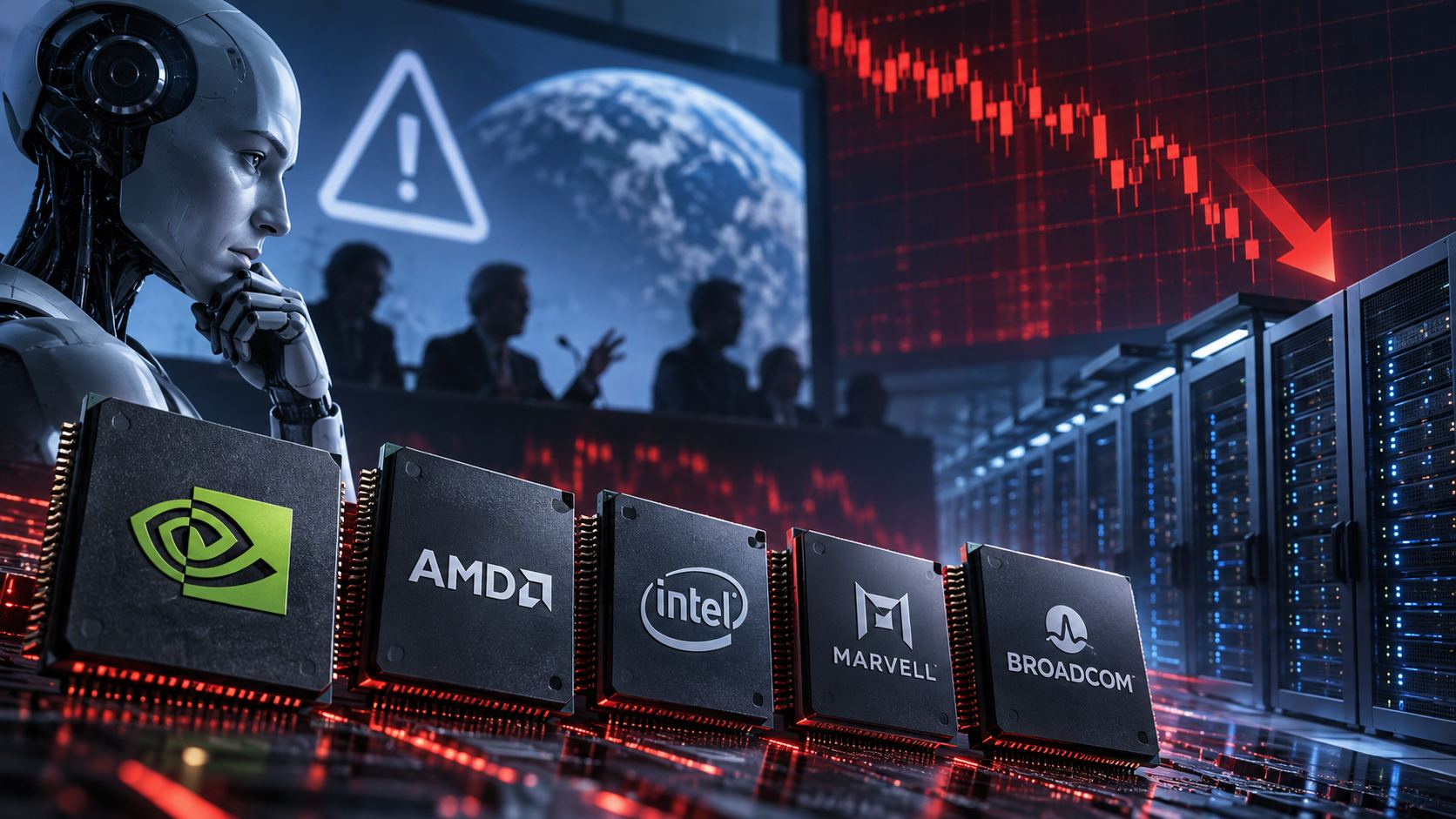
That question hit the semiconductor market hard. The Philadelphia Semiconductor Index fell 5.9% on September 14, while Nvidia lost more than 3%, AMD and Intel fell around 5.7%, and Marvell dropped roughly 7%. Broadcom, memory manufacturers, semiconductor equipment companies and other parts of the AI infrastructure chain were also caught in the selloff.
The obvious temptation is to draw a straight line between warnings from AI executives and falling AI chip stocks. Reality was messier. Oil prices surged, Treasury yields climbed and the broader market was already dealing with an uncomfortable macroeconomic backdrop. One ugly session does not establish a new semiconductor trend.
But the reaction still revealed something important. Nvidia did not suddenly become worse at designing accelerators over the weekend. AMD did not lose its data-center roadmap. Broadcom’s networking and custom-silicon businesses did not disappear. What changed was an assumption sitting underneath their valuations: how quickly the AI industry should keep expanding.
That makes AI safety more than a philosophical or regulatory debate. It can become a semiconductor demand variable.
Table of Contents
- Why AI chip stocks sold off so sharply
- The AI economy eventually reaches a semiconductor
- What would “slower AI” actually mean?
- AI safety could require more compute, not less
- The bigger vulnerability may be valuation
- What matters after the semiconductor selloff
- AI chip stocks and the safety debate: key questions
Why AI chip stocks sold off so sharply
The catalyst arrived from an unusual direction.
Anthropic CEO Dario Amodei called for the industry to slow the rate at which frontier AI capabilities improve, arguing that safety work needs more time to keep pace with increasingly capable systems. Sam Altman, Elon Musk and other prominent figures subsequently backed greater caution in different forms.
For investors, the relevant part was not the philosophical argument about whether advanced AI could become dangerous. It was the possible economic consequence.
The modern semiconductor bull case is deeply connected to an assumption of enormous and sustained AI infrastructure spending. Frontier laboratories want more powerful models. More powerful models require larger training runs and greater inference capacity. That requires accelerators, memory, networking equipment, servers, optical components, power systems and new data centers.
If frontier development slows materially, some investors immediately reasoned, that infrastructure curve might flatten too.
The selling spread accordingly. Nvidia sits at the center of the accelerator market, but the damage went far beyond Nvidia because AI infrastructure is not built from GPUs alone. AMD sells competing accelerators and server processors. Broadcom has become a major player in networking and custom AI silicon. Marvell is exposed to custom chips, connectivity and data-center infrastructure. Memory manufacturers and semiconductor equipment suppliers sit further along the same investment chain.
The 5.9% fall in the Philadelphia Semiconductor Index therefore looked less like a judgment on one company than a rapid repricing of the AI infrastructure narrative.
There were also good reasons not to overinterpret it. Rising Treasury yields and an oil shock were putting pressure on risk assets at the same time. Expensive technology stocks are particularly sensitive to changes in rates, and semiconductor shares had already spent years absorbing enormous expectations around AI.
The session did not prove that AI spending is about to collapse.
It showed how quickly AI chip stocks can react when the expected speed of that spending is questioned.
The AI economy eventually reaches a semiconductor
The connection between an essay about AI safety and Marvell’s share price can look absurd until the economic chain is laid out.
Frontier AI companies compete largely by improving the capabilities, reliability and usefulness of their models. Doing that requires huge amounts of computation, both when models are trained and when millions of users, companies and software agents run them afterward.
That demand moves downstream.
AI laboratories and technology companies need compute capacity. Cloud providers and specialized AI infrastructure companies build data centers to provide it. Those facilities require accelerators such as Nvidia GPUs and AMD Instinct chips, along with CPUs, high-bandwidth memory, networking silicon, optical connectivity, storage and a long list of supporting components.
Model development becomes capital expenditure. Capital expenditure becomes semiconductor revenue.
The relationship is not perfectly linear. A company can spend more efficiently. New chips can deliver more computation per dollar or per watt. Inference demand can grow even when frontier training slows. Existing models can generate enormous compute requirements as adoption expands.
But the direction of travel matters.
The semiconductor industry has benefited from a market willing to believe that AI compute demand could continue expanding at an extraordinary rate for years. Hyperscalers and AI companies have reinforced that thesis by committing enormous sums to data centers and computing infrastructure.
This is why the safety debate suddenly matters to companies that do not train frontier models themselves.
Nvidia does not need to believe that AI development should slow down for the question to affect Nvidia. Its customers do.
What would “slower AI” actually mean?
There is a major difference between talking about slowing AI and actually reducing semiconductor demand.
The mildest version would amount to greater caution around model releases: more testing, stronger evaluations, additional cybersecurity work and longer periods between training a model and making it widely available.
That scenario might barely disturb infrastructure spending. Companies could continue building compute capacity while spending more time validating what runs on it.
A more consequential version would involve voluntary limits on the size or frequency of frontier training runs. If major laboratories deliberately reduced the pace at which they trained increasingly powerful models, demand for the most advanced accelerators could grow more slowly than current expectations imply.
Regulation could go further. Governments might impose licensing requirements, mandatory evaluations or restrictions on models above certain capability or compute thresholds. Such measures would not necessarily stop infrastructure construction, but delays matter when financial markets are pricing rapid growth.
The most severe scenario would involve a genuine coordinated pause in frontier development across major laboratories and countries. That could directly reduce the urgency of the compute race.
It is also the hardest scenario to imagine sustaining.
AI companies compete with one another. The United States competes with China. Cloud providers have invested enormous sums in infrastructure they intend to monetize. A company voluntarily reducing its development pace faces the possibility that another laboratory simply keeps going.
That competitive problem explains why several market observers remained skeptical that the weekend’s warnings would translate into a meaningful reduction in AI capital expenditure.
There is also a distinction between slowing frontier capability development and slowing AI deployment. The world already has powerful models. Businesses are still integrating them into software, search, advertising, coding, customer service, cybersecurity and internal workflows.
Even if the next frontier model arrives later than expected, millions of additional users and AI agents could continue pushing inference demand higher.
For AI chip stocks, those are very different versions of a slowdown.
AI safety could require more compute, not less
There is another possibility hidden inside the market’s initial reaction: making AI safer may itself become computationally expensive.
Independent evaluations need infrastructure. Model monitoring needs infrastructure. Cybersecurity needs infrastructure. Running multiple versions of a model through extensive adversarial testing requires computation. More elaborate inference-time safeguards can also increase the amount of processing required to produce an answer.
A safety-driven slowdown in capability development therefore does not automatically translate into an equivalent slowdown in chip demand.
Capital expenditure could also move rather than disappear. An AI laboratory might devote less compute to racing toward the next capability milestone while spending more on evaluations, interpretability, monitoring, security or redundant systems.
And then there is inference.
Training attracts attention because frontier training clusters can be enormous, but successful AI products consume compute every time they are used. If AI becomes embedded across software and autonomous agents begin performing longer sequences of tasks, inference could become an increasingly important source of semiconductor demand regardless of how frequently the industry trains a new frontier model.
This distinction matters because the bearish version of the semiconductor argument assumes a fairly simple equation:
slower models = less compute = fewer chips.
The actual system contains more moving parts.
The financial risk is not that every form of AI caution destroys semiconductor demand. It is that enough caution could reduce the growth rate investors have already priced into parts of the sector.
The bigger vulnerability may be valuation
That difference between growth and growth expectations is where Monday’s reaction becomes particularly useful.
Nvidia can remain an extraordinarily profitable company while its stock falls. Broadcom can continue selling AI networking products while investors decide that the future deserves a lower multiple. Marvell can grow its AI business while disappointing a market that expected it to grow even faster.
Markets price the future rather than merely recording the present.
For AI chip stocks, that future has increasingly included huge assumptions about data-center construction, accelerator demand and the amount of capital that technology companies will continue pouring into artificial intelligence.
The safety debate introduces another variable into those models.
Investors already watch GPU supply, electricity availability, data-center construction, memory capacity, customer concentration, export restrictions, competition, interest rates and the ability of AI companies to monetize their infrastructure.
They may now have to add the politically and technologically acceptable speed of frontier AI development to the list.
That does not automatically make semiconductor stocks bearish. It makes the range of possible outcomes wider.
Monday’s broader market conditions reinforce the need for caution when interpreting the move. The 10-year Treasury yield briefly pushed above 5%, while rising oil prices revived inflation concerns. Both developments can pressure richly valued technology stocks regardless of what Dario Amodei thinks about AI safety.
The semiconductor selloff therefore cannot cleanly be attributed to one cause.
But markets rarely offer laboratory conditions. What matters is which stocks investors choose to sell when several risks arrive simultaneously.
On Monday, they sold the companies most exposed to the physical expansion of AI.
What matters after the semiconductor selloff
The next useful evidence will come from corporate behavior rather than another day of share-price movements.
If Microsoft, Meta, Amazon, Google, OpenAI and other major infrastructure buyers continue increasing AI capital expenditure, the economic consequences of the safety debate may remain limited. The industry could adopt stricter testing and governance without materially reducing its appetite for compute.
Chipmakers can provide another signal. Nvidia, AMD, Broadcom and Marvell have unusually good visibility into orders, customer plans and the architecture of future data centers. Any change in guidance, order patterns or management commentary would carry considerably more weight than the market’s first reaction to a weekend of safety warnings.
Regulation is another dividing line. Voluntary caution can disappear quickly when competitive pressure intensifies. Binding rules affecting training runs, deployment schedules or compute access would have much clearer economic consequences.
Until then, the September 14 selloff should be treated for what it was: a stress test for one of the assumptions underneath the AI semiconductor boom.
The fundamentals of Nvidia, AMD, Broadcom or Marvell did not transform in 48 hours. Investors simply confronted a possibility that had received relatively little attention during the infrastructure build-out.
The AI industry has spent years asking how quickly it can obtain more compute.
If the question becomes how quickly it should use that compute to push capabilities forward, semiconductor investors have a new variable to price.
And when an industry is valued partly on extraordinary speed, even a discussion about slowing down can move billions of dollars.
AI chip stocks and the safety debate: key questions
Why did AI chip stocks fall on September 14, 2026?
Semiconductor stocks fell amid concerns that calls from prominent AI leaders to slow frontier development could eventually reduce the growth of AI infrastructure spending. Rising Treasury yields, higher oil prices and broader market weakness also contributed to the session.
How much did the Philadelphia Semiconductor Index fall?
The Philadelphia Semiconductor Index fell 5.9% on September 14, reflecting broad weakness across semiconductor and AI infrastructure companies.
Why would slower AI development hurt semiconductor companies?
Frontier AI development requires large amounts of compute, which drives spending on GPUs, custom accelerators, memory, networking chips and data centers. A material slowdown could reduce the expected growth rate of that spending.
Would an AI slowdown automatically reduce demand for Nvidia GPUs?
No. Inference, enterprise adoption, safety testing and existing AI workloads could continue increasing compute demand even if frontier model development slows. The impact would depend on what form the slowdown takes.
Why are Broadcom and Marvell exposed to the same issue?
AI data centers require much more than GPUs. Broadcom and Marvell sell technologies used in networking, connectivity and custom silicon, making them part of the broader infrastructure chain behind AI expansion.
Could AI safety spending increase semiconductor demand?
Potentially. More extensive evaluations, monitoring, cybersecurity and inference-time safeguards can themselves require additional computation. Safety spending could therefore redirect some compute demand rather than eliminate it.
Does one semiconductor selloff mean the AI chip boom is ending?
No. A single trading session cannot establish a long-term change in semiconductor demand. Future capital-expenditure plans, chipmaker guidance, customer orders and regulation will provide much stronger evidence.
Is this financial advice?
No. This article is editorial analysis for informational purposes only and does not constitute personalized investment, trading or financial advice.
Sources: Reuters, Investopedia, Semafor.