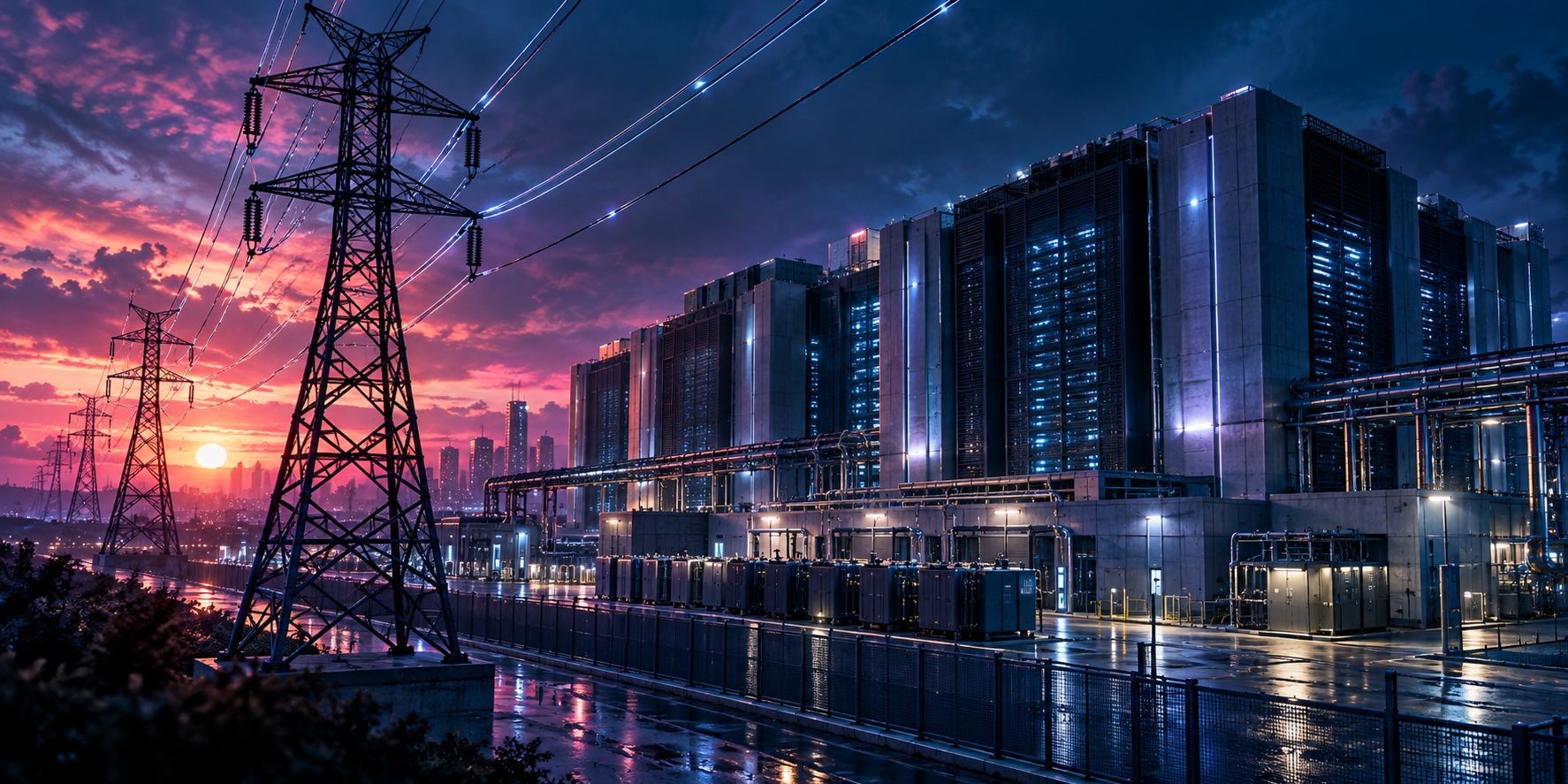
A room full of GPUs sits in the dark.
Not because the model failed. Not because the chips are late. Not because someone discovered a fatal flaw in the architecture.
There is simply not enough power to switch the building on.
For most of the AI boom, the industry has talked about compute as if it were primarily a semiconductor problem. Nvidia GPUs, custom accelerators, memory bandwidth, model efficiency and trillion-dollar infrastructure plans dominate the conversation. But underneath that increasingly sophisticated stack sits a much older machine: the electrical grid.
And that machine is becoming a bottleneck.
Vertiv just put a price on the problem. The critical-infrastructure company has agreed to acquire UtilityInnovation Group, or UIG, for approximately $1.45 billion in cash at closing, with as much as another $1.15 billion tied to future EBITDA targets. The transaction is expected to close in the fourth quarter of 2026, subject to regulatory approval.
The interesting part is not simply that Vertiv is buying another infrastructure company. It is where Vertiv is moving.
Historically, Vertiv has lived largely inside the data center: power management, cooling, racks and the infrastructure required to keep computing equipment alive. UIG pushes it upstream, toward microgrids, onsite generation, switchgear and the architecture connecting a data center to electricity before the servers ever get to work.
The industry spent years asking who would own artificial intelligence.
The emerging question is more primitive: who gets to turn it on?
Table of contents
- The invisible queue behind the AI boom
- Vertiv is moving outside the machine room
- Microgrids become an AI infrastructure weapon
- From site selection to “first token”
- The price reveals what Vertiv believes
- AI infrastructure is becoming power politics
- Who decides when AI gets switched on?
- AI data center power: key questions
The invisible queue behind the AI boom
The AI industry has a supply chain everyone can see.
GPUs are ordered. Memory is manufactured. Servers are assembled. Data center campuses are announced. Models are trained.
Then there is another supply chain, one that is much easier to ignore until it stops everything: substations, transmission lines, transformers, switchgear, permits, generation capacity and grid connections.
This is where the physical reality of AI starts fighting the speed of software.
South Korea offers an extreme illustration. The country expects additional electricity requirements of roughly 25 to 30 gigawatts as semiconductor production, AI data centers, electric vehicles and electrified heating expand. That is power demand on the scale of dozens of large generating units.
Malaysia is experiencing its own version of the collision. Data centers accounted for an average of roughly 7% of electricity consumption in Peninsular Malaysia in 2026, according to Reuters, with their share reaching 9.3% during a particularly hot period in August as cooling demand surged. By 2035, officials estimate data centers could consume as much as 31% of the peninsula’s electricity.
The problem is not confined to Asia.
In the United States, AI data center development is increasingly colliding with grid-interconnection delays, utility constraints and the sheer time required to build new electrical infrastructure. The strange result is that the fastest-moving technology industry on Earth increasingly depends on infrastructure measured in years rather than product cycles.
You can manufacture another server.
You cannot instantly manufacture another transmission network.
Vertiv is moving outside the machine room
This is what makes the UtilityInnovation Group acquisition more interesting than its headline price.
Vertiv already sells the machinery that keeps digital infrastructure operating: critical power equipment, thermal management and other systems surrounding servers and racks.
UIG moves the company toward what happens before that infrastructure becomes useful.
Founded in 2020 and headquartered in Raleigh, North Carolina, UIG specializes in microgrid systems, advanced power controls and behind-the-meter power architecture. Its technology includes proprietary controls software, customized microgrid switchgear and energy storage orchestration.
In other words, this is not about making a GPU faster.
It is about making sure the GPU has electricity.
According to Vertiv’s acquisition announcement, UIG expands its infrastructure portfolio upstream toward the utility interconnect and onsite power sources.
That distinction matters.
The traditional data center infrastructure supplier enters once the site and its power assumptions are relatively well defined. The emerging AI infrastructure model increasingly requires power architecture to influence the site itself.
Where can electricity come from?
How much is available?
When will the grid connection arrive?
Can the campus operate before it does?
Can generation be installed onsite?
Can batteries and multiple power sources be coordinated?
The electrical system is no longer plumbing added to the computer factory. It is becoming part of the architecture that determines whether the computer factory can exist.
Microgrids become an AI infrastructure weapon
A microgrid can combine utility electricity with onsite generation, storage and control systems, allowing a site to manage its own local power resources with greater flexibility.
That makes the technology particularly attractive when the alternative is waiting for the traditional grid.
Vertiv says the combined company should be able to support conventional grid-connected facilities, “bridge-to-grid” deployments and islanded sites powered by onsite generation.
The bridge-to-grid concept is especially revealing.
Instead of treating the utility connection as the absolute starting gun for a data center, developers can potentially build an interim power architecture capable of getting capacity online earlier, then integrate more grid electricity later.
That does not make electricity free, abundant or easy. Onsite generation still requires equipment, fuel, financing, permits and regulatory acceptance. Microgrids do not magically erase the physical constraints surrounding massive computing campuses.
But they can change which constraint controls the calendar.
And in the AI infrastructure race, time itself has become an asset.
From site selection to “first token”
Vertiv CEO Gio Albertazzi supplied perhaps the most important sentence in the entire acquisition announcement.
“For AI data center operators, competitive advantage increasingly depends on how quickly they can move from site selection to first token.”
It is an unusually good description of where the AI infrastructure race is heading.
The industry’s preferred unit of progress has moved steadily backward through the stack.
First, everyone cared about the model.
Then the GPU.
Then the rack.
Then cooling.
Then the data center.
Now the competition reaches the electrical connection before the building.
“First token” turns all of that infrastructure into a stopwatch. A billion-dollar AI facility generates no useful inference while waiting for power. GPUs sitting in crates do not produce tokens. A completed building without sufficient electricity is effectively stranded compute.
The economic objective is therefore not merely acquiring computing hardware.
It is compressing the distance between choosing a piece of land and producing the first useful unit of computation on it.
That changes what counts as strategically valuable.
The company that can ship a faster chip has leverage.
So does the company that can remove six months from the moment that chip starts earning money.
The price reveals what Vertiv believes
Vertiv’s initial $1.45 billion purchase price values UIG at approximately 13 times expected 2027 EBITDA, according to the company.
There is also an interesting piece of financial engineering inside the transaction: up to $1.15 billion of additional cash consideration depends on UIG reaching EBITDA targets over subsequent 12- and 24-month periods.
That means a substantial portion of the deal’s potential headline value is conditional.
The structure says two things at once.
Vertiv believes power constraints are important enough to spend heavily on capabilities positioned directly against them. But the earnout also leaves a large portion of the ultimate price dependent on UIG actually delivering the expected earnings.
That is worth noting without turning the acquisition into a stock recommendation. The more interesting signal is strategic.
Vertiv is effectively paying to move closer to the source of the constraint.
The company that once helped keep the data center alive now wants a larger role in determining how the data center gets enough electricity to become alive in the first place.
AI infrastructure is becoming power politics
This is where the story stops being about Vertiv.
AI has often been described through the language of software: intelligence, models, agents, algorithms and data.
Its industrial expansion is forcing a different vocabulary into the conversation.
Megawatts. Transformers. Gas turbines. Transmission. Cooling water. Substations. Nuclear reactors. Permitting.
The abstraction is collapsing into machinery.
A 100-billion-parameter model sitting inside a building without adequate electrical infrastructure might be intellectually impressive, but operationally it does not exist.
That gives a different class of actors increasing influence over the AI economy.
Utilities matter. Grid operators matter. Electrical engineers matter. Local regulators matter. Energy developers matter. The communities deciding whether another transmission line, power plant or giant data center gets built matter.
The frontier AI laboratory may design the intelligence, but someone else controls the physical conditions under which that intelligence can run.
That is not simply an infrastructure problem.
It is infrastructure becoming policy.
Every new AI campus creates questions about who receives scarce capacity, who pays for grid upgrades, what forms of generation are acceptable, how quickly permits should be issued and how the costs of rapidly expanding electricity demand should be distributed.
The AI race is therefore moving into territory the software industry cannot solve with another release.
Code can scale at digital speed.
Power systems cannot.
Who decides when AI gets switched on?
For the last decade, one of the defining questions surrounding artificial intelligence has been who will control it.
The labs?
Big Tech?
Governments?
Open-source communities?
That debate is not disappearing. But underneath it, another layer of control is becoming visible.
AI is physical infrastructure disguised as software.
Its models ultimately depend on fabs, copper, transformers, cooling systems, transmission capacity and enormous quantities of electricity. The larger the industry becomes, the harder those dependencies are to abstract away.
Vertiv’s move upstream is a corporate transaction, but it also captures that transition neatly.
The valuable territory is moving from the server rack toward the electrical system feeding it.
The people who build artificial minds still matter.
Increasingly, so do the people holding the switch.
We spent ten years asking who would control AI.
The next question is shorter: who decides when the building gets to start?
AI data center power: key questions
Why do AI data centers need so much electricity?
AI workloads concentrate large numbers of high-performance accelerators in dense computing clusters. Those chips require substantial electricity directly and also generate heat that must be removed by cooling infrastructure.
What is “time to power” for a data center?
Time to power is the period required for a data center project to secure and deploy the electrical capacity needed to begin operating. Grid connections and supporting infrastructure can become major schedule constraints.
What does “first token” mean in Vertiv’s strategy?
It refers to the point when an AI data center becomes operational enough to produce its first AI output. Vertiv is framing infrastructure competition around reducing the time between site selection and that moment.
What does UtilityInnovation Group do?
UIG develops microgrid solutions, advanced power controls, customized switchgear, energy storage integration and behind-the-meter power architectures for data centers and other complex power environments.
How much is Vertiv paying for UIG?
Vertiv has agreed to pay approximately $1.45 billion in cash at closing, plus up to $1.15 billion in additional cash if specified EBITDA targets are achieved.
Has Vertiv completed the acquisition?
No. The transaction was announced in September 2026 and is expected to close in the fourth quarter of 2026, subject to regulatory approvals and customary closing conditions.
Does this article recommend buying Vertiv stock?
No. This article examines the strategic implications of the UIG acquisition and the growing importance of electricity infrastructure to AI. It is not financial advice or an investment recommendation.