The AI industry loves a magic trick. A new model appears, benchmarks jump, context windows grow, agents get smarter, and millions of people stare at a chat box wondering what just happened.
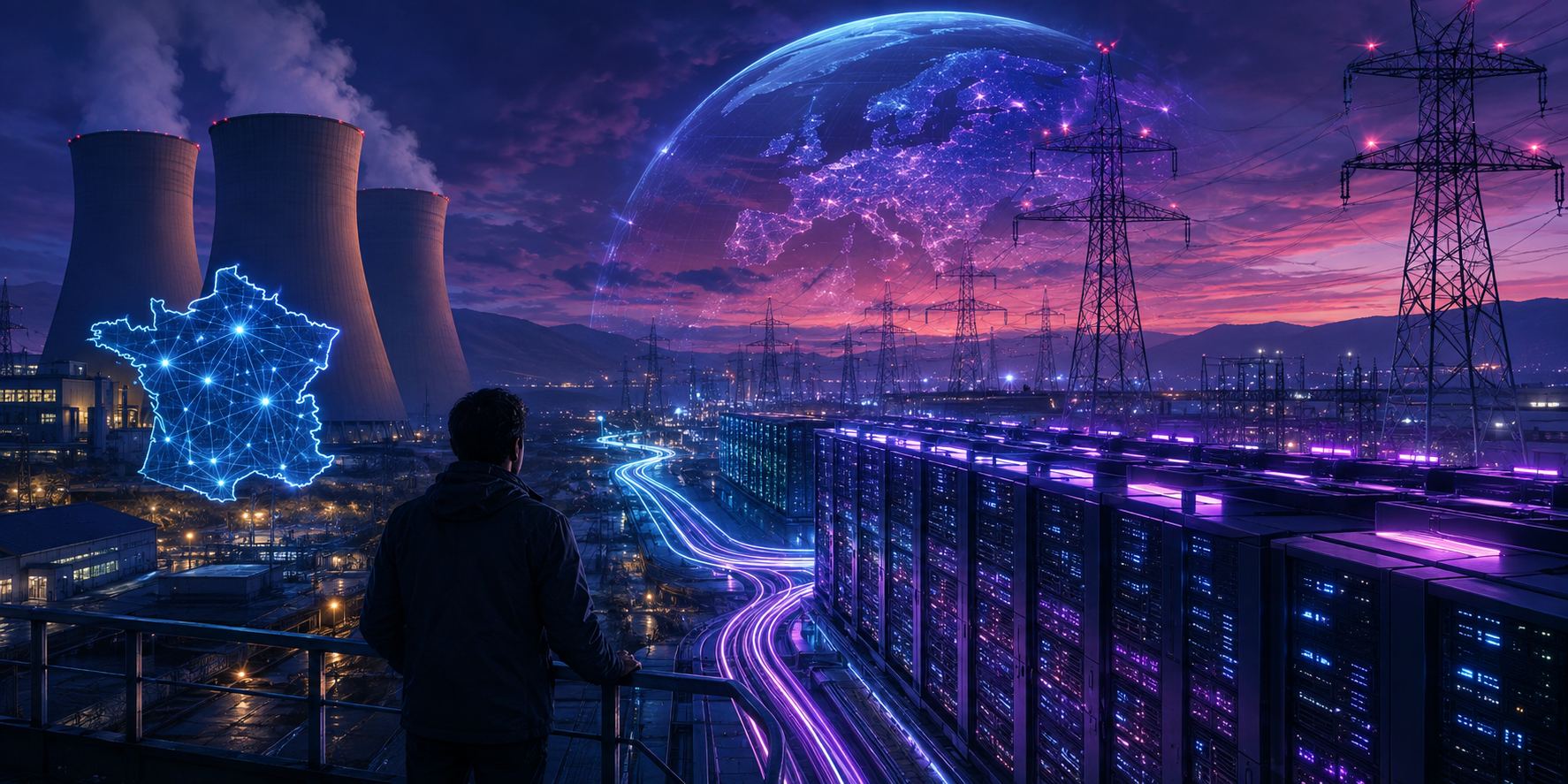
But behind that apparently weightless software sits something brutally physical: warehouses full of accelerators, substations, cooling systems, fiber connections and industrial quantities of electricity.
The next phase of the AI boom may therefore be less about who builds the cleverest model and more about who can actually keep the machines running.
In Dune, whoever controls the spice controls the universe. In the AI economy, the updated version is becoming obvious: whoever controls the compute controls a growing part of the game.
And that creates an intriguing possibility for countries that already possess large amounts of reliable electricity. France, in particular, could be sitting on an asset whose strategic importance is only beginning to become visible. Its nuclear fleet cannot magically turn the country into an AI superpower, but abundant low-carbon electricity, a developed transmission grid and suitable sites for data centers are exactly the ingredients that an increasingly power-hungry AI industry is hunting for.
Norway spent decades turning North Sea hydrocarbons into an extraordinary economic asset. France’s opportunity is obviously different — electricity cannot simply be treated like an underground barrel of oil — but the underlying geopolitical question has a familiar shape.
What happens when a resource your country already possesses suddenly becomes much more valuable to the global economy?
Table of contents
- Everyone Watches the Models. Follow the Power Cables.
- CoreWeave Becomes an Infrastructure Proxy
- Nvidia Wants Open AI — And More Hardware Demand
- Bitcoin Miners Discover Their Second Life
- France Could Be Sitting on an AI Energy Gold Mine
- The New Stack Has a Physical Layer
- So What? Watch the Megawatts
- AI infrastructure: key questions
Everyone Watches the Models. Follow the Power Cables.
The public face of artificial intelligence is software. ChatGPT, Claude, Gemini and every newly released open model make AI look like an endless competition between algorithms.
The industrial reality looks more like an infrastructure boom.
Training and operating increasingly capable AI systems requires GPUs or other accelerators. Those chips need servers. Servers need data centers. Data centers need cooling, networking and grid connections. And all of it needs electricity — lots of it, delivered reliably and in the right place.
That changes the economics of AI.
A brilliant research team can design a better architecture. It cannot code its way around a missing electrical connection.
The closest geek analogy might be StarCraft. You can have minerals, workers and an ambitious expansion strategy, but if your infrastructure cannot supply what comes next, the build stops. The AI economy is discovering its own version of the Protoss pylon problem.
No power, no expansion.
The International Energy Agency has already identified data centers as a rapidly growing source of electricity demand, while national governments are increasingly treating computing infrastructure as an industrial and strategic issue rather than merely an IT one.
The compute must flow.
CoreWeave Becomes an Infrastructure Proxy
CoreWeave offers one of the clearest illustrations of this shift.
The company began life in crypto mining before transforming itself into a specialized cloud provider built around GPU-intensive workloads. It has since become something close to a publicly traded proxy for one question: how valuable is scarce AI computing capacity?
That question was on full display after CoreWeave’s latest results. Its shares jumped more than 14% in extended trading after the company beat quarterly revenue expectations and issued a strong outlook amid booming AI demand. Reuters also reported that CoreWeave raised its 2026 capital-spending forecast as it races to add infrastructure.
The company has secured major agreements involving Meta and Anthropic, reinforcing the idea that hyperscale AI developers increasingly need long-term access to specialized compute rather than simply buying servers when convenient.
That is the interesting part of the CoreWeave story.
It is not merely another AI stock reacting to another earnings report. The market is attempting to put a price on the infrastructure beneath the models.
GPU clusters are becoming productive industrial assets.
Data-center capacity is becoming strategic inventory.
Power availability is becoming a constraint.
Suddenly, a building full of hot silicon starts looking less like boring IT infrastructure and more like an oil field for the token economy.
Nvidia Wants Open AI — And More Hardware Demand
Nvidia sits at the center of this transformation because it sells the machinery on which much of the AI economy runs.
That makes its software strategy particularly interesting.
The company has continued expanding its Nemotron family of open models, including highly efficient mixture-of-experts systems designed to reduce the amount of active computation required for inference. Nvidia’s documentation for its Nemotron 3 family, for example, describes 30-billion-parameter models that activate only a small fraction of those parameters during inference, with configurations designed for compact GPU deployments.
The strategic logic is easy to see.
Making capable AI models more accessible does not necessarily weaken Nvidia’s hardware business. It can expand the universe of applications that developers want to run.
A model that can be deployed on a single powerful GPU is still a model that needs a GPU.
And once millions of companies start running agents, coding systems, search tools, industrial copilots and autonomous workflows continuously, inference itself becomes an enormous infrastructure market.
Open AI software can therefore act as fuel for hardware demand.
It is the classic platform strategy with a silicon twist: make it easier to build things, and more people need the machinery underneath.
Nvidia does not need every valuable model to be proprietary.
It needs the compute to flow.
Bitcoin Miners Discover Their Second Life
Perhaps the strangest evidence of the infrastructure shift comes from an industry that already knows exactly what it means to turn electricity into computation: Bitcoin mining.
Riot Platforms has signed a long-term agreement with Anthropic to supply computing capacity from its Rockdale, Texas campus. The 20-year deal is expected to generate roughly $9.1 billion in revenue for Riot and involves 191 megawatts of capacity, according to reports on the agreement.
That is a remarkable sentence when you remember what Riot historically was.
A Bitcoin miner is effectively becoming an AI infrastructure landlord.
Yet the transition makes industrial sense. Large crypto miners have spent years learning how to acquire power, build high-density computing sites and operate enormous electrical loads. AI companies now desperately need many of the same ingredients.
The workloads are different. The economics are different. The hardware requirements are different.
But the underlying real estate has similarities: land, electricity, grid access, cooling potential and the ability to deploy huge amounts of computing equipment.
Bitcoin miners may therefore possess something more valuable than their mining rigs: sites where very large amounts of power are already available.
The AI gold rush is creating a second life for parts of the crypto infrastructure boom.
France Could Be Sitting on an AI Energy Gold Mine
This is where the story becomes especially interesting for France.
France has spent decades building something the AI industry now badly wants: a large nuclear-powered electricity system.
The French energy regulator CRE estimated the full production cost of EDF’s historical nuclear fleet at €60.3 per MWh for 2026-2028. That figure should not be confused with the final electricity price paid by a data center — grid charges, market conditions, contracts and other costs matter — but it illustrates the industrial base France already possesses.
More importantly, nuclear power provides large quantities of relatively predictable, low-carbon electricity.
The French government has explicitly identified this as an AI advantage. Following the 2025 AI Action Summit, the Élysée highlighted France’s “decarbonized, abundant, and stable electricity supply,” its high-voltage network and available sites as reasons to build AI infrastructure in the country. More than €109 billion of AI-related investment commitments were announced around the summit.
France already has 352 operating data centers consuming around 10 TWh of electricity per year, according to ADEME. AI could push that number much higher.
And this is where the comparison with Norway becomes useful — provided we do not stretch it too far.
Norway discovered that owning a strategic energy resource could reshape its economic position. North Sea oil generated export revenues, industrial capabilities and ultimately enormous national wealth.
France is not about to export nuclear electrons in barrels, and building AI data centers is not equivalent to extracting oil. But cheap-enough, scalable, low-carbon electricity could become a form of industrial leverage in a compute-constrained world.
Instead of exporting only electricity, France could use that electricity to attract higher-value activity built on top of it: data centers, AI cloud infrastructure, model training, inference, semiconductor-related investment and the companies that cluster around those assets.
In other words, the real prize may not be selling the megawatt-hour.
It may be selling what the megawatt-hour allows you to produce.
France also has limitations. Grid connections take time. Data centers compete with electrification elsewhere in the economy. Nuclear reactors require enormous investment and maintenance. Local water, land and infrastructure constraints cannot be ignored. And energy alone will not compensate for weak financing, regulation, talent shortages or insufficient access to advanced chips.
But geography in the AI economy may increasingly be determined by electricity.
If that happens, France’s nuclear legacy starts looking less like an artifact of twentieth-century industrial policy and more like a potentially valuable twenty-first-century compute asset.
The New Stack Has a Physical Layer
For years, the technology industry trained investors and users to think in layers of abstraction.
Applications sat on platforms. Platforms sat on cloud infrastructure. Somewhere underneath, anonymous servers did the dirty work.
AI is making that physical layer impossible to ignore.
The emerging stack looks more like this: models depend on accelerators; accelerators depend on data centers; data centers depend on grids; grids depend on generation capacity.
At the bottom of the world’s most advanced software is a power station.
That means AI competition could increasingly reward actors that control several layers simultaneously. Nvidia controls critical hardware and software. Cloud providers control enormous computing fleets. Companies such as CoreWeave specialize in turning GPUs into rentable capacity. Former Bitcoin miners can monetize power-rich sites. Governments control permitting, transmission infrastructure and energy policy.
And countries with abundant reliable electricity suddenly possess something every AI company needs.
In Dune, the spice was valuable because an entire civilization depended on it.
Compute is not spice, but the analogy works better every quarter.
So What? Watch the Megawatts
If you follow AI, keep watching the models. They still matter enormously.
But add three indicators to your dashboard: energy availability, data-center capacity and the cost of compute.
They may explain more about the next stage of the AI race than another leaderboard showing a two-point benchmark improvement.
The companies capable of securing gigawatts, GPUs and suitable sites could acquire an advantage that cannot be replicated by downloading a model from GitHub.
And the countries that can supply those resources may discover that old industrial infrastructure has acquired an unexpected new value.
For France, that raises a question far bigger than whether it can produce the next ChatGPT.
It is whether decades of investment in nuclear electricity can be converted into a durable position in the global compute economy.
Norway had the North Sea.
France has reactors.
In the age of AI, that distinction may become considerably more interesting than it sounds.
The compute must flow.
AI infrastructure: key questions
Why does AI require so much electricity?
Training and running AI models requires large numbers of high-performance accelerators operating in data centers, alongside networking, storage and cooling infrastructure.
Why is CoreWeave important to the AI infrastructure story?
CoreWeave specializes in GPU cloud infrastructure, making it a relatively direct example of how demand for AI computing capacity is becoming an economic sector of its own.
Why are Bitcoin miners moving into AI data centers?
Some miners already control valuable power connections, land and high-density computing infrastructure. Those assets can potentially be adapted for more lucrative AI and high-performance computing workloads.
Could nuclear power give France an advantage in AI?
Potentially. France has a large low-carbon nuclear fleet and substantial grid infrastructure, which could help attract power-intensive data centers. Electricity alone, however, does not guarantee AI leadership.
Is French nuclear electricity really cheap?
France’s CRE estimates the full production cost of the historical nuclear fleet at €60.3/MWh for 2026-2028. That is a production-cost estimate, not the final electricity price available to every data-center operator.
Could France become the “Norway of AI”?
The analogy has limits, but the strategic idea is relevant: France could potentially use an existing energy advantage to attract high-value AI infrastructure, much as natural resources transformed the economic position of energy-producing countries.
What should AI investors watch besides new models?
Electricity availability, grid connections, data-center construction, GPU supply and compute costs are increasingly important indicators of how quickly AI capacity can expand.
Is this financial advice?
No. References to Nvidia, CoreWeave, Riot Platforms or other companies are for editorial and analytical purposes only and should not be considered investment advice.