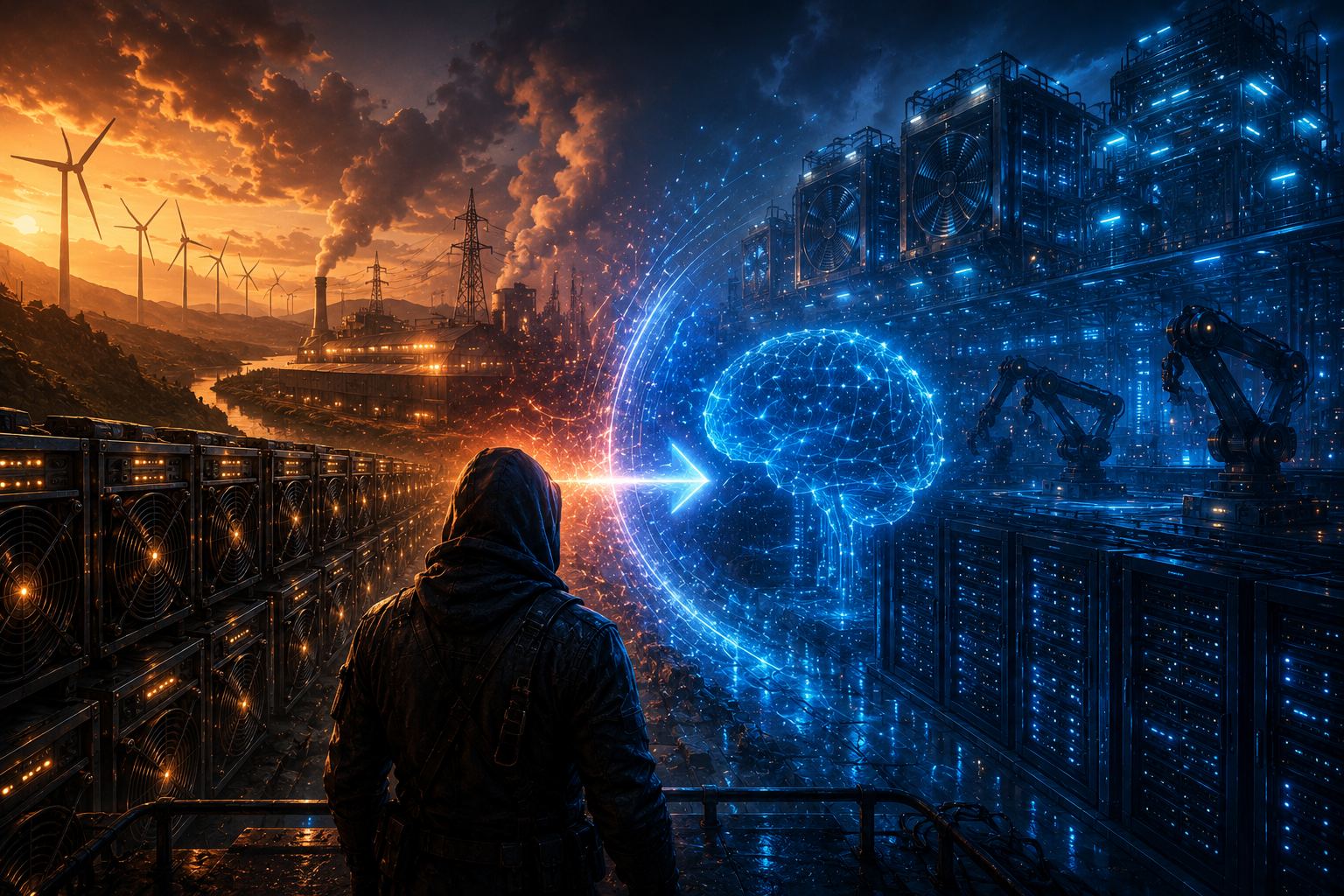
For years, bitcoin miners optimized one of the most specialized character builds in modern business. Think Diablo, except instead of stacking critical-hit damage or elemental resistance, the stats were megawatts, ASIC efficiency, cooling capacity and hash rate.
The quest was brutally simple: turn electricity into bitcoin more efficiently than the other guy.
Now parts of the industry are discovering that a character respec may be available.
The ASICs themselves are not secretly great AI accelerators. They are purpose-built machines designed for Bitcoin’s SHA-256 hashing algorithm. But the industrial empire constructed around those machines — power connections, substations, land, cooling systems, buildings and teams accustomed to operating enormous computing loads — suddenly looks interesting to an entirely different industry.
Artificial intelligence needs compute. Compute needs data centers. And data centers, increasingly, need something even harder to obtain: huge amounts of power in places where that power can actually be delivered.
That is where bitcoin mining and AI begin to occupy the same map.
Table of contents
- The Mining Rig Gets a New Quest
- Riot Meets Anthropic
- Why Miners Have a Weirdly Useful Inventory
- Mining Economics Versus AI Economics
- Crypto’s Most Unexpected Pivot
- So What? Three Signals to Watch
- Bitcoin Mining and AI: Key Questions
The Mining Rig Gets a New Quest
The first thing to understand about this transition is that bitcoin miners are not simply replacing mining software with an AI model.
Bitcoin ASICs and AI GPUs are fundamentally different hardware. A mining facility therefore cannot become a frontier AI cluster by installing a new driver and rebooting the machines.
The more interesting asset is everything surrounding the computers.
Large mining companies spent years hunting for cheap electricity, negotiating grid access, acquiring land, constructing industrial facilities and figuring out how to cool dense racks of machines that run around the clock. Those capabilities were built for Bitcoin, but they are not necessarily valuable only to Bitcoin.
The 2024 halving made that distinction harder to ignore. Bitcoin’s block subsidy fell from 6.25 BTC to 3.125 BTC, once again squeezing the amount of bitcoin miners receive for the same fundamental task.
AI arrived with the opposite problem. Instead of trying to reduce an existing infrastructure footprint, AI companies have been racing to find more computing capacity and more electricity to feed it.
Anthropic, for example, said in February 2026 that training a single frontier AI model would soon require gigawatts of power and estimated that the US AI sector would need at least 50 gigawatts of capacity over the following several years.
Suddenly, the mining industry’s obsession with megawatts looks less like a crypto-specific quirk and more like an infrastructure advantage.
Riot Meets Anthropic
Riot Platforms offers one of the clearest examples of how dramatic the respec can become.
In August 2026, Riot announced a 20-year agreement with Anthropic expected to generate $9.1 billion in contracted revenue. The agreement covers 191 megawatts of computing capacity at Riot’s Rockdale campus in Texas and runs through June 2048, with extension options that could increase its ultimate value.
That sentence would have sounded bizarre only a few years ago.
Riot became one of the public companies most closely associated with industrial-scale Bitcoin mining. Yet its infrastructure is now being sold to one of the companies at the center of the generative AI race.
The Anthropic contract did not appear from nowhere. Riot had already announced a long-term data center lease with AMD in January 2026, initially covering 25 MW of critical IT load at Rockdale with substantial expansion options. Riot has also described a broader strategic evolution toward data centers and digital infrastructure.
The important part is not that Riot has “become an AI company.” That description would go too far.
The more interesting development is that infrastructure originally assembled around bitcoin mining can be monetized through a completely different compute market.
That changes the strategic value of the underlying assets.
Why Miners Have a Weirdly Useful Inventory
Imagine a strategy game where the meta suddenly changes. You built an entire economy around one military unit, then a patch makes another unit dominant. The question becomes whether your existing buildings are obsolete — or whether they can produce something much more valuable.
Bitcoin miners have accumulated a strangely useful collection of buildings.
First comes electricity. A serious mining operation may require hundreds of megawatts, which means miners have already spent years dealing with utilities, transmission constraints, substations and power markets.
Then there is land. Large AI campuses require enormous physical footprints, and suitable sites with realistic access to power are not interchangeable with random empty plots on a map.
Cooling is another piece. Mining and AI facilities have different technical requirements — AI data centers generally demand more sophisticated networking, redundancy and reliability — but miners already understand the operational problem of extracting heat from extremely dense computing environments.
Finally, there is organizational experience. Running industrial compute infrastructure 24/7 requires maintenance teams, electrical expertise, construction knowledge and the ability to deploy hardware at enormous scale.
None of this means a mining warehouse is automatically hyperscale-ready. Converting or redeveloping sites can require major capital expenditure. AI workloads can demand different cooling architectures, fiber connectivity and uptime guarantees.
But a miner with secured power may be starting several levels ahead of a developer holding nothing except land and a data center blueprint.
Mining Economics Versus AI Economics
This leads to the question that matters most: what is the highest-value use of a megawatt?
For bitcoin mining, the calculation is familiar. Revenue depends on bitcoin’s price, network difficulty, transaction fees, machine efficiency and electricity costs. Hashprice can move quickly. Another halving eventually arrives. Newer ASICs continuously pressure older equipment.
The business can be extraordinarily profitable during favorable periods, but its economics remain tightly linked to Bitcoin.
AI infrastructure introduces a different model.
Instead of using electricity to compete for probabilistic block rewards, a company can potentially sign long-term contracts to provide data center capacity to large customers. That can produce more predictable contracted revenue, although it also introduces construction obligations, financing requirements, customer concentration risk and the technical standards expected by sophisticated AI clients.
So there is no universal equation saying AI always beats mining.
A miner with exceptionally cheap electricity, efficient ASICs and strong bitcoin economics may have little reason to abandon mining capacity. Another operator sitting on a power-rich site in a desirable data center market could conclude that the grid connection itself is more valuable than the hashes it currently produces.
The decision increasingly resembles an opportunity-cost calculation.
Every megawatt allocated to Bitcoin is a megawatt that cannot simultaneously power an AI cluster. If AI customers are willing to pay enough for long-duration access to that infrastructure, management teams have to compare the economics.
The scarce resource is no longer necessarily the mining machine.
It may be the socket.
Crypto’s Most Unexpected Pivot
That possibility also creates an unusual problem for investors: what exactly is a bitcoin mining company worth if bitcoin mining stops being its only important business?
Historically, listed miners have often traded as leveraged proxies for Bitcoin. Investors watched BTC prices, hash rate, mining costs, fleet efficiency, bitcoin production and treasury holdings.
AI infrastructure adds another valuation framework.
Power capacity matters. So does land. Contracted data center revenue matters. The quality and duration of customers matter. Development pipelines, financing requirements and non-mining revenue begin to matter.
Riot itself illustrates the transition. Its regulatory filings now explicitly discuss an evolution from a bitcoin-mining-focused enterprise toward a diversified data center and digital infrastructure company.
That does not mean every miner deserves an “AI premium.” Announcing an AI strategy is considerably easier than building a high-specification data center, securing a credible tenant and delivering capacity on schedule.
The Riot-Anthropic deal is significant precisely because it moves beyond the PowerPoint stage into a long-duration commercial agreement.
But it still does not prove that the entire mining industry will follow.
Some mining sites will be poorly located for AI. Some will lack suitable connectivity. Some will require uneconomic upgrades. Some miners will remain miners because their electricity and operating model make Bitcoin the better use of their infrastructure.
A respec is an option, not a mandatory quest.
So What? Three Signals to Watch
The crypto-AI convergence becomes a genuine structural trend if the numbers start moving, not merely the narratives.
Watch new contracts with credible AI, cloud and semiconductor companies. Long-term agreements with identifiable counterparties are much stronger evidence than announcements that a miner is “exploring AI opportunities.”
Next, watch available and developable power capacity. Megawatts with realistic grid access are becoming a strategic metric. Riot said in January that its data center portfolio included 1.7 GW of fully approved power capacity, illustrating why investors may increasingly examine miners as energy and infrastructure portfolios rather than collections of ASICs.
Finally, watch the percentage of revenue coming from outside bitcoin mining. That is where the respec becomes measurable. If data center revenue grows from a side quest into a meaningful share of sales, the market may eventually stop valuing certain miners primarily as bitcoin proxies.
The irony is difficult to miss.
Bitcoin miners spent more than a decade building industrial infrastructure for one of the strangest workloads ever invented: machines performing trillions of hashes to secure a decentralized monetary network.
AI has now created another enormous computational appetite.
And some miners may discover that the most valuable loot they collected along the way was never the ASIC fleet.
It was the power behind it.
Bitcoin Mining and AI: Key Questions
Can bitcoin mining machines be used to train AI models?
Not realistically at scale. Bitcoin ASICs are specialized for SHA-256 hashing, while modern AI training and inference typically rely on GPUs and other AI accelerators. The reusable assets are primarily the power, land and data center infrastructure.
What is the Riot Platforms deal with Anthropic?
Riot has signed a 20-year agreement to provide Anthropic with 191 MW of computing capacity at its Rockdale, Texas campus. The initial agreement is expected to generate $9.1 billion in contracted revenue.
Why are AI companies interested in infrastructure owned by bitcoin miners?
Large miners can control valuable power connections, land, substations and industrial facilities. AI developers face growing pressure to secure exactly those resources as data center demand expands.
Will all bitcoin miners become AI data center companies?
No. Sites differ significantly in power availability, location, connectivity and upgrade costs. Bitcoin mining may remain the more attractive use of capacity for many operators.
What should investors watch?
Key indicators include signed AI or HPC contracts, developable power capacity, data center capital expenditure and the percentage of company revenue generated outside bitcoin mining.
Is this article financial advice?
No. This article is for informational purposes only and does not constitute investment advice or a recommendation to buy or sell bitcoin, Riot Platforms shares or any other asset.