
Cryptocurrency started as a radical idea about money on the internet. Today, it is also a technology stack, a financial market, a culture war, a startup playground, a scam magnet, and one of the most misunderstood words in tech.
At its simplest, a cryptocurrency is a digital asset secured by cryptography and usually recorded on a blockchain or a similar distributed ledger. Unlike the money in your bank account, it is not normally issued by a central bank. Unlike a PayPal balance, it does not need one company to keep the master record. The network itself keeps track of who owns what.
That is the clean definition. The reality is messier, and more interesting. Some cryptocurrencies are designed to work like money. Some behave more like software fuel. Some are voting chips, collectibles, speculative assets, community tokens, or little more than internet jokes with a ticker symbol. Understanding crypto means understanding both sides: the elegant technical idea and the chaotic market built around it.
This article is part of Crypto Explained, Geek’n’Destroy’s beginner-friendly guide to cryptocurrency, blockchain, Bitcoin, wallets, tokens, DeFi, NFTs and the vocabulary of Web3.
Sommaire
- What is cryptocurrency?
- How cryptocurrency works
- Why cryptocurrency was created
- Examples of cryptocurrencies
- What cryptocurrency is used for
- How people store and use crypto
- The risks beginners should understand
- What people often misunderstand about crypto
- Why cryptocurrency still matters
- What to Remember (FAQ)
What is cryptocurrency?
Cryptocurrency is a form of digital asset that uses cryptography to secure ownership and transactions. In most cases, it exists only online, and its transaction history is recorded on a public database called a blockchain.
The word “currency” can be misleading. Bitcoin was designed as peer-to-peer electronic cash, and some crypto assets are still built around payments. But the broader crypto world now includes many things that are not really currencies at all: tokens used inside apps, stablecoins tied to traditional money, governance tokens for online communities, NFTs representing digital items, and assets used to pay fees on blockchain networks.
That is why regulators and institutions often prefer the wider term “crypto-assets.” It is less catchy, but more accurate. A cryptocurrency can be money-like, but it can also be a piece of programmable infrastructure.
The key idea is ownership without the usual gatekeeper. A bank, payment processor or platform does not need to approve every transaction. Instead, the network follows rules written in code, and users control access to their assets through cryptographic keys.
How cryptocurrency works
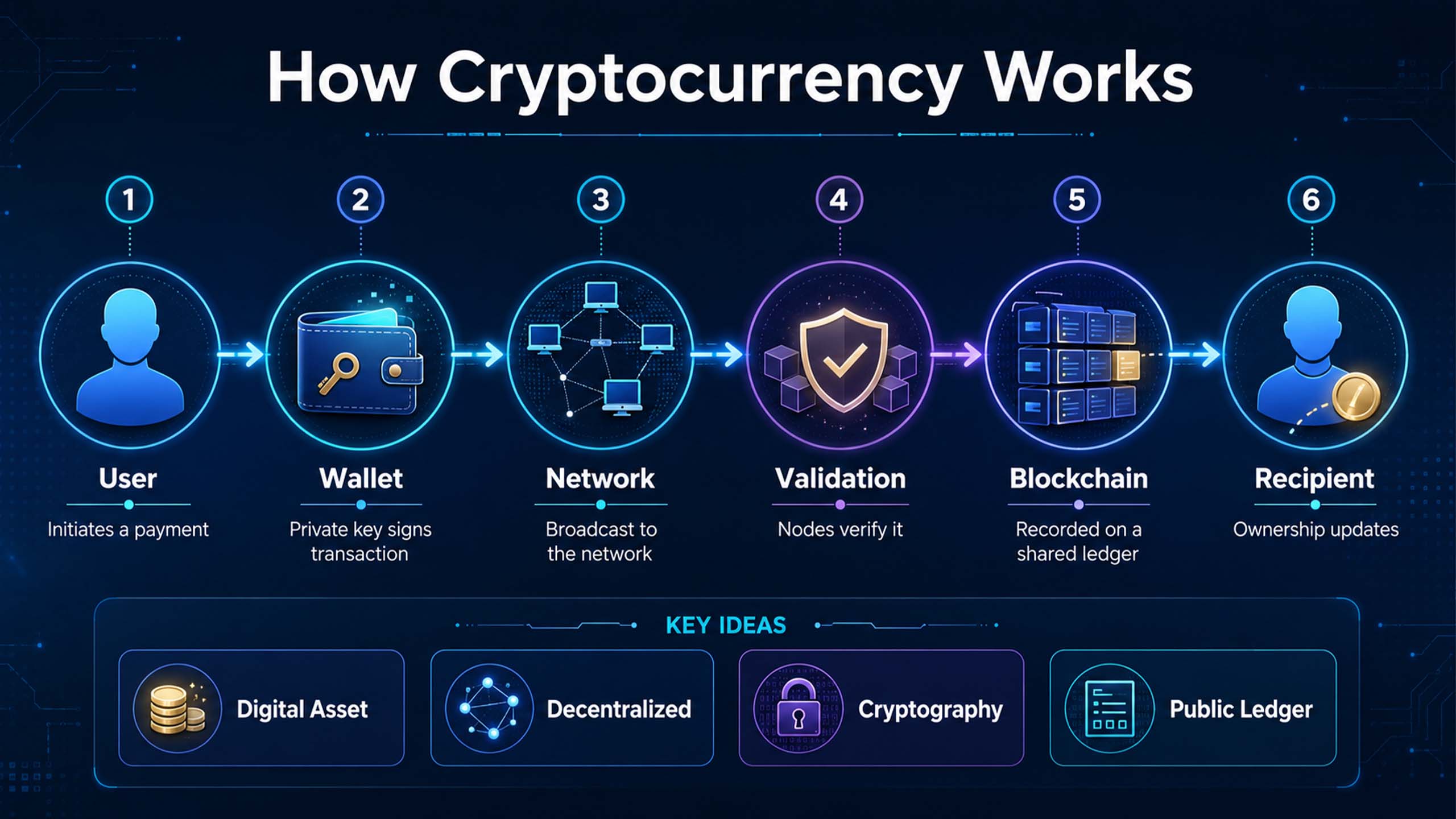
Most cryptocurrencies run on a blockchain. A blockchain is a shared ledger: a record of transactions maintained by many computers instead of one central database. When someone sends crypto, the network checks whether the sender has the right to move those funds, then updates the ledger.
This system relies on public and private keys. A public key, or an address derived from it, is like an account number you can share. A private key is more like the ultimate password. Whoever controls the private key controls the assets linked to that address.
That is powerful, but unforgiving. If you forget your banking password, a bank can usually reset it. If you lose the private key to a self-custody crypto wallet, there may be no recovery button. Crypto replaces institutional trust with technical control, and that trade-off is at the heart of everything.
Different networks use different methods to agree on the state of the ledger. Bitcoin uses proof of work, where miners spend computing power to secure the network. Ethereum now uses proof of stake, where validators lock up crypto to help process transactions. The goal is the same: prevent cheating without putting one central authority in charge.
Why cryptocurrency was created
The original crypto dream was not “number go up.” It was digital money that could move between people without needing a bank or payment company in the middle.
Before Bitcoin, online money had a hard problem: if a digital file can be copied, what stops someone from spending the same digital coin twice? Banks solve this with centralized ledgers. Bitcoin proposed another route: a peer-to-peer network where everyone can verify the history of transactions.
That idea arrived with a political mood attached. Bitcoin’s 2008 white paper appeared during a global financial crisis, when trust in banks and governments had been badly shaken. Its design reflected a desire for money with predictable rules, public verification and no central operator who could change the ledger at will.
From there, crypto expanded beyond payments. Developers realized that blockchains could do more than move coins. They could run programmable agreements, issue tokens, build decentralized exchanges, manage online communities and create new forms of digital ownership. Some of that experimentation is genuinely useful. Some of it is theatrical nonsense wearing a technical costume.
Examples of cryptocurrencies
Bitcoin is the first and most famous cryptocurrency. It is often described as digital gold because many holders treat it as a scarce asset rather than everyday spending money. Its supply rules, security model and cultural importance make it the reference point for the entire crypto market.
Ether is the native asset of Ethereum. It is used to pay transaction fees and power activity on the Ethereum network, including decentralized finance apps, NFT marketplaces and smart contracts. If Bitcoin is mainly about money and settlement, Ethereum is closer to a decentralized computing platform.
Stablecoins are crypto tokens designed to track the value of another asset, usually a fiat currency like the US dollar. They are widely used for trading, payments and moving value between crypto platforms. Their promise is stability, but the quality of that promise depends on reserves, regulation, transparency and issuer behavior.
Then there are thousands of other tokens. Some support serious infrastructure. Some represent governance rights in decentralized protocols. Some are meme coins driven by community hype. Many will not survive. A ticker symbol and a Discord server do not magically create durable value.
What cryptocurrency is used for
The most obvious use case is sending value online. Crypto can move across borders without the same rails as traditional banking. For people in stable financial systems, that may sound like a niche feature. For people dealing with capital controls, unstable currencies or limited banking access, the appeal can be more concrete.
Crypto is also used for speculation. This is the part everyone sees: huge price swings, sudden rallies, brutal crashes, and traders trying to catch the next narrative before it burns out. Speculation brings liquidity and attention, but it also distorts the public image of the technology. Many people first encounter crypto as a casino with better branding.
Developers use crypto networks to build decentralized apps. In DeFi, users can trade, lend, borrow or provide liquidity through protocols rather than traditional financial intermediaries. In gaming and digital culture, tokens can represent in-game assets, memberships or collectibles. In creator economies, crypto can be used for community access, payments or experimental ownership models.
The strongest use cases tend to share one thing: they need a shared digital record that multiple parties can trust without handing full control to one company. If a normal database works better, faster and cheaper, crypto is probably the wrong tool.
How people store and use crypto
To use cryptocurrency, you need a crypto wallet. A crypto wallet does not literally store coins like a leather wallet stores cash. It stores the private keys that let you control crypto assets recorded on a blockchain.
There are two broad approaches. Custodial wallets are managed by a company, usually an exchange. They feel familiar because the platform handles login, recovery and much of the complexity. The downside is obvious: if the company freezes withdrawals, gets hacked, collapses or restricts access, your control is limited.
Self-custody wallets put control in your hands. That can mean a mobile wallet, browser wallet or hardware wallet. You hold the keys, sign transactions and interact directly with networks or apps. This is closer to the original crypto ethos, but it requires care. A phishing link, a leaked seed phrase or a fake wallet app can be enough to lose funds permanently.
For beginners, this is one of the biggest shocks. Crypto can feel like modern finance, but it often behaves more like digital wilderness survival. Convenience and control sit on opposite ends of the same rope.
The risks beginners should understand
Cryptocurrency is risky in several different ways at once. The first is price volatility. Crypto assets can rise quickly and fall even faster. A project can be popular in January and nearly forgotten by June. Even major assets can move dramatically compared with traditional currencies.
The second risk is custody. If you leave assets on a platform, you rely on that platform. If you self-custody, you rely on your own security habits. Neither path is automatically safe. They simply fail in different ways.
The third risk is fraud. Crypto is attractive to scammers because transactions are usually hard to reverse, users may be inexperienced, and hype can overpower common sense. Fake giveaways, phishing links, romance scams, pump-and-dump groups, fake exchanges and rug pulls are all part of the landscape.
There is also regulatory uncertainty. Rules differ by country and asset type. Some tokens may be treated like commodities, securities, payment instruments or something else entirely depending on jurisdiction and design. Anyone building, investing or launching a crypto product needs to take that seriously.
What people often misunderstand about crypto
The first misunderstanding is that crypto is anonymous. Most major blockchains are public. Addresses are pseudonymous, not invisible. If an address is linked to a person, its transaction history can become very revealing.
The second misunderstanding is that crypto is always decentralized. Some networks are highly distributed. Others depend heavily on a small team, a foundation, a company, a few validators or one dominant app. “On-chain” does not automatically mean “decentralized.”
The third misunderstanding is that every cryptocurrency is trying to replace money. Many tokens are closer to access passes, software fuel or governance instruments. Others have no serious function beyond speculation. Treating every crypto asset as a currency creates confusion.
The fourth misunderstanding is that blockchain makes everything trustworthy. A blockchain can prove that a transaction happened. It cannot prove that a project is honest, that a token is fairly valued, that a team will deliver, or that a smart contract is free of bugs. Code can reduce certain trust problems, but it does not abolish human behavior.
Why cryptocurrency still matters
Crypto has been declared dead many times, usually after spectacular crashes. Yet the core idea keeps returning because the internet still has unresolved problems around money, ownership, identity, platform power and cross-border value transfer.
That does not mean every crypto narrative deserves belief. The industry has produced brilliant engineering and embarrassing grifts, sometimes in the same week. The useful way to look at cryptocurrency is not as a guaranteed revolution or a guaranteed scam, but as a toolkit. Some tools are sharp. Some are dangerous. Some are solutions looking for a problem.
The most durable parts of crypto are likely to be the ones that disappear into infrastructure: stablecoin payments, settlement rails, tokenized assets, decentralized finance components, wallet-based login, community ownership models, and programmable contracts. The loudest coins may not be the most important ones.
For beginners, the main thing to remember is simple: cryptocurrency is not just digital money. It is a way to create and move digital value using networks, cryptography and shared ledgers instead of relying entirely on central intermediaries. That idea is powerful enough to matter, and messy enough to deserve caution.
What to Remember (FAQ)
What is cryptocurrency in simple terms?
Cryptocurrency is digital value secured by cryptography and usually recorded on a blockchain. It can be used for payments, investing, apps, governance or other online systems.
Is cryptocurrency real money?
Some cryptocurrencies can be used like money, but most are not official currencies. Their value usually depends on market demand, network utility, trust and liquidity.
What is the difference between cryptocurrency and blockchain?
Cryptocurrency is a digital asset. Blockchain is the shared ledger technology that records transactions for many cryptocurrencies. Bitcoin is a cryptocurrency; the Bitcoin blockchain is the network that tracks it.
Is Bitcoin the same as cryptocurrency?
No. Bitcoin is the first major cryptocurrency and still the best-known one, but cryptocurrency is the broader category. Ethereum, stablecoins and many other tokens are also part of the crypto ecosystem.
Can cryptocurrency be hacked?
A major blockchain can be very hard to attack directly, but wallets, exchanges, apps and users can still be hacked or tricked. Many crypto losses come from scams, phishing or poor custody, not from breaking the blockchain itself.
Should beginners buy cryptocurrency?
Beginners should first understand how crypto works, how wallets and private keys function, and how much risk they can afford. Crypto is volatile, complex and not suitable for money someone cannot afford to lose.
Sources: Federal Trade Commission, Bitcoin white paper, European Supervisory Authorities crypto-assets factsheet