
A smart contract is one of the ideas that made crypto bigger than digital money. Bitcoin showed that a blockchain could move value without a bank. Smart contracts showed that a blockchain could also run code.
At its simplest, a smart contract is a program stored on a blockchain. It follows rules written in code and can execute actions when specific conditions are met. It can move tokens, hold collateral, record ownership, automate payments, run votes, manage liquidity pools or power decentralized apps.
The phrase “smart contract” is slightly misleading. A smart contract is not necessarily smart, and it is not always a legal contract. It is software. Sometimes brilliant software. Sometimes terrifying software. Sometimes software that controls millions of dollars and still looks like it was named by people who enjoy making newcomers suffer.
Smart contracts matter because they are the engine behind much of modern crypto: DeFi, tokens, NFTs, DAOs, decentralized exchanges, lending protocols, stablecoins and many Web3 applications. They turn blockchain from a ledger into a programmable environment.
This article is part of Crypto Explained, Geek’n’Destroy’s beginner-friendly guide to cryptocurrency, Bitcoin, blockchain, wallets, tokens, stablecoins, exchanges, DeFi, Ethereum, NFTs and the vocabulary of Web3.
Sommaire
- What is a smart contract?
- How smart contracts work
- Why Ethereum made smart contracts famous
- Examples of smart contracts
- Smart contracts and tokens
- Smart contracts in DeFi
- The oracle problem
- Why smart contracts matter
- The risks beginners should understand
- What people often misunderstand about smart contracts
- What to Remember (FAQ)
What is a smart contract?
A smart contract is code deployed on a blockchain that can store data, receive transactions and execute rules. On Ethereum and similar networks, smart contracts live at blockchain addresses, just like user accounts do. The difference is that a smart contract is controlled by code, not by a private key.
A normal app runs on a company’s servers. A smart contract runs on a blockchain network. That means its behavior can be inspected, transactions can be verified, and the same contract can be used by many people without one central company manually processing every action.
The basic promise is automation with transparency. If the contract says users can trade token A for token B, borrow against collateral, mint an NFT or vote in a DAO, the blockchain can execute those rules without a human operator approving each step.
This is why smart contracts are often described as “self-executing.” That does not mean they wake up and do things on their own like tiny financial robots with caffeine problems. Usually, a user or another contract sends a transaction that triggers the function. The smart contract then runs according to its code.
A smart contract is best understood as public, blockchain-based logic. It can hold assets, enforce rules and coordinate activity between people who may not know or trust each other.
How smart contracts work
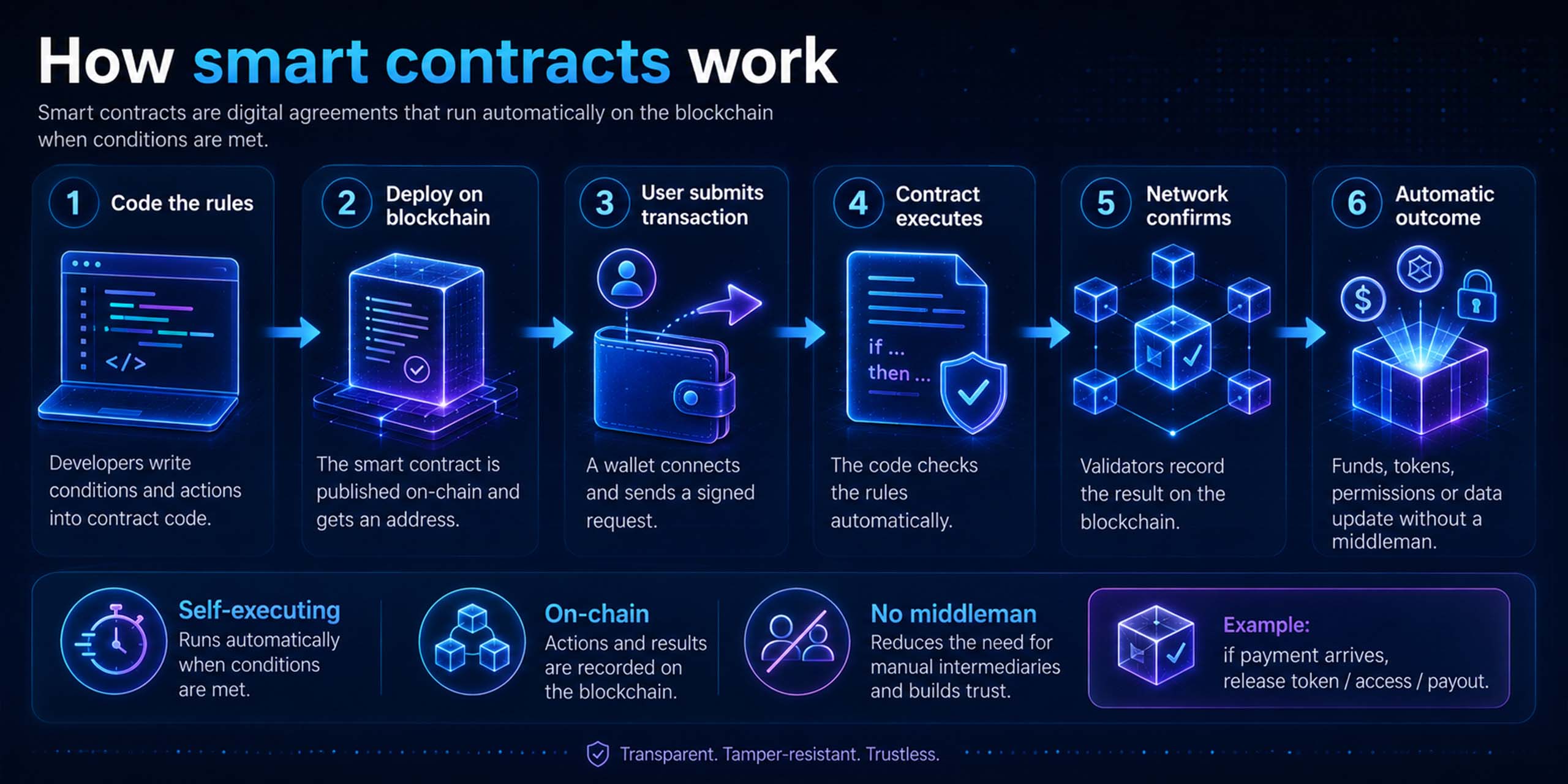
A smart contract starts with code. Developers write the contract using a programming language, such as Solidity for Ethereum-compatible networks. The code defines the contract’s functions, data and rules.
Once ready, the contract is deployed to a blockchain. Deployment creates a contract address. From that point, users, wallets and other contracts can interact with it by sending transactions.
Imagine a simple token contract. It may keep a record of wallet balances. If Alice sends 10 tokens to Bob, the contract checks whether Alice has enough tokens, subtracts 10 from her balance, adds 10 to Bob’s balance, and records the change on-chain.
That sounds simple, but the same principle can power much more complex systems. A lending contract can check collateral levels. A decentralized exchange can calculate swap prices. A DAO contract can count votes. A stablecoin contract can mint or burn tokens according to its rules.
Every action costs network resources. On Ethereum, users pay gas fees to execute smart contract transactions. More complex actions usually cost more because the network has to do more computation.
The key point is that a smart contract is not a promise made in a PDF. It is operational code. If the blockchain accepts the transaction, the rules execute.
Why Ethereum made smart contracts famous
Smart contract ideas existed before Ethereum, but Ethereum made them widely usable in crypto. It created a general-purpose blockchain where developers could deploy programs rather than only record payments.
That changed everything. Instead of building a new blockchain for every new crypto experiment, developers could build on Ethereum. They could create tokens, decentralized exchanges, lending markets, NFT collections, DAOs and applications that share the same base network.
Ethereum’s smart contract model helped create the modern idea of programmable money. Money and assets could become software components. A token could be transferred by a contract. A loan could be enforced by collateral rules. A marketplace could settle trades without a central platform holding custody.
This is also why Ethereum became so important to crypto tokens. Standards like ERC-20 and ERC-721 are smart contract patterns. They make it easier for wallets, exchanges and apps to recognize and interact with different assets.
Ethereum did not just add a feature to blockchain. It changed what people thought blockchains were for. After Ethereum, crypto was no longer only about sending coins. It became about building systems.
That power came with complexity. Smart contracts can do more than simple payments, which also means they can fail in more interesting and expensive ways.
Examples of smart contracts
The easiest smart contract example is a token. A token contract defines supply, balances, transfers and permissions. Many stablecoins, governance tokens and utility tokens work this way.
Another example is a decentralized exchange. A smart contract can hold pools of tokens and let users swap between them. Instead of a company matching buyers and sellers in a private database, the contract uses on-chain rules to execute trades.
A lending protocol is also powered by smart contracts. Users deposit assets, borrow against collateral, pay interest and face liquidation if collateral falls too low. The contract does not care about charm, credit score or dramatic excuses. It cares about collateral ratios.
NFTs are another common use case. An NFT contract records which wallet owns each token and can define minting rules, transfers and metadata links. The artwork or item may live elsewhere, but the ownership record is managed by the contract.
DAOs use smart contracts for governance. A contract can manage votes, treasury funds and proposal execution. That does not mean the DAO is perfectly democratic or wise. It means some parts of its decision-making can be executed on-chain.
The common thread is coordination. Smart contracts let people and apps coordinate around shared rules without relying entirely on one central operator.
Smart contracts and tokens
Most crypto tokens are smart contracts. That is one of the most important things beginners should understand.
When someone creates an ERC-20 token on Ethereum, they are usually deploying a smart contract that tracks balances and defines transfer rules. The token is not a separate mini-blockchain. It is a contract running on an existing blockchain.
This is why tokens can be created so quickly. A developer can use a standard template, adjust parameters, deploy the contract and suddenly a tradable asset exists. That can be useful for serious projects. It can also be useful for absolute nonsense with a mascot and a Telegram channel.
Token standards make the ecosystem work. If a token follows a known standard, wallets can display it, exchanges can list it, DeFi protocols can integrate it, and users can transfer it in predictable ways.
Smart contracts can also define more advanced token behavior. They can allow minting, burning, freezing, staking, vesting, voting or fee mechanisms. These features matter because they shape the token’s economics and risk.
A token is not just a symbol. It is a smart contract with rules. Reading those rules, or at least understanding what they allow, is part of understanding the asset.
Smart contracts in DeFi
DeFi depends on smart contracts. Without them, there is no decentralized lending protocol, no automated market maker, no on-chain stablecoin system, no yield strategy and no real decentralized exchange.
In a DeFi lending market, smart contracts manage deposits and loans. Users supply assets to a pool. Borrowers provide collateral. Interest rates may adjust based on supply and demand. If collateral falls below the required level, the contract can trigger liquidation.
In a decentralized exchange, smart contracts manage liquidity pools. Traders swap assets through the pool, and liquidity providers earn fees. Prices shift according to rules defined by the protocol.
In a stablecoin system, smart contracts may mint tokens when collateral is deposited and burn them when debt is repaid. The contract can enforce collateral requirements, fees and liquidation rules.
This is what makes DeFi different from a normal finance app. The core logic is not hidden inside a company’s private backend. Much of it runs on public blockchain infrastructure.
That transparency is valuable, but it does not remove risk. A smart contract can be transparent and still flawed. It can be public and still misunderstood. DeFi’s favorite trick is turning openness into a user manual nobody reads until after the exploit.
The oracle problem
Smart contracts are good at reading blockchain data. They are not naturally good at knowing what happened in the outside world.
This creates the oracle problem. A smart contract may need external information: the price of ETH in dollars, the result of a sports match, the status of a shipment, an interest rate, weather data, or whether a real-world payment happened. Blockchains do not automatically know those things.
An oracle is a system that brings external data on-chain so smart contracts can use it. In DeFi, price oracles are especially important because lending protocols, derivatives and stablecoin systems often depend on accurate market prices.
If an oracle is wrong, delayed or manipulated, the smart contract may execute perfectly according to bad information. That is the nightmare. The code may work as designed, but the input is poisoned.
This is why smart contracts do not eliminate trust completely. They shift trust. Users may trust code, validators, data feeds, governance processes, infrastructure providers and the economic incentives around the system.
A smart contract can enforce rules with precision. It cannot magically verify the entire real world.
Why smart contracts matter
Smart contracts matter because they make digital agreements programmable, open and composable.
Programmability means financial and ownership logic can be written into software. Tokens, loans, swaps, votes and rewards can be automated.
Transparency means smart contract code and transactions can often be inspected publicly. That does not make every user an auditor, but it gives the ecosystem a shared surface for verification.
Composability means one contract can interact with another. A token can be used in a lending protocol, traded on a DEX, deposited into a vault and governed by a DAO. This is the “money Lego” idea behind much of DeFi.
Smart contracts can also reduce counterparty risk in certain situations. If users interact with code that holds and releases funds according to clear rules, they may not need to trust one company to manually honor every transaction.
But the benefit is not “trust disappears.” The better framing is trust minimization. Smart contracts can reduce reliance on certain intermediaries, but users still rely on code quality, security assumptions, governance and data sources.
That is why smart contracts are such a big deal. They do not make the internet trustworthy. They give developers a new way to build systems where trust is distributed differently.
The risks beginners should understand
The first risk is bugs. A smart contract can contain mistakes, and those mistakes can be exploited. Once funds are locked in a contract, a bug can become a direct financial loss.
The second risk is immutability. Some smart contracts are difficult or impossible to change after deployment. That can be good because it prevents arbitrary tampering. It can be bad when a contract needs a security fix and there is no clean upgrade path.
The third risk is malicious design. Not every dangerous contract is accidentally broken. Some are built to trap users, block selling, drain approvals, mint unlimited tokens or give insiders special powers.
The fourth risk is bad permissions. Users often approve contracts to spend tokens from their wallets. A careless approval can expose funds. This is one reason wallet prompts matter. Clicking “confirm” is not a personality trait.
The fifth risk is complexity. A user may interact with one app without realizing it depends on several contracts, a token, a bridge, an oracle and a governance system. If one layer fails, the user can still lose money.
Audits can help, but they are not guarantees. Open-source code can help, but only if competent people review it. A famous protocol can still have weaknesses. A smart contract is powerful because it executes automatically. That is also why mistakes travel fast.
What people often misunderstand about smart contracts
The first misunderstanding is that smart contracts are legal contracts. They can support or automate parts of an agreement, but code is not automatically equivalent to a legally enforceable contract. Law, jurisdiction, intent and consumer protection still matter.
The second misunderstanding is that smart contracts are intelligent. They are not AI. They do not understand context. They do not know if an outcome is fair. They execute code based on inputs and blockchain state.
The third misunderstanding is that smart contracts remove all trust. They reduce some kinds of trust and introduce others. Users may not trust a bank clerk, but they must trust code, audits, oracles, governance and wallet security.
The fourth misunderstanding is that “deployed on-chain” means safe. A scam contract can live on a blockchain just as easily as a useful one. Blockchains are good at preserving records. They are not moral filters.
The fifth misunderstanding is that smart contracts always save money. Sometimes automation reduces costs. Sometimes gas fees, audits, complexity and security risks make a smart contract more expensive than a normal backend.
Smart contracts are not magic legal robots. They are blockchain programs that can hold assets and execute rules. That makes them incredibly useful, and occasionally absolutely merciless.
What to Remember (FAQ)
What is a smart contract in simple terms?
A smart contract is a program stored on a blockchain that executes rules when users or other contracts interact with it.
Are smart contracts legally binding?
Not always. A smart contract is code, not automatically a legal contract. It can support agreements, but legal enforceability depends on context, jurisdiction and the actual relationship between parties.
What are smart contracts used for?
Smart contracts are used for tokens, DeFi protocols, decentralized exchanges, NFTs, DAOs, stablecoins, lending markets and many Web3 applications.
Do smart contracts run by themselves?
Usually, they run when triggered by a transaction from a user, wallet, app or another contract. They execute according to their code once the blockchain processes the transaction.
Can a smart contract be changed?
Some smart contracts are immutable after deployment. Others use upgrade mechanisms. Upgradeability can help fix bugs, but it also introduces trust and governance risks.
Are smart contracts safe?
Smart contracts can be secure, but they are not automatically safe. Bugs, malicious code, bad permissions, oracle failures and poor design can lead to serious losses.
Sources: Ethereum.org Smart Contracts, NIST Smart Contract Glossary, Solidity Documentation