
Ethereum is the blockchain that turned crypto from “internet money” into programmable infrastructure. Bitcoin proved that a decentralized network could track digital value without a central bank. Ethereum asked a bigger question: what if a blockchain could also run applications?
That is why Ethereum matters. It is not just a cryptocurrency, not just a payment network, and not just another speculative asset with a chart. Ethereum is a programmable blockchain: a decentralized network where developers can deploy smart contracts, issue tokens, build apps, run financial protocols and create digital ownership systems.
Its native asset is Ether, usually called ETH. ETH is used to pay transaction fees, secure the network through staking, and serve as a core asset across the Ethereum ecosystem. But Ethereum’s real importance comes from everything built around it: DeFi, NFTs, DAOs, stablecoins, tokenized assets, Layer 2 networks and thousands of experiments that range from genuinely useful to beautifully deranged.
Ethereum is messy because it is ambitious. It wants to be a settlement layer, an app platform, a financial engine, a developer ecosystem and a neutral base for digital ownership. That ambition is why it became so important. It is also why Ethereum can be confusing for beginners.
This article is part of Crypto Explained, Geek’n’Destroy’s beginner-friendly guide to cryptocurrency, Bitcoin, blockchain, wallets, tokens, stablecoins, exchanges, DeFi, NFTs and the vocabulary of Web3.
Sommaire
- What is Ethereum?
- Why Ethereum was created
- How Ethereum works
- What is ETH?
- Smart contracts and decentralized apps
- Why Ethereum became the home of tokens
- Gas fees explained
- Ethereum and proof of stake
- Ethereum vs Bitcoin
- Ethereum and Layer 2 networks
- The risks and limits beginners should understand
- What to Remember (FAQ)
What is Ethereum?
Ethereum is a decentralized blockchain network designed to run smart contracts and decentralized applications. A blockchain is a shared digital ledger, but Ethereum adds a programmable layer on top of that ledger.
On Bitcoin, the main idea is simple and powerful: send and verify digital money. Ethereum expands that idea by allowing code to live on the blockchain. That code can manage assets, enforce rules, create tokens, automate trades, handle collateral, organize votes or run parts of an application.
This is why Ethereum is often described as a world computer. The phrase is a bit grand, and very Ethereum, but the underlying point is useful. Ethereum lets many independent computers agree not only on balances and transactions, but also on the state of programs running across the network.
Those programs are called smart contracts. They are the reason Ethereum became the foundation for so much of modern crypto: DeFi, NFTs, stablecoins, DAOs, token launches, decentralized exchanges and Web3 apps.
Ethereum is not owned by one company. It is open-source infrastructure maintained by a global ecosystem of developers, validators, users, researchers, companies and community groups. That makes it more open than a traditional platform, but not magically simple. Ethereum has governance debates, technical trade-offs and social politics like every important technology.
Why Ethereum was created
Ethereum was proposed by Vitalik Buterin in 2013 and launched in 2015. The goal was to create a blockchain that could do more than record payments.
Bitcoin had already shown that a decentralized network could maintain a shared ledger. But building more complex applications on Bitcoin was difficult by design. Ethereum introduced a more flexible approach: a blockchain with a general-purpose programming environment.
That was the breakthrough. Instead of creating a separate blockchain for every new idea, developers could deploy applications on Ethereum itself. A token, lending protocol, game item, governance system or marketplace could all use Ethereum as the base layer.
This helped create the idea of programmable money. Money, assets and agreements could become software objects. A token could move according to code. A loan could be managed by a smart contract. A marketplace could execute trades without a central operator holding the order book.
Of course, the dream arrived with the usual crypto baggage: hype, speculation, bugs, scams, governance fights and projects that needed a normal database but chose a token anyway. Still, Ethereum’s core idea reshaped crypto. It turned blockchains into development platforms.
How Ethereum works
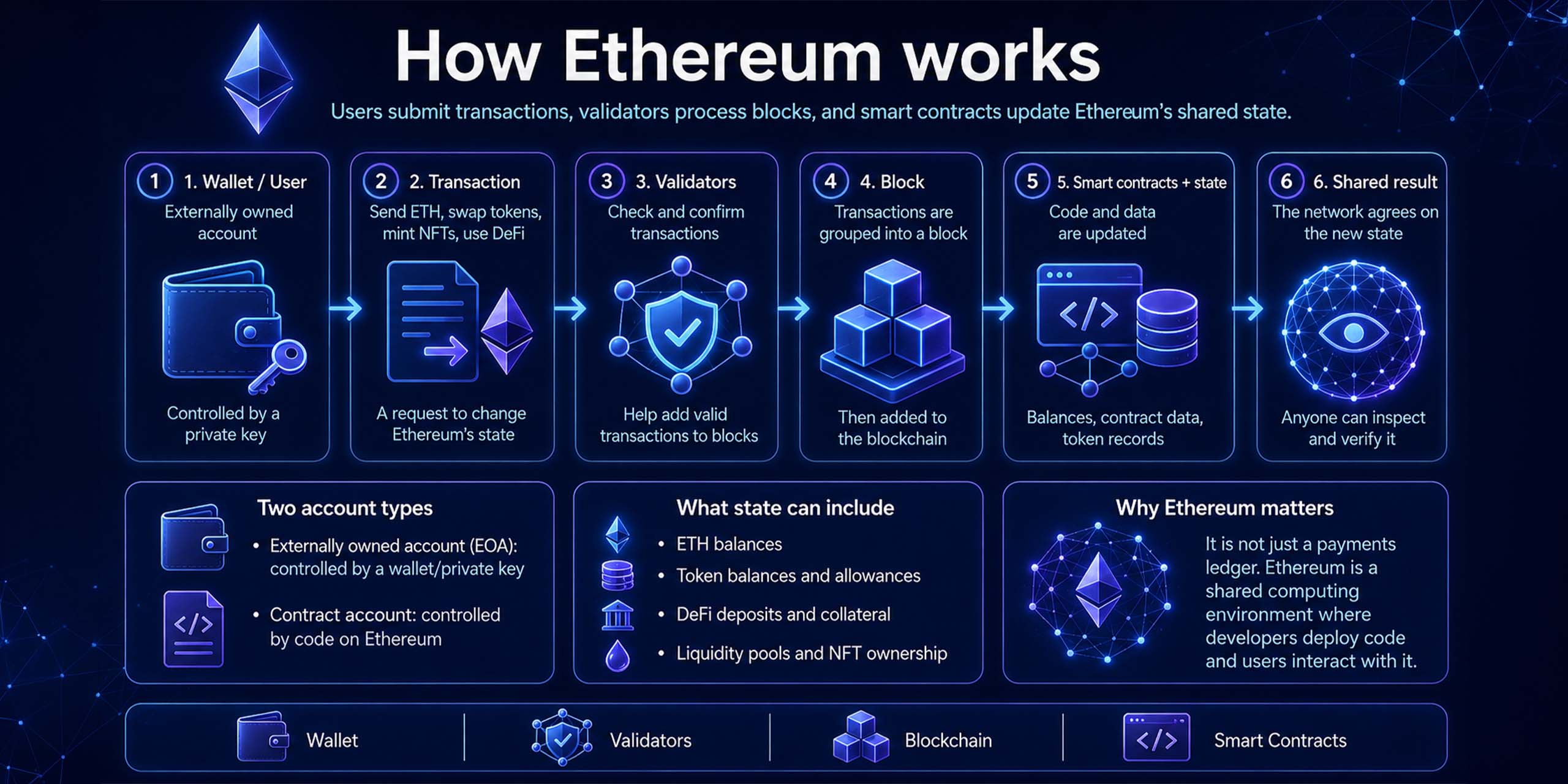
Ethereum works through a network of computers that maintain and update a shared blockchain. Users submit transactions, validators help process them, and the network agrees on the current state of accounts, balances and smart contracts.
Ethereum has two basic types of accounts. An externally owned account is controlled by a private key, usually through a crypto wallet. A contract account is controlled by code deployed on Ethereum. That distinction is important because Ethereum is not just tracking who owns ETH. It is also tracking what smart contracts exist and what state they are in.
When a user sends ETH, swaps tokens, mints an NFT or interacts with a DeFi protocol, they submit a transaction. That transaction changes the state of Ethereum if it is valid and included in a block.
This state can include simple balances, but also complex contract data. A lending protocol may track deposits and collateral. A token contract may track balances and allowances. A decentralized exchange may track liquidity pools. Ethereum records these changes in a way the network can verify.
The result is a shared computing environment. Developers write code. Users interact with that code. Validators keep the network synchronized. Everyone can inspect the blockchain, though understanding what is happening can still require a strong stomach and several browser tabs.
What is ETH?
ETH is Ethereum’s native asset. It is sometimes casually called “Ethereum,” but technically Ethereum is the network and ETH is the asset used inside it.
ETH has several roles. First, it pays for transactions. Whenever someone uses Ethereum, they pay a fee known as gas, and that fee is priced in ETH. Sending ETH, deploying a smart contract, swapping tokens or interacting with a DeFi app all require gas.
Second, ETH helps secure the network. Ethereum uses proof of stake, which means validators lock up ETH as collateral to participate in block creation and validation. Honest participation can earn rewards. Dishonest or careless behavior can be penalized.
Third, ETH is a core asset in the broader Ethereum economy. It is used as collateral in DeFi, traded on exchanges, held by investors, paired in liquidity pools and treated by many users as the base asset of the Ethereum ecosystem.
ETH is not a stablecoin. Its price can move dramatically. It is not a share in a company either. Holding ETH does not mean owning equity in Ethereum. It is a crypto asset tied to network usage, monetary policy, staking, market demand, speculation and belief in Ethereum’s long-term role.
A beginner-friendly way to put it: Ethereum is the city; ETH is the fuel, collateral and native money used inside the city.
Smart contracts and decentralized apps
The reason Ethereum became so important is smart contracts. A smart contract is code stored on a blockchain that runs according to its rules.
A simple smart contract might create a token and track balances. A more complex one might manage a lending market, run a decentralized exchange, handle NFT ownership or coordinate votes in a DAO. Once deployed, smart contracts can be used by anyone if the contract is public and the user has the right wallet and funds.
A decentralized application, or dapp, usually combines smart contracts with a user interface. The website or app might look normal, but the financial or ownership logic runs on-chain. When users click buttons, their wallets ask them to sign blockchain transactions.
This is powerful because smart contracts can be open and composable. One protocol can interact with another. A token can be used across many apps. Developers can build on existing contracts like public infrastructure.
It is also risky because code can hold real value. Bugs can become losses. Malicious contracts can drain wallets. Poorly designed incentives can break under stress. A smart contract executes logic; it does not understand fairness, regret or “wait, I clicked the wrong thing.”
Ethereum’s greatest strength is that it lets developers turn rules into public software. Its greatest danger is that public financial software can fail very publicly.
Why Ethereum became the home of tokens
Ethereum made it easy to create and manage tokens. That is one of the biggest reasons it became the center of so much crypto activity.
A token on Ethereum is usually created by a smart contract. The contract defines how the token works: how many units exist, who owns them, how transfers happen, whether new tokens can be minted, and what permissions apply.
The most famous Ethereum token standard is ERC-20, used for many fungible tokens such as governance tokens, utility tokens and stablecoins. Another key standard is ERC-721, widely associated with NFTs. ERC-1155 supports more flexible multi-token designs, often useful for gaming and collectibles.
Token standards matter because they allow wallets, exchanges and apps to support many assets in a predictable way. Without common standards, every token would be a special little snowflake of integration pain.
Ethereum’s token ecosystem helped power ICOs, DeFi, NFTs, DAOs and stablecoin markets. Some of that created real infrastructure. Some of it created spectacular bubbles. Both things can be true.
This is the Ethereum pattern in miniature: open tools, fast experimentation, big breakthroughs, big mistakes.
Gas fees explained
On Ethereum, gas is the fee users pay to perform actions on the network. It exists because every transaction consumes computing resources, and those resources are limited.
A simple ETH transfer uses relatively little gas. A complex smart contract interaction uses more. Deploying a contract, swapping through a decentralized exchange or minting NFTs can cost more because the network has to do more work.
Gas fees serve several purposes. They compensate validators, help prevent spam, and force users to pay for the computational resources they consume. Without fees, a public blockchain would be much easier to overload with junk transactions.
The frustrating part is that gas fees can rise when demand is high. During busy periods, users compete for block space, and transactions can become expensive. This has been one of Ethereum’s biggest user experience problems.
Gas is also one reason Layer 2 networks became so important. Instead of doing every action directly on Ethereum’s base layer, users can move activity to scaling networks that settle back to Ethereum. The goal is to keep Ethereum secure while making everyday usage cheaper and faster.
For beginners, gas fees are often the first unpleasant surprise. The second is realizing that a failed transaction can still cost gas. The network charges for computation, not emotional closure.
Ethereum and proof of stake
Ethereum now uses proof of stake to secure the network. This means validators lock up ETH as collateral and help propose and verify blocks.
Before 2022, Ethereum used proof of work, like Bitcoin. In September 2022, Ethereum completed an upgrade known as The Merge, which replaced proof of work with proof of stake. That shift dramatically reduced Ethereum’s energy consumption and changed how the network is secured.
In proof of stake, validators are selected to propose blocks and check other validators’ work. If they behave honestly, they can earn rewards. If they act dishonestly, part of their staked ETH can be destroyed through penalties. The system is designed to make honest behavior economically rational.
Staking can happen in different ways. Some users run their own validators, which requires technical knowledge and a significant ETH deposit. Others use staking services, pooled staking or liquid staking tokens. Each option carries different risks and trust assumptions.
Proof of stake did not make Ethereum perfect. It introduced its own debates around validator concentration, staking providers, liquidity and governance. But it did move Ethereum away from energy-intensive mining and into a security model based on capital at risk.
Ethereum vs Bitcoin
Ethereum and Bitcoin are often compared, but they are trying to do different things.
Bitcoin is focused on being decentralized digital money and a scarce settlement asset. Its design is conservative, intentionally narrow and resistant to frequent change. That is part of its appeal.
Ethereum is more flexible. It is built to support applications, tokens and smart contracts. It changes more often, has a larger developer surface and embraces experimentation. That makes it more adaptable, but also more complex.
Bitcoin’s native asset is BTC. Ethereum’s native asset is ETH. Bitcoin uses proof of work. Ethereum uses proof of stake. Bitcoin is often described as digital gold. Ethereum is often described as a programmable settlement layer or decentralized app platform.
Neither model is simply “better.” They optimize for different priorities. Bitcoin prioritizes monetary simplicity and durability. Ethereum prioritizes programmability and ecosystem growth.
A useful analogy: Bitcoin is like a digital vault with extremely strict rules. Ethereum is more like a public operating system for digital assets and financial software. The vault is easier to understand. The operating system can do more, and break in more interesting ways.
Ethereum and Layer 2 networks
Ethereum’s popularity created a problem: the base layer can become expensive and congested. That is where Layer 2 networks come in.
A Layer 2 is a scaling system built on top of Ethereum. It processes activity more cheaply or efficiently, then uses Ethereum as a settlement and security layer. Many Ethereum scaling efforts are based on rollups, which bundle transactions and post compressed data or proofs back to Ethereum.
Layer 2 networks are important because they make Ethereum more usable. Instead of paying high fees for every small action on the base layer, users can trade, mint, transfer or interact with apps on a Layer 2 at lower cost.
This does add complexity. Users must understand bridges, different networks, wallet settings, withdrawal times, and the security assumptions of each Layer 2. Crypto never misses a chance to solve one problem by creating three new dropdown menus.
Still, Layer 2 networks are central to Ethereum’s roadmap. The likely future of Ethereum is not every user doing every transaction directly on the base chain. It is Ethereum as a settlement layer, with much of the everyday activity happening across Layer 2 ecosystems.
That makes Ethereum less like one chain and more like a network of networks orbiting a shared base layer.
The risks and limits beginners should understand
Ethereum is important, but it is not risk-free.
The first risk is smart contract risk. Ethereum apps can be hacked, exploited or badly designed. Even if the Ethereum base layer works, users can lose funds inside a flawed protocol.
The second risk is wallet risk. Ethereum gives users direct access to powerful applications, but that also means users can sign dangerous approvals, connect to fake websites or lose seed phrases. A public blockchain will not save someone from a malicious popup.
The third risk is fee and usability complexity. Ethereum has improved, and Layer 2 networks help, but the experience can still be confusing. Gas, bridges, token approvals, network switching and transaction failures are not beginner-friendly.
The fourth risk is centralization pressure. Ethereum is decentralized in important ways, but parts of the ecosystem can concentrate around large staking providers, infrastructure companies, stablecoin issuers, front-end interfaces or governance groups. Decentralization is not a trophy Ethereum won once. It is an ongoing fight.
The fifth risk is market volatility. ETH can rise and fall sharply. Tokens built on Ethereum can be even more volatile. A strong technology ecosystem does not guarantee a smooth investment.
Ethereum’s biggest limit is also its biggest feature: flexibility. Because developers can build so many things on it, users face a huge range of quality. Ethereum hosts serious infrastructure, experimental research, useful financial tools, JPEG mania, governance theater and scams with excellent typography.
That does not make Ethereum worthless. It makes discernment mandatory.
What to Remember (FAQ)
What is Ethereum in simple terms?
Ethereum is a programmable blockchain that lets developers build smart contracts, tokens and decentralized applications. Its native asset is ETH.
Is Ethereum the same as Bitcoin?
No. Bitcoin is mainly designed as decentralized digital money and a scarce settlement asset. Ethereum is designed as a programmable platform for apps, tokens and smart contracts.
What is ETH used for?
ETH is used to pay gas fees, secure Ethereum through staking, transfer value, provide collateral in DeFi and participate in the Ethereum ecosystem.
What are smart contracts on Ethereum?
Smart contracts are programs stored on Ethereum that execute rules automatically. They power tokens, DeFi protocols, NFTs, DAOs and many decentralized apps.
Does Ethereum still use mining?
No. Ethereum moved from proof of work to proof of stake in 2022. Validators now secure the network by staking ETH instead of mining with energy-intensive hardware.
Why are Ethereum fees sometimes expensive?
Ethereum fees rise when demand for block space is high. Complex smart contract actions also cost more gas than simple transfers. Layer 2 networks are designed to reduce these costs for many users.
Sources: Ethereum.org, Ethereum whitepaper, Ethereum smart contracts documentation