Bitcoin is the original cryptocurrency, the asset that turned a niche cryptography experiment into a global financial and cultural phenomenon. It is also the reason most people heard the word “crypto” in the first place.
At its simplest, Bitcoin is peer-to-peer digital money. It lets people send value over the internet without relying on a bank, card network or payment company to approve the transaction. Instead, Bitcoin uses cryptography, a public blockchain and a network of participants to keep a shared record of ownership.
That sounds clean. The reality is more layered. Bitcoin is a payment network, a digital asset, a political idea, a software protocol, a speculative market, a savings narrative, a mining industry and, depending on whom you ask, either the future of money or the world’s most dramatic spreadsheet.
The useful way to understand Bitcoin is to separate the hype from the design. Bitcoin does not do everything. It is not fast like a modern card network, not flexible like Ethereum, and not stable like a dollar-backed stablecoin. But it does one thing with unusual intensity: it creates a scarce digital asset that can be transferred and verified without a central issuer.
This article is part of Crypto Explained, Geek’n’Destroy’s beginner-friendly guide to cryptocurrency, blockchain, wallets, tokens, DeFi, NFTs and the vocabulary of Web3.
Sommaire
- What is Bitcoin?
- Why Bitcoin was created
- How Bitcoin works
- Bitcoin and blockchain
- What Bitcoin mining does
- Why Bitcoin is scarce
- What Bitcoin is used for
- How people store Bitcoin
- Bitcoin’s limits and trade-offs
- What people often misunderstand about Bitcoin
- What to Remember (FAQ)
What is Bitcoin?
Bitcoin is a decentralized digital currency and payment network launched in 2009. It allows users to send value directly to each other using the internet, without needing a bank or financial intermediary to maintain the central ledger.
The word “Bitcoin” can mean two things. With a capital B, Bitcoin usually refers to the network and protocol. With a lowercase b, bitcoin can refer to the asset itself, often abbreviated as BTC. In everyday writing, people use “Bitcoin” for both, which is fine as long as the context is clear.
Bitcoin is the first successful cryptocurrency, but it is not the same thing as crypto as a whole. Crypto is the broader ecosystem. Bitcoin is the original and still the reference point. If cryptocurrency is the category, Bitcoin is the founding case study.
Bitcoin has no central company, CEO or official government issuer. Its rules are enforced by software, network participants and economic incentives. Anyone can download compatible software, run a node, verify the blockchain or hold bitcoin in a wallet.
That openness is part of its appeal. It is also what makes Bitcoin strange to newcomers. There is no customer support desk for the Bitcoin network itself. There is no password reset for a lost private key. Bitcoin gives users more control than traditional finance, but it also gives them more responsibility.
Why Bitcoin was created
Bitcoin appeared in 2008, when a person or group using the name Satoshi Nakamoto published a paper titled Bitcoin: A Peer-to-Peer Electronic Cash System. The network went live in January 2009.
The original problem was simple to state but hard to solve: how can digital money work without a trusted third party?
Physical cash is easy to understand. If you hand someone a banknote, you no longer have it. Digital money is different because digital information can be copied. Without a central ledger, someone could try to spend the same digital coin twice. This is called the double-spending problem.
Banks solve double spending by keeping private ledgers. Payment companies solve it by checking and approving transactions through their own systems. Bitcoin proposed another route: a public, peer-to-peer network that lets participants agree on the order of transactions.
That timing mattered. The Bitcoin white paper appeared during the global financial crisis, when trust in banks, governments and monetary institutions had taken a serious hit. Bitcoin’s design reflected a different instinct: rules instead of discretion, verification instead of permission, and a money supply that could not be changed by a central committee.
That does not mean every Bitcoin user shares the same philosophy. Some see it as digital cash. Some see it as digital gold. Some see it as an investment. Some see it as a protest against monetary policy. Bitcoin is one protocol, but it carries several stories.
How Bitcoin works
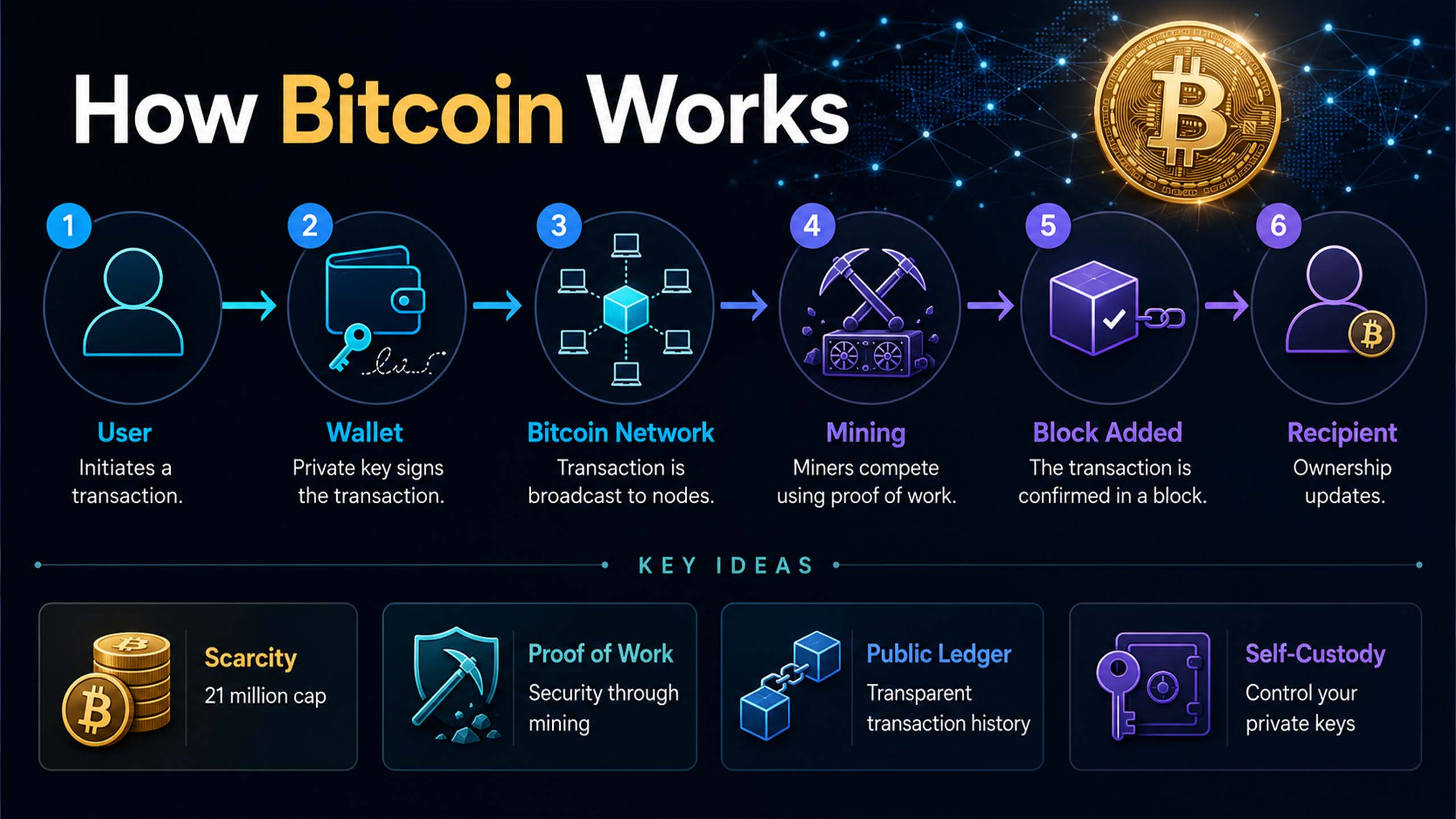
Bitcoin works through a combination of cryptography, a public ledger, peer-to-peer networking and proof of work.
When someone sends bitcoin, they are not moving a physical coin or a file from one device to another. They are creating a transaction that says, in effect, “I have the right to spend this bitcoin, and I authorize it to move to this address.” That transaction is signed using a private key.
A private key is a secret piece of data that proves control over bitcoin. A public address is what other people can use to send bitcoin to you. The private key is what lets you spend it. If someone else gets your private key, they can take the bitcoin. If you lose it, the network cannot restore it for you.
Once signed, the transaction is broadcast to the Bitcoin network. Nodes check whether it follows the rules. Is the signature valid? Has the bitcoin already been spent? Does the transaction format make sense? Valid transactions can then be collected into blocks by miners.
The result is a system where ownership is not based on names, accounts or government identity documents. It is based on cryptographic proof and the shared history recorded by the network.
Bitcoin and blockchain
Bitcoin runs on the Bitcoin blockchain, a public ledger that records confirmed transactions. The blockchain is shared across the network, which means anyone can verify the history of Bitcoin transactions without asking a bank for permission.
A blockchain is made of blocks linked together in order. Each block contains a batch of transactions and a reference to the previous block. This creates a chain of records that becomes harder to rewrite as more blocks are added after it.
This is why Bitcoin was the breakthrough. It combined several existing ideas — digital signatures, peer-to-peer networking, hashing and proof of work — into a system that could maintain a shared transaction history without a central administrator.
For a broader explanation of that technology, see our guide to what blockchain is. The short version is this: blockchain gives Bitcoin its memory. It lets the network agree on who owns what.
But Bitcoin’s blockchain is deliberately limited. It is not designed to run every kind of app or store large amounts of arbitrary data. Compared with platforms like Ethereum, Bitcoin is conservative. That is not an accident. Many Bitcoin supporters see simplicity and resistance to change as strengths, not flaws.
What Bitcoin mining does
Bitcoin mining is the process that confirms transactions, adds new blocks to the blockchain and helps secure the network.
Miners compete to find a valid proof of work for the next block. In plain English, they run specialized computers that perform huge numbers of calculations, trying to find a result that fits Bitcoin’s rules. The first miner to find a valid block can broadcast it to the network.
If nodes accept the block, the miner receives newly issued bitcoin plus transaction fees. This reward is not just a prize. It is the incentive that encourages miners to spend real-world resources securing the system.
Proof of work makes rewriting Bitcoin’s history expensive. An attacker who wanted to alter past transactions would need to redo the proof of work for those blocks and then outpace the honest network. On a mature network like Bitcoin, that is designed to be extremely difficult.
Mining is also one of Bitcoin’s most controversial features. It consumes energy by design. Defenders argue that this energy use secures a neutral monetary network and can be powered by renewable or otherwise wasted energy. Critics argue that Bitcoin’s energy demand is too high for the social value it provides. Both sides are arguing about the same core fact: Bitcoin turns electricity and hardware into security.
Why Bitcoin is scarce
Bitcoin’s most famous monetary rule is its supply cap. The protocol is designed so that no more than 21 million bitcoin will ever be created.
New bitcoin enters circulation through mining rewards. When Bitcoin launched, the block subsidy was 50 BTC per block. Roughly every 210,000 blocks, that subsidy is cut in half in an event known as the halving. The reward has fallen over time, and it will keep decreasing until new issuance eventually becomes negligible.
This predictable issuance schedule is central to Bitcoin’s identity. Unlike fiat currencies, whose supply can expand through central bank and government action, Bitcoin’s supply rules are transparent and difficult to change without broad network agreement.
That scarcity is why Bitcoin is often compared to gold. The comparison is imperfect, but useful. Gold is scarce because it is physically hard to mine. Bitcoin is scarce because its software rules limit issuance and the network enforces those rules.
Scarcity alone does not guarantee value. A badly drawn picture can be scarce too. Bitcoin’s value comes from a mix of scarcity, security, liquidity, network effects, belief, utility, market access and cultural momentum. The supply cap is important, but it is only one piece of the story.
What Bitcoin is used for
Bitcoin was introduced as peer-to-peer electronic cash, and it can still be used for payments. People can send bitcoin across borders, pay another user directly or receive funds without a traditional bank account.
In practice, many users now treat Bitcoin less like everyday cash and more like a store of value. They buy and hold it because they believe its scarcity, decentralization and long track record will matter over time. This is the “digital gold” narrative.
Bitcoin is also used as a settlement asset. Large transfers can move across the network without relying on a traditional payment rail. For some users, that is valuable because Bitcoin can operate across borders and outside normal banking hours.
In countries with unstable currencies, strict capital controls or limited banking access, Bitcoin can offer a way to hold or move value outside the local financial system. That does not make it risk-free. Bitcoin’s price can be extremely volatile. But for some people, volatility may be weighed against other risks they already face.
Bitcoin also plays a symbolic role in crypto. Even people building on other chains often measure the broader market against Bitcoin. When Bitcoin moves, the rest of crypto usually pays attention.
How people store Bitcoin
To use Bitcoin, people need a Bitcoin wallet. A wallet does not literally store coins. It stores the private keys that allow the user to control bitcoin recorded on the blockchain.
There are two main custody models. A custodial wallet is managed by a company, such as a crypto exchange. This can feel easier because the platform handles login, recovery and user interface. The trade-off is that the user depends on the company to actually hold and release the funds.
A self-custody wallet gives the user direct control over the private keys. This can be a mobile wallet, desktop wallet, browser wallet or hardware wallet. Self-custody is closer to Bitcoin’s original spirit, but it demands careful security.
Hardware wallets are popular for longer-term storage because they keep private keys offline. Still, no wallet removes the need for caution. Seed phrases can be stolen. Fake wallet apps exist. Phishing attacks are common. A user can understand Bitcoin perfectly and still lose funds by signing the wrong transaction or storing a recovery phrase badly.
Bitcoin ownership is brutally simple: control the keys, control the coins. That phrase sounds empowering until someone realizes it also means “lose the keys, lose the coins.”
Bitcoin’s limits and trade-offs
Bitcoin is powerful because it is narrow. It focuses on being secure, decentralized and resistant to arbitrary change. That focus creates trade-offs.
The Bitcoin base layer is not built for massive retail payment volume. Blocks are limited, transactions compete for space, and fees can rise when demand is high. This is why scaling systems such as the Lightning Network exist: they aim to make smaller, faster Bitcoin payments more practical without changing the base layer’s core design.
Bitcoin is also not private by default. The blockchain is public. Addresses are pseudonymous, but every transaction is visible. If an address becomes linked to a person, company or exchange account, the history around it can become very revealing.
Another limitation is programmability. Bitcoin can support scripts and more advanced features, but it is not designed like Ethereum, where smart contracts are central to the network’s identity. This makes Bitcoin less flexible, but also reduces certain kinds of complexity and risk.
Then there is volatility. Bitcoin may be described as digital money, but its price can swing dramatically. That makes it difficult to use as a stable unit of account. A coffee priced in bitcoin today could feel very different tomorrow. For now, Bitcoin is more often held, traded or used for settlement than used as daily pocket money.
What people often misunderstand about Bitcoin
The first misunderstanding is that Bitcoin is anonymous. It is not. Bitcoin is pseudonymous. You do not need to attach your legal name to a wallet address, but the transaction history is public.
The second misunderstanding is that Bitcoin is backed by nothing. It is not backed by a government, company or physical commodity. But it is backed in a broader sense by its network, security model, scarcity rules, liquidity, infrastructure and user belief. Whether that is enough is the debate.
The third misunderstanding is that Bitcoin and blockchain are interchangeable. Bitcoin uses blockchain technology, but blockchain is the ledger structure. Bitcoin is the asset and network built on top of that structure.
The fourth misunderstanding is that Bitcoin is old tech and therefore obsolete. Bitcoin is old by crypto standards, yes. That is partly the point. Its long operating history is one reason supporters trust it. In money-like systems, boring durability can be a feature.
The fifth misunderstanding is that Bitcoin is the same as every other cryptocurrency. It is not. Bitcoin has no central foundation controlling issuance, no company roadmap in the usual sense, no switch to proof of stake, and no attempt to become a general-purpose app platform. Its culture is unusually conservative because its core value proposition depends on predictability.
Bitcoin is not the whole crypto story. But it is the first chapter, the reference asset, and still the cleanest example of what made cryptocurrency feel genuinely new: digital value that can be owned, transferred and verified without a central gatekeeper.
What to Remember (FAQ)
What is Bitcoin in simple terms?
Bitcoin is digital money that can be sent over the internet without a bank in the middle. It uses cryptography, a public blockchain and a decentralized network to track ownership.
Who created Bitcoin?
Bitcoin was created by Satoshi Nakamoto, a pseudonymous person or group that published the Bitcoin white paper in 2008 and launched the network in 2009.
Is Bitcoin the same as cryptocurrency?
No. Bitcoin is the first successful cryptocurrency, but cryptocurrency is the broader category. Other crypto assets include Ethereum, stablecoins, tokens, NFTs and many more.
Why does Bitcoin have value?
Bitcoin’s value comes from a mix of scarcity, security, liquidity, network effects, market demand and belief in its role as decentralized digital money. Its price is still highly volatile.
How many bitcoin will ever exist?
Bitcoin is designed with a maximum supply of 21 million bitcoin. New issuance decreases over time through halvings.
Is Bitcoin safe?
The Bitcoin network itself has a strong security record, but users can still lose bitcoin through scams, hacked exchanges, phishing, bad wallet security or lost private keys.
Sources: Bitcoin white paper, Bitcoin.org, Bitcoin Developer Guide