
Blockchain is one of those tech words that escaped its original context and started appearing everywhere: finance decks, startup pitches, gaming projects, supply chain experiments, political speeches, art platforms, and crypto Twitter arguments that should probably have ended three hours earlier.
At its core, a blockchain is a shared digital ledger. It records information across a network of computers, groups that information into blocks, and links those blocks together in chronological order. Once data is added and accepted by the network, changing it becomes extremely difficult without being noticed.
That simple idea explains why blockchain became the backbone of cryptocurrency. If people want to send digital value without a bank in the middle, they need a record everyone can trust. A blockchain gives the network a common version of history: who sent what, when, and under which rules.
But blockchain is not magic dust. It does not automatically make a project honest, decentralized, useful, or valuable. It is a specific kind of database with specific trade-offs. Used well, it can solve real coordination problems. Used badly, it is a slow, expensive spreadsheet with a manifesto attached.
This article is part of Crypto Explained, Geek’n’Destroy’s beginner-friendly guide to cryptocurrency, Bitcoin, wallets, tokens, DeFi, NFTs and the vocabulary of Web3.
Sommaire
- What is blockchain?
- How blockchain works
- What is inside a block?
- How blockchains agree on what is true
- Why blockchain matters for cryptocurrency
- What blockchain is used for
- Public, private and permissioned blockchains
- The limits of blockchain
- What people often misunderstand about blockchain
- What to Remember (FAQ)
What is blockchain?
A blockchain is a digital ledger that stores records in blocks, then links those blocks together using cryptography. Each block contains data, a timestamp or ordering mechanism, and a cryptographic reference to the previous block. That reference is what creates the “chain.”
The best analogy is not a normal spreadsheet, but a shared notebook copied across many computers. When the network accepts a new page, every honest participant can update their copy. If someone tries to rewrite an old page, the rest of the notebook no longer matches.
This design makes blockchains tamper-evident. That does not mean impossible to attack in every situation. It means changes are meant to be visible, difficult, and rejected by the network unless the attacker can overpower or manipulate the system’s rules.
In crypto, the records are usually transactions: Alice sent Bitcoin to Bob, a wallet paid a fee, a smart contract changed state, a validator received a reward. But a blockchain can technically record many kinds of data. The important point is not the type of information. It is the shared, verifiable history.
How blockchain works
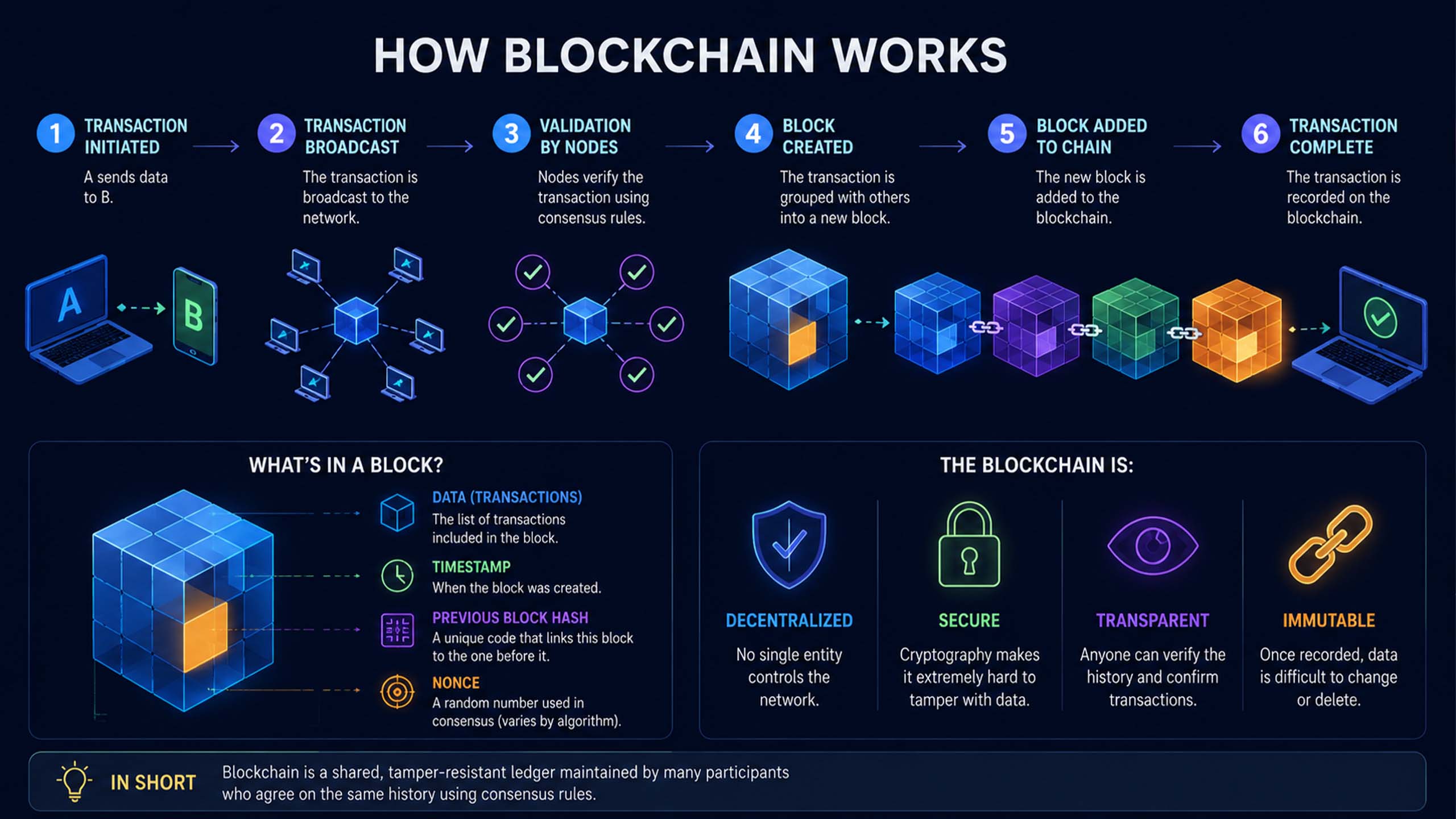
A blockchain network is usually maintained by many computers, often called nodes. These nodes keep copies of the ledger, check new transactions, and help enforce the rules of the network.
When a user sends a transaction, it is broadcast to the network. The nodes check whether it follows the rules. Does the sender have the right to move the asset? Is the transaction correctly signed? Has the same asset already been spent somewhere else? If the transaction passes these checks, it can be included in a new block.
Once a block is proposed and accepted, it becomes part of the chain. The new block points back to the previous one, which points back to the one before that, all the way to the first block. In crypto culture, that first block is usually called the genesis block.
This structure creates a timeline. Instead of trusting one company to say what happened, the network builds a shared record that participants can verify for themselves.
What is inside a block?
A block is a container for data. On a cryptocurrency network, that data usually includes a list of transactions. The block also includes technical information that helps the network verify where it belongs in the chain.
One key element is the hash. A hash is like a digital fingerprint generated from data. Change the data, even slightly, and the hash changes. Blockchains use hashes to link blocks together and protect the integrity of the history.
A block typically includes a reference to the previous block’s hash. That is what makes rewriting old records so hard. If someone modifies a past block, its hash changes. Then the next block no longer points to it correctly. The attack ripples forward and becomes visible.
This is why blockchain is often described as immutable. The better word is “resistant.” Data on a mature blockchain is difficult to rewrite because doing so would require changing history faster or more convincingly than the rest of the network can defend it.
How blockchains agree on what is true
The hardest problem for a blockchain is not storing data. Normal databases already do that very well. The hard part is agreement.
A decentralized network needs a way to decide which transactions are valid and which version of the ledger is correct. This is called consensus. Without consensus, a blockchain would be just a crowd of computers shouting different versions of the truth.
Bitcoin uses proof of work. Miners compete to add blocks by performing energy-intensive computation. The system makes it costly to attack the network and rewards miners who follow the rules.
Ethereum uses proof of stake. Validators lock up ETH as collateral and participate in proposing and checking blocks. If they behave honestly, they can earn rewards. If they misbehave, they can be penalized.
Different consensus systems make different trade-offs. Proof of work is battle-tested but energy-intensive. Proof of stake is more energy-efficient but depends on economic incentives and validator behavior. The big question is always the same: how does the network make honesty more attractive than cheating?
Why blockchain matters for cryptocurrency
Blockchain became famous because it helped solve a major problem for digital money: double spending.
Digital information is easy to copy. That is wonderful for photos, documents and memes. It is disastrous for money. If a digital coin can be copied like a JPEG, someone could spend the same coin twice.
Traditional finance solves this by using central authorities. Your bank keeps the ledger. Visa, Mastercard, PayPal or another payment network updates balances and decides whether a transaction is valid. Bitcoin proposed another model: a public network that orders transactions and makes the history verifiable.
That is the breakthrough. A blockchain lets users agree on ownership without needing one central operator to maintain the master record. This is why blockchain and cryptocurrency are so closely connected.
Still, they are not the same thing. Cryptocurrency is the asset. Blockchain is the ledger technology that often records it. Bitcoin is a cryptocurrency. The Bitcoin blockchain is the network that tracks Bitcoin transactions.
What blockchain is used for
The most important use case remains cryptocurrency. Bitcoin, Ethereum and many other crypto networks use blockchains to record transfers, balances, fees and network activity.
Blockchain is also used for smart contracts. These are programs that run on a blockchain and execute when certain conditions are met. Ethereum popularized this idea by turning the blockchain into something closer to a decentralized computing platform, not just a payment ledger.
In DeFi, blockchain networks allow people to trade, lend, borrow and provide liquidity through protocols rather than traditional financial intermediaries. In NFTs, blockchains record ownership of unique tokens linked to digital items, memberships, artworks or collectibles. In DAOs, blockchain-based tokens can help coordinate voting and governance.
Outside crypto, companies and institutions have explored blockchain for supply chains, identity systems, document verification and settlement infrastructure. Some experiments make sense. Others could have used a conventional database and saved everyone a lot of slides.
A useful rule of thumb: blockchain becomes interesting when multiple parties need a shared record, do not fully trust one another, and do not want one participant to control the database. If there is already a trusted central operator, blockchain may add complexity without solving much.
Public, private and permissioned blockchains
Not all blockchains work the same way. A public blockchain is open for anyone to use, inspect and often participate in. Bitcoin and Ethereum are the classic examples. Anyone can create a wallet, send transactions, and verify the ledger.
A private blockchain is controlled by one organization or a limited group. Access is restricted, and the network is not open in the same way. These systems are often used in enterprise contexts where participants want some blockchain-like features without full public decentralization.
A permissioned blockchain sits somewhere in between. Certain users may be allowed to validate transactions, access data or perform specific actions. This can make sense for banks, logistics networks or consortia where participants are known but still need a shared record.
The word “blockchain” sounds more radical when people imagine Bitcoin. But many enterprise blockchains are closer to shared databases with cryptographic audit trails. That is not automatically bad. It just means the design is serving a different purpose.
The limits of blockchain
Blockchain has real strengths, but it pays for them. Public blockchains can be slower and more expensive than centralized databases because many computers must verify and agree on the state of the ledger.
Scalability is a constant challenge. A payment company can process huge volumes by controlling its own infrastructure. A decentralized blockchain must coordinate across a distributed network while preserving security and resistance to manipulation. That is harder.
There is also the famous “garbage in, garbage out” problem. A blockchain can verify that data was recorded. It cannot automatically verify that the data was true in the real world. If someone records a fake luxury handbag as authentic, the blockchain may preserve the lie beautifully.
Privacy is another issue. Public blockchains are transparent by design. That transparency helps verification, but it can expose transaction patterns. Addresses are pseudonymous, not magically anonymous. Once an address is linked to a person or company, the history can become revealing.
And then there is governance. Blockchains are often described as code-based systems, but humans still write the code, debate upgrades, run infrastructure, build apps and fight over values. Decentralization changes politics. It does not remove politics.
What people often misunderstand about blockchain
The first misunderstanding is that blockchain is Bitcoin. Bitcoin uses a blockchain, but blockchain is the broader technology. Ethereum, Solana, Polygon and many other networks use blockchain designs for different purposes.
The second misunderstanding is that blockchain automatically creates trust. It is better to say that blockchain changes where trust sits. Instead of trusting one central administrator, users trust code, incentives, cryptography, network participants and the social process around upgrades.
The third misunderstanding is that blockchain data is always correct. It may be consistent, visible and hard to alter, but correctness depends on what was recorded and how it entered the system. A blockchain cannot solve every truth problem by itself.
The fourth misunderstanding is that decentralization is binary. In reality, it is a spectrum. A network can be decentralized in its validators but centralized in development. It can be open in theory but dominated by a few major platforms in practice. Serious blockchain analysis always asks: decentralized where, exactly?
The final misunderstanding is that blockchain is useful everywhere. It is not. For many products, a traditional database is cheaper, faster, easier to maintain and better for users. Blockchain earns its place only when shared verification and reduced reliance on a central operator are worth the trade-offs.
What to Remember (FAQ)
What is blockchain in simple terms?
Blockchain is a shared digital ledger that records information in blocks linked together by cryptography. It lets a network agree on a common history without relying entirely on one central authority.
Is blockchain the same as cryptocurrency?
No. Blockchain is the technology that records transactions and data. Cryptocurrency is a digital asset that often runs on a blockchain.
Why is blockchain hard to change?
Blocks are linked using cryptographic hashes. If someone changes an old block, the link to later blocks breaks, and the network can detect the change.
What is a block in blockchain?
A block is a bundle of data, usually transactions, plus technical information that connects it to the previous block and helps the network verify it.
Can blockchain be used without crypto?
Yes. Some private or enterprise blockchains are used for supply chains, records, identity or settlement systems. But public blockchains usually need crypto assets to pay fees, reward participants or secure the network.
Is blockchain always decentralized?
No. Some blockchains are highly decentralized, while others are controlled by a small group, company or consortium. The word “blockchain” alone does not guarantee decentralization.
Sources: NIST Blockchain Technology Overview, Bitcoin white paper, Ethereum documentation