Web3 is the idea of a new kind of internet built around ownership, decentralization and user-controlled assets. Instead of logging into platforms that own your identity, your data, your audience and your digital stuff, Web3 imagines a web where users connect with wallets, hold tokens, use decentralized apps and carry value across services.
That is the pitch, anyway. The reality is more complicated, and much more interesting.
Web3 is not a single product, protocol or company. It is a broad term for a set of technologies and ideals: blockchains, crypto wallets, smart contracts, tokens, decentralized identity, DAOs, NFTs and decentralized finance. Some of these tools are already useful. Some are experimental. Some have been inflated by enough hype to qualify as weather systems.
The core idea is still important: today’s web is dominated by large platforms. They host the content, control the accounts, shape the feeds, take the fees and decide what users can keep. Web3 asks whether parts of that power can move back to users, communities and open networks.
The honest answer is: sometimes, maybe, and not nearly as easily as the slogans promised.
This article is part of Crypto Explained, Geek’n’Destroy’s beginner-friendly guide to cryptocurrency, Bitcoin, blockchain, wallets, tokens, stablecoins, exchanges, DeFi, Ethereum, smart contracts, NFTs and the vocabulary of Web3.
Sommaire
- What is Web3?
- Web1, Web2 and Web3 explained
- How Web3 works
- Why wallets are central to Web3
- Digital ownership and tokens
- What Web3 apps look like
- Web3 identity and decentralized identifiers
- DAOs, communities and governance
- The risks and limits beginners should understand
- What people often misunderstand about Web3
- What to Remember (FAQ)
What is Web3?
Web3 is a vision for a more decentralized internet where users can own and control digital assets, identity and access through blockchain-based tools.
In the simplest version, Web3 means using crypto infrastructure to change how online services work. A user might connect to an app with a wallet instead of a username and password. They might own tokens that represent membership, voting power, digital collectibles, in-game items or access rights. They might use a decentralized exchange instead of a traditional trading platform, or participate in a DAO instead of a company-run community.
The important word is ownership. On today’s web, most digital things live inside platform accounts. Your audience is on Instagram, your videos are on YouTube, your items are inside a game, your purchases are tied to a company database. If the platform changes the rules, shuts down, bans your account or removes a feature, your control can disappear quickly.
Web3 tries to make some digital objects portable. If an asset lives on a public blockchain and is controlled by a wallet, it can potentially move across apps, marketplaces and communities. That is the dream: fewer closed platforms, more open networks.
But Web3 is not a magic replacement for the internet. Most Web3 users still depend on websites, cloud infrastructure, wallets, front-end interfaces, APIs, app stores and companies. The decentralized layer is real, but it does not float in space. It still touches the messy old web.
Web1, Web2 and Web3 explained
The usual Web3 story starts with three eras.
Web1 was the early web of static pages, personal sites, forums, directories and open protocols. Users mostly read pages and followed links. Publishing existed, but it required more technical effort. The web felt open, weird and less centralized, partly because no small group of giant platforms had yet swallowed everyone’s attention.
Web2 is the social, interactive and platform-driven web. Users create content, upload videos, post updates, share photos, build audiences and use cloud apps. Web2 made the internet easier and more social, but it also concentrated power in major platforms: Google, Meta, Amazon, Apple, TikTok, X, YouTube, Discord and the rest of the modern attention machinery.
Web3 is presented as the next shift: a web where users can own assets and interact through decentralized networks rather than relying entirely on platform accounts. Instead of every service keeping its own private database of your identity and assets, Web3 leans on wallets, blockchains and tokens as shared infrastructure.
This three-part story is useful, but too neat. Web1 was not pure decentralization. Web2 is not only evil platforms. Web3 is not automatically liberation with a nicer logo. Real technology history is messier than conference slides.
The better way to frame it is this: Web3 is a response to platform power. It asks whether the internet can keep the usability of Web2 while recovering some of the openness of Web1.
How Web3 works
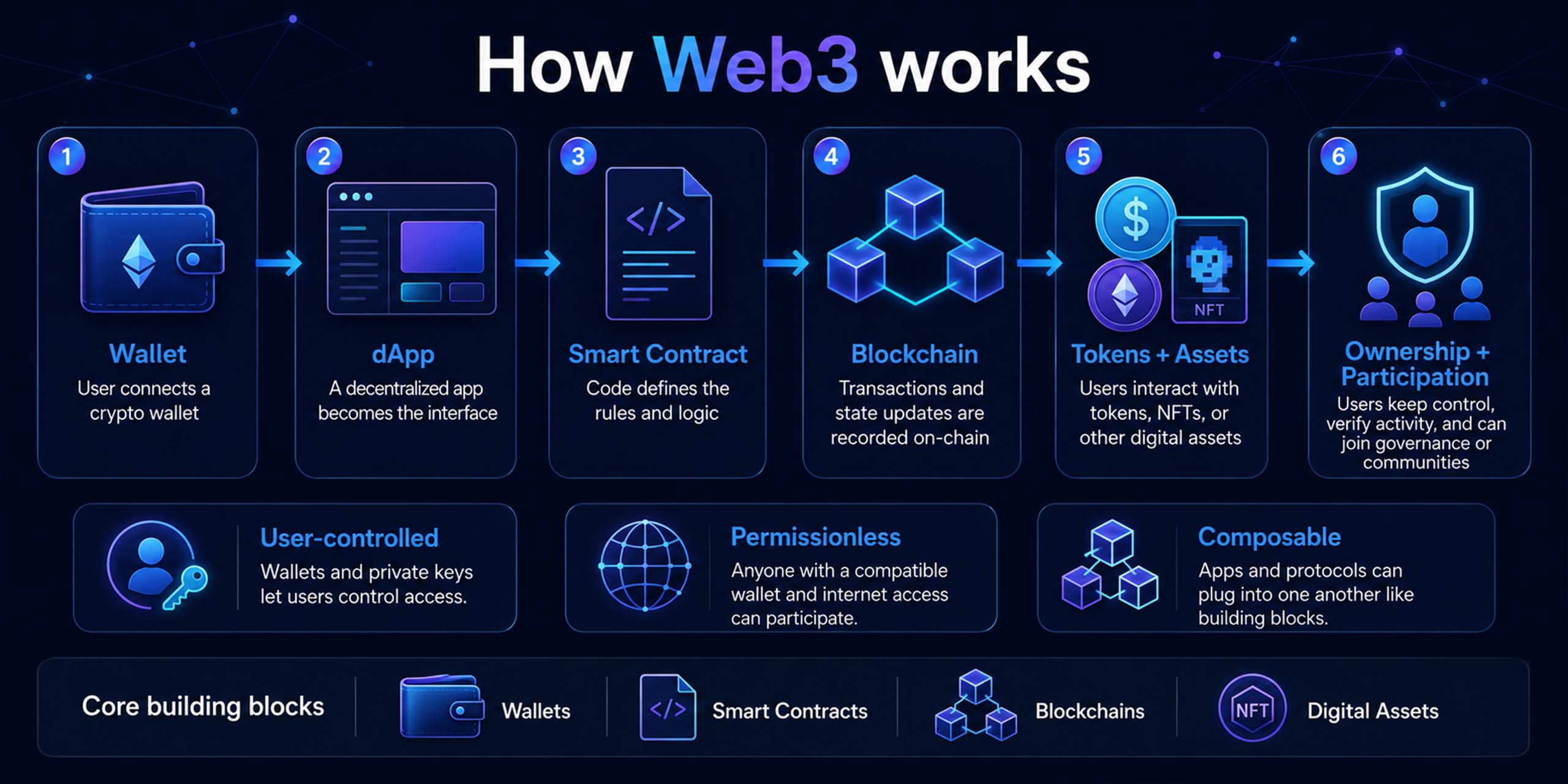
Web3 works by combining several crypto technologies.
A blockchain provides a shared ledger. It records ownership, transactions and smart contract activity. A wallet gives users control over keys and addresses. A smart contract defines programmable rules. A token represents value, access, ownership, voting power or another digital right.
When a user connects to a Web3 app, the app may read the user’s wallet address and on-chain assets. If the user wants to perform an action, the wallet asks them to sign a transaction or message. The blockchain then records the result if the transaction is valid.
For example, a user might connect a wallet to a decentralized finance app, deposit a stablecoin, receive a token representing their position, and later withdraw funds. Or they might connect to an NFT marketplace, list a collectible and sign a sale. Or they might vote in a DAO using a governance token.
This is very different from a normal Web2 account. A Web2 platform usually stores user data and permissions in its own private database. A Web3 app can read public blockchain data and interact with assets the user controls directly.
That openness is powerful. It also means the user experience can be rough. Wallet pop-ups, gas fees, seed phrases, token approvals, bridges and network switching are not exactly the warm embrace of mainstream product design. Web3 gives users more control, then asks them to understand more things than most people reasonably want to know.
Why wallets are central to Web3
The wallet is the center of the Web3 experience. It is not just a place to “store crypto.” It is a login tool, signature device, asset manager and identity layer.
In Web2, identity usually starts with an email address, username or social login. In Web3, identity often starts with a wallet address. A user connects the wallet to an app and signs a message proving they control that address.
This can make login portable. Instead of creating a new account for every platform, a user can connect the same wallet to many apps. The app can see relevant assets, memberships or permissions attached to the wallet. If the user owns a certain token, they might unlock a community, event, game feature or voting page.
That is why wallets are so closely tied to Web3’s ownership story. The wallet controls the keys, and the keys control the assets. It is simple, elegant and occasionally a nightmare.
Wallet-based access also changes responsibility. If a user loses a seed phrase, signs a malicious transaction or connects to a fake site, there may be no password reset or support team that can undo the damage. Web3 shifts power toward users, but also shifts risk toward users.
The wallet is Web3’s superpower and its biggest onboarding problem. It gives users control, but it also makes the internet feel like defusing a tiny financial bomb every time a pop-up appears.
Digital ownership and tokens
Web3’s strongest claim is digital ownership. That usually means using tokens to represent assets, rights or participation on a blockchain.
A token can represent a currency-like asset, a stablecoin, a governance vote, an NFT, a membership pass, an in-game item or access to a digital experience. Because tokens can be held in wallets and recognized by different apps, they can become more portable than traditional platform items.
This is why NFTs became so closely associated with Web3. The early NFT boom was messy, speculative and often ridiculous, but the underlying idea was bigger than expensive cartoon avatars. A non-fungible token can represent a unique digital object, access right or ownership record.
Gaming is an obvious example. In a normal game, items usually belong inside the game’s database. If the company shuts the game down or bans the account, the item is gone or inaccessible. A Web3 game might issue items as tokens that players can hold in wallets, trade externally or use across connected experiences.
Creators can also use tokens for memberships, drops, royalties, community access or funding. A music artist could issue token-gated access to private content. A media project could reward early supporters. A community could use tokens to coordinate ownership or governance.
The hard question is whether ownership actually improves the product. A bad game with tradable items is still a bad game. A lazy membership token is still a lazy membership program. Web3 ownership matters only when portability, scarcity, programmability or community control create value that a normal database cannot.
What Web3 apps look like
Web3 apps can look surprisingly normal. Many are websites with a “Connect Wallet” button. The difference is what happens underneath.
A decentralized exchange lets users trade tokens from their wallets, often through smart contracts and liquidity pools. A DeFi lending app lets users supply assets, borrow against collateral or earn yield. An NFT marketplace lets users mint, buy or sell unique tokens. A DAO tool lets members vote on proposals or manage a treasury.
Some Web3 apps focus on finance. Others focus on gaming, identity, social networks, creator tools, collectibles, infrastructure or data storage. The variety is broad because Web3 is not a single vertical. It is a design pattern for building with wallets, tokens and decentralized networks.
The best Web3 apps use blockchain because they need shared ownership, open settlement, user-controlled assets or composability. A DeFi protocol makes sense on-chain because users need to verify deposits, collateral and transactions. A tokenized membership may make sense if access should be portable across different services.
The weakest Web3 apps use blockchain because the pitch deck needed a token. If the product does not benefit from public ownership, open verification or decentralized coordination, Web3 may only add friction.
That is the useful test: does the blockchain part make the app better, or just more complicated?
Web3 identity and decentralized identifiers
Identity is one of Web3’s most ambitious ideas. Instead of every platform controlling a separate account, users could carry parts of their identity across the internet.
A wallet address can already act as a basic Web3 identity. It can show what assets a user controls, what communities they joined, which NFTs they hold, how they voted, or what on-chain actions they performed. That can be useful, but also extremely public.
More advanced identity systems use concepts such as decentralized identifiers, or DIDs. A DID is designed to let an entity identify itself in a way that is not fully dependent on a centralized registry or platform. In theory, this can support portable identity, credentials and reputation systems.
The promise is attractive. A user could prove membership, qualifications, age range, reputation or access rights without handing every platform the same personal data. Creators, workers, gamers and communities could carry identity across services.
The challenge is enormous. Identity is not just a technical problem. It involves privacy, recovery, fraud, regulation, social context and human messiness. A permanent public record can be useful for ownership and disastrous for personal life. Not everything should be on-chain. Honestly, most things should not be on-chain.
Web3 identity has real potential, especially when it uses cryptography to prove claims without exposing too much information. But the best version will need restraint, privacy and good design. “Put your whole life in a wallet” is not a plan. It is a Black Mirror episode with venture funding.
DAOs, communities and governance
Web3 is not only about assets. It is also about coordination. That is where DAOs, or decentralized autonomous organizations, come in.
A DAO is an internet-native organization that uses tokens, smart contracts and online governance to coordinate people and resources. Some DAOs manage DeFi protocols. Others fund projects, collect art, run communities, invest in assets or experiment with new forms of organization.
The big idea is that communities can own and govern shared resources more directly. Instead of a platform deciding everything, token holders or members may vote on proposals, treasury spending, upgrades or rules.
This can be powerful. It can also be messy. Voting power often follows token ownership, which means whales can dominate. Participation can be low. Governance can become theater. Legal structures can be unclear. And not every decision improves when it is turned into a Discord debate with a token snapshot.
Still, DAOs are one of Web3’s more interesting experiments because they ask a real question: can online communities become economic and governance systems, not just audiences gathered on someone else’s platform?
The answer is not settled. Some DAOs will become useful coordination tools. Many will become abandoned group chats with treasuries and lore. Both outcomes are very on-brand for crypto.
The risks and limits beginners should understand
The first Web3 risk is security. Wallets, smart contracts, bridges, token approvals and phishing attacks create many ways to lose assets. Web3 gives users control, but attackers love environments where mistakes are irreversible.
The second risk is centralization hiding behind decentralization. A project may use a blockchain while relying on centralized front ends, cloud infrastructure, admin keys, small validator sets, concentrated token ownership or a founding team with enormous control.
The third risk is speculation. Tokens can make communities more aligned, but they can also turn every product decision into price drama. When users become investors, incentives change. Not always for the better.
The fourth risk is user experience. For mainstream users, Web3 can still be too hard. Seed phrases, gas fees, failed transactions and cross-chain bridges are not friendly. A technology that wants billions of users cannot require everyone to become part-time security engineers.
The fifth risk is privacy. Public blockchains can reveal transaction histories. Wallets can become behavioral profiles. If Web3 identity is badly designed, users may lose more privacy than they gain ownership.
There is also regulation. Tokens, stablecoins, DeFi protocols and DAOs may raise legal questions around securities, payments, consumer protection, taxation and financial crime. Web3 does not exist outside the law just because it has a white paper.
Web3’s limits are not proof that the idea is useless. They are proof that building a better internet is harder than minting a token and calling it a revolution.
What people often misunderstand about Web3
The first misunderstanding is that Web3 means every website must be on a blockchain. It does not. Blockchains are useful for specific problems: shared ownership, settlement, verification, tokens, coordination and trust minimization. They are terrible for many ordinary web tasks.
The second misunderstanding is that Web3 is fully decentralized today. It is not. Many Web3 apps depend heavily on centralized services, hosted interfaces, major wallets, infrastructure providers, app stores, exchanges and cloud platforms.
The third misunderstanding is that Web3 equals crypto speculation. Speculation has dominated much of the public image, but Web3 also includes identity, governance, creator tools, open finance, gaming assets and digital ownership experiments.
The fourth misunderstanding is that ownership always matters. Sometimes it does. Sometimes users just want the app to work. Not every playlist, badge, sword, article comment or loyalty point needs to become a tradable asset.
The fifth misunderstanding is that Web3 will simply replace Web2. More likely, the useful parts of Web3 will be absorbed into the existing internet. Wallets may become easier. Tokens may become invisible infrastructure. Stablecoin payments may feel normal. Digital ownership may matter in specific contexts rather than everywhere.
The future of Web3 is probably not a parallel internet where everyone lives inside a crypto dashboard. It is more likely a slow, uneven blending of Web2 convenience with Web3 ownership tools. Less revolution poster, more plumbing. And honestly, plumbing is underrated.
What to Remember (FAQ)
What is Web3 in simple terms?
Web3 is the idea of a more decentralized internet where users can own digital assets, connect with wallets and interact with apps built on blockchains and smart contracts.
How is Web3 different from Web2?
Web2 is dominated by platforms that control accounts, data and content distribution. Web3 tries to give users more control through wallets, tokens, open networks and decentralized applications.
Does Web3 require cryptocurrency?
Most Web3 systems use crypto infrastructure, including wallets, tokens and blockchains. Users may not always notice the crypto layer, but it is usually part of how ownership and transactions work.
What are examples of Web3?
Examples include decentralized exchanges, DeFi lending apps, NFT marketplaces, DAOs, token-gated communities, blockchain games and wallet-based identity tools.
Is Web3 fully decentralized?
No. Some Web3 systems are decentralized in important ways, but many still rely on centralized websites, infrastructure providers, wallets, exchanges, cloud services or concentrated token ownership.
Is Web3 just hype?
Some of it is hype, speculation and bad product design. But the underlying ideas — portable digital ownership, programmable assets, decentralized finance and user-controlled identity — remain important experiments.
Sources: Ethereum.org Web3, W3C Decentralized Identifiers, Moxie Marlinspike