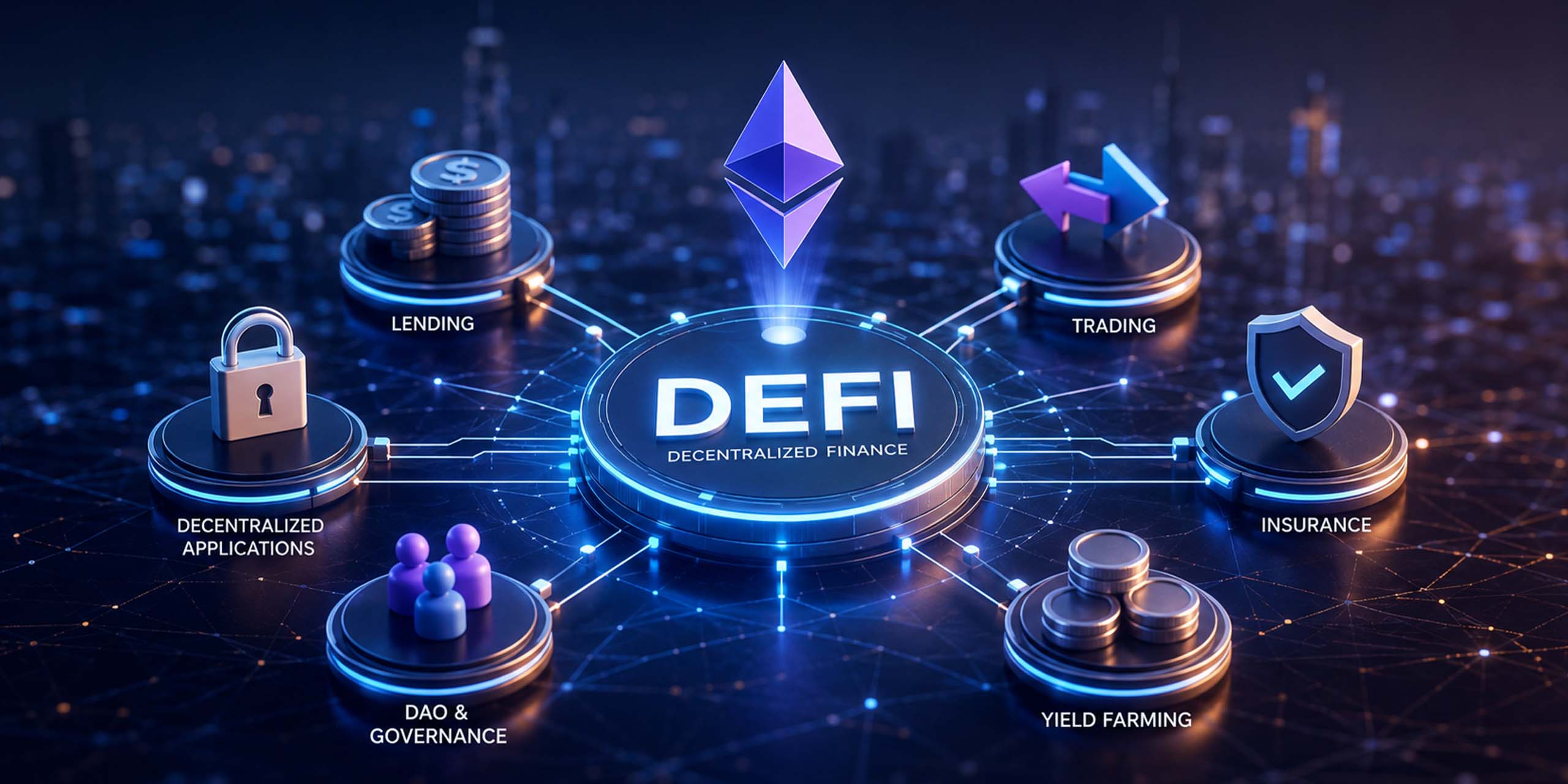
DeFi stands for decentralized finance. It is the part of crypto that tries to rebuild financial services — trading, lending, borrowing, payments, yield, derivatives, asset management — using blockchains and smart contracts instead of banks, brokers or traditional financial platforms.
That does not mean DeFi is finance without rules, risk or intermediaries of any kind. The slogan is cleaner than the reality. In practice, DeFi replaces many traditional middlemen with software, liquidity pools, governance tokens, price oracles, wallets, validators, bridges and protocol teams. Some of those pieces are genuinely decentralized. Some are not.
The basic idea is still powerful: if financial logic can run on a public blockchain, users can interact with it directly from a crypto wallet. No bank branch. No market hours. No application form for every product. Just code, collateral, liquidity and a transaction fee.
That openness is why DeFi became one of crypto’s most important experiments. It is also why beginners should approach it with both curiosity and caution. DeFi can make markets more accessible and programmable. It can also turn one bad click, one bad contract or one bad liquidation into a very expensive lesson.
This article is part of Crypto Explained, Geek’n’Destroy’s beginner-friendly guide to cryptocurrency, Bitcoin, blockchain, wallets, tokens, stablecoins, exchanges, NFTs and the vocabulary of Web3.
Sommaire
- What is DeFi?
- How DeFi works
- Why smart contracts matter in DeFi
- How wallets connect users to DeFi
- Decentralized exchanges and liquidity pools
- DeFi lending and borrowing
- Why stablecoins are central to DeFi
- Yield farming, staking and rewards
- The risks beginners should understand
- What people often misunderstand about DeFi
- What to Remember (FAQ)
What is DeFi?
DeFi is a collection of blockchain-based financial applications that users can access without relying on traditional financial intermediaries. Instead of a bank managing deposits, a broker matching trades or a lending company approving loans, DeFi uses smart contracts to execute financial functions on-chain.
Most DeFi activity happens on programmable blockchains, especially networks that support smart contracts. Ethereum played the biggest early role, but DeFi now exists across many blockchain ecosystems and Layer 2 networks.
The simplest way to understand DeFi is to compare it with traditional finance. In traditional finance, institutions control the accounts, infrastructure and rule enforcement. In DeFi, users connect wallets to protocols, sign transactions and interact with code that lives on a blockchain.
That does not make DeFi automatically fair, safe or decentralized. It means the financial service is built differently. The logic is often public. Transactions are usually visible. Access can be global. But the risks move closer to the user.
DeFi is not one product. It is a stack of protocols: decentralized exchanges, lending markets, stablecoins, derivatives, synthetic assets, insurance experiments, bridges, aggregators and yield tools. Some are useful infrastructure. Some are financial engineering with a neon sign. Some are disasters waiting for a bull market.
How DeFi works
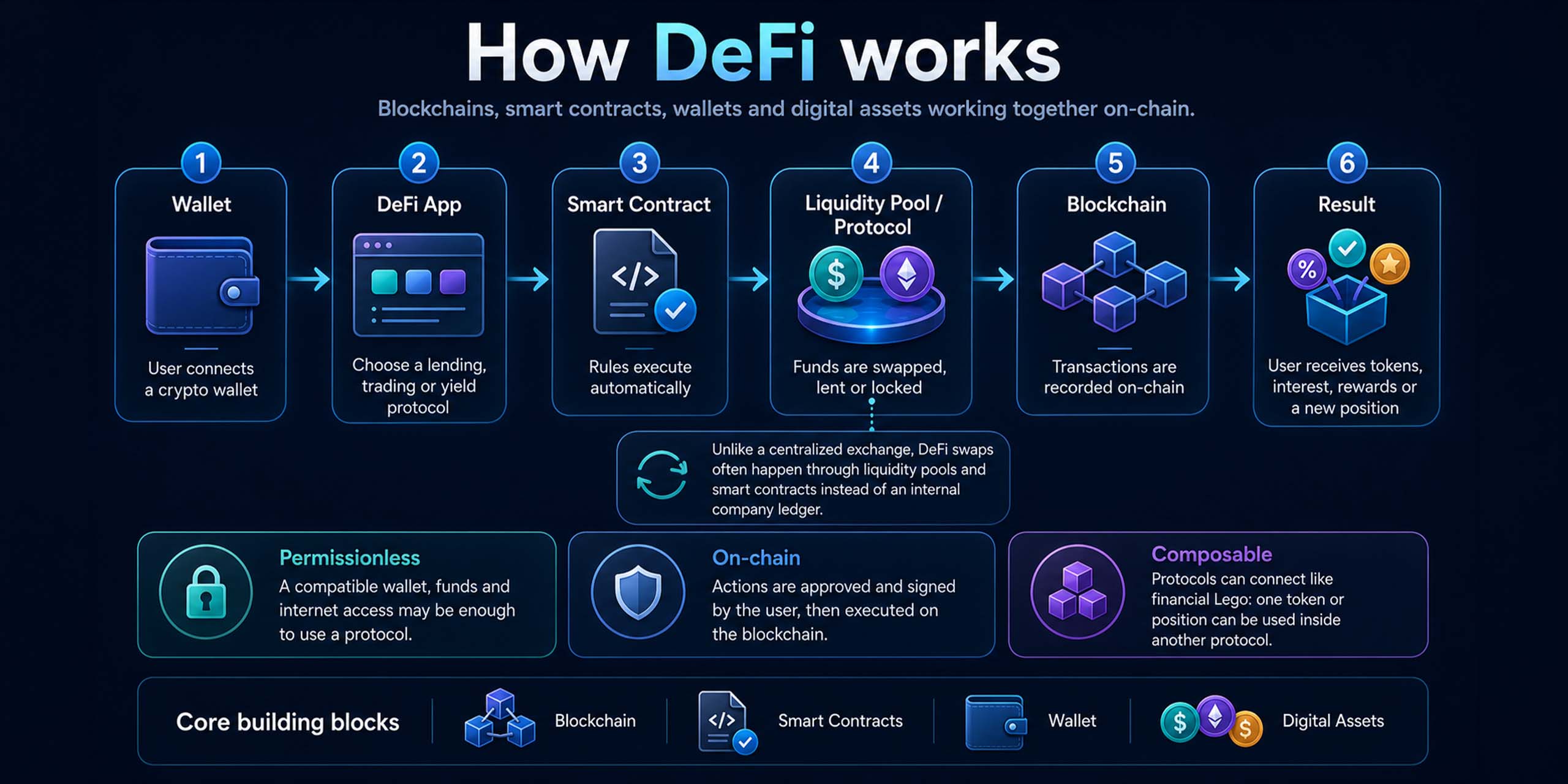
DeFi works by combining blockchains, smart contracts, crypto wallets and digital assets.
A blockchain provides the shared ledger. It records transactions and stores the state of DeFi protocols. A smart contract contains the rules. It can hold funds, calculate interest, swap tokens, enforce collateral requirements or distribute rewards. A wallet lets the user connect, approve and sign actions.
Imagine someone wants to trade one token for another. On a centralized exchange, the platform matches orders and updates balances inside its own system. In DeFi, the user may connect a wallet to a decentralized exchange, approve a transaction and swap through a liquidity pool. The transaction happens on-chain, and the wallet receives the new asset if everything works.
That design makes DeFi permissionless in a technical sense. A user does not necessarily need to open a brokerage account or ask a bank for approval. If they have a compatible wallet, funds and internet access, they can interact with the protocol.
It also makes DeFi composable. Protocols can plug into one another like financial Lego pieces. A token from one protocol can be used in another. A lending position can become collateral. A decentralized exchange can route trades through several pools. This is one of DeFi’s most creative features — and one of the reasons risks can spread quickly.
Why smart contracts matter in DeFi
A smart contract is a program that runs on a blockchain. In DeFi, smart contracts are the machinery behind financial products.
A lending protocol uses smart contracts to track deposits, loans, collateral and liquidations. A decentralized exchange uses smart contracts to manage liquidity pools and swaps. A yield aggregator uses smart contracts to move funds through strategies. A stablecoin protocol may use smart contracts to mint, burn or manage collateral.
The appeal is automation. Once deployed, a smart contract can execute rules without waiting for a human clerk, bank officer or platform moderator. If the conditions are met, the code runs.
The danger is also automation. If the code contains a bug, the bug can become financial reality. If a contract allows funds to be drained under certain conditions, the blockchain will not pause because the outcome feels unfair. A smart contract does not care that everyone is having a bad morning.
This is why audits, open-source code, battle testing and cautious design matter in DeFi. Even then, no audit is a magic shield. DeFi users are trusting code, incentives and the security assumptions around a protocol.
In traditional finance, users often trust institutions and legal systems. In DeFi, they also trust software. That can reduce some kinds of human discretion, but it introduces a different kind of fragility.
How wallets connect users to DeFi
A DeFi user usually starts with a wallet. The wallet holds or manages the private keys that control assets on-chain. It is the user’s access point to protocols.
When someone connects a wallet to a DeFi app, the app can read public information such as token balances and address activity. To actually move assets or approve a transaction, the user must sign with the wallet.
This is where DeFi feels different from a normal fintech app. There may be no username, password or account recovery controlled by the protocol. The wallet is the account. The user signs actions directly.
That can be liberating. It can also be unforgiving. If a user signs a malicious approval, connects to a fake website or sends funds to the wrong chain, there may be no support desk with a reversal button. The protocol may be decentralized, but the mistake is very personal.
Approvals deserve special attention. Many DeFi apps ask permission to spend a token from a wallet. A limited approval can be reasonable. A broad approval to a malicious contract can be dangerous. Beginners should learn to read wallet prompts before treating them like cookie banners.
In DeFi, the wallet is not just a storage tool. It is the remote control for financial software.
Decentralized exchanges and liquidity pools
One of the most important DeFi products is the decentralized exchange, or DEX. A DEX lets users trade crypto assets directly from their wallets through smart contracts.
Many DEXs use liquidity pools. Instead of relying on a traditional order book where buyers and sellers place bids and asks, users deposit pairs of tokens into pools. Traders swap against those pools. Liquidity providers earn fees, but they also take risk.
This model helped make DeFi explode because it allowed markets to appear quickly. A token did not need a centralized exchange listing to become tradable. If someone created a pool and users provided liquidity, trading could begin.
The downside is that openness does not equal safety. A scam token can have a liquidity pool. A fake version of a legitimate token can trade on a DEX. A pool can be thin, making prices easy to manipulate. A user can suffer from slippage, where the final execution price is worse than expected.
DEXs are one of DeFi’s clearest innovations. They are also a perfect example of the DeFi trade-off: fewer gatekeepers, more personal responsibility.
For a deeper breakdown of trading venues, see our guide to what a crypto exchange is.
DeFi lending and borrowing
DeFi lending protocols allow users to deposit crypto assets into pools that other users can borrow from. The system is managed by smart contracts rather than a traditional bank.
In many DeFi lending markets, borrowers must provide collateral. Because crypto prices can move sharply, the collateral is often worth more than the amount borrowed. If the collateral value falls too far, the position can be liquidated to protect lenders.
This is very different from walking into a bank and asking for a personal loan. DeFi lending is usually overcollateralized, automated and market-driven. The protocol does not care about your salary, credit score or charming handshake. It cares about collateral ratios and contract rules.
Lenders may earn interest because their assets are being used by borrowers. Borrowers may use loans to access liquidity without selling assets, increase exposure, short assets or build more complex strategies.
The risk is liquidation. If market prices move quickly, a borrower can lose collateral. Lenders also face protocol risk, smart contract risk and asset risk. A lending protocol can look calm until volatility turns it into a blender.
DeFi lending is useful, but it is not a free yield machine. It is a risk market.
Why stablecoins are central to DeFi
DeFi would be much harder to use without stablecoins. They provide a relatively stable unit of account inside a volatile ecosystem.
Traders use stablecoins to move between positions without leaving crypto rails. Lending protocols use them as borrowing assets. DEXs use them in liquidity pools. Payment apps use them for transfers. Many DeFi strategies depend on stablecoins because they make financial activity easier to price.
A dollar stablecoin can behave like programmable cash on a blockchain. That is extremely useful. It means users can trade, lend, borrow and settle value without constantly holding volatile assets.
But stablecoins bring their own risks. A stablecoin can lose its peg. An issuer can face banking or regulatory problems. A crypto-backed stablecoin can suffer from collateral stress. An algorithmic design can collapse if confidence breaks.
This is why DeFi risk is often layered. A user may think they are using a lending protocol, but they are also exposed to the stablecoin, the collateral, the oracle, the chain, the wallet and the smart contracts. DeFi stacks risks like pancakes. Delicious in theory, heavy in practice.
Yield farming, staking and rewards
One of the reasons DeFi became famous is yield. Users saw opportunities to earn returns by lending assets, providing liquidity, staking tokens or participating in incentive programs.
Yield farming usually means moving assets across DeFi protocols to earn rewards. A user might provide liquidity to a pool, receive a token representing that position, then deposit that token somewhere else to earn additional rewards. Sometimes this is clever. Sometimes it is a spreadsheet with anxiety.
Rewards can come from real usage, trading fees, borrowing demand or token incentives. The difference matters. Yield paid from actual protocol revenue is not the same as yield paid by printing more tokens. The second can work temporarily, but it may become dilution with better marketing.
Staking is related but not identical. In some contexts, staking helps secure a proof-of-stake blockchain. In other contexts, “staking” is used loosely to describe locking tokens in a protocol to earn rewards. Crypto vocabulary is not always helpful to the innocent.
Beginners should be skeptical of unusually high yields. A high percentage return is not a gift from the universe. It is usually compensation for risk, token inflation, low liquidity, leverage, smart contract exposure or a market that has not yet found the trapdoor.
In DeFi, yield is never just yield. It is a risk signal.
The risks beginners should understand
The first DeFi risk is smart contract failure. If a protocol has a bug or exploit, funds can be lost quickly. Public code helps scrutiny, but it also gives attackers something to study.
The second risk is oracle failure. Many protocols rely on price oracles to bring market prices on-chain. If an oracle is manipulated, delayed or poorly designed, a protocol can make bad financial decisions automatically.
The third risk is liquidity. A token may be easy to buy and hard to sell. A liquidity pool may look deep until stress hits. Slippage can turn a reasonable trade into a mistake.
The fourth risk is liquidation. Borrowers can lose collateral when prices move against them. In fast markets, liquidations can happen suddenly, especially when users are overleveraged.
The fifth risk is governance. A protocol may claim decentralization while a small group controls admin keys, governance votes or upgrade powers. “Community governed” sounds better than “a few whales can change your financial app,” but sometimes those are closer than people admit.
There are also bridge risks, stablecoin risks, wallet risks, phishing risks and regulatory risks. DeFi is not one risk. It is a pile of interlocking risks that can activate together.
The harsh but useful rule: if a DeFi product offers easy money, ask where the risk is hiding. It is always somewhere.
What people often misunderstand about DeFi
The first misunderstanding is that DeFi means no intermediaries. DeFi reduces or changes certain intermediaries, but it does not remove all dependence. Users may still rely on front-end websites, developers, validators, oracles, bridges, governance structures and infrastructure providers.
The second misunderstanding is that DeFi is always decentralized. Some protocols are meaningfully decentralized. Others are decentralized mostly in the brochure. Control can concentrate through token ownership, admin keys, hosted interfaces or development teams.
The third misunderstanding is that DeFi is private. Public blockchains are transparent. Wallet addresses may not show a legal name, but transaction histories can be analyzed. DeFi activity often leaves a very visible trail.
The fourth misunderstanding is that DeFi is safer because it is “just code.” Code can be inspected, but code can also be wrong. And even perfect code cannot protect users from bad assumptions, weak token design, market panic or signing malicious transactions.
The fifth misunderstanding is that traditional finance and DeFi are total opposites. In reality, they increasingly interact. Stablecoins depend on banks and reserves. Institutions study tokenized assets. Regulators watch DeFi risks. Crypto-native protocols still need real-world users, liquidity and legal context.
DeFi is not finance with the humans removed. It is finance with the humans moved to different layers.
What to Remember (FAQ)
What is DeFi in simple terms?
DeFi means decentralized finance: financial apps built on blockchains that let users trade, lend, borrow or earn yield through smart contracts instead of traditional intermediaries.
How does DeFi work?
DeFi works through smart contracts, crypto wallets and blockchain-based assets. Users connect a wallet, sign transactions and interact with protocols that execute financial rules on-chain.
What is DeFi used for?
DeFi is used for decentralized trading, lending, borrowing, stablecoin payments, liquidity provision, yield strategies, derivatives and other blockchain-based financial services.
Is DeFi the same as crypto?
No. Crypto is the broader ecosystem of digital assets and blockchain networks. DeFi is a specific part of crypto focused on financial services.
Is DeFi safe?
DeFi is risky. Users can lose money through smart contract bugs, hacks, liquidations, bad token design, phishing, stablecoin failures, poor liquidity or governance problems.
Do you need a wallet to use DeFi?
Yes, most DeFi apps require a crypto wallet. The wallet lets users connect to protocols, hold assets, sign transactions and manage permissions.
Sources: Ethereum.org DeFi, Bank for International Settlements, Financial Stability Board