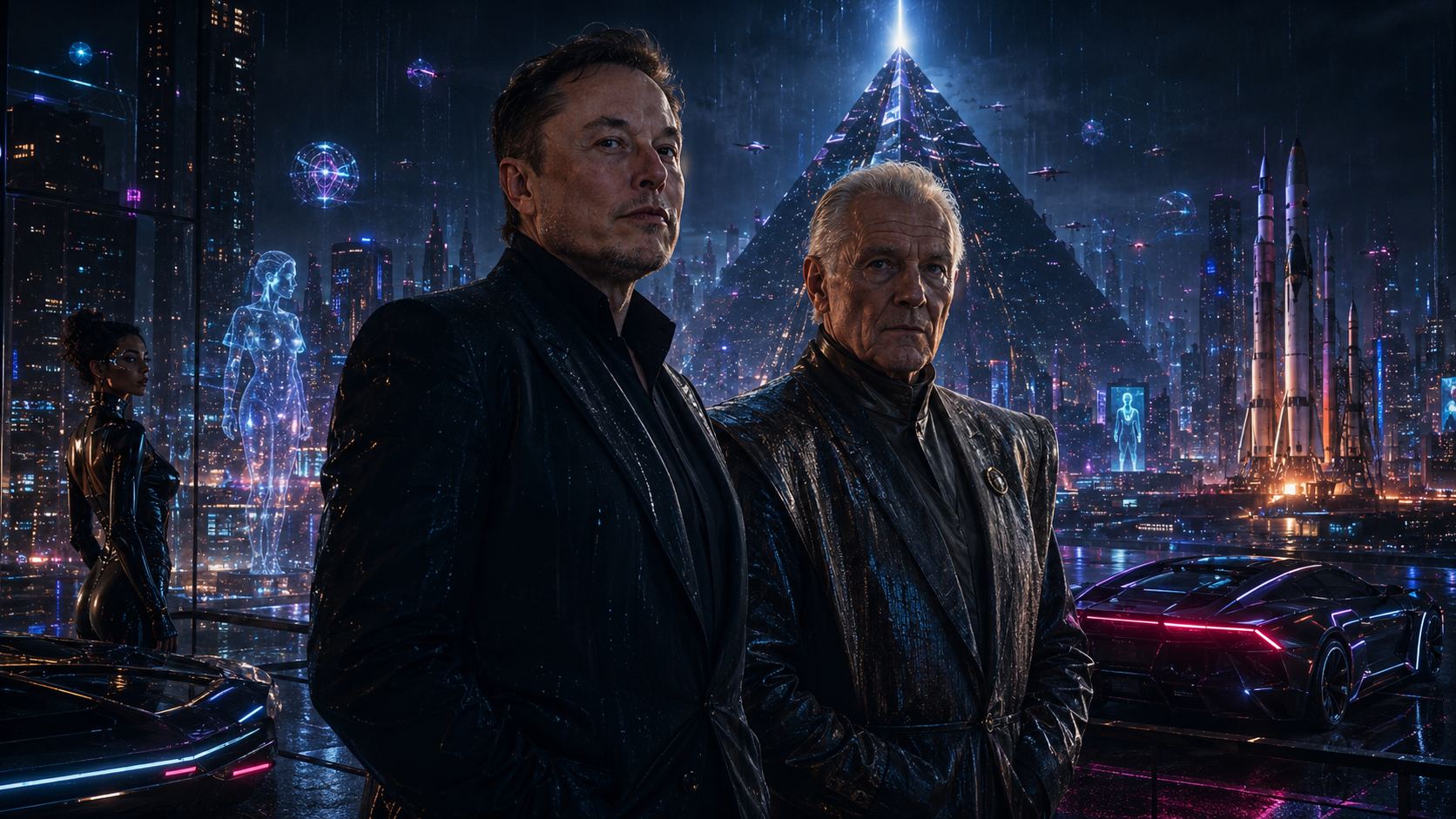
In Blade Runner, Eldon Tyrell is not simply a billionaire. He is the architect of a civilization.
His corporation manufactures the artificial workers that keep an entire economic system running. His monumental pyramid rises above Los Angeles like the headquarters of a new form of sovereignty. Tyrell is not elected. He is not accountable to the people living beneath him. He does not need to rule the world directly.
He only needs the world to depend on what he creates.
That is where the comparison with Elon Musk becomes interesting.
Musk is obviously not Tyrell. One is a real industrialist operating under laws, regulators, investors and governments; the other is a fictional corporate god living above a dystopian Los Angeles. Their personalities could hardly be more different, either. Tyrell is a quiet corporate pharaoh. Musk is a hyper-public executive whose announcements, arguments and memes unfold in real time.
But Blade Runner raises a question that feels increasingly contemporary: what happens when technologies essential to society are concentrated inside private empires moving faster than the institutions designed to oversee them?
Table of contents
- Eldon Tyrell and the power of dependency
- Musk is building infrastructure, not just products
- When companies become part of the operating system
- Blade Runner’s real warning: intelligence without wisdom
- The future nobody voted for
- Elon Musk and Eldon Tyrell: key questions
Eldon Tyrell and the power of dependency
The frightening thing about Eldon Tyrell is not that he behaves like a conventional dictator. He does not.
In Ridley Scott’s Blade Runner, the Tyrell Corporation produces replicants: bioengineered beings designed for dangerous and undesirable work, particularly in off-world colonies. Tyrell’s power comes from technological capability and from the economic system that has grown around his creations.
His headquarters makes the metaphor impossible to miss. The Tyrell complex towers over Los Angeles in gigantic pyramid-like structures, visually separating its creator from the crowded, polluted city below.
The architecture says everything.
Political leaders govern from institutions. Tyrell governs from infrastructure.
That distinction matters because infrastructure creates a different form of power. Governments can change. Elections can replace leaders. Laws can be rewritten. But once societies become dependent on technological systems, removing the companies behind them can become enormously difficult.
Tyrell does not need a crown.
Dependency is enough.
Musk is building infrastructure, not just products
This is where Musk becomes a particularly interesting real-world comparison — not because he is secretly a Blade Runner villain, but because the businesses associated with him increasingly operate across technologies that could shape how future societies function.
Tesla helped push electric vehicles from an automotive niche into a global industrial competition. Its ambitions have also expanded toward autonomous driving, robotics, batteries and energy systems.
SpaceX changed the economics and cadence of orbital launches while Starlink turned the company into a major satellite communications operator. That matters commercially, but it also has geopolitical consequences: satellite connectivity has become strategically important enough that governments increasingly think about access to space and communications infrastructure as questions of national resilience.
The comparison becomes even more striking when the pieces start converging.
In February 2026, SpaceX acquired xAI, bringing Musk’s space and artificial-intelligence ambitions under the same corporate structure. X had already been folded into xAI in 2025. The result is an increasingly interconnected ecosystem spanning rockets, satellites, communications, social media, artificial intelligence and computing infrastructure.
Then there is Neuralink, which is developing brain-computer interfaces and has moved into human trials.
Individually, each company operates in a different market.
Taken together, however, they form something much more unusual: a private technological ecosystem touching transportation, communications, space access, AI, digital discourse and potentially the interface between computers and the human brain.
Tyrell created replicants.
Musk’s companies are building pieces of the infrastructure around tomorrow’s humans.
When companies become part of the operating system
There is nothing inherently sinister about a private company building important infrastructure. Much of modern technological progress has emerged from private enterprise, and Musk’s companies have delivered genuine engineering achievements.
The more interesting issue is scale.
A car company sells vehicles. A telecommunications company sells connectivity. An aerospace company launches spacecraft. An AI company builds models.
But when ownership, leadership or strategic control across those layers begins to converge, the company — or network of companies — starts looking less like a collection of businesses and more like part of society’s technological operating system.
That creates questions that traditional antitrust and regulatory frameworks were not necessarily designed to answer.
What happens when the same private ecosystem can influence access to communications, artificial intelligence, orbital infrastructure and major digital platforms?
What happens when governments themselves become customers of technologies they are simultaneously expected to regulate?
And what happens when technological development moves faster than lawmakers can understand its consequences?
These questions extend far beyond Musk.
Amazon operates cloud infrastructure while participating in commerce, logistics, media and AI. Alphabet controls major layers of search, advertising, mobile software, video and artificial intelligence. Meta operates platforms that mediate communication for billions of people while building increasingly powerful AI systems.
The broader trend is what matters.
The most consequential companies of the 21st century increasingly do not merely sell products. They build environments in which other economic and social activity takes place.
That is a very different kind of corporate power.
Blade Runner’s real warning: intelligence without wisdom
Tyrell’s fatal flaw is not a lack of intelligence.
It is almost the opposite.
He is brilliant enough to manufacture beings virtually indistinguishable from humans. His creations can think, fight, remember, fear and desire. Some are superior to humans in strength and intelligence.
But technological capability has advanced beyond moral understanding.
The replicants do not remain simple products because they experience their own existence. Roy Batty does not confront his creator because the technology malfunctioned. He confronts him because the technology worked well enough to create something capable of understanding mortality.
Tyrell solved the engineering problem.
He did not solve the consequences.
That distinction may be Blade Runner‘s most useful lesson for the AI era.
Modern technology culture frequently asks whether something can be built. Can cars drive themselves? Can machines reason? Can neural signals control computers? Can thousands of satellites create a planetary communications network? Can AI systems perform increasingly complex intellectual work?
Those are engineering questions.
The harder questions begin afterward.
Who controls these systems? Who is responsible when they fail? What rights do users have? How dependent should governments become on private infrastructure? What happens when commercial incentives conflict with public interests? And who decides when deployment should slow down?
Technological intelligence does not automatically produce institutional wisdom.
The future nobody voted for
None of this means technological visionaries should stop building.
Civilization advances because people attempt things that established institutions consider unrealistic. Reusable rockets, mass-market electric vehicles and practical brain-computer interfaces all belong to categories that once sounded closer to science fiction than conventional industry.
The danger is not ambition itself.
The danger appears when the ability to imagine the future, finance it, build it and deploy it becomes concentrated in too few hands without equally capable systems of accountability.
Democratic institutions are deliberately slow. Engineering organizations can be extraordinarily fast. That mismatch is becoming one of the defining political problems of the technological century.
Regulation that moves too aggressively can suffocate useful innovation.
Regulation that moves too slowly can wake up one morning to discover that the infrastructure it hoped to regulate has become indispensable.
Blade Runner exaggerates that tension into dystopian science fiction, but the underlying question is no longer fictional.
How much of civilization’s technological architecture should depend on decisions made inside corporations?
And how much power should any individual accumulate simply because they are exceptionally effective at building things the rest of society comes to need?
Eldon Tyrell lived in a pyramid above the rain.
Elon Musk lives in the feed, the factory, the launchpad and the algorithm.
Different century.
Same warning: visionaries can move civilization forward. They can also drag it somewhere nobody voted to go.
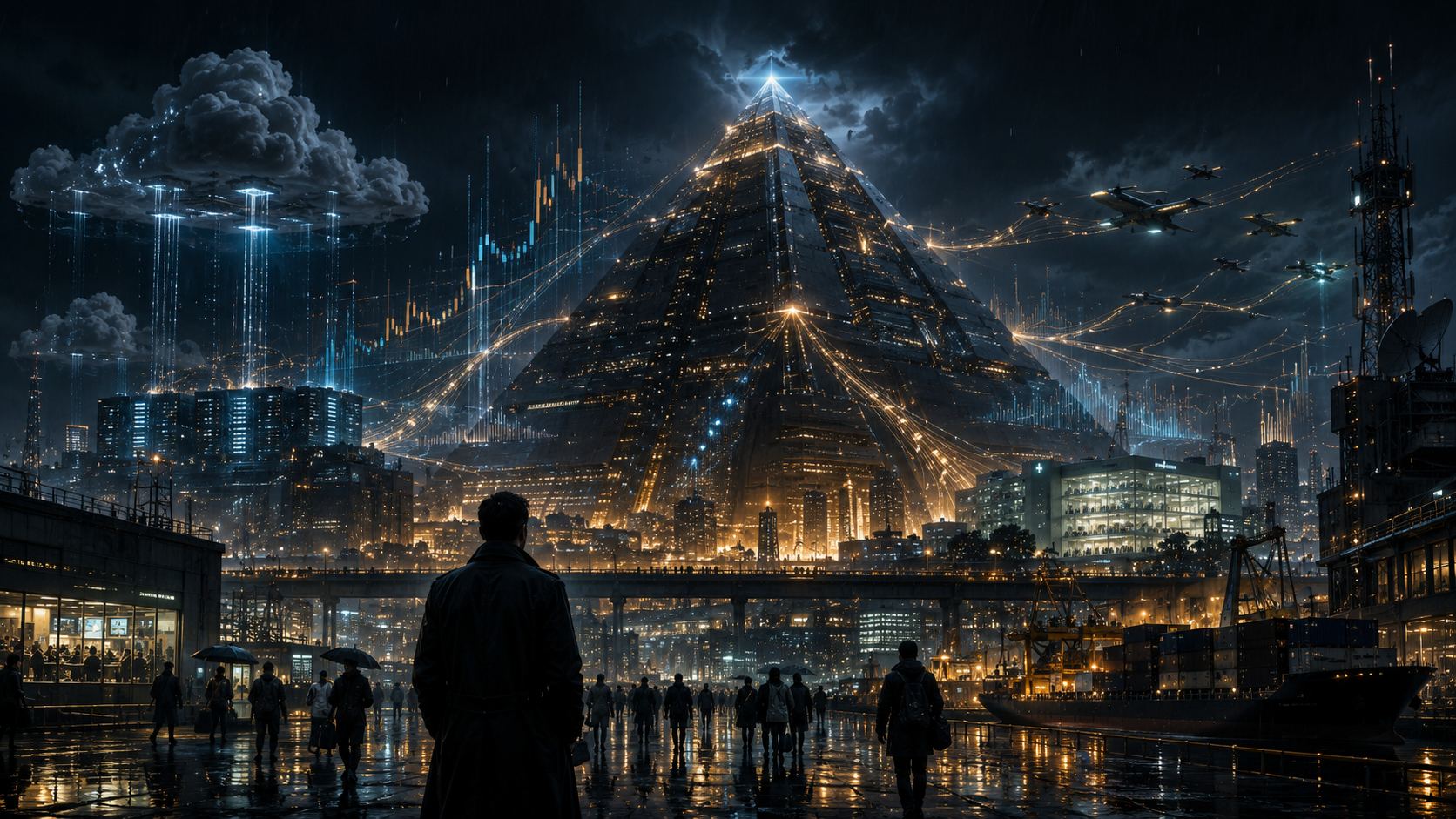
A Blade Runner-inspired vision of a world where Big Tech has become infrastructure, dependency, and systemic power.
Elon Musk and Eldon Tyrell: key questions
Is Elon Musk really comparable to Eldon Tyrell?
Only as a metaphor. Eldon Tyrell is a fictional character with extraordinary control over a dystopian economy, while Musk operates real companies within legal, regulatory and financial systems. The comparison is useful for examining technological dependency and concentrated private power, not for claiming the two are equivalent.
Why is the Tyrell Corporation so powerful in Blade Runner?
Tyrell Corporation manufactures replicants, bioengineered beings used as workers in the film’s off-world economy. Its enormous pyramid headquarters visually reinforces its economic and technological dominance.
Why does SpaceX matter to the comparison?
SpaceX operates launch infrastructure and the Starlink satellite network, giving it a role that extends beyond selling conventional consumer products. Space and satellite communications can have commercial, governmental and strategic importance.
Does Elon Musk still own separate AI and social media companies?
The structure has consolidated. X was absorbed by xAI in 2025, and SpaceX acquired xAI in February 2026, bringing AI, social media, space and satellite connectivity into a more integrated corporate ecosystem.
What does Neuralink add to the comparison?
Neuralink is developing brain-computer interfaces, moving Musk’s broader technological footprint toward direct interaction between human neural activity and computers. Its current medical ambitions should not be confused with the much more advanced technologies imagined in science fiction.
What is Blade Runner’s warning about technology?
One interpretation is that technological capability can advance faster than society’s ability to understand its ethical consequences. Tyrell can create extraordinary life, but he fails to fully reckon with the desires and suffering of what he has created.
Is the argument that private technology companies are bad?
No. Private companies have driven major technological advances. The issue is whether societies can maintain effective accountability when increasingly essential infrastructure is controlled by a small number of corporations or individuals.
What is the biggest difference between Musk and Tyrell?
Tyrell exists inside a deliberately dystopian fictional world and exercises a degree of corporate power far beyond what Musk possesses. Musk’s companies remain subject to governments, regulators, courts, competitors, investors and other institutional constraints.