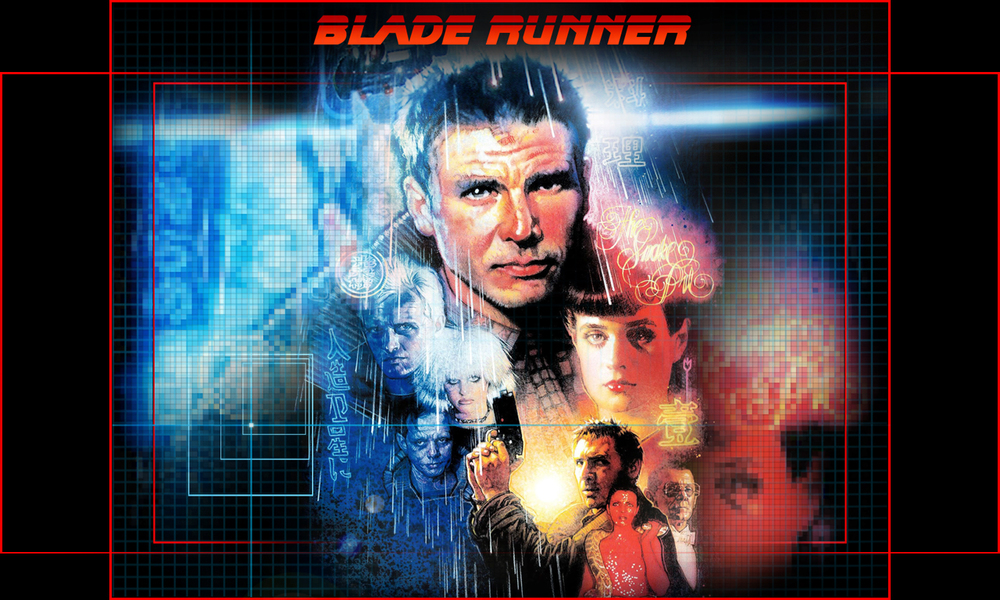
Ridley Scott’s noir masterpiece wasn’t just a great sci-fi film. It was a 40-year prophecy about AI, surveillance, megacorporations, and what it means to be human.
Table of contents
- Los Angeles, 2019. Sound familiar?
- Prophecy #1: AI that passes the Turing test
- Prophecy #2: The Tyrell Corporation predicted Big Tech perfectly
- Prophecy #3: Surveillance, identity, and the architecture of control
- Prophecy #4: Climate collapse as backdrop
- The Real Prophecy: The question it was really asking
- Blade Runner: key questions
Los Angeles, 2019. Sound familiar?
When Ridley Scott’s Blade Runner hit theaters in June 1982, most audiences were baffled. It bombed at the box office, got mixed reviews, and made Harrison Ford angrier than a replicant told to retire early. Critics found it cold, confusing, slow. The studio slapped on a voiceover to “help” audiences understand it. It didn’t help.
More than forty years later, Blade Runner feels less like a film and more like a leaked document from a timeline we accidentally walked into. Not because flying cars exist (they don’t, unfortunately) but because almost everything that mattered in that film has come true. The tech. The power structures. The existential dread. The corporations selling you your own humanity back at a premium.
So let’s break it down, prophecy by prophecy.
Prophecy #1: AI that passes the Turing test
The central tension of Blade Runner is built around the Voight-Kampff test: a psychological interview designed to distinguish replicants (bioengineered AIs) from humans by detecting micro-emotional responses. The horror of the film is that the test becomes increasingly unreliable. Roy Batty doesn’t just pass: he transcends. He composes poetry. He grieves. He spares a life.
In 1982, this was pure science fiction. Today, we have language models that write legal briefs, debug code, compose symphonies, and comfort people through grief. We have chatbots that millions of users form genuine emotional bonds with. We’ve had researchers publicly struggle to determine whether certain AI systems display something resembling distress. The Voight-Kampff test isn’t a sci-fi gimmick anymore, it’s literally what AI safety researchers argue about on arXiv every week.
“All those moments will be lost in time, like tears in rain.” — Roy Batty, Replicant, 2019
The film also anticipated the specific kind of AI anxiety we’re living through: not Terminator-style robot wars, but the quieter, more unsettling question of consciousness, rights, and moral consideration. Do replicants deserve freedom? Do they feel pain that matters? We’re asking the exact same questions about LLMs right now, and we’re not much closer to an answer than Deckard was.
Prophecy #2: The Tyrell Corporation predicted Big Tech perfectly
Eldon Tyrell runs a vertically integrated monopoly that manufactures life itself and operates above the law. His pyramid headquarters towers over Los Angeles. Governments don’t regulate him, they commission from him. He sells replicants to off-world colonies, controls their lifespan (literally, built-in four-year expiry), and frames their exploitation as opportunity: “More human than human” is his slogan, which is basically just an Apple keynote.
Replace “replicants” with “user data,” “attention,” or “algorithmic engagement” and you have a fairly accurate description of how a handful of tech companies have operated for the past decade. The Tyrell Corporation is Amazon, Meta, and OpenAI having a baby in a boardroom. It controls a resource so fundamental (intelligence, or the appearance of it) that the entire economy reorganizes around its product roadmap.
The film even nails the founder archetype. Tyrell is brilliant, detached, visionary, and utterly indifferent to the suffering his products cause. He genuinely believes he’s doing something magnificent. He’s not a villain twirling a mustache: he’s a guy who got very good at one thing and convinced himself that made him wise about everything. Sound like anyone you follow on X?
Prophecy #3: Surveillance, identity, and the architecture of control
The LA of Blade Runner is a city built around identification. Blade runners hunt replicants using biometrics. Every corner has a screen. Cameras are embedded in the urban fabric. The state, or rather, the corporation acting as the state, has near-total visibility into bodies moving through space.
We now live in cities with facial recognition cameras, predictive policing algorithms, always-on microphones, and location data that gets sold to data brokers and occasionally subpoenaed by governments. China’s social credit system looks remarkably like the off-world colony management that Blade Runner implies exists in the background. The UK has more CCTV cameras per capita than almost any country on Earth. And we carry the surveillance apparatus in our pockets voluntarily because it also plays podcasts.
More subtly: the film anticipated the identity crisis that surveillance creates. Rachael doesn’t know she’s a replicant. Her memories are implants. Her sense of self is engineered. We’re not there yet biologically. But algorithmically? The content you’ve been fed since you were a teenager online has shaped your preferences, politics, and self-image in ways you can’t fully audit. Your “authentic” taste in music, your “genuine” political views: how much of that is you, and how much is a Voight-Kampff test you passed without realizing you were taking it?
Prophecy #4: Climate collapse as backdrop
Nobody in Blade Runner ever says “climate change.” They don’t need to. The environment is just… gone. Acid rain falls constantly. No natural animals exist. The owl in Tyrell’s office is a fake, owning a real one is a status symbol for the ultra-rich. The earth is so depleted that the whole upper class has emigrated off-planet. The people left behind are the ones who couldn’t afford to leave.
That specific vision, environmental collapse creating a two-tier society where the wealthy escape and the poor inherit the wreckage, is no longer dystopian fiction. It’s the subject of serious academic literature on “climate gentrification,” on billionaires buying land in New Zealand, on how rising sea levels will hit low-income coastal communities first and hardest. The rich aren’t literally going off-world yet, but they are building bunkers, buying islands, and funding space companies while the rest of us sort recycling.
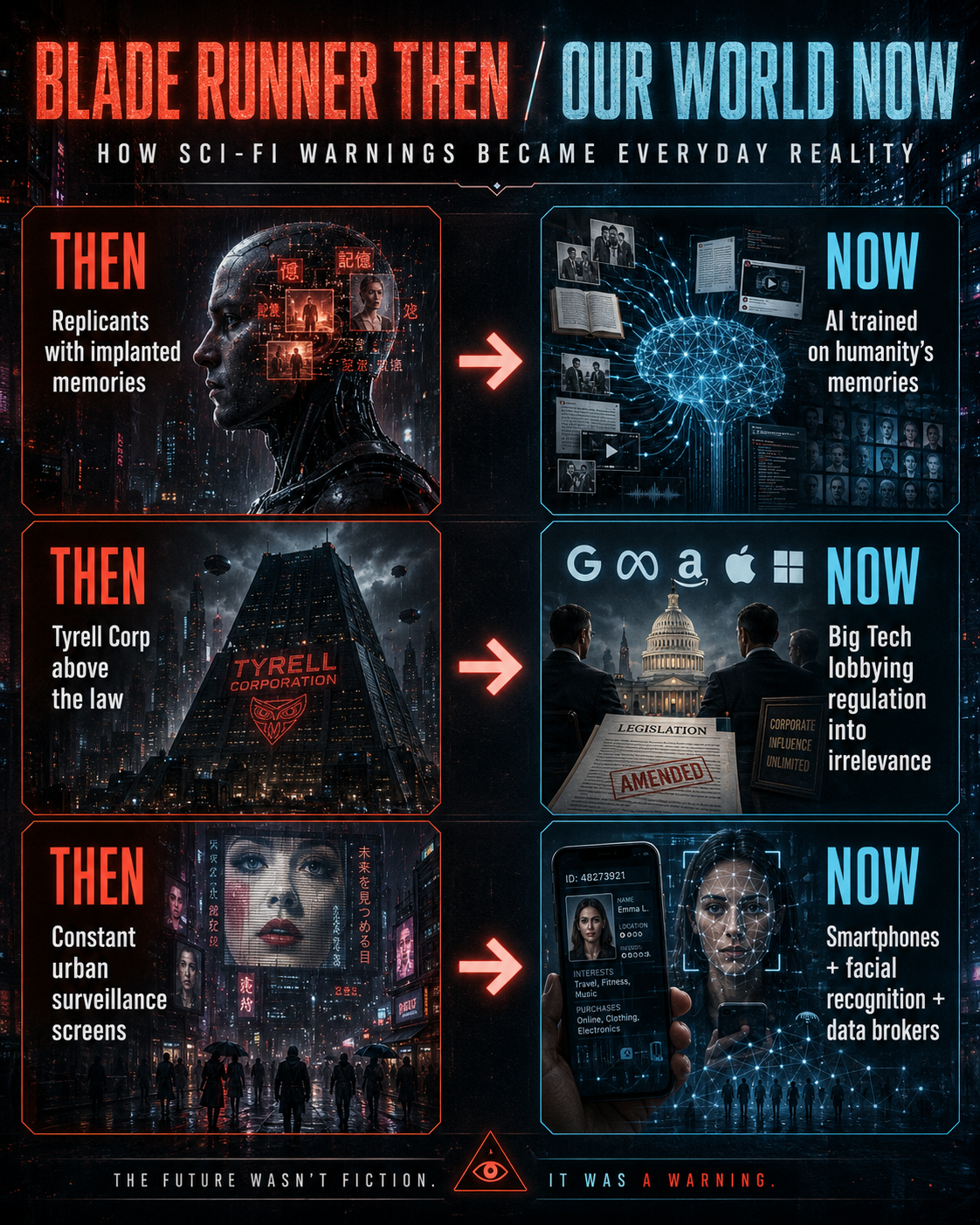
In 1982, Blade Runner imagined a future of artificial memories, untouchable megacorporations, and constant urban surveillance. In 2026, we have AI trained on humanity’s digital traces, Big Tech shaping the rules of the game, and pockets full of sensors, data, and facial recognition. Science fiction didn’t miss the timeline. It was just a few decades early.
The Real Prophecy: The question it was really asking
Here’s the thing about Blade Runner that makes it genuinely prescient rather than just accidentally lucky with its tech predictions: it was never really about technology. It was about what happens when humans create beings they can exploit, and then have to decide whether those beings deserve rights. It was about the moral gymnastics corporations perform to sell exploitation as progress. It was about what identity means when it can be manufactured and monetized.
We are living through that question right now, with AI systems that are trained on human creativity without consent, that perform emotions to maximize engagement, and that are being deployed faster than any ethical framework can catch up. We have no Blade Runners. We have no Voight-Kampff test. We have Senate hearings where elderly legislators ask Facebook executives how their business model works and everyone just kind of accepts that nothing will change.
Roy Batty’s final monologue — “all those moments will be lost in time, like tears in rain” — wasn’t just poetic. It was a warning about what we lose when we build intelligence without wisdom, power without accountability, and progress without asking who, exactly, it’s progressing toward.
Blade Runner didn’t predict the future. It diagnosed the present we were already building, forty years before we arrived.
Philip K. Dick, who wrote the source novel Do Androids Dream of Electric Sheep? in 1968, spent his entire career asking one question: what does it mean to be human in a world that manufactures humanity? He died in March 1982, just months before the film adaptation was released, never seeing the cultural monument his paranoid, visionary prose would become. But he had already seen enough, enough of corporate power, of identity erosion, of systems that simulate empathy while practicing control, to know that the android wasn’t the threat. We were.
Deckard might be a replicant. You might be living in a simulation. Either way: it’s raining.
Blade Runner: key questions
When was Blade Runner released?
Blade Runner was released in June 1982.
Who directed Blade Runner?
Blade Runner was directed by Ridley Scott.
What novel is Blade Runner based on?
Blade Runner is based on Philip K. Dick’s 1968 novel Do Androids Dream of Electric Sheep?.
What is the Voight-Kampff test?
The Voight-Kampff test is a fictional psychological test used in Blade Runner to distinguish replicants from humans by measuring emotional responses.
Why is Blade Runner still relevant today?
Blade Runner remains relevant because it explores artificial intelligence, corporate power, surveillance, manufactured identity, environmental collapse, and the question of what makes someone human.
What does “more human than human” mean?
“More human than human” is the slogan of the Tyrell Corporation. In the film, it reflects the idea that artificial beings can imitate or even surpass human qualities.
Why is Roy Batty’s final monologue so famous?
Roy Batty’s final monologue is famous because it turns a supposed artificial being into one of the most emotionally human characters in the film, capturing memory, mortality, and loss in a few lines.