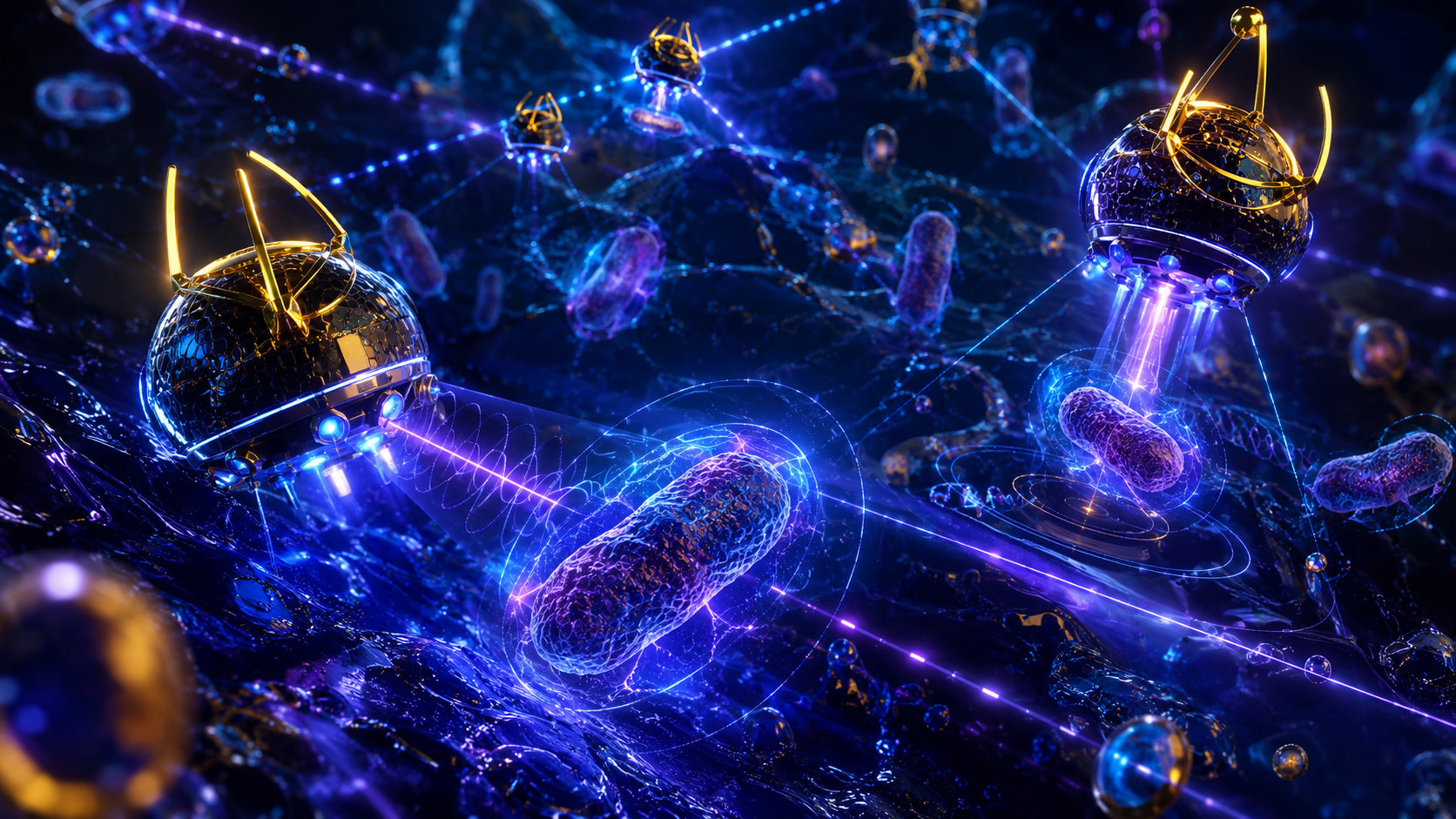
Tiny robots, big sci-fi energy. Researchers at Julius-Maximilians-Universität Würzburg in Germany have demonstrated light-driven nanorobots smaller than one micrometer that can locate, capture, transport, and release bacteria in liquid environments.
That sounds like the opening scene of a very nerdy medical thriller, but the work is real. Published in Nature Communications, the study shows how nanorobots powered and steered by light can act as microscopic cleaners, manipulating bacteria with impressive control and without batteries, onboard fuel, or chemical propulsion.
The breakthrough is not a tiny Terminator for infections. Not yet. But it does point toward a future where researchers could manipulate microbes with far more precision, clean targeted bacterial biofilms, or build the foundations for highly localized antimicrobial tools.
Table of contents
- What the researchers built
- How light controls the nanorobots
- Capturing bacteria without a claw
- Why this matters for microbiology
- Not ready for the clinic yet
- Nanorobots: key questions
What the researchers built
The Würzburg team designed sub-micrometer nanorobots, meaning machines smaller than one millionth of a meter. According to the university, they are roughly 50 times smaller than the diameter of a human hair.
At that scale, moving through liquid is not like driving a tiny submarine. Brownian motion, drag, heat, and weak optical forces all become part of the game. The achievement here is that the researchers managed to make these devices controllable enough to perform useful tasks around living biological objects.
In the lab, the nanorobots were tested with model bacteria including Escherichia coli and Staphylococcus carnosus. They were able to capture bacteria, carry them across a defined area, assemble groups of bacteria, and release them at selected locations.
That is the key point: this is not just movement. It is robotic manipulation at a scale where human tools are laughably oversized.
How light controls the nanorobots
The nanorobots are driven by light using plasmonic nanoantennas made from gold. These tiny gold structures interact with a laser beam and convert optical input into controlled motion.
The system uses an unfocused laser beam rather than a tightly focused optical tweezer. By changing the polarization state of the light, the researchers can steer the robot, adjust its orientation, and guide it along specific trajectories. In the paper, the team reports speeds of up to 50 micrometers per second.
That may sound slow, but at sub-micrometer scale it is fast enough to matter. Imagine a device smaller than a bacterium moving dozens of body lengths per second while being controlled remotely by light. That is less “tiny toy car” and more “programmable physics bug.”
The design also solves a classic nano-scale headache: keeping the robot oriented. At this size, random rotational motion can wreck precision. The researchers used the optical response of the plasmonic motor to provide both propulsion and orientation control, helping the nanorobot stay aligned while it moves.
Capturing bacteria without a claw
These nanorobots do not grab bacteria with mechanical claws. Instead, they use gentle opto-thermophoretic forces.
In plain English, the illuminated nanostructure creates a local thermal and optical environment that can attract nearby bacteria. The robot can then pull a bacterium along, transport it, and release it when the light is switched off or adjusted.
That capture-transport-release cycle is the real magic trick. The researchers showed that nanorobots could sweep defined regions and collect bacterial targets, effectively behaving like light-driven robotic cleaners.
The approach is elegant because the “command system” is external. There is no onboard processor, no microscopic battery pack, and no chemical fuel tank. The laser acts as both power source and steering wheel.
Why this matters for microbiology
Microbiology often deals with objects that are alive, mobile, fragile, and very small. Manipulating individual bacteria or bacterial clusters in liquid is difficult, especially when researchers want precision without damaging the sample.
A light-controlled nanorobot platform could give scientists a new way to interact with microorganisms directly. Possible research uses include arranging bacteria for observation, isolating targets in complex samples, studying microbial interactions, or cleaning specific zones in a controlled environment.
The biofilm angle is especially interesting. Bacterial biofilms are structured communities that can be hard to remove and highly relevant in medicine, industry, and research. A future version of this technology could, in theory, help remove or reorganize bacteria in very specific locations rather than blasting an entire area with chemicals.
That does not mean hospital nanobots are around the corner. But as a platform for precision microbiology, this is a serious step forward.
Not ready for the clinic yet
The obvious temptation is to jump straight to futuristic antimicrobial therapies. Light-guided nanorobots swimming through the body and cleaning infections sounds like a blockbuster pitch.
Reality is more complicated.
The current work is a laboratory demonstration. Turning this into a medical tool would require huge progress on safety, biocompatibility, control in complex biological environments, immune response, targeting, light delivery inside tissue, manufacturing, and regulatory approval.
Still, the proof of principle matters. The researchers have shown that sub-micrometer machines can be powered by light, steered with precision, and used to manipulate bacteria in liquid. That is a meaningful foundation for future work in nanotechnology, biomedical research, and localized sensing.
The most exciting part may be the simplicity of the control concept. No fuel. No onboard electronics. Just smart nanostructures, gold plasmonic antennas, and carefully tuned light.
Sometimes the smallest machines need the cleanest interface: shine, steer, grab, release.
Nanorobots: key questions
What did the Würzburg researchers create?
They created light-driven nanorobots smaller than one micrometer that can capture, transport, and release bacteria in liquid environments.
How are the nanorobots powered?
They are powered and steered by laser light interacting with gold plasmonic nanoantennas built into the robot structure.
How fast can these nanorobots move?
The study reports propulsion speeds of up to 50 micrometers per second.
Do the nanorobots physically grab bacteria?
Not with mechanical claws. They use opto-thermophoretic forces to attract and hold nearby bacteria, then release them by changing or switching off the light.
Could this become a medical treatment?
Possibly in the long term, but the current work is a laboratory proof of concept. Clinical use would require major additional research on safety, control, biocompatibility, and delivery.
Why is this important?
It gives scientists a new way to manipulate bacteria with high precision, which could help microbiology research, biofilm studies, localized sensing, and future antimicrobial technologies.