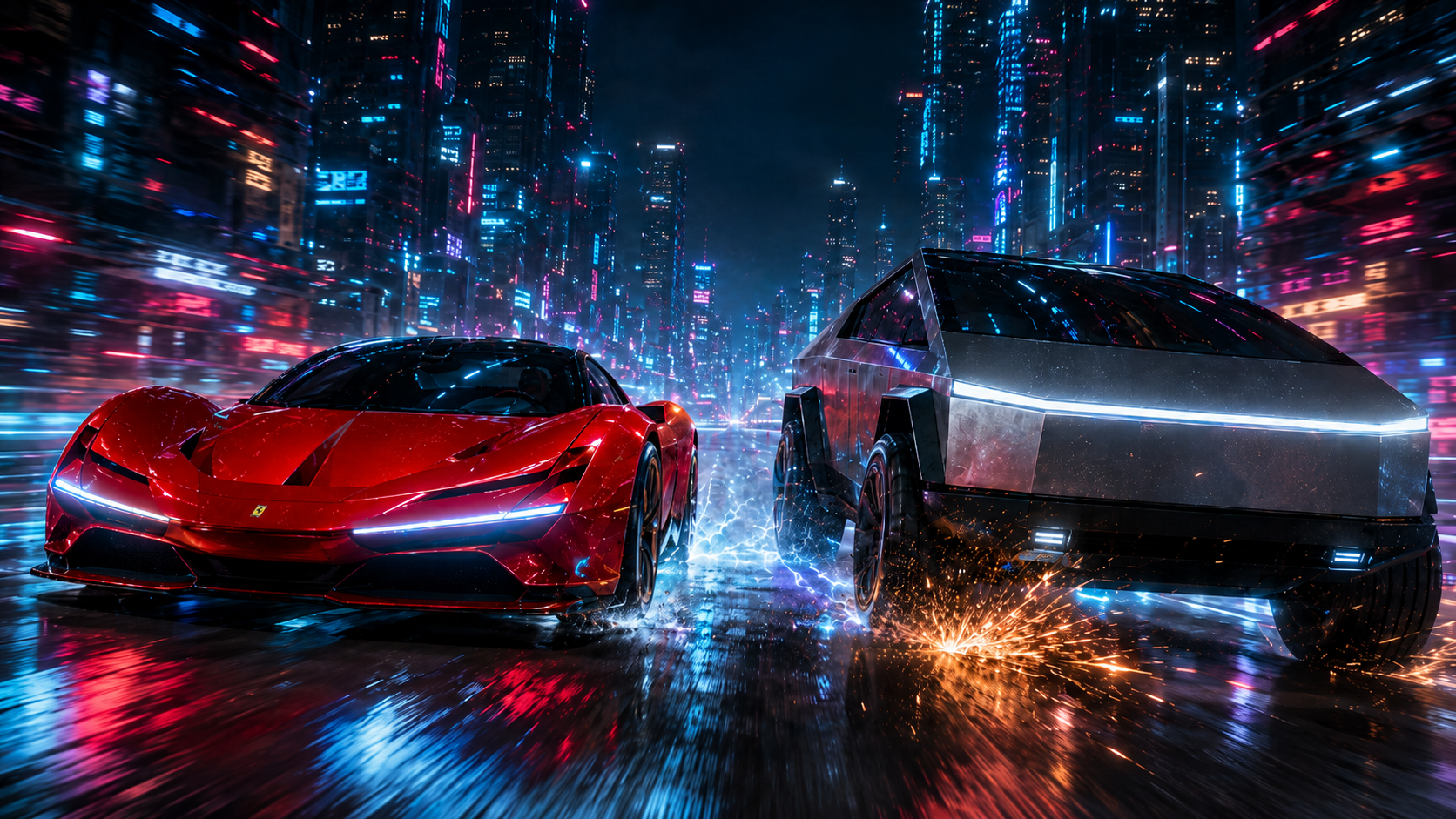
Ferrari has entered the electric chat, and it did not arrive quietly. It arrived like a Batmobile ordered through a Cyberpunk 2077 character creator by someone whose net worth has commas in places most people never see.
The car is the Luce, Ferrari’s first all-electric model: a reported $640,000, five-seat, four-door EV designed with input from Jony Ive’s LoveFrom studio. It is not just a car launch. It is a cultural grenade rolled into the intersection of supercar mythology, luxury pricing, electric mobility, investor anxiety, and internet ridicule.
According to Reuters, Ferrari’s Milan-listed shares fell 8.4% after the reveal, while its New York-listed shares dropped 5.1%. The backlash was not limited to anonymous accounts roasting the design from behind anime avatars. Criticism also reportedly came from Italian Deputy Prime Minister Matteo Salvini and former Ferrari chairman Luca Cordero di Montezemolo.
CEO Benedetto Vigna has defended the price as fair for the innovation Ferrari is putting on the road. That may be true. It may also be exactly the kind of line that makes the internet reach for the flamethrower.
Table of contents
- The supercar boss fight
- When innovation meets sticker shock
- Ferrari versus the EV multiverse
- The brand armor problem
- Luxury tech’s next test
- So what?
- Ferrari Luce EV: key questions
The supercar boss fight
The image is almost too absurd to be real: a $640,000 electric Ferrari, with room for five, rolling into a market where mainstream EV demand is wobbling, Tesla’s cultural dominance has become complicated, Porsche has learned that not every electric halo car gets infinite applause, and luxury buyers are still trying to decide whether silent speed counts as soul.
Ferrari is not launching an electric appliance. It is launching an argument.
The Luce asks Ferrari fans to accept a new kind of fantasy. Not the old fantasy of a red V12 machine screaming through an Alpine tunnel like a mechanical opera. This is a different script: instant torque, software-shaped performance, minimalist design language, advanced electric architecture, and enough status radiation to light up a Monaco valet stand from orbit.
That is why the reaction matters. A Ferrari EV was always going to be controversial. But a Ferrari EV that looks less like a traditional supercar and more like a luxury sci-fi family pod was guaranteed to trigger the boss fight.
Supercar loyalists do not only buy speed. They buy theater. They buy smell, vibration, noise, danger, ritual, and the sense that the machine exists for a purpose more romantic than school pickup. A five-seat electric Ferrari challenges that code. It says the future of Maranello may include practicality, digital calm, and a powertrain that does not announce itself with combustion thunder.
To some buyers, that is progress. To others, it sounds like someone installed a productivity app on the Batmobile.
When innovation meets sticker shock
The first mistake in reading the Luce is treating its price like a normal EV price. Nobody is cross-shopping a $640,000 Ferrari against a Model Y because they need to optimize total cost of ownership.
At this level, the battery is only one line item. The real price includes brand permission, scarcity, engineering, design risk, software, performance, personalization, and the emotional tax of owning the first electric chapter in Ferrari history.
Ferrari has spent decades mastering one of the strongest business models in the auto industry: sell fewer cars than the market wants, protect margins, and make ownership feel like access to a private mythology. That is not just marketing. It is financial engineering with leather seats.
The Luce’s price is therefore not simply “what the car costs.” It is Ferrari saying: our badge survives the powertrain shift, and you will pay to be early.
From the company’s point of view, that logic is rational. High-end EV development is expensive. A new electric platform, new battery integration, new sound philosophy, new design language, and new manufacturing demands all cost money. Ferrari cannot behave like a mass-market EV maker chasing volume and tax credits. Its entire business depends on not looking desperate.
But public perception does not run on spreadsheet logic.
To the wider internet, $640,000 for an electric five-seater invites mockery because EVs have already been culturally coded in two conflicting ways: as futuristic performance machines and as expensive gadgets that depreciate like cursed loot. A Ferrari badge can elevate that story, but it cannot erase the fact that many people now associate EVs with software glitches, charging anxiety, resale uncertainty, political trench warfare, and design sameness.
That is the trap. Ferrari wants the Luce to be read as innovation. Critics are reading it as hubris.
Ferrari versus the EV multiverse
Ferrari is not entering an empty arena. It is entering the EV multiverse, where every brand has already chosen a different superpower and a different weakness.
Tesla built the modern EV myth around software, acceleration, charging infrastructure, and Silicon Valley disruption. Its early cars made electric performance feel like a cheat code. But Tesla also turned the car into a tech platform, and tech platforms age brutally. The company’s challenge now is not proving EVs can be fast. It is proving the brand still feels fresh, aspirational, and coherent in a more crowded market.
Porsche took a more traditional route with the Taycan: make an electric car that still feels like a Porsche. The Taycan helped legitimize premium EV performance, but it also exposed the difficulty of keeping demand hot once the novelty fades and the broader EV market cools. Porsche could speak to driving credibility. Ferrari has to speak to mythology.
Lucid represents another branch of the tree: extreme efficiency, huge range, elegant engineering, and a luxury-tech pitch aimed at buyers who want the anti-Tesla. It is impressive, but it does not have Ferrari’s century-deep emotional archive. Lucid can sell futuristic competence. Ferrari has to sell desire.
Then there are the ultra-premium and luxury players around the edges: Rolls-Royce with the Spectre, Mercedes with EQ models, BMW with electric flagships, and a wave of Chinese premium EV brands pushing screens, speed, and executive-lounge interiors at aggressive pace. The problem for Ferrari is that the technical battlefield is no longer exclusive. EV performance is weirdly democratic. A family sedan can now produce acceleration numbers that once belonged to bedroom posters.
That means Ferrari cannot win by saying “our EV is fast.” Of course it is fast. In 2026, speed alone is not the dragon. The dragon is meaning.
The Luce has to answer a harder question: what does Ferrari become when silence replaces the scream?
The brand armor problem
Luxury brands can survive absurd prices. In fact, absurdity is part of the machine. A six-figure handbag, a seven-figure watch auction, a yacht with a garage for a smaller yacht — the point is not rational utility. The point is symbolic power.
But luxury brands cannot survive ridicule as easily.
Ridicule is different from criticism. Criticism says the product may be flawed. Ridicule says the fantasy has collapsed. For a brand like Ferrari, that is dangerous because the fantasy is the asset.
This is why the Luce backlash has bite. The harshest reactions are not merely saying “too expensive” or “too electric.” They are saying the car does not look or feel like the dream people associate with Ferrari. Once that frame takes hold, the company loses control of the narrative. The vehicle stops being a bold technological leap and becomes a meme with a finance department.
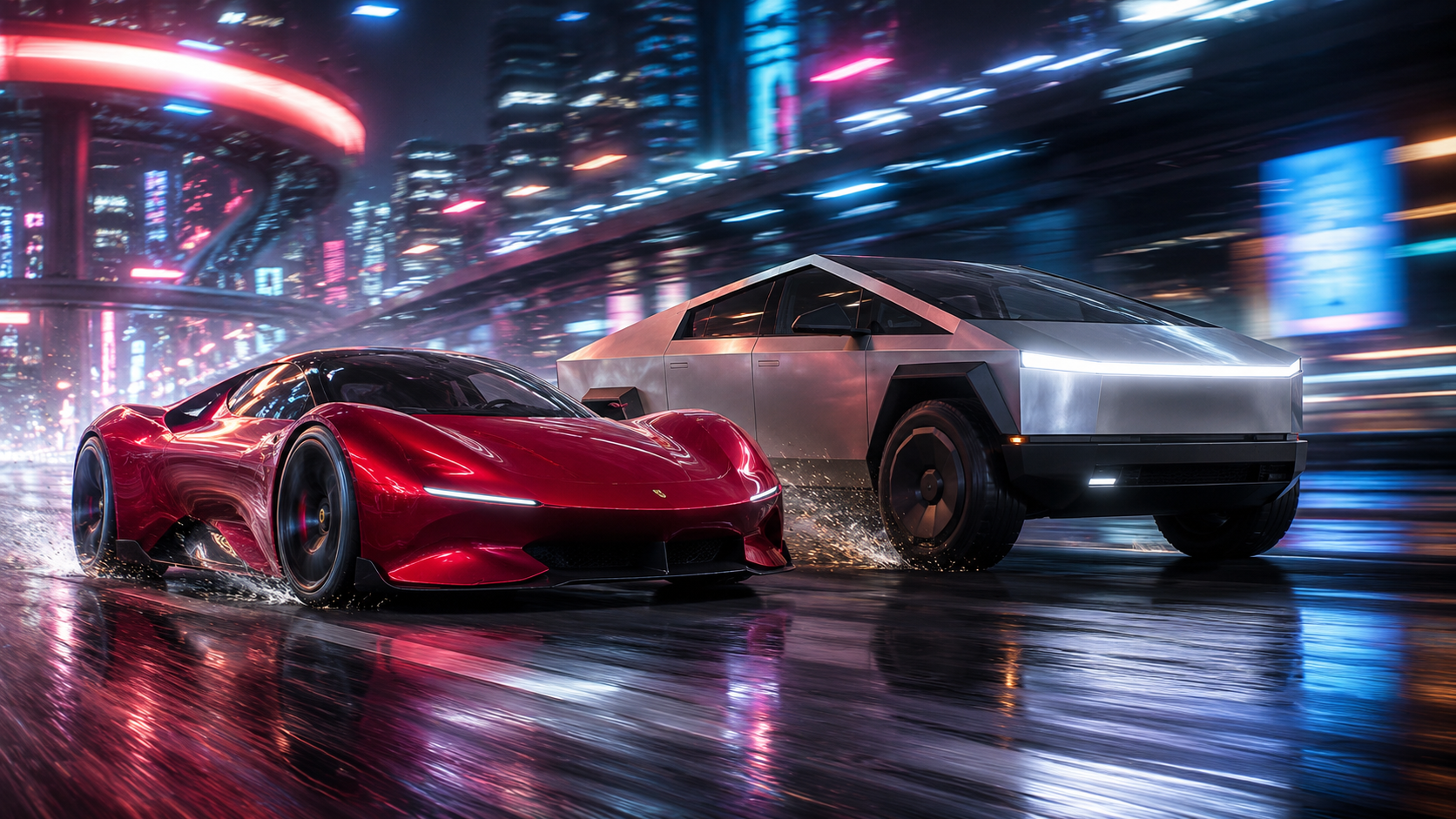
Tesla knows this territory well. The Cybertruck was not just a pickup. It was a rolling ideology: brutalist, polarizing, overexposed, impossible to ignore. To fans, it was the future refusing to ask permission. To critics, it was a stainless-steel punchline. The Luce is obviously a very different object, aimed at a very different buyer, but the cultural mechanism is similar.
Both vehicles ask customers to accept that futuristic design may look strange before it looks iconic. Both rely on brand believers to translate shock into status. Both risk discovering that “different” and “desirable” are not synonyms.
Ferrari’s advantage is that its customer base is smaller, richer, and more loyal. Its production discipline gives it a buffer Tesla does not have in the same way. If Ferrari only needs a limited number of buyers, internet outrage may not matter much at the order-book level.
But brand sentiment does matter over time. Ferrari is not just selling units. It is maintaining a valuation premium built on pricing power, scarcity, heritage, and confidence that the company knows exactly what it is doing.
The Luce tests that confidence.
Luxury tech’s next test
The next phase of luxury EVs will not be won by range charts alone. It will be won by narrative control.
For mainstream buyers, the EV conversation often revolves around price, charging, incentives, reliability, and resale value. For luxury buyers, those questions do not disappear, but they are filtered through status. Does the car make me feel ahead of the curve, or like I bought a compliance experiment? Does it feel like a future collectible, or like a very expensive beta test? Does it enhance the brand’s aura, or drain it?
Ferrari has a narrow path. It must make electrification feel inevitable without making combustion feel obsolete. It must make the Luce feel new without making the old Ferrari dream feel embarrassing. It must attract younger, tech-forward, globally wealthy buyers without alienating the purists who still define the brand’s emotional core.
That is harder than building a fast EV.
The Luce may ultimately work. The most mocked luxury products are sometimes the ones that become status objects once enough influential people start using them. A strange Ferrari parked outside the right hotel can change the conversation faster than a thousand comment threads. Scarcity has a way of sanding down public outrage.
But the risk is real. The EV market is no longer riding the same easy hype cycle. Investors are more skeptical. Buyers are more selective. Governments are adjusting timelines. Automakers are walking back aggressive electric targets. In that context, Ferrari’s first full EV is not launching into a clean future. It is launching into a battlefield covered in charging cables, culture-war shrapnel, and quarterly earnings pressure.
The Luce is not just Ferrari’s electric car. It is Ferrari asking whether its brand can bend reality one more time.
So what?
For readers, the Luce is worth watching because it shows where the EV story goes after the mass-market gold rush. The first wave was about proving electric cars could be fast, viable, and desirable. The next wave is about whether elite brands can make electric power feel emotionally irreplaceable, not merely technically impressive.
For investors, the checklist is sharper.
Watch order demand. If Ferrari can turn outrage into a full book of wealthy buyers, the backlash becomes noise. If demand looks thinner than expected, the Luce becomes a warning sign.
Watch margins. Ferrari’s valuation depends heavily on pricing power and profitability. An expensive EV that protects margins is a flex. One that requires too much investment for too little return is a problem.
Watch brand sentiment. Ferrari can survive people being angry. It should worry if people start laughing for the wrong reasons.
Watch luxury EV adoption. The ultra-rich do buy electric cars, but they do not automatically want electric versions of every fantasy. Ferrari has to prove that an EV can be a trophy, not a compromise.
Most of all, watch whether Ferrari can make electrification feel desirable rather than defensive. The Luce cannot feel like a regulatory homework assignment with a famous badge. It has to feel like the next poster on the wall.
Because at $640,000, “trust the badge” is not enough. The fantasy has to boot up.
Ferrari’s $640K EV Just Turned Luxury Into a Stress Test
Ferrari Luce EV: key questions
What is the Ferrari Luce?
The Luce is Ferrari’s first all-electric model, reportedly a five-seat, four-door luxury EV priced around $640,000.
Why is the Ferrari Luce controversial?
The controversy comes from its high price, electric powertrain, unconventional design, and the perception that it moves away from Ferrari’s traditional supercar identity.
How did investors react to the Ferrari Luce reveal?
Ferrari shares fell after the reveal, with Reuters reporting an 8.4% drop for Milan-listed shares and a 5.1% decline for New York-listed shares.
Is the Ferrari Luce competing with Tesla?
Not directly on price or audience. But culturally, it competes in the same EV conversation around technology, status, design, and whether electric cars can create desire beyond acceleration numbers.
Why compare the Luce to the Cybertruck?
Like Tesla’s Cybertruck, the Luce is polarizing, expensive in its own category, visually divisive, and built around the idea that futuristic design can become status if enough believers buy in.
Is this financial advice?
No. This article is for editorial and informational purposes only. It is not financial advice, investment guidance, or a recommendation to buy or sell Ferrari stock.