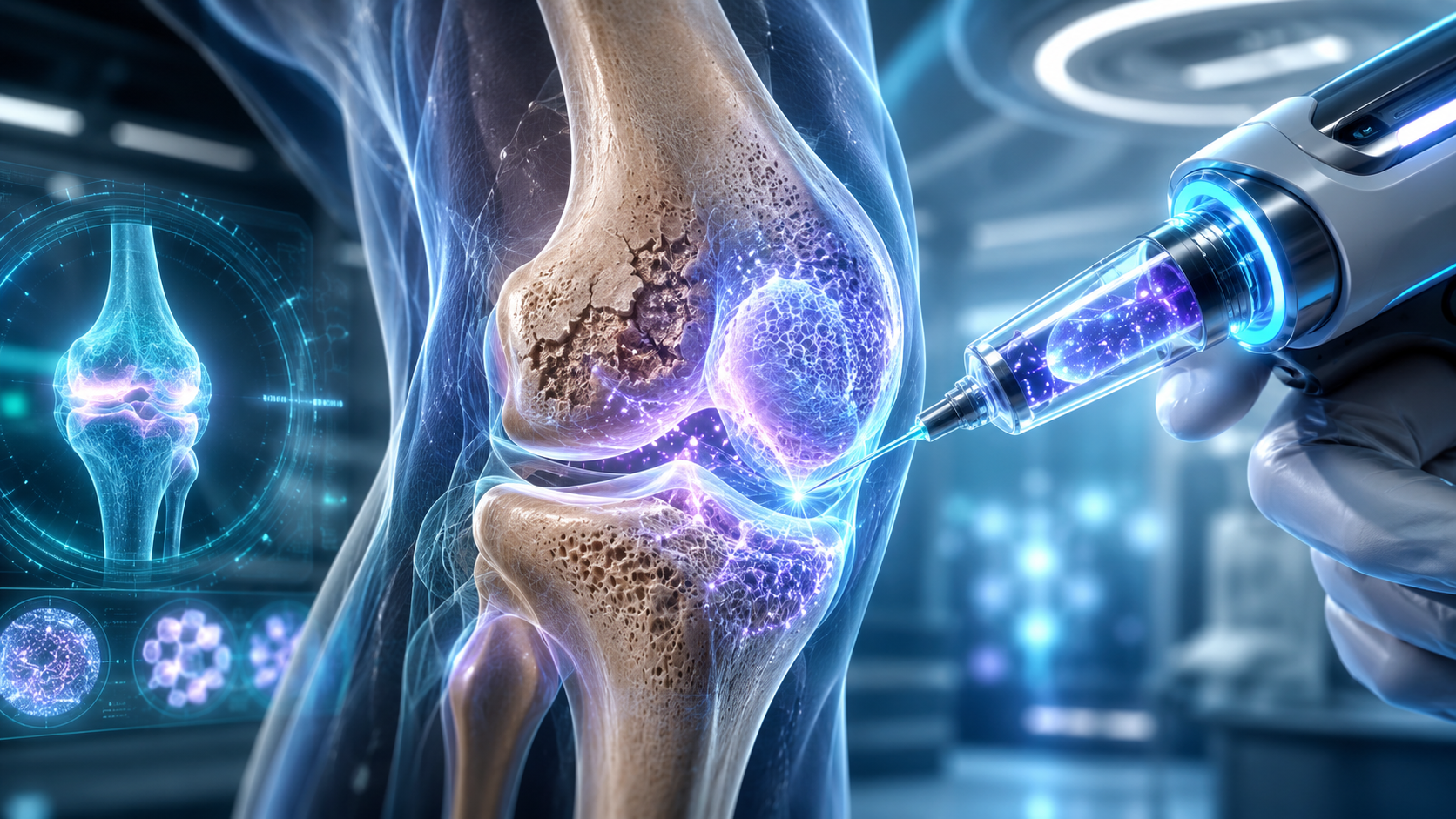
Osteoarthritis is usually treated like a one-way street: manage the pain, slow the damage, replace the joint if things get bad enough. But what if the real endgame was not just relief, but repair?
That is the promise behind a new experimental approach led by researchers at the University of Colorado Boulder. In animal studies, the team says a single regenerative injection helped damaged joints rebuild cartilage and bone, returning osteoarthritic tissue to a near-normal state within four to eight weeks.
No, this is not a cure available at your local clinic. Human trials have not started yet. But for a disease affecting hundreds of millions of people worldwide, even a serious preclinical signal is worth paying attention to.
- Why osteoarthritis needs a better answer
- What the Colorado team is building
- How the injection could regenerate joints
- Why this is still not a cure
- What comes next
- Osteoarthritis regeneration: key questions
Why osteoarthritis needs a better answer
Osteoarthritis is not just “getting old and creaky.” It is a degenerative joint disease involving cartilage breakdown, changes in the underlying bone, inflammation, pain, stiffness, and loss of mobility.
The scale is brutal. A major global burden study published in The Lancet Rheumatology estimated that around 595 million people were living with osteoarthritis in 2020. The World Health Organization also describes osteoarthritis as a significant contributor to years lived with disability among musculoskeletal conditions.
For many patients, treatment still means a familiar menu: exercise, weight management, physical therapy, anti-inflammatory drugs, painkillers, injections to reduce symptoms, and eventually joint replacement surgery when the joint is too damaged.
That can help. It does not truly regenerate the joint.
What the Colorado team is building
According to CU Boulder, a multidisciplinary team involving CU Boulder, CU Anschutz, and Colorado State University has developed a suite of therapies designed to prompt aging or damaged joints to repair themselves.
The project is backed by the Advanced Research Projects Agency for Health, better known as ARPA-H, through its NITRO program, which focuses on tissue regeneration in osteoarthritis. The federal agency has framed the effort as part of a broader push to move beyond symptom control and toward regenerative treatments.
The team’s work has also led to the creation of a startup, Renovare Therapeutics, aimed at helping move the technology toward clinical development and eventual commercialization.
The headline idea is simple enough to sound almost sci-fi: inject the joint once, then let the body rebuild what osteoarthritis has damaged.
The biology, of course, is much messier.
How the injection could regenerate joints
The Colorado approach appears to rely on two complementary strategies.
The first is a controlled-release drug delivery system. Instead of flooding the body with medication, the therapy is designed to release small amounts of an already FDA-approved drug directly inside the affected joint over time. The goal is to create a local environment that encourages repair rather than ongoing degeneration.
The second strategy is more like a biological repair kit. For more advanced damage, the team is developing an injectable biomaterial scaffold that can recruit the body’s own repair cells. Once placed in the damaged area, the material is meant to help those cells rebuild lost cartilage and bone.
In animal models, the results reported so far are striking. Treated joints reportedly moved back toward a healthier state within four to eight weeks, including regeneration of damaged cartilage and bone. Experiments using human cells taken from patients undergoing joint replacement also showed encouraging regenerative effects.
That matters because osteoarthritis has long been treated as mostly irreversible. If these results translate to humans, the category could shift from “manage decline” to “rebuild tissue.”
That is a big “if.”
Why this is still not a cure
This is where the hype needs a hard reality check.
The treatment has shown promise in animal studies and human cell experiments, not in completed human clinical trials. That distinction is everything. Many therapies that look powerful in preclinical models fail once they reach real patients, where biology, safety, dosing, disease stage, age, inflammation, and long-term durability all become harder problems.
There are also practical questions. Would the injection work only for early-stage osteoarthritis, or also for severely damaged joints? How long would the regenerated tissue last? Could it reduce pain as well as structural damage? Would repeated treatments be needed? Could there be immune, inflammatory, or off-target effects?
The researchers still need to publish detailed peer-reviewed results, complete additional animal work, and move through safety and toxicology studies before testing the approach in humans.
So no, this is not a miracle shot. Not yet.
But it is one of the more interesting signals in a field badly in need of better tools.
What comes next
The next phase is about validation, safety, and translation. ARPA-H has said the Colorado-led project is advancing under its osteoarthritis regeneration program, while CU Anschutz has reported that safety and toxicology studies are expected before human trials planned for 2028.
That timeline may shift. Clinical development usually does.
Still, the direction is clear: researchers are trying to build a minimally invasive, regenerative treatment that could one day sit somewhere between pain management and joint replacement. If successful, that would be a major upgrade for patients whose current options are often too weak at the beginning and too drastic at the end.
For now, the smart read is cautious optimism. Osteoarthritis is not being erased by a simple shot tomorrow. But the idea of regenerating cartilage and bone inside an arthritic joint is moving from fantasy into serious experimental medicine.
And for millions of people living with painful, damaged joints, that is not nothing.
Osteoarthritis regeneration: key questions
Can this new osteoarthritis injection cure arthritis today?
No. The treatment is still experimental and has not yet been approved for patients. The reported results come from animal studies and lab tests using human cells.
What did the researchers observe in animal studies?
The CU Boulder-led team reported regeneration of damaged cartilage and bone, with treated osteoarthritic joints returning toward a healthier state within four to eight weeks.
How does the treatment work?
The approach combines controlled drug delivery with injectable biomaterials designed to recruit the body’s own repair cells and support cartilage and bone regeneration.
When could human trials begin?
Current reports suggest human trials could begin around 2028, after additional safety, toxicology, and preclinical work.
Should patients change their current osteoarthritis treatment?
No. Anyone with osteoarthritis should follow medical advice from a qualified clinician. This research is promising, but it is not yet an available treatment.