
AI has spent the past two years wearing a very expensive Nvidia jacket. Every conversation about the boom seems to orbit GPUs, accelerators, networking chips and the glorious heat death of enterprise cloud budgets.
But the machine has another dependency that is less glamorous and much harder to fake: electricity.
Not metaphorical electricity. Not “energy” as a startup keynote word. Actual electrons, delivered at industrial scale, around the clock, through grids that were not originally designed for hyperscale AI factories.
That is why nuclear power has suddenly re-entered the AI story like Tony Stark walking into the cave with a box of scraps. The Arc Reactor metaphor is almost too obvious: compact, powerful, always-on energy that keeps the suit alive. Except this time, the suit is a global cloud infrastructure stack, and the glowing core may look less like Marvel tech and more like a recommissioned reactor in Pennsylvania.
The result is one of the stranger plot twists of the AI boom: Microsoft, Three Mile Island, Oklo, Cameco, Uranium Energy and data centers now belong in the same sentence.
AI needs more than chips
The clean version of the AI story goes like this: bigger models need more compute, more compute needs more chips, more chips mean more revenue for semiconductor giants.
That story is true. It is just incomplete.
AI data centers are physical industrial sites. They need land, cooling systems, transformers, fiber connections, backup systems, grid interconnections and a terrifying amount of power. Training large models is energy-hungry, but inference may become the bigger long-term load as AI assistants, copilots, search products, coding agents, image tools and enterprise automation run constantly for millions of users.
The cloud was never weightless. AI simply made its weight visible.
A traditional data center already consumes serious electricity. An AI data center pushes the equation harder because GPUs and specialized accelerators run dense, hot and often at high utilization. The more successful an AI product becomes, the more the infrastructure behind it has to scale. That means not just more chips, but more megawatts.
This is where the conversation leaves Silicon Valley and enters utility territory. Power procurement, grid congestion, long-term energy contracts and nuclear fuel supply are not usually TikTok-friendly topics. But they are becoming central to the economics of AI.
The question is no longer only “Who has the best model?” or “Who gets the next Nvidia allocation?” It is also: who can secure enough stable electricity to keep the whole machine online?
Three Mile Island enters the chat
Three Mile Island is not just another power plant name. For decades, it was shorthand for nuclear anxiety in the United States after the 1979 accident at Unit 2. That history is part of the cultural charge around the site. It carries a little Fallout energy: the uneasy retro-futurist glow of a technology that can look either like civilization’s engine room or its warning label.
That is why the current restart story matters.
Constellation Energy announced in 2024 a 20-year power purchase agreement with Microsoft to support the restart of Three Mile Island Unit 1, now being positioned under the Crane Clean Energy Center name. The unit targeted for restart is not the reactor involved in the 1979 accident; Unit 1 was shut down in 2019 for economic reasons. Constellation said the agreement would help bring carbon-free power back onto the grid, with Microsoft using the deal to support its electricity needs. Constellation’s announcement framed the restart as a major clean-energy move tied to long-term demand.
The story has since accelerated. Reuters reported on June 2, 2026, that U.S. regulators granted a waiver designed to speed up reconnection of the plant, which is being restarted to serve Microsoft data centers in the region. Reuters also reported earlier that the project faced potential grid-connection delays, with PJM indicating transmission upgrades could push interconnection later than Constellation’s preferred timeline.
That tension is the real story. Restarting a nuclear plant is hard. Connecting it to the grid at the speed Big Tech wants may be just as hard. The AI economy wants Arc Reactor energy. The grid still works like the grid.
Uranium stocks get the side quest
Markets love a side quest. Once investors understand that AI is not only a chip story, they start looking for second-order beneficiaries.
That is how nuclear-linked names such as Oklo, Cameco and Uranium Energy end up in the AI conversation.
Oklo represents the futuristic end of the trade: advanced reactors, small modular designs, long development timelines and a heavy dose of narrative power. It is not a boring utility. It is closer to a venture-style bet on what nuclear could become if advanced reactor deployment actually scales.
Cameco sits in a different lane. It is one of the best-known uranium producers and a major nuclear fuel-cycle name, which makes it a more direct proxy for uranium demand and the broader nuclear supply chain. If reactors matter more, fuel matters more. That does not make the stock simple or risk-free, but it explains why AI electricity demand can echo into uranium markets.
Uranium Energy, meanwhile, gives investors a more leveraged uranium-miner angle. That can be attractive during nuclear enthusiasm and painful when the cycle turns. Uranium equities often move with a mix of commodity expectations, policy headlines, utility contracting activity and investor appetite for high-beta energy themes.
The important point is not that every nuclear stock is suddenly an AI stock. That would be lazy. The important point is that AI has widened the map.
In the first wave, investors chased chip designers, equipment makers and cloud platforms. In the next wave, they are looking at electricity generation, uranium enrichment, grid hardware, power management, cooling, industrial real estate and long-term power contracts. Nuclear is one of the loudest parts of that broader infrastructure trade because it offers something hyperscalers crave: large-scale, low-carbon, always-on power.
The data center arms race
Hyperscalers do not want power the way a household wants power. They want massive, predictable blocks of electricity that can support facilities costing billions of dollars and operating for years.
That changes the energy math.
Solar and wind can be cheap and scalable, but they are intermittent. Batteries help, but long-duration storage at hyperscale remains a difficult and expensive puzzle. Gas plants can be reliable, but they come with emissions and fuel-price exposure. Nuclear, for all its political baggage and construction headaches, has one extremely attractive feature: it can run continuously.
For AI infrastructure, that matters. A data center does not want to pause because the weather changed. A model-serving cluster does not care that the sun went down. Customers expect cloud services to be available whenever they click, prompt, query, generate or deploy.
This is why Big Tech is becoming unusually interested in energy procurement. Microsoft is not alone. Amazon, Google and Meta have all explored or signed nuclear-related energy arrangements in different forms, from power purchase agreements to advanced reactor partnerships. The exact structures vary, but the strategic impulse is similar: secure reliable electricity before power becomes the bottleneck.
And bottleneck is the right word.
The AI boom is colliding with a grid that already has constraints. New power plants, transmission lines and interconnections can take years. Local communities may resist new infrastructure. Regulators have to balance reliability, cost, climate goals and safety. Utilities are suddenly being asked to serve growth curves that look more like software adoption charts than traditional electricity forecasts.
That is why Three Mile Island is symbolically powerful. A plant that was once economically sidelined is being reconsidered because the demand curve changed. AI did not just create a new software market. It changed the value of dormant industrial assets.
What it means for investors and geeks
For investors, the obvious warning comes first: nuclear is not a cheat code.
Nuclear projects are complex. They face regulatory risk, cost overruns, construction delays, fuel-supply issues, political opposition and execution challenges. Advanced reactor companies can trade on huge expectations long before they generate meaningful revenue. Uranium miners can be volatile. Utilities can look stable until a project timeline shifts or regulators change the economics.
So no, “AI needs power” does not automatically mean “buy every uranium ticker on the screen.”
But it does mean the AI investment universe is broader than the usual semiconductor leaderboard. Nvidia, Broadcom, Marvell and the rest of the chip ecosystem remain essential. Yet the next phase of the AI buildout may reward the companies that solve the unsexy problems: power, cooling, grid connection, land, transformers, substations and energy contracts.
For geeks, the shift is just as interesting. AI is often discussed as pure abstraction: tokens, models, agents, synthetic media, digital labor. Nuclear brings the story back to atoms. The future is not floating in the cloud. It is bolted to concrete, wired into transmission lines and cooled by industrial systems.
That is the real Arc Reactor lesson. Tony Stark’s suit was only as powerful as the energy source in his chest. The AI industry is discovering the same thing. A frontier model without electricity is just expensive math sitting in the dark.
The actionable “so what?” is simple: look beyond the chipmakers. Follow the energy infrastructure behind AI. Track nuclear restarts, power purchase agreements, uranium supply, grid bottlenecks, data center locations and the companies building the physical layer of the cloud.
The AI race is still about intelligence. But increasingly, it is also about who gets plugged in first.
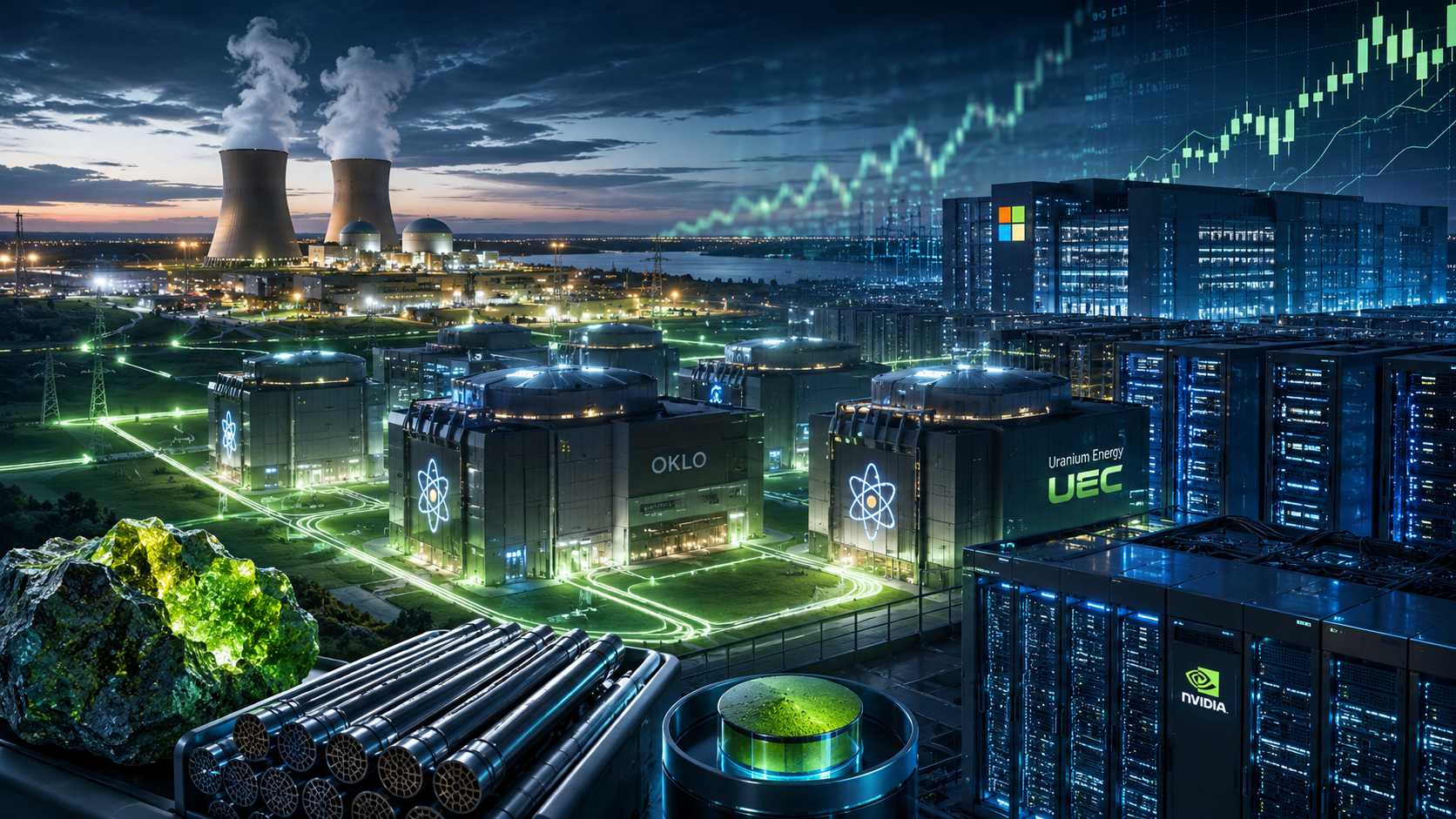
AI energy.
Nuclear power and AI: key questions
Why does AI need so much electricity?
AI needs large amounts of electricity because training and running advanced models requires dense computing hardware, especially GPUs and accelerators, inside power-hungry data centers.
Why is Three Mile Island important to the AI energy story?
Three Mile Island matters because Constellation is working to restart Unit 1 under a long-term power deal with Microsoft, linking a famous nuclear site directly to AI-era data center demand.
Was the Three Mile Island reactor involved in the 1979 accident the one being restarted?
No. The restart plan concerns Unit 1, which shut down in 2019 for economic reasons. The 1979 accident happened at Unit 2.
Why are uranium stocks connected to AI?
Uranium stocks are connected indirectly. If AI data centers increase demand for nuclear power, investors may pay more attention to uranium miners, fuel suppliers and nuclear technology companies.
Is nuclear power a guaranteed winner from AI?
No. Nuclear power has major advantages for reliable low-carbon electricity, but projects can face delays, high costs, regulatory hurdles and political opposition.
Is this financial advice?
No. This article is for information and analysis only. Stocks, uranium miners, utilities and nuclear technology companies can be volatile, and readers should do their own research or consult a qualified financial adviser.