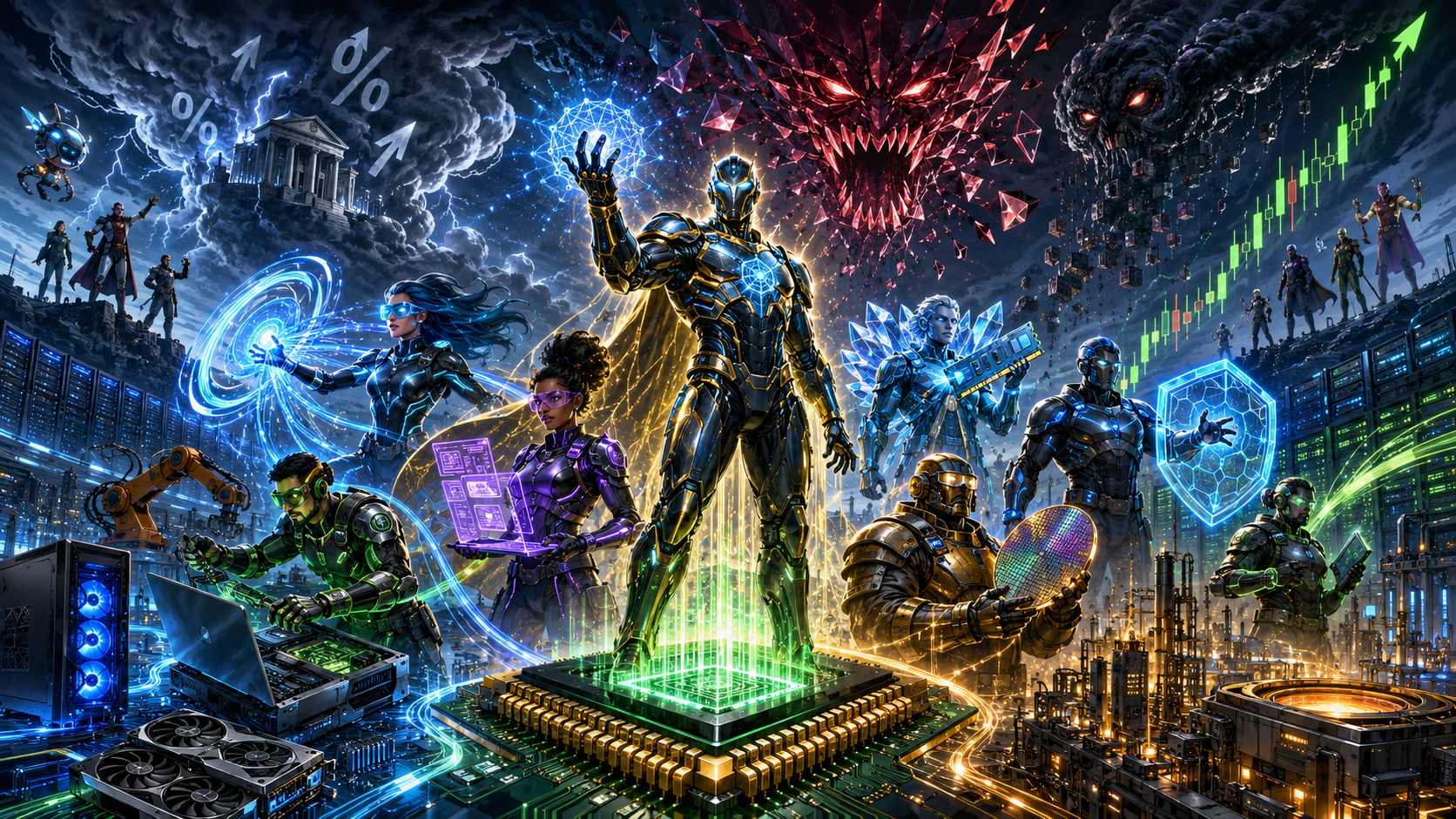
The AI stock market has started to look suspiciously like the Marvel Cinematic Universe: one breakout hero, a rapidly expanding cast, increasingly expensive sequels, and a growing suspicion that not every character deserves their own franchise.
For years, Nvidia has been the obvious protagonist. It had the origin story, the weapon, the charisma, the numbers, and the market’s full attention. But the AI trade is no longer just about one company selling the most important chips in the room. Broadcom, Dell, Micron, CrowdStrike, Samsung, PC makers, memory suppliers, server builders, networking players, and software names are all being pulled into the same narrative gravity field.
The question is whether this is becoming a coherent shared universe of economic winners — or whether Wall Street is slapping “AI” on every poster and hoping investors buy tickets for yet another spin-off.
- Phase One: Nvidia as Iron Man
- Phase Two: the expanded AI cast
- Not every spin-off deserves a franchise
- The villains: valuation, rates, and weak demand
- So what? A simple AI stock checklist
- AI rally: key questions
Phase One: Nvidia as Iron Man
Every cinematic universe needs a first hit. For Marvel, it was Iron Man: not the safest bet on paper, but the film that proved the model could work. For the AI market, Nvidia has played that role with almost absurd efficiency.
Nvidia did not merely benefit from the AI boom. It gave the boom its visual language. GPUs became the arc reactor. Data centers became the battlefield. Jensen Huang became the leather-jacketed frontman explaining why the next wave of computing needed more silicon, more power, more networking, more memory, and more everything.
The company’s dominance in AI accelerators turned it into the central character of the market. Every hyperscaler capex plan, every generative AI launch, every model-training arms race seemed to come back to one question: how many Nvidia chips can the world actually get?
Now Nvidia is pushing the story closer to the edge — literally. Recent reporting around Nvidia’s Arm-based PC ambitions, including N1 and N1X laptop chip expectations, has collided with the company’s broader move into AI PCs through chips such as RTX Spark and support from manufacturers including Microsoft, Dell and HP. That matters because it suggests Nvidia does not want to be only the king of the AI data center. It wants a role in the device sitting on your desk, in your backpack, and eventually in every local AI workflow.
That is very MCU Phase One: prove the hero works, then start building the post-credit scenes.
Phase Two: the expanded AI cast
The AI rally’s second act is where the story gets more complicated — and more interesting.
Dell is no longer just the company that sells laptops to offices and servers to IT departments. It has become one of the clearest infrastructure beneficiaries of the AI buildout. Reuters reported that Dell recently raised its fiscal 2027 AI server revenue expectation to roughly $60 billion, up from a prior $50 billion forecast, while lifting broader revenue guidance after strong results driven by AI data center demand. Reuters
That is not a cameo. That is a supporting role with screen time.
Broadcom is another key character, but in a less flashy suit. The company is not trying to replace Nvidia as the face of AI. Its appeal is more industrial: networking, connectivity, and custom silicon. As AI data centers become larger, denser, and more specialized, the pipes matter almost as much as the engines. Broadcom’s pitch is that the AI factory needs more than GPUs. It needs custom chips, switches, interconnects, and a whole nervous system that keeps the machine alive.
Micron is the memory character who suddenly turns out to be essential to the plot. AI models are hungry not only for compute, but for memory bandwidth. High-bandwidth memory has become one of the bottlenecks of the AI supply chain, and market reports have framed Micron’s rally as extreme enough to push it into trillion-dollar territory. Whether that valuation proves durable is another question, but the logic is clear: no memory, no AI acceleration at scale.
Samsung is fighting for a bigger role in the same memory-heavy script. The company has benefited from hopes tied to AI, chip exports, and high-bandwidth memory samples. Reuters reported that Samsung began shipping samples of its latest 12-layer HBM4E memory chips, a development investors treated as another sign that the AI memory race is widening beyond the current leaders. Reuters
Then there is CrowdStrike, which represents a different branch of the AI universe. Cybersecurity is not the obvious “AI chip” trade, but it may be one of the more durable software angles. AI expands attack surfaces, automates threats, and increases the need for real-time detection. CrowdStrike has to prove that cybersecurity spending remains resilient even when IT budgets get tighter. Its numbers have kept the debate alive: the company reported more than $5 billion in ending annual recurring revenue for fiscal 2026 and guided fiscal 2027 revenue above analyst estimates. CrowdStrike
And yes, even PC makers want in. The AI PC narrative is still early, and it risks becoming one of those Marvel Disney+ spin-offs that everyone agrees exists but not everyone watches. Still, if local AI workloads, assistants, creative tools, and enterprise copilots move onto devices, PC makers could get a refresh cycle with better average selling prices.
The cast is expanding fast. The real issue is whether the script can support all of them.
Not every spin-off deserves a franchise
This is where the Marvel metaphor becomes useful — and a little brutal.
A shared universe works when the characters connect to the main story. It breaks when every side character gets a spin-off because the studio is addicted to the brand. Markets do the same thing. A theme works until investors stop asking whether a company has actual exposure and start rewarding anything with a vague connection to the buzzword.
There are real AI beneficiaries. A company selling GPUs into hyperscaler demand is not the same as a company mentioning AI in a slide deck. A memory supplier shipping high-bandwidth products into AI servers is not the same as a consumer electronics brand claiming its next product is “AI-powered” because it has a chatbot button. A cybersecurity platform using AI to defend enterprise networks may have a stronger claim than a low-margin hardware vendor hoping for a one-cycle upgrade bump.
The market’s job now is casting discipline.
Nvidia is Iron Man because the revenue connection is obvious. Dell’s AI server backlog and guidance give it a credible infrastructure role. Broadcom’s networking and custom chip exposure sits close to the data center buildout. Samsung and Micron are tied to the memory bottleneck. CrowdStrike has a software-security angle that may matter more as AI increases complexity.
But not every “AI stock” is an Avenger. Some are background extras in a battle scene.
The villains: valuation, rates, and weak demand
Even a good franchise can stumble. Ask anyone who sat through too many mandatory spin-offs before Avengers: Endgame finally forced the arcs to converge.
The AI rally has three obvious villains: valuation, rates, and demand.
Valuation is the easiest to understand. When investors price every AI-adjacent company like it has already won the next decade, the margin for disappointment shrinks. Great companies can be bad stocks if the entry price assumes perfection. In a market where some AI winners are already trading on heroic expectations, even a small slowdown in orders, margins, or guidance can feel like a plot twist.
Rates are the second villain. AI is capital intensive. Data centers require chips, power, cooling, land, networking, and financing. Higher rates make long-duration growth stories harder to justify and increase the cost of funding massive infrastructure plans. The Federal Reserve has remained cautious as inflation risks complicate the path toward easier monetary policy, which is not exactly a friendly backdrop for speculative multiples. Federal Reserve
Then comes demand. AI enthusiasm does not automatically override IT budget discipline. Enterprises still have procurement cycles. CFOs still ask annoying but important questions. Consumers may not rush to replace laptops simply because the new model can run local AI features. If corporate spending slows, PC demand weakens, or hyperscalers digest earlier purchases, the market will have to separate recurring demand from pull-forward hype.
Dell’s results show the boom is real in parts of the infrastructure stack. Samsung’s HBM samples show the memory race is real. CrowdStrike’s recurring revenue suggests cybersecurity is still a priority. But the broader AI trade is no longer priced like a niche opportunity. It is priced like a universe.
Universes are expensive to maintain.
So what? A simple AI stock checklist
The useful move for investors, analysts, and tech watchers is not to ask whether a company “does AI.” That question is now almost meaningless. The better question is: where does the company sit in the AI value chain, and can that position turn into durable economics?
Start with direct AI revenue. Is the company actually selling into AI workloads, or is it simply attaching AI language to an existing product? Dell’s AI server forecast is concrete. A vague “AI transformation strategy” is not.
Then look at margin. AI revenue that arrives with brutal component costs, pricing pressure, or low differentiation may not deserve the same multiple as software-like recurring revenue or highly specialized silicon.
Next, examine backlog and visibility. Orders, remaining performance obligations, long-term supply agreements, and customer commitments matter because they show whether demand is already contracted or merely hoped for.
After that, check dependency on Nvidia. This is not automatically bad. Many winners in the AI stack currently ride Nvidia’s ecosystem. But there is a difference between benefiting from Nvidia’s growth and being completely hostage to Nvidia supply, pricing, or architecture decisions.
Finally, test the guidance. Are forecasts rising because customers are placing orders, or because management knows the market wants a bigger AI number? Strong guidance backed by real demand is one thing. Promotional guidance built for the trailer is another.
The AI rally may well become a real shared universe. Nvidia can remain the central hero while Broadcom, Dell, Micron, Samsung, CrowdStrike, and PC makers develop credible arcs of their own. But the market has entered the dangerous middle phase, where every company wants a cape and every investor is looking for the next origin story.
The MCU worked because, at its best, the pieces connected. The AI rally has to prove the same thing: that this is not just endless sequels to the Nvidia story, but a broader economic franchise where the supporting cast actually earns the screen time.
AI rally: key questions
Is Nvidia still the main AI stock?
Nvidia remains the central AI infrastructure name because its GPUs and broader computing platform sit at the heart of the current data center buildout. But the rally is expanding into servers, memory, networking, cybersecurity, and AI PCs.
Why are Dell, Broadcom, Micron, Samsung, and CrowdStrike part of the AI story?
Dell is tied to AI servers, Broadcom to networking and custom chips, Micron and Samsung to high-bandwidth memory, and CrowdStrike to cybersecurity demand in a more complex AI-driven threat environment.
Are all AI stocks real beneficiaries?
No. Some companies have direct AI revenue, strong demand, and visible orders. Others mostly use AI as a marketing layer. The difference matters more as valuations rise.
What are the biggest risks to the AI rally?
The biggest risks are high valuations, persistent inflation, cautious central banks, higher interest rates, weaker IT budgets, and slower-than-expected consumer or enterprise adoption.
How should investors evaluate an AI stock?
A practical checklist includes direct AI revenue, margin quality, backlog, dependence on Nvidia, customer concentration, and whether management guidance is supported by real demand.
Is this financial advice?
No. This article is for information and analysis only. It is not financial advice, investment advice, or a recommendation to buy or sell any stock, crypto asset, ETF, or security.