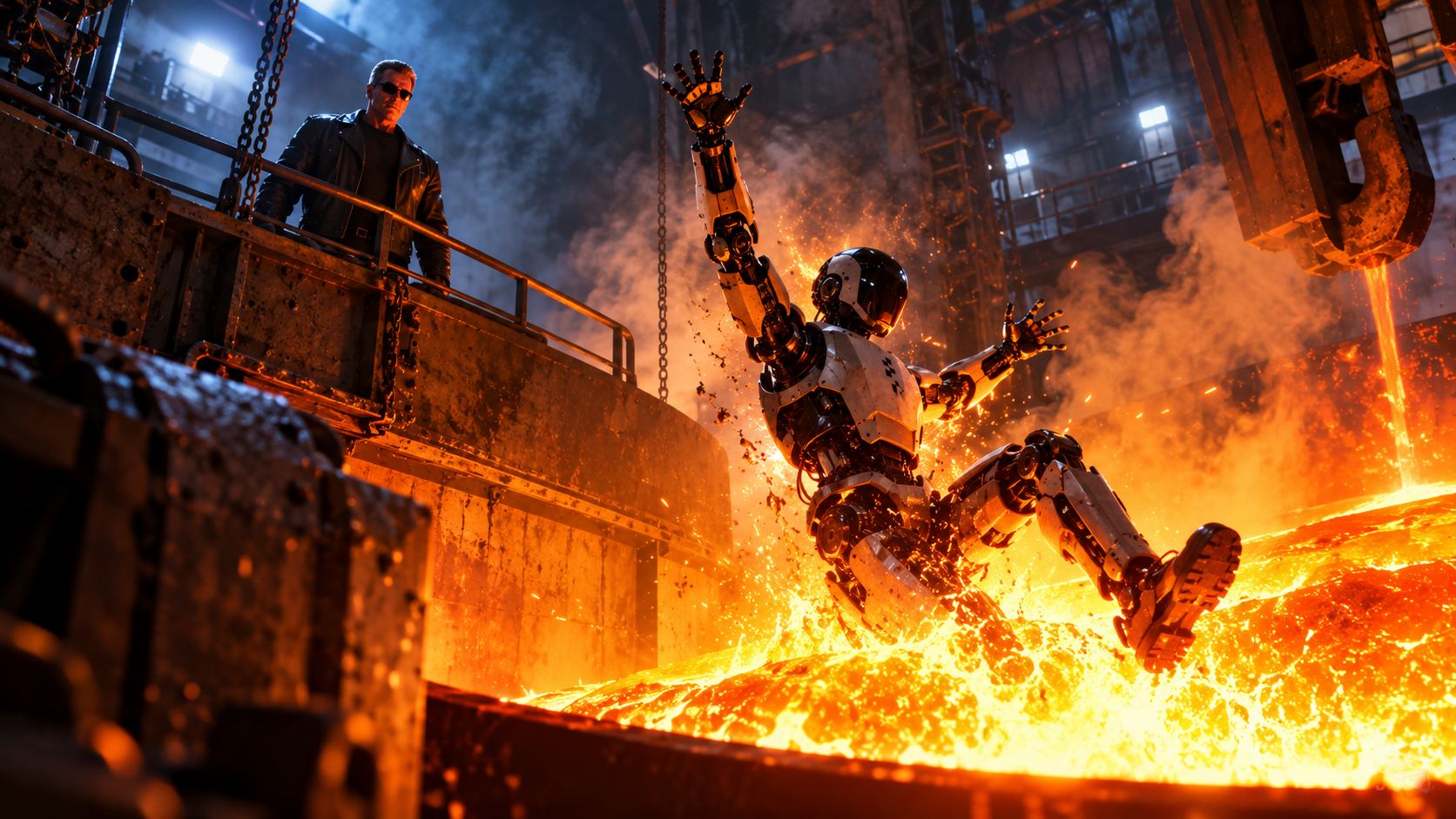
Figure’s F.02 humanoid robot had a remarkably short career.
The machine entered service in late 2025, spent months working in Figure’s manufacturing operations and at BMW’s plant in Spartanburg, South Carolina, walked thousands of steps, handled tens of thousands of components and contributed to real automotive production.
Eleven months later, Figure decommissioned it. Then, in a finale so perfectly calibrated for the internet that Arnold Schwarzenegger became part of the story, the company sent much of the fleet to Finland and taught the robots to jump autonomously into molten steel.
The imagery is irresistible. Humanoid machines disappearing into a furnace while the star of Terminator 2 watches is the sort of corporate stunt that can swallow the underlying story whole. Yet the spectacle matters less than the reason Figure was willing to destroy machines it had spent years developing.
F.02 was not retired because Figure has abandoned humanoid robots. It was retired because the company believes it has already moved beyond them.
In almost any mature industrial sector, retiring a major piece of machinery less than a year after deployment would invite uncomfortable questions about durability, economics and planning. Factories are normally filled with equipment designed to survive years of repetitive work. Industrial robots can remain in service for a decade or longer, accumulating maintenance cycles rather than becoming obsolete before their first birthday.
Humanoid robotics is operating on a very different clock.
Figure 03 has already succeeded F.02, while Figure is simultaneously developing later generations. Hardware, AI models, manufacturing methods and the company’s understanding of what a useful humanoid should actually look like are evolving together. The robot being deployed today can therefore become less valuable as a platform long before it physically stops working.
That makes F.02’s brief life more interesting than a conventional product discontinuation. The robot was simultaneously a machine, a worker, a prototype and a data-gathering platform. Even its destruction became another robotics experiment.
For now, extreme obsolescence may be part of the development process.
The harder question is how long that can remain true once customers are expected to buy robots by the thousands.
Table of contents
- Figure retired F.02 after only 11 months
- Figure gave F.02 a very Terminator ending
- F.02 actually did real factory work
- Was F.02 a prototype or a product?
- Figure 03 explains why F.02 had to disappear
- Humanoid robotics is moving at software speed
- Eventually, the economics have to slow the replacement cycle
- BMW is where the experiment becomes industrially interesting
- The entire humanoid industry faces the same problem
- F.02 may have been more valuable dead than mature
- Figure F.02: key questions
Figure retired F.02 after only 11 months
Figure announced the retirement of F.02 with an unusually concise biography.
According to the company, the humanoid spent 11 months in service. During that period, Figure says F.02 walked 5.6 miles, completed 30,000 steps and handled 90,000 parts.
Those figures should be read for what they are: operational statistics published by Figure itself, rather than independently audited measures of robot productivity. Even with that qualification, they tell us something important about the role F.02 played.
This was not merely a humanoid performing carefully staged demonstrations in a laboratory.
F.02 was part of Figure’s attempt to move humanoid robotics into repetitive industrial work, where success is measured less by whether a robot can perform an impressive action once than by whether it can perform useful actions thousands of times without becoming a nuisance to the humans around it.
That transition from demonstration to repetition is one of the central challenges facing the entire humanoid robotics industry.
A robot folding a towel in a promotional video can demonstrate dexterity. A robot manipulating tens of thousands of components in a factory begins generating a different kind of evidence: cycle times, failure modes, wear, awkward edge cases, maintenance requirements and all the tiny mechanical frustrations that laboratory demonstrations tend to hide.
F.02’s most valuable output may therefore have been neither distance walked nor parts moved.
It was data.
Figure gave F.02 a very Terminator ending
Figure could have quietly dismantled the old machines. Instead, the company turned their destruction into one final engineering exercise.
According to Figure’s account, F.02 contained proprietary actuators and other custom hardware the company did not want circulating outside its control. Disassembling the fleet by hand would also have required engineering resources that Figure preferred to direct toward newer robots. Melting the machines solved the disposal problem, but the project quickly became something considerably stranger.
Arnold Schwarzenegger suggested throwing them into molten steel.
The obvious Terminator 2 reference became the premise for an elaborate decommissioning operation in which Figure says its engineers first trained F.02 robots to jump from the second floor of its San Jose facility onto airbags. Human stunt performers were used as movement references, while simulation helped train the control system for the leap.
The machines were then shipped to Imatra, Finland, where the final jumps would take place beside a 75-ton electric arc furnace.
That environment created its own robotics problem. The robots had to perform in extreme heat, surrounded by industrial equipment and electromagnetic interference, in a location they had never encountered during training. Figure says the jumps were autonomous.
In other words, F.02 was still being used as an experimental platform while Figure was destroying it.
The video is deliberately theatrical, and Schwarzenegger’s presence removes any doubt about what Figure wants viewers to remember. But underneath the science-fiction imagery is a revealing engineering mentality. Most companies dispose of obsolete hardware after it has stopped producing useful information. Figure found a way to extract another autonomy experiment from F.02 on its way into the furnace.
The company says a small number of F.02 units remain in storage, while metal recovered from the destroyed robots was returned to the United States and turned into commemorative objects.
It is difficult to imagine a more literal representation of the pace of the humanoid race: a robot can go from cutting-edge industrial experiment to raw material in less than a year.
F.02 actually did real factory work
The furnace makes for better footage, but the factory is where F.02’s story becomes important.
Figure’s relationship with BMW put the humanoid into an environment where usefulness has a much harsher definition than it does in a robotics laboratory. The companies worked together on deploying Figure’s machines at BMW’s Spartanburg plant in South Carolina, exposing F.02 to automotive manufacturing rather than another controlled demonstration.
Figure says its robots spent ten months working within the production environment and participated in processes associated with the manufacture of more than 30,000 BMW X3 vehicles.
That does not mean humanoid robots built 30,000 cars.
Automotive production consists of enormous chains of specialized operations involving human workers, conventional industrial robots, logistics systems and machinery. Figure’s humanoids performed specific tasks inside that larger system. The significance lies in putting a general-purpose humanoid into an environment already designed around human bodies and existing production lines rather than rebuilding the factory around a specialized machine.
That is the economic promise behind much of the current humanoid boom.
Traditional industrial robots are extraordinarily capable when the environment and task are designed for them. A robotic arm bolted inside a manufacturing cell can weld, paint or manipulate components with speed and precision no humanoid needs to imitate. The humanoid argument begins where specialization becomes inconvenient.
Factories and warehouses already contain shelves, carts, tools, doors, workstations and pathways designed around human proportions. If a robot can navigate those spaces and manipulate the same objects without requiring the entire environment to be redesigned, companies gain a potentially flexible form of automation.
F.02 was an attempt to discover how much of that promise survives contact with a real factory.
The BMW footage matters for precisely that reason. Strip away the science-fiction aesthetics surrounding humanoid robotics and what remains is a machine operating inside one of the most mature manufacturing industries on Earth. The robot does not need to look spectacular there. It needs to become boring enough to be useful.
Eleven months after F.02 entered service, however, Figure decided it had learned enough to replace the platform.
Was F.02 a prototype or a product?
This is where the language surrounding humanoid robotics becomes slippery.
Figure is building robots it ultimately intends to commercialize at enormous scale, but the machines currently appearing in factories still behave partly like development platforms. They perform productive work while simultaneously teaching their manufacturers how the next generation should be built.
That is a very different relationship from the one customers normally have with industrial equipment.
A factory buying a conventional machine generally wants stability. It wants known performance, predictable maintenance, available spare parts and a useful operating life long enough to amortize the initial investment. A machine becoming obsolete eleven months after deployment would normally be a problem rather than evidence of rapid innovation.
Humanoid robotics has not yet reached that equilibrium.
The underlying hardware is changing. Actuators are changing. Hands are changing. Sensors are changing. Batteries, compute systems and manufacturing methods are changing. At the same time, the AI models controlling the robots are improving fast enough that capabilities can evolve independently of the physical machine.
Companies are effectively trying to stabilize hardware while the definition of a good humanoid robot is still being discovered.
That creates an unusual development environment in which building something useful today may be the fastest route to discovering why it should not be built the same way tomorrow.
F.02 fits almost perfectly into that category.
Figure 03 explains why F.02 had to disappear
Figure has already introduced the machine intended to move beyond F.02.
Figure 03 is presented not merely as a robot with improved specifications but as a redesign intended for manufacturing at scale. Figure says the new generation incorporates changes to its sensory system, hands, battery, charging architecture, safety systems and overall construction.
That emphasis on manufacturability is revealing.
The challenge in humanoid robotics is no longer simply making a bipedal machine that can walk across a room without falling over. Several companies have demonstrated increasingly impressive locomotion and manipulation. The commercial problem is producing machines in sufficient numbers, at acceptable cost, with enough reliability that businesses can justify deploying them.
At scale, tiny design decisions become enormous economic decisions.
A component that is unnecessarily expensive matters little on one prototype and a great deal on thousands of robots. A complicated assembly step that consumes an extra hour becomes thousands of additional hours of factory labor. A part that frequently fails in the field becomes a maintenance network.
The progression from F.02 to Figure 03 therefore tells us something about where Figure believes the bottleneck is moving.
The question is becoming less Can we build a humanoid? and more Can we manufacture one repeatedly, cheaply enough and reliably enough to create an industry?
F.02 helped answer the first question.
Its successors have to attack the second.
Humanoid robotics is moving at software speed
There is something almost unnatural about watching heavy industrial hardware iterate this quickly.
Software companies can replace products constantly because copying software costs essentially nothing. A new version can be deployed to millions of machines without physically rebuilding those machines.
Robotics inherits some of that velocity from artificial intelligence, but none of the physical world has disappeared. A humanoid robot still has motors, gears, bearings, batteries, wiring, sensors, structural components and hands containing mechanical assemblies that must survive thousands or eventually millions of movements. Every new generation has to be manufactured, assembled, shipped, serviced and physically placed into the world.
That makes the current pace of iteration expensive.
Yet AI is pushing robotics companies toward precisely that rhythm. Better models expose weaknesses in hardware. New tasks demand different manipulation capabilities. Factory deployments generate data that changes design requirements. Improved hardware then produces better data for the next generation of AI.
The robot and the intelligence controlling it are evolving together.
This feedback loop helps explain why an 11-month-old humanoid can already belong to the past. F.02 did not need to become useless for Figure to replace it. It only needed to become less useful as a development platform than the machine the company could build next.
That is rational during an experimental phase.
It becomes much more complicated once somebody has paid for the robot.
Eventually, the economics have to slow the replacement cycle
Humanoid companies frequently describe a future in which robots become common economic assets: machines that businesses purchase or lease because the cost of deploying them is lower than the value of the labor they can perform.
For that equation to work, useful life matters.
Imagine a company paying tens of thousands of dollars for a humanoid robot. The investment becomes easier to justify if the machine can work productively for years, receiving software improvements and replaceable components along the way. If the hardware architecture becomes obsolete every 11 months, calculating a return on investment becomes considerably more difficult.
This is why F.02’s retirement can simultaneously represent technical progress and highlight an unresolved commercial problem.
Early customers and partners can tolerate rapid hardware replacement because they are participating in development. BMW is not simply shopping for an off-the-shelf worker from a mature robotics catalog; deployments of this kind help establish what humanoids can actually do in automotive manufacturing.
Mass-market customers will eventually expect something different.
They will want warranties, service agreements, predictable operating costs, replacement parts and an answer to the mundane question that every capital-equipment buyer eventually asks: how many years will this thing remain useful?
The humanoid industry has spent years demonstrating capability. Durability and depreciation will become increasingly important as the technology moves from experimental deployments toward commercial fleets.
A robot that can work is impressive.
A robot that can keep working long enough to pay for itself is a business.
BMW is where the experiment becomes industrially interesting
This is why the BMW deployment matters more than another polished humanoid demonstration.
A car factory is an unforgiving environment for technology theater. Production lines operate according to schedules, cycle times and quality requirements. A robot that frequently requires human intervention may technically complete its assigned task while providing little economic advantage.
Figure says its BMW deployment progressed from initial testing to sustained production work, with F.02 robots performing thousands of operations during their time in Spartanburg.
The interesting question is what happens next.
If Figure’s newer generations can replace F.02 while improving reliability, manipulation, autonomy and manufacturing economics, the rapid retirement of the older robot will look like a normal step in an aggressive development program. Each generation will have converted factory experience into better hardware.
If successive generations continue replacing one another before they establish long operating histories, however, the industry will eventually confront a more uncomfortable interpretation: humanoid robotics may still be searching for a stable machine architecture.
Those possibilities are not mutually exclusive today.
A young technology can advance rapidly precisely because its design remains unsettled. The point at which that stops being an advantage will be one of the most important transitions in the commercialization of humanoid robots.
The entire humanoid industry faces the same problem
Figure is hardly alone in moving quickly.
Tesla continues developing Optimus. Apptronik is working on Apollo. Agility Robotics has been pushing Digit into logistics and manufacturing environments. Boston Dynamics replaced the hydraulic version of Atlas with an electric platform. Chinese robotics companies are iterating rapidly while pushing toward lower manufacturing costs and greater production volumes.
The industry has entered a period in which each new robot risks making the previous generation look old almost immediately.
That can create misleading expectations.
Smartphones trained consumers to expect meaningful hardware updates every year while still assuming that the previous model would remain useful for years. Industrial machinery usually evolves more slowly because reliability, certification, integration and capital costs reward stability.
Humanoid robots sit uncomfortably between those worlds.
Their intelligence increasingly follows the rapid development cycle of AI. Their bodies remain physical capital.
The companies that eventually build viable businesses may therefore be those that learn where to draw the boundary between the two: hardware stable enough to remain economically useful for years, combined with software capable of improving continuously.
If that happens, future humanoid generations may look less like complete replacements and more like platforms.
F.02 shows that Figure is not there yet.
Few competitors are.
F.02 may have been more valuable dead than mature
There is an easy way to tell the story of F.02’s retirement: Figure built a robot, put it to work, learned from it and replaced it with something better.
That is probably true, but it misses what makes the episode interesting.
F.02 occupied a peculiar moment in the evolution of humanoid robotics. It was advanced enough to leave the laboratory and perform repetitive work inside a real automotive factory, yet temporary enough that its manufacturer retired the platform before it had completed a full year of service. Then, rather than quietly dismantling the obsolete fleet, Figure turned its destruction into one final autonomy test and sent robots jumping into molten steel.
According to Figure, those 11 months produced 30,000 steps, 5.6 miles of walking and 90,000 handled parts. Its BMW deployment also contributed to a production process that turned out tens of thousands of vehicles.
Those numbers are modest compared with what mature industrial automation accomplishes over years of continuous operation. They are enormous compared with a humanoid robot that exists primarily in demonstrations.
F.02 lived in the gap between the two.
Its successors will be judged against a higher standard because Figure itself is raising the stakes. Newer robots are supposed to be more manufacturable, more capable and better suited to large-scale deployment. Eventually, one of these generations must stop behaving like a prototype that happens to work and start behaving like a product that happens to improve.
That is the transition worth watching.
The strange thing about F.02 is not that Figure retired a robot after 11 months. At this stage of the humanoid race, replacing hardware quickly may be exactly what rapid progress looks like.
The real milestone will come when Figure builds a robot good enough that throwing it into molten steel after 11 months would seem economically insane.
Figure F.02: key questions
What was Figure F.02?
F.02 was a humanoid robot developed by Figure as part of the company’s effort to create general-purpose machines capable of working in environments designed for humans. It was deployed in industrial settings, including automotive manufacturing.
Why did Figure retire F.02?
Figure has moved on to newer generations of humanoid hardware. The company says maintaining F.02 was becoming less useful as its newer fleet expanded, while manually dismantling the older robots would have consumed engineering resources it wanted to direct elsewhere.
Did Figure really melt its robots?
Yes. Figure says most of the F.02 fleet was sent to a steel facility in Imatra, Finland, where robots autonomously jumped into molten steel. A small number of F.02 machines were retained rather than destroyed.
Was Arnold Schwarzenegger involved?
Yes. Schwarzenegger appears in Figure’s decommissioning film and, according to Figure, suggested melting the robots. His involvement turns the sequence into an explicit reference to the ending of Terminator 2: Judgment Day.
How long was F.02 in service?
Figure says F.02 spent 11 months in service before being decommissioned.
How much work did F.02 perform?
According to Figure, F.02 walked 5.6 miles, completed 30,000 steps and handled 90,000 parts during its operational life. These figures are company-reported rather than independently audited.
Did Figure robots actually work at BMW?
Yes. Figure deployed humanoid robots at BMW’s Spartanburg plant in South Carolina. Figure says the deployment lasted ten months and that the robots participated in production processes associated with more than 30,000 BMW X3 vehicles. This does not mean the robots independently built those vehicles; they performed specific tasks within the larger production system.
What replaces Figure F.02?
Figure has introduced Figure 03 as a newer humanoid platform, with changes intended to improve sensing, manipulation, safety and manufacturability.
Does retiring F.02 after 11 months mean the robot failed?
Not necessarily. Figure presents the retirement as part of its rapid development cycle, with experience from F.02 informing newer hardware. At the same time, such a short lifecycle illustrates how immature and rapidly changing commercial humanoid robotics remains.
Sources: