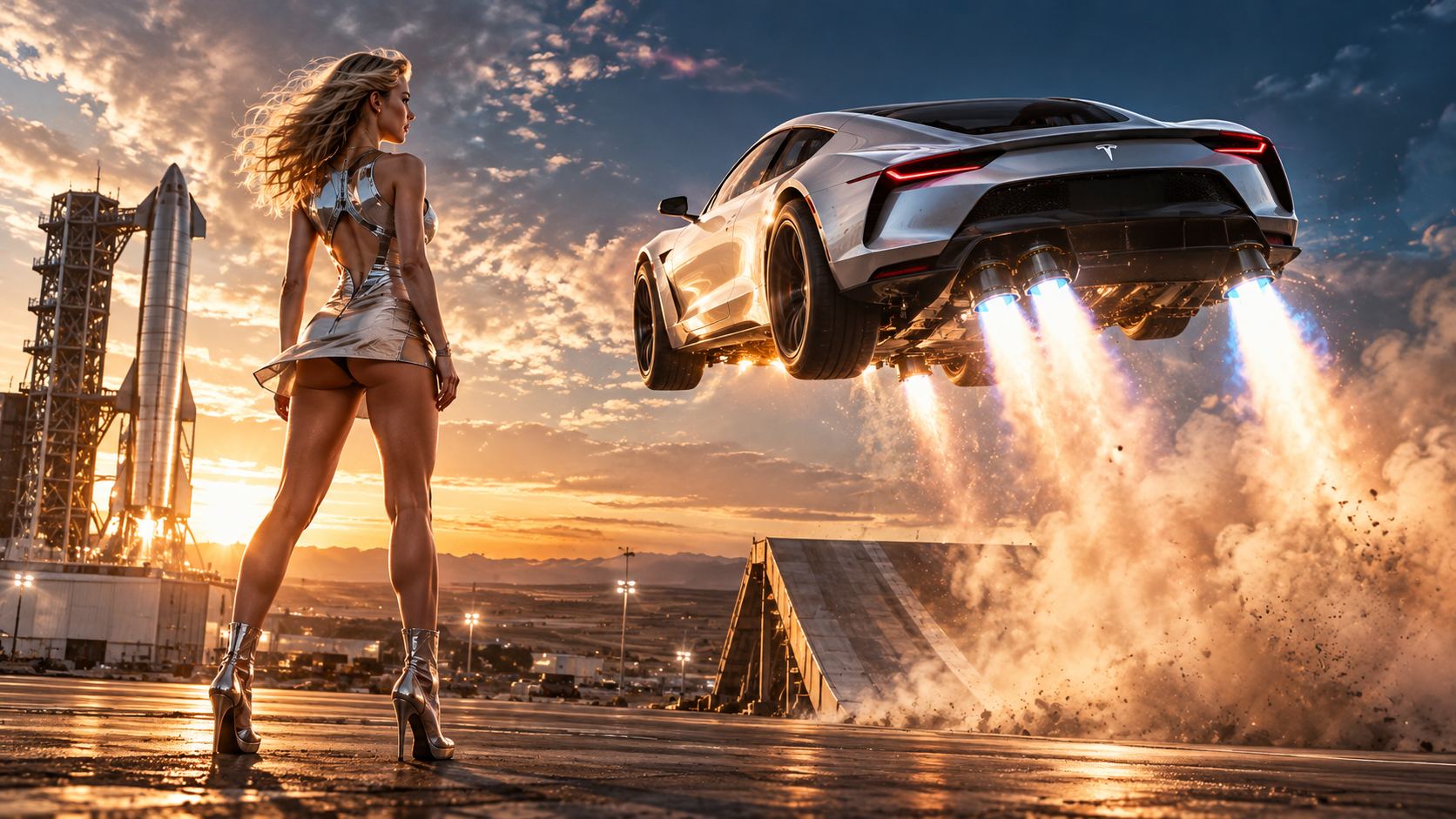
On October 15, 2026, Tesla finally did something it had been talking about for nearly a decade: it sent a Roadster into the air.
At a demonstration at SpaceX’s test facility near McGregor, Texas, the redesigned electric sports car climbed an inverted ramp, performed airborne maneuvers and used compressed-air thrusters to help control its descent. Tesla also displayed a 0–60 mph acceleration time of 0.81 seconds, a figure that would put the prototype in a category far beyond conventional production cars.
The footage was spectacular. The engineering questions are even better.
Accelerating to 60 mph in 0.81 seconds means subjecting a vehicle to an average acceleration of approximately 3.4 g. Making a two-ton machine jump, rotate and land requires another set of forces entirely. And turning those demonstrations into something a customer can safely operate introduces problems that have little to do with producing an impressive launch video.
The demonstration itself is real, with contemporary reporting from TechCrunch and Car and Driver describing the event. But the 0.81-second result remains a Tesla-presented measurement, not an independently certified production-car record. The aerial maneuvers involved a controlled prototype demonstration, not an ordinary customer driving a street-legal vehicle.
Tesla is targeting production in 2028, almost a decade after the second-generation Roadster was originally supposed to arrive. Its most extreme configurations blur the distinction between a sports car, a stunt vehicle and an experimental aircraft.
To understand what Tesla has actually achieved, we need to separate three questions: how quickly can a car accelerate, how can compressed air make it leave the ground, and what would it take to make that capability useful outside a carefully prepared test site?
Table of Contents
- What Tesla actually demonstrated in October 2026
- The physics of reaching 60 mph in 0.81 seconds
- How compressed-air thrusters can launch a car
- Why Tesla also needs powerful suction fans
- The difference between jumping, hovering and flying
- The engineering problems nobody can accelerate away from
- The long road from prototype to production
- What the flying Roadster really proves
- Tesla flying Roadster: Frequently asked questions
What Tesla actually demonstrated in October 2026
The latest Roadster is substantially more ambitious than the electric supercar Tesla unveiled in November 2017.
That original presentation promised extraordinary acceleration, a top speed exceeding 250 mph and a range of approximately 620 miles. The company initially targeted production in 2020.
Those deadlines came and went.
Elon Musk subsequently introduced the idea of a SpaceX-inspired propulsion package, with small rocket-like thrusters intended to improve acceleration, braking and cornering. By 2026, that idea had evolved into the centerpiece of an extensively redesigned vehicle.
The October 15 event finally provided a public demonstration.
Tesla showed a Roadster prototype using powerful underbody fans to maintain contact with an inverted ramp. The vehicle also performed airborne stunts, including jumps and rotations, with cold-gas thrusters assisting its movement and landing.
The company presented a sub-one-second acceleration run, with a reported 0–60 mph time of 0.81 seconds. Accounts of the event describe both a roughly one-second demonstration and the more precise 0.81-second result displayed in Tesla’s material.
That distinction matters. A manufacturer’s displayed timing result is evidence of what the manufacturer reported, but independent verification would require additional information about the measurement procedure, vehicle configuration, starting conditions and repeatability.
The event also revealed three planned configurations.
- Performance: A two-seat version intended for road use, with active aerodynamics and a suction system.
- Thrust: A two-seat, track-oriented version incorporating rear-mounted cold-gas thrusters for additional acceleration.
- Rocket: A more extreme, single-seat configuration with a broader thruster system intended to enable aerial maneuvers.
Tesla has described the Rocket configuration as invitation-only. Its flight-oriented capabilities should not be confused with road approval, and the company has not established that such a vehicle can legally operate on public roads.
Musk has suggested production could begin in 2028. No independently verified production specification or final selling price has been established.
The demonstration is therefore best understood as an engineering milestone rather than proof that a flying Roadster is ready for customers.
And the most revealing place to begin is with the acceleration figure.
The physics of reaching 60 mph in 0.81 seconds
Sixty miles per hour is approximately 26.82 meters per second.
If a vehicle accelerates from rest to that speed in 0.81 seconds, its average acceleration is:
Acceleration = change in velocity / time
26.82 / 0.81 = approximately 33.1 meters per second squared.
Earth’s gravitational acceleration is approximately 9.81 meters per second squared.
Divide the Roadster’s calculated acceleration by that figure, and the result is approximately 3.37 g.
In other words, the car would accelerate forward at an average rate equivalent to roughly 3.4 times Earth’s gravitational acceleration.
That does not mean the driver suddenly weighs 3.4 times as much in the ordinary vertical sense. It means the driver experiences an intense longitudinal force pressing them into the seat.
For comparison, a conventional performance car accelerating from 0 to 60 mph in three seconds averages approximately 0.91 g. Even a car completing the sprint in two seconds averages around 1.37 g.
The difference is enormous.
A 0.81-second run is not merely a somewhat faster version of an already quick electric car. It operates in a range where tire traction, propulsion forces, occupant restraint and structural loading become exceptionally demanding.
Why ordinary tires are not enough
A conventional car accelerates by applying torque to its wheels. The tires push backward against the road, and the road pushes the car forward.
The available forward force depends on the grip between the tires and the surface, together with the load pressing the tires into that surface.
Under a simplified model, the maximum traction force is related to the tire-road friction coefficient multiplied by the normal force.
With ordinary gravity providing that normal force, achieving sustained acceleration above 3 g would require an extraordinary effective friction coefficient.
Real tires and racing surfaces can provide impressive grip, but relying on conventional tire traction alone for a 3.4 g launch would be an extreme proposition.
Tesla’s solution is to add forces that ordinary road cars do not possess.
Underbody suction can increase the force pressing the tires against the road. Rear-facing thrusters can push the vehicle forward without depending on tire traction.
This changes the fundamental equation.
A conventional electric car must transmit nearly all of its propulsive force through the tires. A thruster-assisted Roadster can generate some of that force directly by expelling compressed gas.
How much thrust would it need?
Consider a hypothetical Roadster weighing 1,800 kilograms. This is an illustrative mass, not a confirmed specification for the demonstrated vehicle.
Newton’s second law gives us:
Force = mass × acceleration.
At an average acceleration of 33.1 meters per second squared, a vehicle of that mass would require approximately 59,600 newtons of net forward force.
That is roughly 60 kilonewtons.
The actual propulsion system would need to overcome aerodynamic drag and rolling resistance as well, while the division of work between tires and thrusters would depend on the vehicle’s configuration.
A 60-kilonewton force is substantial. It is not physically impossible, but it is far outside what most drivers associate with an automobile.
There is another complication: average acceleration does not reveal the peak force.
If the car accelerates unevenly, with an especially violent initial launch followed by a reduction in acceleration, the peak g-force could exceed the calculated average.
Without a complete acceleration trace, the precise loads on the vehicle and its occupants remain unknown.
How compressed-air thrusters can launch a car
The Roadster’s propulsion system is frequently described as rocket technology, but it does not necessarily involve combustion.
A conventional chemical rocket accelerates by expelling hot gases produced through a chemical reaction.
A cold-gas thruster instead releases gas stored under high pressure through a nozzle. The gas accelerates outward, and the vehicle experiences a force in the opposite direction.
The principle is the same fundamental momentum exchange that makes rockets work.
Gas goes one way. The vehicle is pushed the other way.
Cold-gas thrusters are well-established aerospace technology, particularly for controlling the orientation of spacecraft.
Tesla’s proposed application is unusual because the system must operate on a heavy terrestrial vehicle, deliver intense bursts of force and potentially function close to people, buildings and other vehicles.
At the unveiling, Tesla engineering executive Lars Moravy described a system incorporating approximately 600 liters of compressed-air storage and multiple thrusters. Reports of the presentation describe carbon-fiber-overwrapped pressure vessels integrated into available spaces within the vehicle.
These vessels store pressurized gas while limiting the mass of the storage structure.
But the crucial figures are not simply tank volume or the number of nozzles.
They are the operating pressure, stored gas mass, achievable mass flow, exhaust velocity, delivered thrust and duration of operation.
Thrust depends on how quickly the gas escapes
A simplified rocket thrust equation is:
Thrust ≈ mass flow rate × exhaust velocity
There can also be a pressure-related contribution at the nozzle exit.
The principle is straightforward: to produce a large force, the system must expel a substantial amount of gas very quickly, accelerate it to high speed, or combine both effects.
Suppose, purely for illustration, a cold-gas system achieved an effective exhaust velocity of 500 meters per second.
Producing 40,000 newtons of thrust would then require a gas mass flow rate of approximately 80 kilograms per second, ignoring the separate pressure term.
A burst lasting half a second would consume around 40 kilograms of gas.
These are illustrative calculations, not Tesla’s published operating parameters. Actual performance depends on tank pressure, gas temperature, nozzle geometry, pressure losses and how the thrusters are controlled.
They nevertheless show why brief, powerful bursts are a more natural application than sustained flight.
A compressed-gas system can release stored energy extremely rapidly, but it carries a finite supply of working fluid.
Once the available pressure or gas mass falls below the required operating level, thrust decreases.
Compressed air is not free energy
Tesla has discussed the ability to recharge its compressed-air system.
That does not eliminate the energy cost.
Compressing air requires work. The vehicle must use energy to drive a compressor, manage the resulting heat and restore the pressure inside its storage vessels.
A battery can supply that energy, but the process introduces additional losses and hardware.
High-pressure tanks, valves, compressors, cooling systems, plumbing and reinforced mounting structures all add mass.
That mass then becomes something the electric drivetrain and thrusters must accelerate.
There is an engineering trade-off at the center of the design: the more ambitious the propulsion system becomes, the more equipment the car may need to carry to support it.
A spectacular short burst of thrust is one problem. Repeating that burst safely and consistently, without excessive weight or recharge time, is another.
Why Tesla also needs powerful suction fans
The Roadster demonstration involved two distinct technologies that can easily be confused.
Cold-gas thrusters generate force by expelling compressed air.
The underbody suction system uses powered fans and aerodynamic sealing to create a pressure difference that pulls the vehicle toward a nearby surface.
The second technique is not science fiction.
Racing engineers have experimented with fan-assisted downforce for decades. The famous Brabham BT46B Formula One car used a fan system in 1978, while the modern McMurtry Spéirling has demonstrated extraordinary performance using active fan-generated downforce.
The advantage is that fan-assisted downforce does not depend entirely on vehicle speed.
Traditional aerodynamic wings become more effective as airflow increases. A sufficiently powerful suction system can generate substantial downward force even when a vehicle is moving slowly.
That can improve traction during acceleration, braking and cornering.
It can also explain one of the Roadster demonstration’s most theatrical moments: driving on an inverted surface.
When a car is upside down, gravity pulls it away from the surface.
For the tires to remain in contact with the inverted track, the suction system must generate enough force to counter the vehicle’s weight and provide the required contact force.
If the hypothetical vehicle weighs 1,800 kilograms, gravity pulls on it with approximately 17,700 newtons.
The suction system must overcome that force before it can provide a meaningful additional margin for grip.
Tesla has described suction capability reaching approximately twice the vehicle’s weight, although that claim requires independent testing under defined conditions.
Even if achieved, such a system would have important limitations.
Its performance depends on the geometry of the nearby surface, leakage around the vehicle, fan capacity and the ability to maintain a pressure difference.
A smooth, prepared ramp is very different from a pothole-filled public road.
And once the car moves far enough away from the surface, the suction system can no longer provide the same benefit.
That is where the distinction between downforce and flight becomes essential.
The difference between jumping, hovering and flying
The Tesla flying Roadster has demonstrated that it can leave the ground and perform controlled-looking aerial maneuvers.
But the phrase flying car covers several very different engineering capabilities.
1. An assisted jump
A vehicle can become airborne after driving over a ramp. Its initial velocity and trajectory determine much of its motion.
Thrusters can modify that trajectory, increase the height or distance traveled, and help control its orientation.
A carefully planned jump can be spectacular without requiring the vehicle to support its own weight continuously through propulsion.
This is the least demanding interpretation of a flying car.
2. A powered vertical hop
A more ambitious system can generate enough upward thrust to lift the vehicle without relying entirely on a ramp.
For a hypothetical 1,800-kilogram Roadster, upward thrust must exceed approximately 17.7 kilonewtons to initiate vertical acceleration, assuming no other meaningful lifting force.
To accelerate upward at an additional 1 g, the thrusters would need to deliver roughly twice the vehicle’s weight in upward force.
That is before accounting for the complexities of controlling the vehicle’s orientation.
A brief vertical hop is physically plausible with sufficient thrust and stored gas.
But a hop is not the same thing as sustained flight.
3. Hovering
Hovering requires the vehicle to continuously generate an upward force equal to its weight.
A conventional helicopter accomplishes this with a rotor. A multicopter uses several propellers. A rocket can do it by continuously expelling propellant.
A compressed-air Roadster would have to keep expelling gas at a rate sufficient to counter gravity.
That creates a severe endurance problem.
Using the earlier illustrative exhaust velocity of 500 meters per second, generating approximately 17.7 kilonewtons of upward thrust would require a mass flow rate of about 35 kilograms per second under the simplified momentum equation.
At that rate, even 250 kilograms of available gas would last only about seven seconds, before accounting for real system limitations and any additional thrust needed for maneuvering.
Again, those figures are a thought experiment, not a calculation of the Roadster’s actual flight endurance.
They show why a vehicle capable of jumping does not automatically become one capable of hovering for useful periods.
4. Controlled flight
A genuine flying vehicle needs more than enough thrust to leave the ground.
It must control its position, altitude, pitch, roll and yaw while responding to disturbances.
It needs a predictable way to move horizontally, navigate obstacles and land safely.
If it is expected to transport people, the demands become considerably more severe.
A car performing a preprogrammed maneuver above a test pad may use carefully timed thruster pulses to stabilize its trajectory.
An aircraft must remain controllable across a much broader range of operating conditions.
Crosswinds, changing payloads, uneven thrust, sensor failures and unexpected disturbances all matter.
And a vehicle that can fly only for a few seconds has very different practical capabilities from one that can travel between destinations.
Tesla has demonstrated an airborne Roadster prototype. That is an impressive achievement, but it does not establish the existence of a practical, independently validated flying car.
The engineering problems nobody can accelerate away from
The most difficult part of the Roadster project may not be generating enough thrust.
It may be making the entire system predictable, repeatable and safe.
The human body has limits
A 3.4 g average forward acceleration is an extraordinary load for a road vehicle.
Humans can tolerate substantial acceleration under appropriate conditions, but tolerance depends on the direction, duration, onset rate, physical condition and restraint system.
Longitudinal acceleration presses the occupant backward into the seat. This differs physiologically from the head-to-foot acceleration experienced by pilots during certain aircraft maneuvers.
The seat, head restraint and harness must distribute those forces appropriately.
A rapid transition from acceleration to braking or from one rotational direction to another creates additional challenges.
An unoccupied demonstration does not establish that a maneuver is safe or comfortable for a human passenger.
The Roadster’s aerial stunts were not a public demonstration of an ordinary customer performing them with a person at the wheel.
Landing is harder than leaving the ground
A vehicle that jumps must eventually return to the surface.
The kinetic energy associated with its downward motion has to be absorbed through the suspension, tires, structure and potentially additional thrust.
Even a modest vertical speed can produce severe loads if the stopping distance is short.
For example, a vehicle descending at 5 meters per second and stopping over 0.2 meters would experience an average deceleration of approximately 6.4 g from the stopping motion alone, before considering how loads are distributed through the structure.
A well-timed thruster pulse could reduce the descent speed before touchdown.
But that makes safe landing dependent on the accuracy of sensors, valves, control software and available gas pressure.
A system that performs beautifully when everything works must also be evaluated for what happens when something does not.
High-pressure storage introduces its own risks
Carbon-fiber-overwrapped pressure vessels can store substantial amounts of compressed gas at relatively low mass.
They are also safety-critical components.
Engineers must account for pressure cycling, temperature changes, impact damage, manufacturing defects, fatigue and the consequences of a vessel or connection failing.
The system also needs reliable pressure regulation and valves capable of delivering repeatable bursts.
Compressed air avoids the combustion risks associated with chemical rocket propellants, but it is not inherently harmless.
Rapid gas release can create dangerous jets, noise and debris hazards. Thrusters operating close to pedestrians, other vehicles or roadside objects would require particular attention.
Braking creates another physics problem
A vehicle that reaches 60 mph in less than a second still has to stop.
At 60 mph, a hypothetical 1,800-kilogram Roadster carries approximately 647 kilojoules of translational kinetic energy.
That energy must go somewhere.
Regenerative braking can recover some of it, while conventional brakes convert energy into heat. Reverse-oriented thrusters could contribute additional deceleration, provided their configuration and control system support it.
Stopping from 60 mph at a constant 1 g requires approximately 36.7 meters of braking distance, excluding reaction time.
At 2 g, the idealized distance falls to around 18.3 meters.
Achieving those figures safely depends on traction, aerodynamic loading, vehicle stability and surface conditions.
Extraordinary acceleration does not automatically guarantee extraordinary braking.
And the more extreme the forces, the more carefully the entire vehicle must be engineered around them.
The long road from prototype to production
Tesla first revealed its second-generation Roadster in 2017, with deliveries originally anticipated in 2020.
The vehicle has since experienced repeated delays, changes in design and evolving performance ambitions.
The October 2026 presentation is therefore significant. After years of promises, Tesla has shown a functioning prototype performing some of the extraordinary maneuvers associated with the project.
But a successful demonstration and a commercially viable vehicle are separated by an enormous amount of engineering work.
A production Roadster would need repeatable performance, reliable components, service procedures, manufacturing tolerances, durability testing and a defined operating envelope.
The company would also need to determine which features belong on a public-road vehicle and which are restricted to closed-course or experimental use.
The three proposed configurations suggest Tesla recognizes that distinction.
A Performance version focused on conventional road use could face a different regulatory pathway from a Thrust version intended for tracks.
The Rocket version, with a more extensive flight-control system, raises questions that conventional automotive regulations were never designed to answer.
What happens when a car becomes an aircraft?
A road vehicle must comply with applicable automotive safety and equipment requirements.
An aircraft operating in regulated airspace may be subject to entirely different certification and operational requirements.
A vehicle capable of making a short controlled jump does not automatically become an aircraft in every legal context. Classification depends on its design, intended operation and the relevant jurisdiction.
But the more a vehicle is marketed or used for powered flight, the harder it becomes to treat the aerial capability as merely another automotive feature.
That raises questions about pilot qualifications, airworthiness, operational limitations, insurance and the safety of people on the ground.
A flight-capable Roadster would also have to contend with failure modes that ordinary sports cars do not encounter.
What happens if a thruster fails while the vehicle is airborne? Can the remaining system stabilize it? How much reserve propellant is required for a safe landing? What surfaces can it use? How are bystanders protected from exhaust jets?
These questions do not make the concept impossible.
They define the engineering and regulatory work required to turn it into a usable product.
The $250,000 figure is not a confirmed selling price
There is also confusion around the Roadster’s cost.
Tesla has reportedly listed a $50,000 reservation requirement for the Performance version and a $250,000 reservation requirement for the Thrust configuration, while describing Rocket as invitation-only.
A reservation payment is not necessarily the final purchase price.
Tesla has not established a definitive retail price for the new configurations.
The original Roadster’s reservation history also complicates comparisons, because the company previously accepted substantial deposits for early versions of the vehicle.
The appropriate conclusion is that the most extreme Roadster configurations are positioned as exceptionally exclusive products, not that a particular final price has been independently confirmed.
Production in 2028 remains Tesla’s stated target.
Given the project’s history, that date should be treated as a plan rather than a guarantee.
What the flying Roadster really proves
The most interesting thing about Tesla’s flying Roadster is that its underlying physics are not mysterious.
Compressed gas can generate thrust. Powerful fans can increase downforce. Multiple thrusters can control a vehicle’s orientation. Electric motors can deliver enormous torque almost instantaneously.
None of those principles violates the laws of physics.
The extraordinary part is combining them inside a compact sports car.
Tesla’s October 2026 demonstration provides evidence that its engineers have developed a prototype capable of performing maneuvers far beyond those of a conventional automobile.
The company has also presented an astonishing acceleration figure, although independent validation and production repeatability remain open questions.
What has not been established is that customers will be able to buy a road-legal vehicle in 2028 and perform the same maneuvers safely whenever they choose.
A brief jump does not establish sustained hovering. A controlled stunt does not establish practical flight. A prototype acceleration run does not establish the performance of a production car.
Those distinctions are not reasons to dismiss the engineering.
They are what make it worth examining.
The Roadster is now operating in territory where automotive design begins to borrow from aerospace engineering, bringing with it aerospace-style problems involving propulsion, structural loads, flight control and safety.
The central challenge is no longer whether enough force can be generated to make a car leave the ground. Tesla has shown that it can.
The harder question is whether that force can be controlled reliably enough, repeatedly enough and safely enough to become a product rather than an extraordinary demonstration.
For a car first promised nearly nine years ago, that may be the most consequential test of all.
Tesla flying Roadster: Frequently asked questions
Did Tesla really demonstrate a flying Roadster?
Yes. Tesla demonstrated a redesigned Roadster prototype performing airborne maneuvers at a SpaceX facility in Texas on October 15, 2026. The vehicle used compressed-air thrusters and an underbody suction system. The demonstration does not establish sustained flight or general road legality.
Can the Tesla Roadster really accelerate from 0 to 60 mph in 0.81 seconds?
Tesla presented a 0.81-second acceleration result during its unveiling. That corresponds to an average acceleration of approximately 3.4 g. The result has not been established as an independently certified production-car performance figure.
How does the Tesla flying Roadster work?
The prototype combines electric propulsion, powerful suction fans and cold-gas thrusters. The fans increase the force pressing the car against a nearby surface, while the thrusters expel compressed air to generate force and control movement.
Does the Roadster use real rocket engines?
Its cold-gas thrusters operate according to the same momentum principle used by rockets, but they do not require chemical combustion. They generate force by releasing pressurized gas through nozzles.
Can the Roadster hover like a helicopter?
Tesla has demonstrated brief airborne maneuvers, not independently verified sustained hovering. Hovering would require continuous upward thrust sufficient to support the vehicle’s weight, creating substantial gas-consumption and control challenges.
When will the new Tesla Roadster be available?
Tesla is targeting production in 2028. The date remains a company projection, and the Roadster has already missed several earlier production targets.
How much will the new Tesla Roadster cost?
A final retail price has not been confirmed. Reported reservation requirements differ by configuration, with the Thrust version associated with a $250,000 reservation payment. That should not be mistaken for a confirmed selling price.
Will the flying Roadster be street-legal?
Tesla describes the Performance configuration as intended for road use, while the more extreme configurations have different purposes. The Rocket version’s aerial capabilities have not been established as approved for public-road operation.
Sources and further reading