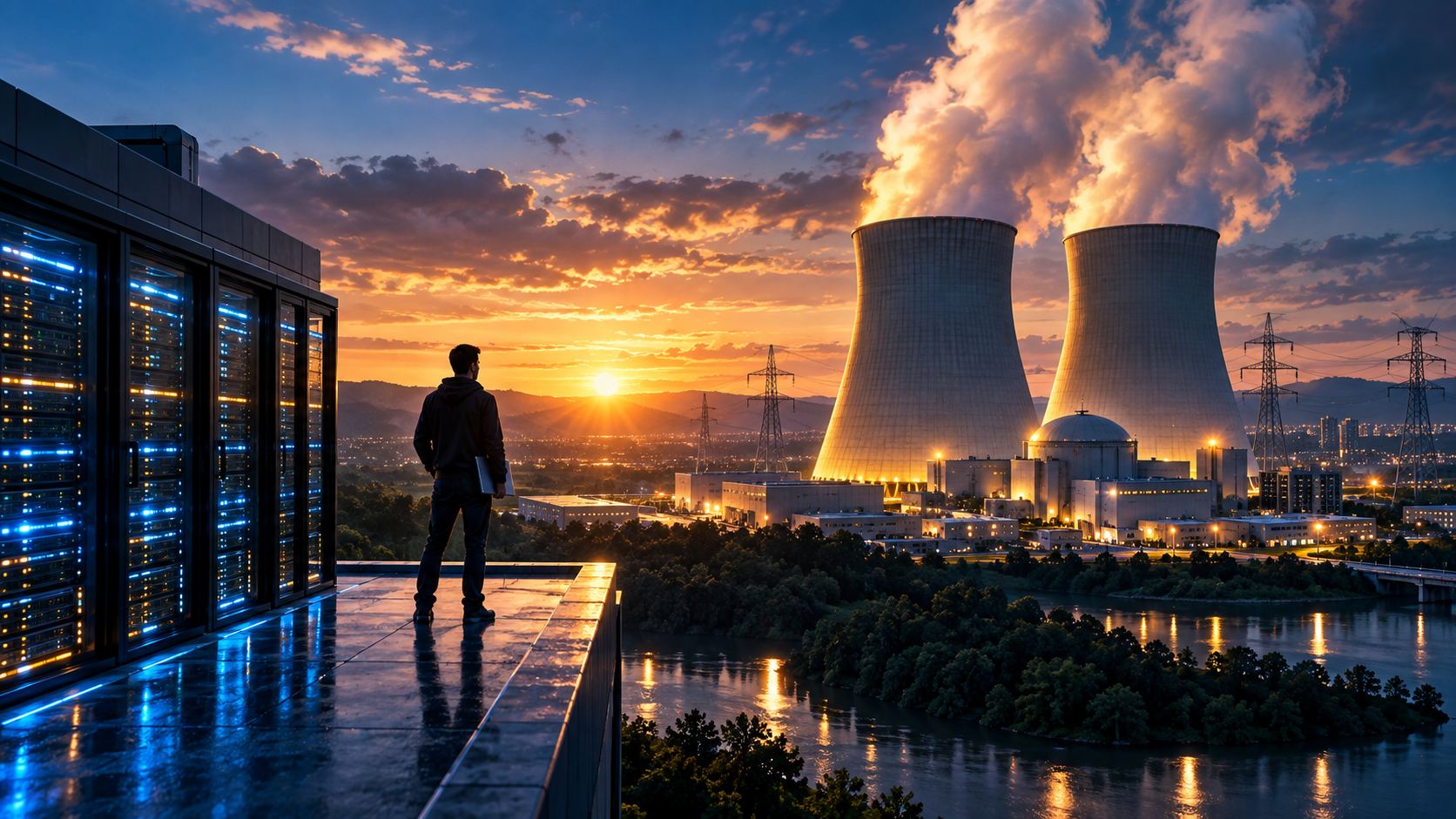
The bullish case for nuclear power has become unusually easy to understand. Artificial intelligence needs data centers, data centers need enormous quantities of electricity, and the technology industry increasingly wants power that is both reliable and low-carbon.
The numbers are large enough to change the electricity market. Lawrence Berkeley National Laboratory estimated in 2026 that data centers could consume about 11.8% of total US electricity by 2030, with its range of scenarios running from 9.5% to 15.3%. The International Energy Agency expects global data-center electricity consumption to more than double by the end of the decade, with AI providing much of the growth.
Nuclear seems almost designed for this problem. US reactors operated at an average 91% capacity factor in 2025, meaning they produced close to their maximum potential output across the year. Unlike wind and solar, existing reactors can deliver large amounts of power regardless of weather or time of day.
Microsoft, Meta, Google and Amazon have all pursued nuclear agreements or projects as their infrastructure requirements expand. Nuclear power has moved from a relatively unfashionable corner of the energy market into the middle of the AI infrastructure conversation.
Yet nuclear stocks remain capable of violent rallies, deep corrections and abrupt reversals.
That is not necessarily a contradiction. AI can strengthen the long-term case for nuclear electricity without removing the financial, regulatory, commodity and execution risks attached to the companies trying to profit from it.
The important question is not simply whether the world needs more nuclear power.
It is which part of the nuclear industry actually captures that demand, how much capital it will require and how long investors must wait for the cash flow to arrive.
Table of Contents
- The AI power boom is genuinely bullish for nuclear
- “Nuclear stocks” are several different investments
- AI moves faster than nuclear construction
- Nuclear still carries enormous execution risk
- Uranium creates its own volatility cycle
- The nuclear fuel cycle is also a geopolitical trade
- Valuation can move faster than the technology
- What actually matters when analyzing nuclear stocks
- Nuclear stocks and the AI boom: key questions
The AI power boom is genuinely bullish for nuclear
The simplest version of the nuclear thesis is not wrong.
Data centers are becoming major industrial electricity consumers. According to Lawrence Berkeley National Laboratory’s 2025 update on US data-center energy use, they could account for roughly 11.8% of national electricity consumption by 2030.
The International Energy Agency expects global data-center consumption to reach around 945 TWh by 2030, more than twice its 2024 level. Renewables are expected to supply much of the additional electricity, but natural gas and nuclear also become important because data centers need power when renewable generation is unavailable.
This helps explain why technology companies are suddenly appearing in nuclear announcements.
Microsoft signed a 20-year power purchase agreement with Constellation supporting the restart of the former Three Mile Island Unit 1 in Pennsylvania, now called the Crane Clean Energy Center. Constellation expects the plant to return to service in 2027 and provide approximately 835 MW of capacity.
Meta followed with a 20-year agreement supporting Constellation’s Clinton Clean Energy Center in Illinois, covering 1,121 MW of nuclear generation beginning in 2027.
Google has backed a different route. Its partnership with Kairos Power and the Tennessee Valley Authority is intended to support advanced reactors, with the first project scheduled for 2030 and a broader collaboration targeting up to 500 MW.
Amazon has also supported nuclear projects involving existing plants and proposed small modular reactors.
These agreements matter because large technology companies can provide something nuclear projects desperately need: customers willing to make long-term commitments to large quantities of electricity.
That can improve project economics dramatically.
It does not make every company exposed to nuclear power equally valuable.
“Nuclear stocks” are several different investments
One reason nuclear stocks appear so erratic is that the label combines businesses with almost completely different economics.
Existing nuclear operators own reactors that already generate electricity. Their economics depend on power prices, operating performance, outages, long-term contracts, regulation and the cost of maintaining or extending their plants. Constellation is a prominent US example.
Uranium miners sit much further upstream. Companies such as Cameco and Kazatomprom primarily care about uranium production, contracting, mining costs and uranium prices. More nuclear generation can support long-term uranium demand, but electricity prices at an AI data center do not flow directly into a uranium miner’s earnings.
Fuel and enrichment companies occupy another part of the chain. Centrus Energy, for example, has become closely associated with efforts to rebuild US uranium-enrichment capacity and produce high-assay low-enriched uranium, or HALEU, required by some advanced reactor designs.
Then there are advanced-reactor developers such as Oklo and NuScale. Their potential value is tied heavily to future deployments. Regulatory approvals, customer agreements, financing, construction schedules and technology execution can therefore matter more than current electricity demand.
Equipment makers and engineering companies add another layer again.
The result is a sector where two stocks can both benefit from the same nuclear renaissance while reacting to completely different news.
An operating plant signing a 20-year power agreement is fundamentally different from a reactor developer signing a non-binding expression of interest for a project that may not operate for years.
AI moves faster than nuclear construction
The AI industry can order another generation of GPUs within months.
A nuclear reactor works on a different clock.
That mismatch is one of the most important reasons the nuclear trade remains volatile.
Existing reactors have an obvious advantage because the expensive physical asset already exists. They can potentially capture stronger electricity demand through renewed contracts, license extensions, capacity uprates or, in unusual cases, the restart of previously closed facilities.
New reactors require much more.
They need sites, engineering work, permits, licenses, financing, equipment, fuel, construction and customers. Each stage can create another decision point where the schedule or economics change.
Regulation is becoming more supportive in the United States. The ADVANCE Act was signed into law in 2024, and in March 2026 the Nuclear Regulatory Commission issued its new Part 53 licensing framework intended to provide an alternative pathway for advanced reactors.
Progress is real. So are the remaining steps.
NuScale received NRC standard design approval for its 462 MW US460 plant design in 2025. That is a significant regulatory achievement, but it does not mean a finished NuScale plant can simply appear on the grid. Individual projects still require the appropriate construction and operating approvals.
Oklo provides an even clearer illustration of the timeline problem. As of September 2026, the NRC remains engaged in pre-application activities for the company’s proposed Aurora Powerhouse. Investors can therefore assign substantial value to future commercial deployment long before the corresponding reactors are generating revenue.
Markets hate empty space.
When years separate today’s valuation from tomorrow’s hoped-for cash flow, every licensing milestone, customer announcement, delay or financing decision can produce a disproportionate move in the stock.
Nuclear still carries enormous execution risk
Modern enthusiasm for nuclear power exists alongside a very expensive recent history.
The Vogtle expansion in Georgia demonstrates why investors remain nervous about construction.
Work on Units 3 and 4 began in 2009. They were originally expected to cost about $14 billion, with commercial operation planned for 2016 and 2017. Unit 3 eventually entered commercial operation in July 2023 and Unit 4 in April 2024.
Vogtle now produces enormous quantities of reliable electricity and represents a major piece of US nuclear infrastructure. Financial markets remember the journey as well as the destination.
Advanced-reactor companies argue that smaller designs, factory manufacturing and greater standardization can improve the economics. That is part of the attraction of small modular reactors.
But the first commercial projects still have to prove those advantages in practice.
The distinction matters because a reactor can work technically and still become a poor investment if it costs too much, arrives too late or requires repeated injections of capital.
The IEA identifies scale, capital intensity, long construction times and technical complexity as persistent financing challenges for new nuclear projects. Long-term power contracts can reduce some of that risk by making future revenue more predictable, which is one reason hyperscaler agreements carry so much weight.
They cannot eliminate construction risk.
Uranium creates its own volatility cycle
The nuclear revival has also revived interest in uranium.
Again, the basic thesis makes sense. More reactors operating for longer periods require more fuel. New reactors create additional future demand. Years of weak uranium pricing following the Fukushima accident also discouraged investment in new mine supply.
But the uranium market does not behave like a simple real-time meter of reactor demand.
Utilities typically secure much of their uranium through long-term contracts rather than buying everything on the spot market. Cameco describes the spot uranium market as relatively thin, with most run-rate fuel requirements procured under longer agreements.
That can produce strange-looking market behavior.
A strong nuclear outlook does not automatically force the uranium spot price upward every week. Utilities may already have fuel contracted. Producers may restart mines when prices improve. Inventories can enter the market. Financial buyers can change positions. A major producer can alter its production guidance.
Supply is also concentrated.
Kazatomprom, the world’s largest uranium producer, entered 2026 with output guidance still subject to factors including the availability of sulfuric acid used in its mining operations. Its planned 2026 production had previously been revised lower than the nominal level once envisaged.
For a uranium miner, those details can matter immediately.
For an AI data center signing a nuclear power contract, they may barely register.
This is why a uranium stock can fall during a period when the strategic case for nuclear electricity is improving. The miner is effectively a leveraged exposure to uranium-market economics, not a direct ownership claim on AI electricity demand.
The nuclear fuel cycle is also a geopolitical trade
Mining uranium is only the beginning.
Natural uranium must be converted and enriched before it can become reactor fuel. Some advanced reactors require HALEU, which contains a higher concentration of uranium-235 than conventional reactor fuel.
Those markets are unusually concentrated.
The IEA estimated in its 2025 nuclear report that four suppliers controlled more than 99% of global enrichment capacity, with Russia alone accounting for around 40%.
That has turned enrichment into an energy-security issue.
The United States banned imports of Russian low-enriched uranium beginning in August 2024, although the law allows temporary waivers under specified conditions through the end of 2027.
Washington has simultaneously been trying to build more domestic capacity. In July 2026, Centrus announced a $900 million Department of Energy task order supporting the expansion of domestic HALEU production, with the total contract potentially exceeding $1 billion if options are exercised.
This may eventually produce an attractive domestic nuclear-fuel industry.
It also means companies in this part of the market can trade on government contracts, appropriations, trade restrictions, enrichment capacity and reactor-fuel specifications.
AI demand is part of the background.
Policy can dominate the foreground.
Valuation can move faster than the technology
There is another source of volatility that has little to do with nuclear physics.
Stocks trade every day. Reactors do not.
When investors become excited about a theme, equity valuations can compress years of expected growth into the present. A company that might build a valuable fleet of reactors in the 2030s can receive a substantial valuation before those plants exist.
That makes the share price extremely sensitive to assumptions.
Imagine that investors believe a developer has a good chance of deploying several reactors within five years. Move the expected date back by two years, increase the assumed construction cost, raise the amount of equity financing required or reduce the probability of regulatory success, and the theoretical present value can change sharply even though the underlying reactor design has not changed.
Interest rates amplify the effect.
Many nuclear projects require large amounts of capital long before they produce electricity. Higher financing costs can therefore damage project economics directly. They can also reduce the valuation investors are willing to pay today for corporate cash flows expected far into the future.
Early-stage nuclear companies can consequently behave more like speculative technology stocks than traditional utilities.
Existing operators are usually less extreme because they already own revenue-producing assets, but they have their own variables: outages, hedging, wholesale electricity prices, operating expenses, regulation and the terms of major customer agreements.
A strong industry trend can support a company without guaranteeing that its stock is attractively priced.
That distinction becomes especially important after a sector has already experienced a large narrative-driven rally.
What actually matters when analyzing nuclear stocks
The AI power boom gives the nuclear industry something it lacked for years: a powerful new source of electricity demand combined with customers wealthy enough to sign very large contracts.
That improves the backdrop.
Analyzing an individual nuclear stock still requires looking beneath the theme.
For an existing operator, the important questions include how much nuclear capacity it owns, the remaining life of those reactors, their operating performance, power prices and the quality of long-term customer contracts.
For a uranium producer, reserves, production costs, mine execution, contracting and realized uranium prices matter more directly.
For an enrichment or fuel company, domestic capacity, government support, customer commitments and the structure of the global fuel market become central.
For an advanced-reactor developer, the list becomes more demanding: regulatory status, technological maturity, signed customers, the difference between binding and non-binding agreements, expected construction costs, access to fuel, financing requirements and how much shareholder dilution could occur before meaningful revenue arrives.
Those companies may all appear in the same nuclear ETF or the same AI-power narrative.
They are not taking the same risks.
That is the underlying reason nuclear stocks can remain extraordinarily volatile even while the industry’s long-term outlook improves.
AI is making electricity more valuable. It is making reliable nuclear generation more strategically important. What it cannot do is remove the years of execution between a promising nuclear project and a profitable one.
The nuclear boom can therefore be real while individual nuclear stocks continue behaving like roller coasters.
Both can be true at the same time.
Nuclear stocks and the AI boom: key questions
Why are nuclear stocks so volatile?
The sector combines commodity exposure, government policy, regulation, expensive construction projects and companies whose expected revenue may still be years away. Small changes in uranium prices, project timelines, financing or investor expectations can therefore produce large share-price moves.
Why is AI increasing interest in nuclear power?
AI data centers require large and growing amounts of electricity. Nuclear plants can provide firm power around the clock while producing very low operational carbon emissions, making them attractive to technology companies trying to secure reliable electricity while meeting emissions targets.
Are all nuclear stocks exposed to the AI boom?
Not equally. Existing reactor operators can potentially benefit directly from higher electricity demand and long-term power agreements. Uranium miners benefit indirectly through fuel demand, while advanced-reactor developers depend on future projects actually reaching commercial operation.
Why can uranium stocks fall when nuclear demand is rising?
Uranium equities react to uranium prices, production costs, mine output, contracting and expectations for future supply. Utilities also buy much of their fuel through long-term contracts, so growing reactor demand does not translate instantly into higher spot prices.
Are small modular reactors already powering major AI data centers?
Most of the immediate nuclear power available to data centers comes from existing reactors or planned restarts. Several advanced-reactor projects are being developed with technology-company support, but the IEA expects the first commercial SMRs to begin contributing around 2030.
Does regulatory approval mean an SMR is ready to be built?
Not necessarily. Approval of a reactor design can be an important milestone, but specific projects can still require construction permits, operating licenses, site approvals, financing and other regulatory steps.
Are nuclear stocks safer because technology companies are signing long-term contracts?
Long-term agreements with strong customers can improve revenue visibility and make individual projects easier to finance. They do not remove construction, operational, regulatory or valuation risk.
Is investing in nuclear stocks the same as investing in uranium?
No. Uranium miners are exposed primarily to the economics of producing and selling nuclear fuel. Reactor operators sell electricity, while developers, engineering companies and enrichment businesses each have different revenue models and risks.
Is this financial advice?
No. This article is for informational purposes only and does not constitute personalized investment, trading or financial advice. Nuclear and uranium stocks can be highly volatile, and individual companies can carry materially different risks.
Sources: Lawrence Berkeley National Laboratory, International Energy Agency, US Nuclear Regulatory Commission