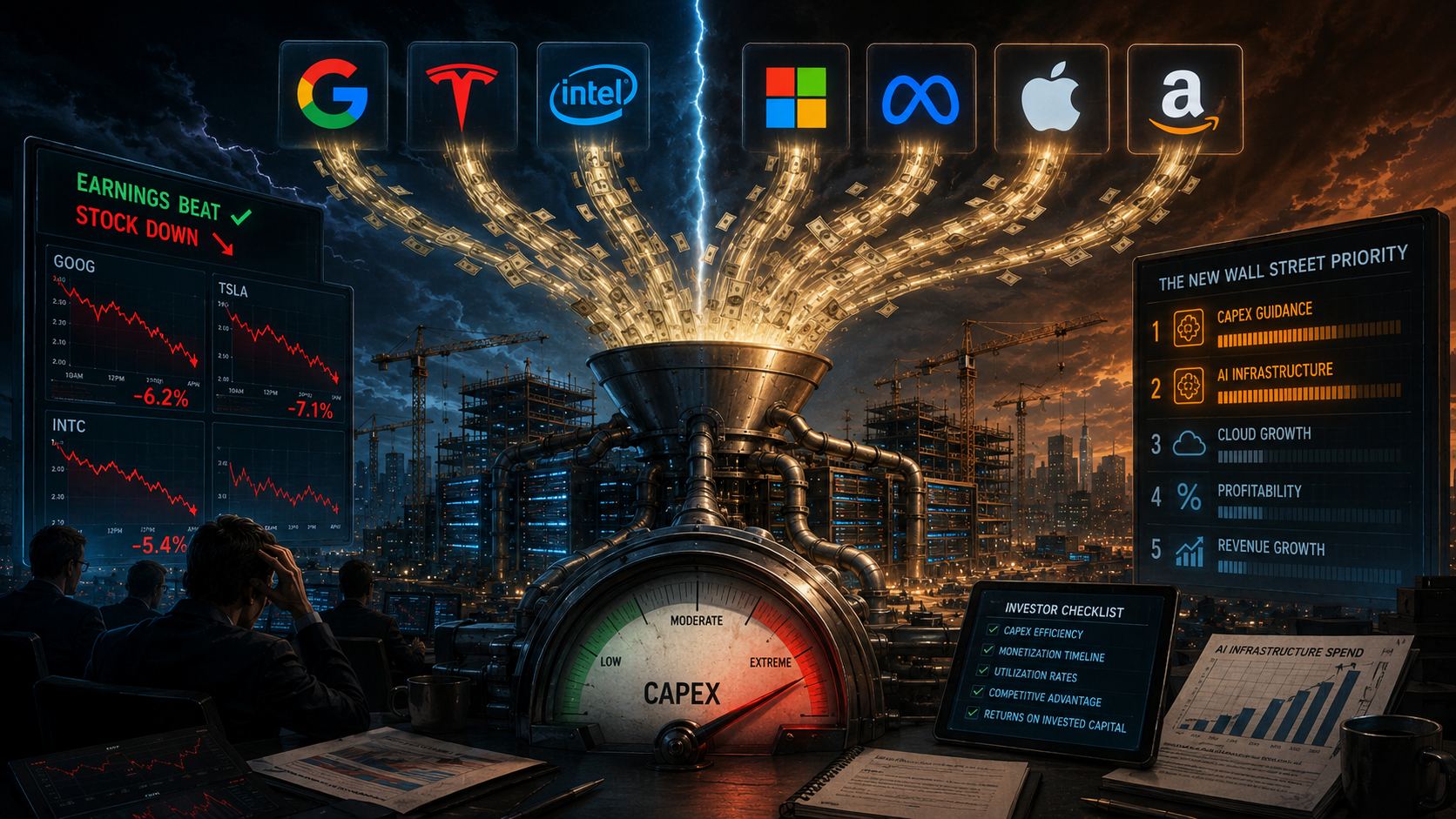
Alphabet, Tesla and Intel all gave investors something to celebrate during the latest earnings cycle. Each company beat at least one major Wall Street expectation. Each also watched its market value fall.
That sounds irrational until you look at the statistic Wall Street has promoted above almost everything else: AI capex.
Alphabet reported stronger-than-expected revenue, powered by explosive Google Cloud growth, but investors focused on another increase in its capital expenditure forecast. Tesla’s earlier earnings beat was overshadowed by concerns about cash consumption and the cost of its robotaxi, artificial intelligence and robotics ambitions. Intel delivered a major revenue surprise, only for its shares to fall as the market examined spending requirements and the durability of its recovery.
Welcome to the new Big Tech earnings paradox. Revenue can beat. Earnings can beat. Cloud demand can accelerate. Yet a company can still lose billions of dollars in market value because investors do not like the price of its AI ambitions.
Welcome to the AI spending paradox
The old earnings-season playbook was simple. A company beat revenue expectations, exceeded earnings estimates and raised its outlook. The stock usually went up.
That formula has stopped working reliably for Big Tech.
Alphabet offered the clearest example. Google Cloud revenue surged during its latest quarter, helping total revenue exceed Wall Street forecasts. The company nevertheless increased its 2026 capital expenditure guidance to between $195 billion and $205 billion. Alphabet also reported negative quarterly free cash flow as infrastructure investment absorbed cash.
The result was a familiar “beat and drop” reaction. Investors were impressed by the growth but alarmed by the bill required to produce it. Reuters reported that Alphabet shares fell after the company raised its spending forecast, despite the strength of Google Cloud.
Tesla and Intel faced different versions of the same problem. Neither company should be evaluated exactly like a cloud hyperscaler, but both are asking shareholders to finance capital-intensive transformations. Tesla is investing in AI computing, autonomous vehicles and robotics. Intel must fund advanced manufacturing while trying to rebuild its competitive position in data centers and processors.
In each case, the market is asking the same question: How much cash must disappear before the promised future arrives?
That is why good earnings can now produce falling share prices. The quarterly score matters, but investors are increasingly pricing the cost of the next several seasons.
Why AI capex is the metric that eats everything
In Moneyball, the Oakland Athletics stopped evaluating players with the same familiar statistics as everyone else. They searched for the number that better explained how games were actually won.
Wall Street has performed its own statistical revolution. Its new obsession is AI capex: the money spent on data centers, servers, GPUs, networking systems, power capacity and cooling infrastructure.
Revenue growth still matters. Operating margins still matter. Earnings per share still matters. But those numbers describe what a company has already achieved. Capital expenditure guidance provides clues about how much shareholders must fund before the next stage of growth becomes profitable.
This has changed the hierarchy of an earnings call.
Investors once rushed to find the revenue growth rate. Now they search the release for capital expenditure guidance. They compare that spending with free cash flow, cloud growth and management’s previous forecast. One revised number can overwhelm an otherwise excellent report.
The concern is not that AI infrastructure is useless. Demand for computing capacity remains strong across Azure, Amazon Web Services and Google Cloud. The concern is that the industry may be building capacity faster than it can monetize it.
AI equipment is also not a one-time expense. Chips become less competitive. Servers require electricity and maintenance. New data centers create depreciation costs that can pressure future margins long after the initial cash payment has been made.
That makes AI capex both an investment in growth and a long-term financial commitment. Wall Street is no longer rewarding the size of the ambition. It wants evidence that the economics work.
Microsoft, Meta, Amazon and Apple face the next test
The next boss battle belongs to Microsoft, Meta, Amazon and Apple.
Six months ago, management teams could announce larger AI budgets and present them as proof of competitive strength. Today, the market is more skeptical. Investors have seen spending forecasts climb repeatedly, while the direct revenue created by generative AI remains difficult to isolate.
Microsoft will be judged on Azure growth, capacity constraints and the commercial contribution of its AI services. Strong Azure demand would support the argument that infrastructure spending is following real customer orders rather than speculative forecasts.
However, growth alone may not be enough. Investors will listen for signs that new capacity can produce attractive margins. They will also watch whether depreciation and energy expenses are growing faster than cloud revenue.
Amazon faces a similar test with AWS. The company can point to enterprise demand, its custom Trainium chips and the scale of its cloud platform. The critical question is whether its massive infrastructure program strengthens AWS profitability or begins to dilute it.
Meta’s case is different. It does not operate a cloud platform comparable to Azure or AWS. Its AI investments must primarily improve advertising performance, engagement, recommendation systems and new products. Investors therefore need measurable evidence that higher AI capex is producing better ad conversion, stronger revenue or lower operating costs.
Apple has largely avoided matching the spending intensity of the hyperscalers. That restraint could protect margins and free cash flow. It could also leave Apple dependent on partners for important AI capabilities. The market must decide whether Apple’s lighter infrastructure strategy represents discipline or delay.
These companies are entering an Avengers: Infinity War moment. They may have different powers and business models, but they are all facing the same final boss: proving that enormous AI budgets can generate proportionally enormous returns.
Is this Dot-com 2.0 or Cloud 2.0?
Every technology investment boom eventually receives the same label: the next dot-com bubble.
The comparison is not completely wrong. AI valuations are high, expectations are aggressive and companies are spending extraordinary amounts to secure market position. Some projects will fail. Some capacity will probably be built in the wrong place or at the wrong price.
But today’s hyperscalers are not fragile startups without revenue. Microsoft, Alphabet, Amazon and Meta generate enormous cash flows from established businesses. They can fund infrastructure on a scale that would have been impossible for most dot-com companies.
The cloud computing cycle may be the more useful comparison.
Amazon, Microsoft and Google once spent heavily on data centers before the cloud’s full economic potential was clear. Investors questioned those investments, but AWS, Azure and Google Cloud eventually became strategic growth engines.
The difference is speed and scale. The AI race compresses massive infrastructure decisions into a shorter period. Several companies are ordering similar chips, pursuing similar customers and building capacity based on similar assumptions about future demand.
That creates a risk the early cloud market did not face to the same degree: everyone may be following the same spreadsheet.
This is where the Moneyball metaphor breaks down. A useful statistic can become less useful once every team optimizes around it. Wall Street is right to monitor AI capex, but spending less is not automatically smart, and spending more is not automatically reckless.
The real question is what each dollar produces.
How to separate productive AI spending from value destruction
Investors do not need to predict the exact number of GPUs each company will require. They need a framework for deciding whether AI investment is creating durable value.
First, compare spending growth with AI-related revenue growth.
Cloud revenue should accelerate as infrastructure expands. For Microsoft and Amazon, watch Azure and AWS. For Alphabet, watch Google Cloud revenue, margins and backlog. If spending rises much faster than the businesses expected to monetize it, the risk increases.
Second, monitor free cash flow rather than earnings alone.
Capital expenditure does not hit adjusted earnings in the same way as an immediate operating expense. A company can therefore report strong earnings while consuming much more cash. Free cash flow shows how much financial flexibility remains after infrastructure spending.
Third, listen for evidence of real demand.
Capacity constraints, contracted backlog, enterprise commitments and rising utilization are stronger signals than vague statements about long-term opportunity. Management should be able to explain who needs the infrastructure and how the company expects to make money from it.
Fourth, watch depreciation and margins.
Today’s data center construction becomes tomorrow’s depreciation expense. If cloud margins weaken as new infrastructure enters service, investors may conclude that the revenue opportunity is less profitable than expected.
Finally, distinguish defensive spending from productive spending.
A company may invest because customers are demanding more capacity. It may also invest because executives fear being left behind. The first can create value. The second can turn into an expensive arms race.
That is the practical “so what?” for upcoming earnings calls. Do not stop at whether AI capex increased. Ask whether demand, revenue, margins and cash generation increased with it.
Wall Street has not suddenly turned against artificial intelligence. It has simply moved to the next stage of the story. The market already believes AI will matter. Now it wants proof that the companies building its infrastructure can earn more than they spend.
For the Magnificent Seven, defeating the final boss will require more than another earnings beat. They must show investors the return on the Infinity Gauntlet.
AI capex: key questions for investors
What does AI capex include?
AI capex generally includes spending on data centers, processors, servers, networking equipment, power systems and other long-term infrastructure used to train and operate AI models.
Why can a stock fall after an earnings beat?
A stock can fall when expectations were already high, guidance disappoints or management announces spending that could reduce future cash flow and margins.
Why are Azure and AWS important to this debate?
Azure and AWS provide evidence of whether enterprise demand for AI computing is translating into sustainable cloud revenue.
Is rising AI capex always a negative signal?
No. Higher spending can create substantial long-term value when it follows real demand and generates attractive revenue, margins and cash returns.
What should investors monitor during Big Tech earnings calls?
Investors should track capital expenditure guidance, cloud growth, free cash flow, contracted demand, utilization, depreciation expenses and management’s explanation of expected returns.
Is this article financial advice?
No. This article is provided for informational purposes only and does not constitute investment or financial advice. Investors should conduct independent research before making financial decisions.