
AI agents are one of the biggest ideas in artificial intelligence right now because they move AI beyond simple answers. A chatbot responds. An AI agent can plan, use tools, follow steps, check progress, and work toward a goal.
That distinction is why the term is suddenly everywhere. After the first wave of generative AI tools, the next obvious question became: what if AI could do more than write, summarize, or explain? What if it could actually help complete the work?
That is the promise of AI agents. It is also where the hype gets very loud, very fast. Not every “agent” is autonomous. Not every chatbot with a tool button is suddenly a digital employee. And no serious business should hand an AI system unlimited access to email, payments, customer data, or production infrastructure just because a demo looked impressive.
The simple version is this: an AI agent is an AI-powered system that can take actions toward a goal, often by using tools, data, memory, and multi-step workflows. It connects AI to action — and that is exactly why it matters.
Sommaire
- What is an AI agent?
- How does an AI agent work?
- Why do AI agents matter now?
- Real-world uses of AI agents
- Common mistakes about AI agents
- AI agent vs related concepts
- What beginners should remember
- What to Remember (FAQ)
What is an AI agent?
An AI agent is a software system that uses artificial intelligence to pursue a goal and complete tasks on behalf of a user, a team, or another system.
Unlike a basic chatbot that only responds to prompts, an AI agent can often decide what steps are needed, use external tools, access information, call APIs, update files, trigger workflows, or interact with other software. In other words, the agent is not limited to producing a nice answer in a chat window. It can help move a process forward.
A simple chatbot might answer: “Here is how to book a flight.”
An AI agent could compare flights, check your calendar, apply your preferences, select the best option, ask for approval, and then complete the booking through a connected service.
That difference matters. The first system gives information. The second system uses information to act.
An AI agent is not only about generating text. It is about connecting AI models to tools, instructions, data, and real-world workflows. That makes agents potentially much more useful than standalone chatbots — and much more sensitive to design mistakes.
For the foundation behind this concept, see our guide to AI models.
How does an AI agent work?
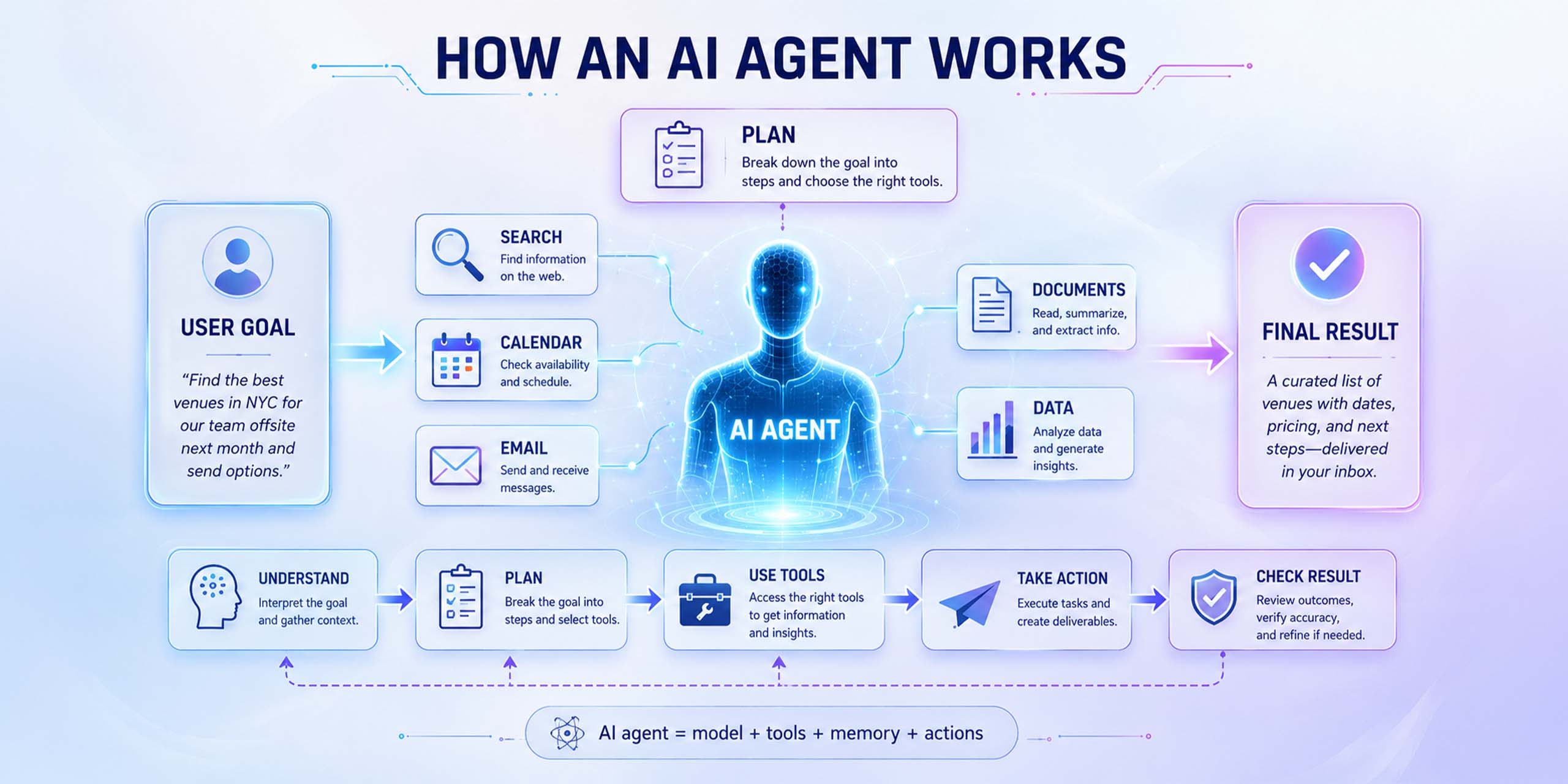
An AI agent usually combines several parts. The model is only one of them.
The first part is the AI model. In many modern agents, this is a large language model because LLMs are good at interpreting instructions, working with text, planning steps, and generating responses. But agents can also use other models depending on the task, including vision models, classification models, recommendation models, or specialized systems.
The second part is the goal. The agent needs to know what it is trying to achieve. “Summarize this document” is a narrow goal. “Prepare a weekly sales report from CRM data and email it to the team after approval” is a broader workflow.
The third part is context. This can include user instructions, documents, data, preferences, previous messages, system rules, retrieved information, or business-specific knowledge. Without good context, an agent is basically guessing with confidence — never ideal, and sometimes a tiny corporate horror movie.
The fourth part is tools. These tools may include search, calendars, email, databases, code execution, APIs, file systems, browsers, business apps, project management software, or internal company platforms. Tool access is what lets an agent move from “I suggest” to “I did.”
The fifth part is planning. The agent breaks a task into smaller steps, decides what needs to happen first, and chooses which tools to use.
The sixth part is execution. The agent performs actions: searching a document, updating a record, writing a file, drafting a response, running a test, or triggering a workflow.
The seventh part is feedback. A good agent should check whether its action worked, adapt when something fails, and ask for human approval when the action is important, risky, expensive, or irreversible.
A simplified AI agent workflow looks like this:
- User goal: the task the user wants completed.
- Context: the information the agent needs to understand the situation.
- Planning: the agent decides what steps are needed.
- Tool use: the agent interacts with software, data, or external systems.
- Action: the agent performs part of the task.
- Evaluation: the agent checks progress or asks for confirmation.
- Result: the task is completed, summarized, or handed back to the user.
This is why AI agents are often described as more “active” than regular AI assistants. They do not just produce an answer. They help operate a workflow.
Why do AI agents matter now?
AI agents matter because they represent the next step after chatbots and generative AI tools. The first wave of modern AI helped people generate content: text, images, summaries, code, ideas, drafts, outlines, and explanations. That was already a major shift.
Agents aim to go further. They connect that intelligence to workflows.
A normal AI assistant can draft an email. An AI agent could draft the email, find the right recipient, pull relevant context from a CRM, check previous conversations, suggest the best timing, and prepare the message for approval.
A normal AI assistant can explain a bug. A coding agent could inspect the repository, propose a fix, edit files, run tests, and open a pull request.
A normal AI assistant can summarize a meeting. An operations agent could extract action items, update a project management tool, create calendar reminders, and notify the right team members.
That is why agents are getting so much attention. They promise to automate not just isolated tasks, but entire chains of work. For businesses, this is the difference between saving ten minutes on a draft and redesigning how a process runs.
The key word, though, is promise. Many agent systems still need narrow scopes, reliable tools, careful permissions, strong logging, and human oversight. They can fail in weird ways: choosing the wrong tool, misunderstanding the goal, skipping a step, hallucinating context, or taking an action that technically works but is strategically wrong.
Still, the direction is clear. AI is moving from answering questions to helping execute work. That is a major shift in how software may operate over the next few years.
Real-world uses of AI agents
AI agents can be useful in many professional workflows, especially when the work involves repeatable steps, software tools, documents, and decisions that can be reviewed.
In customer support, an AI agent can read a ticket, identify the issue, retrieve account information, suggest a solution, draft a reply, escalate complex cases, or update the support system. The best version does not pretend every customer problem is simple. It handles the repetitive layer and knows when to hand the conversation to a human.
In sales, an AI agent can research leads, summarize company information, prepare outreach drafts, update CRM records, and remind sales teams about follow-ups. A useful sales agent does not just generate generic messages. It pulls context together so the human salesperson can act faster and with less busywork.
In software development, coding agents can inspect code, suggest fixes, generate tests, write documentation, and help developers manage repetitive technical work. The dream is not just autocomplete on steroids. It is an assistant that can understand a task, modify a codebase, run checks, and explain what changed.
In marketing, agents can analyze performance data, generate campaign variations, prepare content calendars, create briefs, organize assets, and route materials for approval. This is especially useful when marketing teams are stuck between too many channels, too many formats, and not enough time.
In business operations, agents can process documents, extract data, update spreadsheets, summarize reports, prepare meeting notes, and coordinate workflows across tools. This is where AI agents may become boring in the best possible way: less spectacle, more saved hours.
In finance, agents can help categorize expenses, flag anomalies, prepare reports, compare invoices, and support compliance workflows. Human validation is essential here because money, legal obligations, and sensitive data leave very little room for “the AI probably got it right.”
In human resources, agents can help summarize resumes, draft job descriptions, prepare onboarding documents, answer internal policy questions, and organize employee requests. The sensitive part is obvious: HR workflows need fairness, privacy, and human accountability.
In research, agents can search documents, extract key information, compare sources, build summaries, and prepare structured notes. This becomes much more useful when the agent works from trusted documents rather than vague model memory.
The best agent use cases usually have a clear goal, a narrow scope, trusted data, defined tools, and an obvious point where a human can review or approve the result. The weaker use cases are the ones that ask an agent to “handle everything” and hope nothing catches fire.
Common mistakes about AI agents
The first mistake is thinking an AI agent is fully independent. Most useful agents still need boundaries, instructions, permissions, monitoring, and human review. Autonomy should be designed carefully, not assumed because the product page says “agentic.”
The second mistake is calling every chatbot an agent. A chatbot that only answers questions is not necessarily an AI agent. To be an agent, the system should be able to pursue a goal, plan steps, use tools, or take actions. Conversation alone is not enough.
The third mistake is giving an agent too much freedom too early. An AI agent with access to email, files, payments, databases, customer records, or production systems can create real problems if it misunderstands a task or uses a tool incorrectly. The more access it has, the more guardrails it needs.
The fourth mistake is ignoring security. AI agents often need access to sensitive systems, which means permissions, logging, approval flows, data privacy, access control, and audit trails matter a lot. A poorly designed agent can become a very efficient way to spread mistakes across multiple tools.
The fifth mistake is expecting perfect reasoning. AI agents may use powerful models, but they can still hallucinate details, skip steps, misunderstand goals, choose the wrong tool, or fail to notice that an action did not work. A multi-step workflow gives the system more chances to be useful, but also more chances to drift.
The sixth mistake is building agents without evaluation. If an AI agent is supposed to complete a workflow, teams need to test whether it actually succeeds. They also need to measure failure cases, cost, speed, reliability, security risk, and user trust. “It worked in the demo” is not an evaluation strategy.
The seventh mistake is forgetting the human handoff. A good AI agent should know when to stop, ask, escalate, or request approval. The worst agents are not the ones that admit uncertainty. The worst agents are the ones that confidently continue after losing the plot.
AI agents are exciting, but they are not magic employees. They are software systems, and software systems need careful design.
AI agent vs related concepts
An AI agent is related to AI models, LLMs, generative AI, chatbots, and automation, but it is not the same thing as any of them.
An AI model is the trained system that produces outputs from inputs. An AI agent may use one or more AI models, but the agent also includes goals, tools, memory, planning, and action.
An LLM is a language-focused AI model. Many AI agents use LLMs because language models are good at interpreting instructions, reasoning over text, and generating responses. But the agent is the full system, not just the model.
Generative AI creates new content. An AI agent may use generative AI to write, summarize, code, or explain, but the agent’s defining feature is its ability to pursue a goal and take steps.
A chatbot is a conversational interface. Some chatbots are simple. Some are powered by LLMs. Some include agent-like features. But conversation alone does not make a system an agent.
Automation usually follows fixed rules: if this happens, do that. An AI agent can be more flexible because it can interpret context, choose between tools, and adapt its next step. That flexibility is useful, but it also creates more risk.
Here is the clean version:
- AI model: the trained system.
- LLM: a language-focused AI model.
- Generative AI: AI that creates new content.
- Chatbot: a conversation interface.
- Automation: a fixed workflow or rule-based process.
- AI agent: an AI system that uses models and tools to work toward a goal.
For more context, read our guide to LLMs and our guide to generative AI.
What beginners should remember
The most important thing to remember is that an AI agent is AI connected to action.
A basic AI tool can answer a question. A generative AI tool can create content. An AI agent can use tools and take steps toward a goal. That makes agents powerful, but also more sensitive than a normal chatbot.
The more an agent can do, the more carefully it needs to be controlled.
A safe AI agent should have a clear task, limited permissions, reliable tools, good context, strong logging, and human approval for important actions. This is not just caution for the sake of caution. It is the difference between a helpful assistant and a system that can make mistakes at scale.
For beginners, the best way to think about AI agents is this: they are not just chatbots with a fancy name. They are systems designed to plan, act, and complete work.
That is why they may become one of the most important parts of the next AI wave. Not because every agent will be autonomous, brilliant, or trustworthy by default. But because connecting AI to tools and workflows changes what AI can actually do.
What to Remember (FAQ)
What is an AI agent in simple terms?
An AI agent is an AI-powered system that can work toward a goal, often by planning steps, using tools, and taking actions on behalf of a user.
Is ChatGPT an AI agent?
ChatGPT can include agent-like features depending on how it is used and what tools it can access. A basic chatbot conversation is not automatically an AI agent.
What can AI agents do?
AI agents can help with tasks such as customer support, coding, research, scheduling, document processing, sales workflows, marketing operations, and business automation.
What is the difference between an AI agent and an LLM?
An LLM is a language model. An AI agent may use an LLM, but it also includes goals, tools, planning, memory, and the ability to take actions.
Are AI agents dangerous?
AI agents can create risk if they have too much access, weak supervision, poor instructions, or unreliable tools. They should be designed with permissions, monitoring, testing, and human approval.
Why are AI agents important?
AI agents are important because they can move AI from answering questions to helping complete real workflows across software, data, and business systems.
Sources: IBM, Google Cloud, AWS