
Embeddings are one of the most important invisible ideas in modern AI. They help search engines understand meaning, recommendation systems find similar items, AI assistants retrieve documents, and RAG systems connect large language models to external knowledge.
The word sounds technical because, honestly, it is. Embeddings live in the mathematical basement of AI: vectors, dimensions, similarity scores, distance metrics, vector databases, all the fun stuff that makes normal people suddenly remember they had something urgent to do elsewhere.
But the basic idea is much easier than the jargon suggests.
The simple version is this: an embedding is a numerical representation of something — such as text, an image, a product, a song, or a user — that helps AI systems compare meaning and similarity.
A computer does not naturally understand that “cheap flights,” “budget plane tickets,” and “low-cost airfare” are related ideas. To a traditional keyword system, those phrases are different strings of text. Embeddings help machines represent them in a way that captures their relationship. Similar meanings end up closer together. Unrelated meanings end up farther apart.
That is why embeddings matter so much. They turn messy human information into a format machines can compare.
Sommaire
- What are embeddings?
- How do embeddings work?
- Why do embeddings matter now?
- Real-world uses of embeddings
- Common mistakes about embeddings
- Embeddings vs related concepts
- What beginners should remember
- What to Remember (FAQ)
What are embeddings?
Embeddings are numerical representations that capture useful relationships between pieces of data. In AI, those pieces of data can be words, sentences, documents, images, products, songs, users, videos, code snippets, support tickets, or almost anything a model can process.
An embedding usually looks like a long list of numbers. That list is called a vector. Each number helps place the item somewhere in a mathematical space. The exact numbers are not meaningful to humans in a simple “this number means happiness, this number means pizza” way. What matters is the position of the vector compared with other vectors.
If two pieces of text have similar meaning, their embeddings should be close together in that space. If they are unrelated, they should be farther apart.
For example:
- “How do I reset my password?”
- “I forgot my login password.”
- “Where can I change my account credentials?”
These sentences use different words, but they point toward a similar intent. A good embedding model can represent them as semantically close. That is what makes embeddings powerful for search, recommendations, clustering, classification, and AI assistants.
Embeddings are not limited to text. An image embedding can represent the visual content of a picture. A product embedding can represent features, descriptions, categories, and behavior patterns. A user embedding can represent preferences or activity. A song embedding can represent genre, tempo, mood, or listening patterns.
The point is always similar: turn complex data into numbers that preserve useful relationships.
For the broader foundation behind trained AI systems, read our guide to AI models.
How do embeddings work?
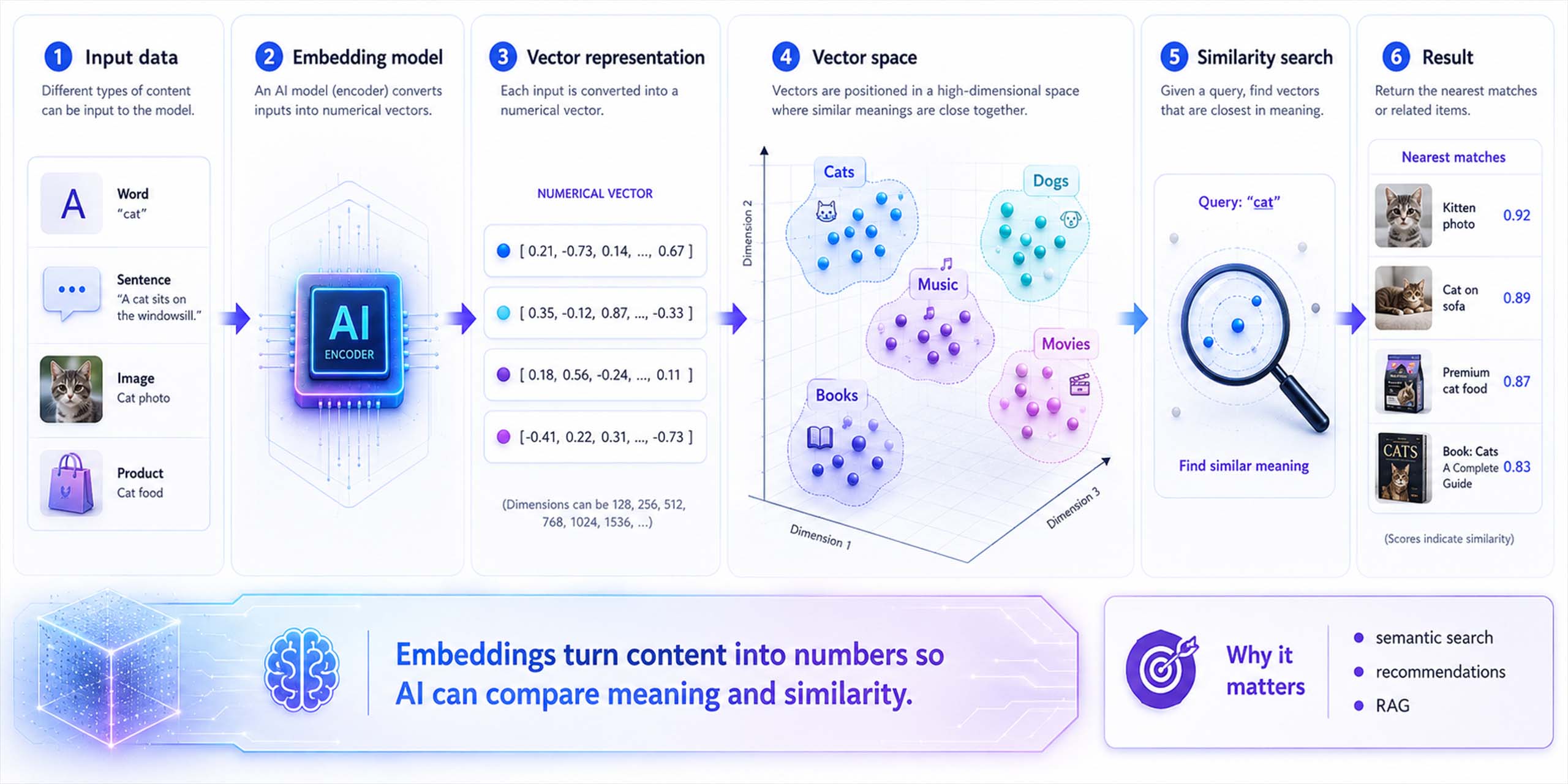
Embeddings work by using a trained model to convert data into vectors. The model has learned patterns from examples, so it can place similar items near each other in a shared mathematical space.
Imagine a map, but instead of mapping cities, it maps meaning. On a normal map, Paris and Lyon are closer than Paris and Tokyo. In an embedding space, “refund policy” and “return rules” may be closer than “refund policy” and “banana bread recipe.” The model is not drawing a physical map. It is building a numerical one.
A simplified embedding workflow looks like this:
- Input: a piece of data, such as a sentence, document, image, product, or audio clip.
- Embedding model: a trained AI model converts that input into a vector.
- Vector: the input becomes a list of numbers that captures useful patterns.
- Storage: vectors can be stored in a database or search index.
- Comparison: the system compares vectors to find similar items.
- Output: the system returns related documents, products, answers, recommendations, or clusters.
The comparison step is usually based on mathematical similarity. If two vectors point in a similar direction or sit near each other, the system treats them as related. This is what allows semantic search to find results that match the meaning of a query, not just the exact words.
Take a company help center. A user asks: “Can I get my money back after canceling?” The documentation might never use that exact sentence. It might say: “Refunds are available within 14 days of subscription termination.” A keyword search could miss the connection. An embedding-based search has a better chance of finding the relevant policy because the meaning is similar.
That is the quiet trick behind many AI search tools. They are not only matching words. They are comparing representations of meaning.
Why do embeddings matter now?
Embeddings matter now because AI systems need better ways to handle unstructured information. Most useful human data does not arrive as neat spreadsheet rows. It appears as documents, messages, images, product descriptions, transcripts, reviews, code, tickets, PDFs, chats, audio, and messy notes written by people who did not plan their lives around database hygiene.
Embeddings help AI systems organize that mess.
They are especially important for semantic search, where the goal is to find information based on meaning rather than exact keywords. This is why embeddings show up in modern search engines, enterprise knowledge tools, ecommerce search, document assistants, customer support bots, and recommendation systems.
They are also central to RAG, or retrieval-augmented generation. In a RAG system, embeddings can help retrieve relevant documents before a language model generates an answer. Instead of asking the model to guess, the system first finds related source material and gives it to the model as context. For the full explanation, read our guide to RAG in AI.
For businesses, this is a big deal. Embeddings make it possible to build AI tools that search internal documentation, compare customer requests, recommend products, detect duplicates, organize knowledge bases, and connect questions to useful sources.
For creators and media teams, embeddings can help organize archives, group similar stories, recommend related content, detect near-duplicates, and search across transcripts or image libraries.
For developers, embeddings are part of the practical AI stack. They connect language models to documents, vector databases, recommendation engines, and search systems. They are not glamorous, but neither is plumbing — and you miss it very quickly when it fails.
Embeddings matter because they give AI systems a usable sense of similarity.
Real-world uses of embeddings
Embeddings are used whenever a system needs to compare meaning, similarity, behavior, or structure.
In semantic search, embeddings help users find relevant information even when they do not use the exact words in the document. This is useful for help centers, internal wikis, research tools, ecommerce catalogs, legal archives, and media libraries.
In RAG systems, embeddings help retrieve relevant passages before a large language model answers. This is one of the most common ways to make AI assistants more grounded in specific documents instead of generic model knowledge.
In recommendation systems, embeddings can represent users, products, songs, videos, articles, games, or movies. If a user likes certain items, the system can find other items with nearby embeddings. That is how platforms can suggest content that feels related without needing a human to manually label every connection.
In ecommerce, embeddings can improve product search, match similar products, power “you may also like” sections, detect duplicate listings, and connect vague user queries to relevant catalog items.
In customer support, embeddings can match new tickets to old tickets, route questions to the right help article, identify recurring issues, and group similar complaints. A support team does not just need answers. It needs patterns.
In cybersecurity, embeddings can represent files, logs, behaviors, or messages so systems can detect unusual similarities or anomalies. This can help flag suspicious activity, phishing attempts, or malware families.
In software development, embeddings can help search code semantically, find similar functions, match documentation to code, group bug reports, or retrieve relevant project files for an AI coding assistant.
In media and publishing, embeddings can suggest related articles, organize large archives, detect topic similarity, improve internal search, and help editors find older coverage that connects to a new story.
In multimodal AI, embeddings can connect different kinds of data. A model may place an image and a text description in a shared space, making it possible to search images with words or match captions to visuals.
The common thread is simple: embeddings are useful when exact matching is too limited and meaning matters more than keywords.
Common mistakes about embeddings
The first mistake is thinking embeddings “understand” meaning like humans do. They do not. Embeddings represent patterns learned by a model. They can capture useful semantic relationships, but they do not have human understanding, judgment, intent, or common sense.
The second mistake is treating similarity as truth. Two documents can be similar without being accurate. A retrieved passage can be relevant but outdated. A product can look similar but be legally different, technically incompatible, or unavailable. Embeddings are good at finding related things. They do not decide whether those things are correct.
The third mistake is assuming embeddings solve search by themselves. A good search system also needs chunking, indexing, metadata, ranking, filtering, permissions, freshness, evaluation, and sometimes keyword search. Embeddings are powerful, but they are not a complete product strategy wearing a cape.
The fourth mistake is ignoring source quality. If the documents are messy, contradictory, outdated, or full of duplicates, embedding them will not magically make the knowledge base good. It will simply make the mess searchable in a more advanced way. Congratulations, you now have semantic chaos.
The fifth mistake is forgetting privacy. Embeddings may be derived from sensitive text, user behavior, customer records, internal documents, or proprietary code. Even though they are numerical representations, they still need careful handling, access control, retention policies, and security review.
The sixth mistake is thinking all embedding models are the same. Some are better for short queries. Some work better for long documents. Some are specialized for code, images, multilingual text, ecommerce, legal documents, or scientific content. Choosing the wrong embedding model can weaken the entire system.
The seventh mistake is skipping evaluation. A team should test whether the embeddings actually retrieve useful results for real user questions. Demo queries are easy. Production search is where optimism goes to be humbled.
Embeddings are one of the most useful ideas in AI, but they still need careful system design.
Embeddings vs related concepts
Embeddings sit near several AI concepts that are often used together.
Artificial intelligence is the broad field of building systems that perform tasks associated with intelligence, such as learning, language, perception, prediction, generation, and decision support.
Machine learning is one approach inside AI where systems learn patterns from data. Embedding models are trained through machine learning techniques. For more context, read our guide to machine learning.
An AI model is a trained system that produces outputs from inputs. An embedding model is a specific kind of model that turns inputs into vectors.
A vector is a list of numbers. An embedding is usually a vector designed to capture useful meaning, similarity, or relationships.
A vector database stores and searches vectors. It helps systems find embeddings that are close to each other. This is useful for semantic search and RAG.
Semantic search uses meaning-based comparison instead of only exact keyword matching. Embeddings are one of the main tools that make semantic search possible.
RAG uses retrieval before generation. Embeddings often help retrieve relevant documents before a language model writes an answer.
A large language model, or LLM, generates or processes language. LLMs can use retrieved context found through embeddings, but embeddings and LLMs are not the same thing.
Here is the clean version:
- Embedding: a numerical representation of data that captures useful relationships.
- Vector: the list of numbers used to represent an item.
- Embedding model: the model that creates embeddings.
- Vector database: a system for storing and searching vectors.
- Semantic search: search based on meaning rather than exact keywords.
- RAG: retrieval of relevant information before AI generation.
- LLM: a language model that may use retrieved context to answer.
The easiest way to remember it: embeddings are how AI systems turn meaning into something they can compare mathematically.
What beginners should remember
The most important thing to remember is that embeddings turn complex information into vectors. Those vectors help AI systems compare similarity.
That is why embeddings power so many modern AI features: semantic search, recommendations, RAG, document retrieval, product matching, clustering, duplicate detection, code search, and multimodal search.
They are not magic. They do not guarantee truth. They do not replace good documents, good search design, or human judgment. They simply give machines a better way to compare meaning than exact keyword matching.
A useful embedding system needs the right model, clean data, smart chunking, good metadata, reliable retrieval, access control, and testing with real questions. Without that, embeddings can still return confident nonsense — just with more elegant math.
The useful question is not “Are we using embeddings?”
The better question is: do these embeddings help users find the right thing, for the right reason, at the right time?
That is where embeddings become valuable. Not as a buzzword, but as the hidden layer that makes AI search feel less literal and more useful.
What to Remember (FAQ)
What are embeddings in simple terms?
Embeddings are numerical representations of data, such as text or images, that help AI systems compare meaning and similarity.
What is a vector embedding?
A vector embedding is a list of numbers that represents something in a mathematical space. Similar items have vectors that are close together.
Why are embeddings important in AI?
Embeddings help power semantic search, recommendations, RAG, document retrieval, clustering, duplicate detection, and other AI systems that compare meaning.
Are embeddings only used for text?
No. Embeddings can represent text, images, audio, video, products, users, code, and other kinds of data.
What is the difference between embeddings and keywords?
Keywords match exact words. Embeddings compare meaning, so they can connect related ideas even when the wording is different.
Do embeddings make AI answers more accurate?
Embeddings can help retrieve more relevant information, especially in RAG systems, but they do not guarantee accuracy. Source quality, retrieval design, and human review still matter.
Sources: Google Developers, OpenAI, IBM