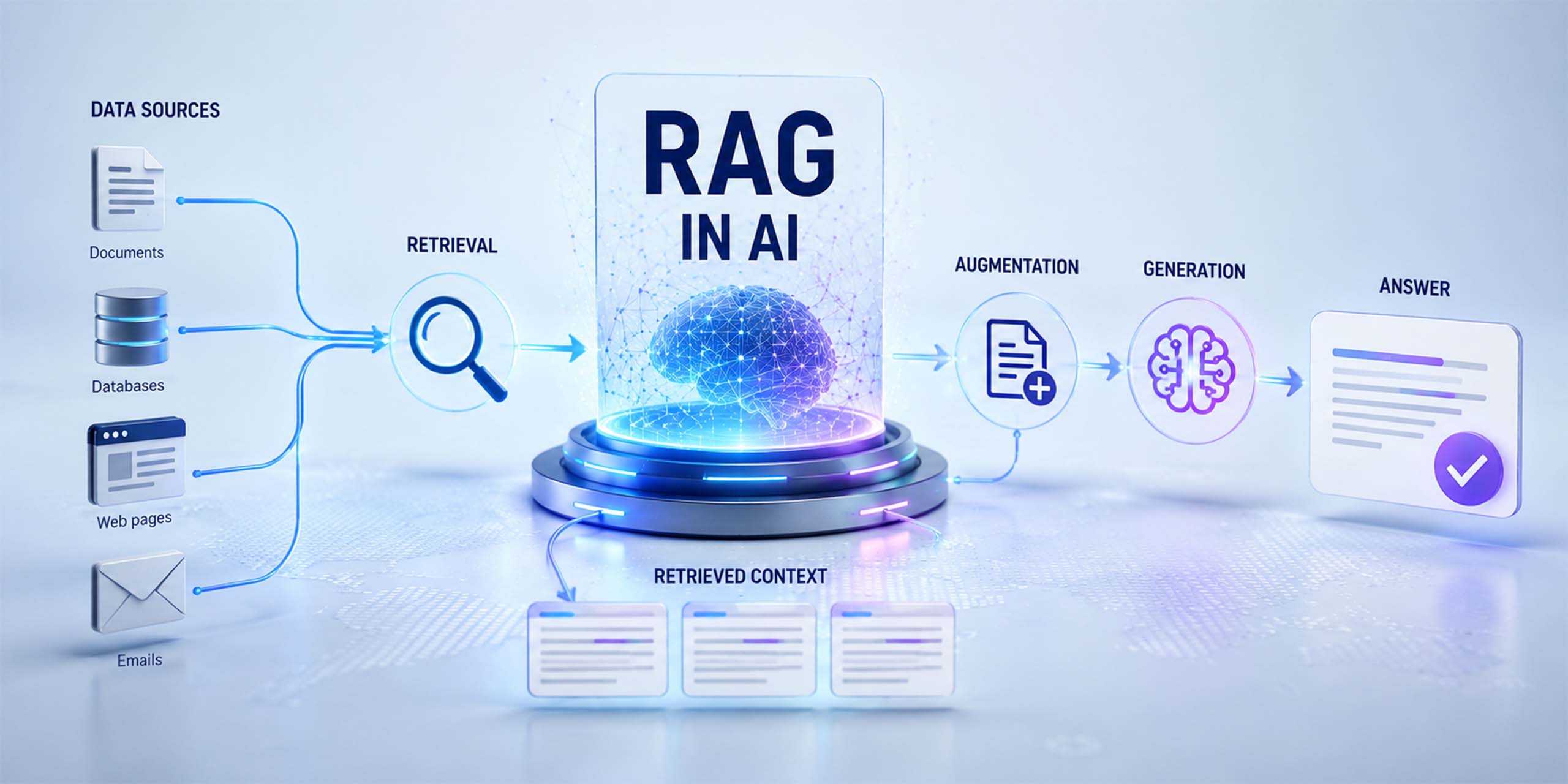
RAG, short for retrieval-augmented generation, is one of the most important ideas in practical AI because it helps large language models answer with information from real sources instead of relying only on what they learned during training.
That sounds dry. It is not. RAG is the reason an AI assistant can answer questions using your company documents, support articles, product catalog, legal files, research archive, internal wiki, or knowledge base. It is one of the main bridges between a powerful general AI model and the specific information a business actually needs.
The simple version is this: RAG is a technique that lets an AI system retrieve relevant information from external sources before generating an answer.
A normal language model may answer from patterns learned during training and whatever context the user provides in the prompt. A RAG system adds another step: it searches a trusted knowledge source, pulls in relevant passages, and gives those passages to the model before it replies.
That does not make AI perfect. It does not magically eliminate hallucinations, bad retrieval, outdated documents, weak sources, or poor system design. But it does make AI much more useful for serious work, because the model is no longer floating in its own statistical memory. It has something concrete to work with.
Sommaire
- What is RAG in AI?
- How does RAG work?
- Why does RAG matter now?
- Real-world uses of RAG
- Common mistakes about RAG
- RAG vs related concepts
- What beginners should remember
- What to Remember (FAQ)
What is RAG in AI?
RAG stands for retrieval-augmented generation. It is an AI approach that combines two things: retrieval and generation.
Retrieval means finding relevant information from an external source. That source might be a document library, website, database, vector database, help center, internal wiki, product catalog, codebase, PDF archive, or research collection.
Generation means using an AI model, usually a large language model, to produce an answer based on the user’s question and the retrieved information.
That combination matters because large language models have limits. They do not automatically know your latest product pricing, internal policies, private documents, support procedures, legal templates, or company strategy. Even when they know general facts, they can still produce confident answers that are wrong, outdated, or too vague.
A RAG system gives the model fresh, relevant context before it answers. Instead of asking the model to guess from memory, the system says: here are the documents that look relevant; use them to answer the user.
For example, imagine a customer asks: “Does this plan include priority support?”
A standard chatbot might answer based on a generic understanding of support plans. A RAG-powered assistant can search the company’s current pricing page, support policy, or plan documentation, then generate an answer grounded in those documents.
That is the key idea: RAG gives AI something to look at before it speaks.
For the foundation behind language models, read our guide to LLMs.
How does RAG work?
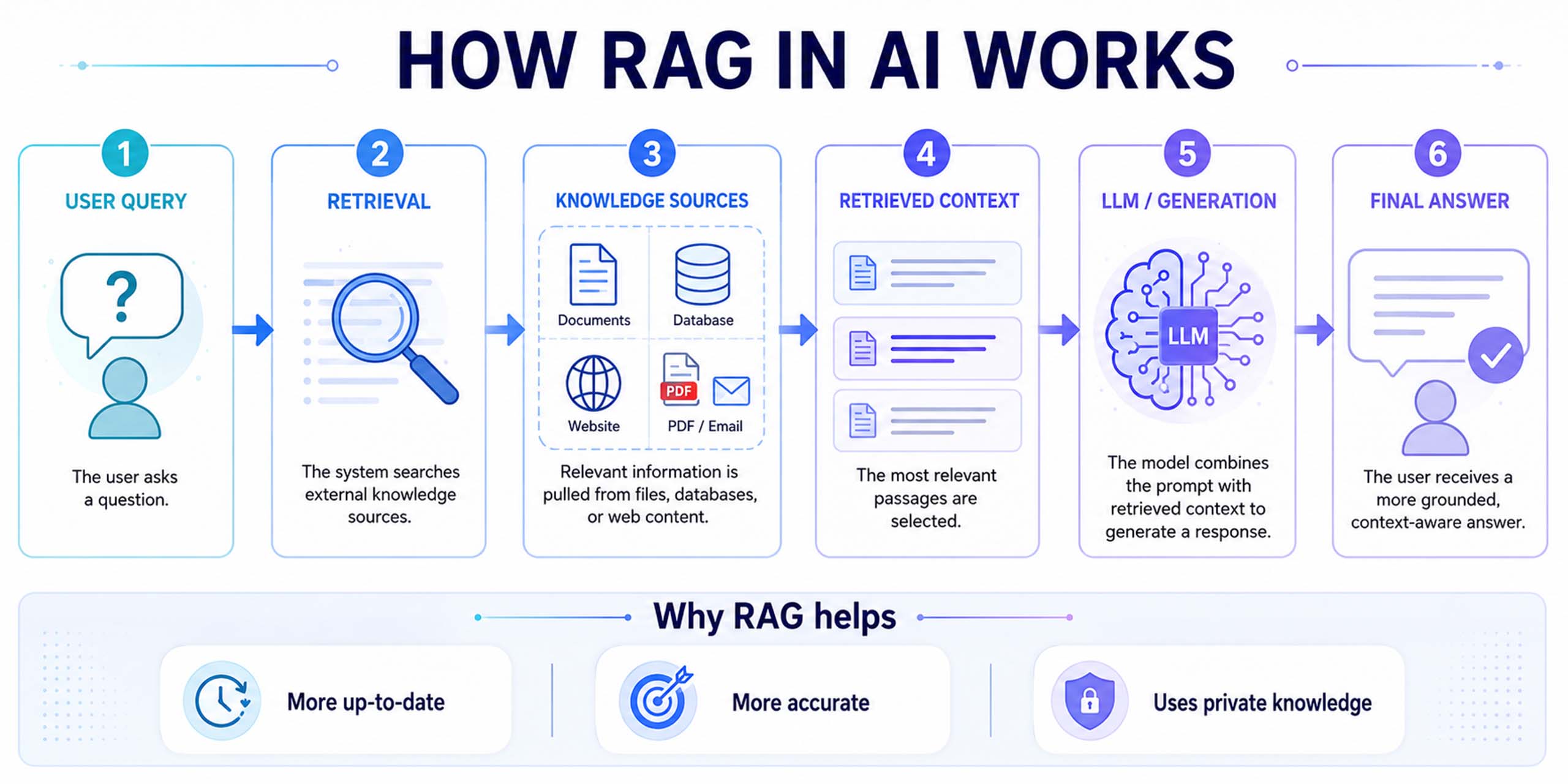
A RAG system works by connecting a generative AI model to an external knowledge source. When a user asks a question, the system retrieves relevant information first, then passes that information to the model as context.
A simplified RAG workflow looks like this:
- User question: the user asks something in natural language.
- Search or retrieval: the system looks for relevant documents, passages, records, or data.
- Ranking: the most relevant results are selected and prepared.
- Context injection: the retrieved information is added to the model’s prompt or context window.
- Generation: the model creates an answer based on the question and retrieved context.
- Response: the system returns the answer, sometimes with citations or links to the sources.
Many RAG systems use embeddings and vector search. Embeddings turn pieces of text into numerical representations that capture meaning. A vector database can then find passages that are semantically similar to the user’s question, even if the exact same words are not used.
That is useful because people rarely ask questions in the same language used by documents. A user might ask, “Can I cancel after the trial?” while the policy document says, “Subscriptions may be terminated before the billing period begins.” Exact keyword search might miss the match. Semantic retrieval has a better chance of finding it.
Once the relevant passages are retrieved, the language model uses them as context. The model still generates the answer, but its answer is guided by the retrieved material. A well-designed RAG system may also show citations so the user can check where the answer came from.
That last part is important. RAG is not only about making AI sound smarter. It is about making answers more grounded, traceable, and useful.
For a broader look at instructions and context, read our guide to prompt engineering.
Why does RAG matter now?
RAG matters because businesses do not just need AI that can talk. They need AI that can work with their own information.
A general AI model can explain marketing, software development, contracts, HR policies, customer support, cybersecurity, or finance in broad terms. That is useful, but not enough. A company assistant needs to know the company’s actual documents, not just the public internet. A support bot needs the latest help center article. A legal assistant needs the right version of a policy. A research assistant needs specific papers, not a confident blur of half-remembered facts.
This is where RAG becomes practical. It lets teams connect AI systems to information that changes, belongs to a specific organization, or needs to be cited. Instead of retraining a model every time a document changes, a RAG system can retrieve the latest available information from the connected source.
That makes RAG especially attractive for enterprise AI. It can be cheaper, faster, and more flexible than training or fine-tuning a model for every update. If the refund policy changes, update the policy document. The RAG system can retrieve the new version when answering.
RAG also matters because it can reduce hallucinations. If the model is instructed to answer only from retrieved sources, it has less reason to invent. Less reason is not the same as no risk. A poorly built RAG system can still retrieve the wrong passage, misread a source, ignore context, or generate a bad answer. But a good RAG setup gives the model a stronger factual anchor.
That is why RAG is one of the key ideas behind AI search, enterprise chatbots, document assistants, legal research tools, internal knowledge bots, and many AI agents.
It is not the whole AI stack. It is the part that says: before answering, go get the relevant information.
Real-world uses of RAG
RAG is useful whenever an AI system needs to answer from specific documents, current information, or private knowledge.
In customer support, a RAG assistant can search help center articles, product documentation, refund policies, troubleshooting guides, and account information before drafting an answer. This helps support teams respond faster without forcing the model to invent policy.
In enterprise search, RAG can turn an internal knowledge base into a conversational assistant. Employees can ask questions about procedures, benefits, project docs, onboarding, technical references, or internal tools and receive answers grounded in company sources.
In legal work, RAG can help retrieve relevant clauses, policies, contracts, case notes, or compliance documents. Human review is essential, but retrieval makes the AI far more useful than a general-purpose chatbot guessing from memory.
In healthcare and life sciences, RAG can help researchers or administrators search medical literature, protocols, patient documentation, or internal guidelines. This is a high-stakes area, so validation, permissions, and source quality matter enormously.
In software development, RAG can connect an AI assistant to a codebase, documentation, tickets, changelogs, and API references. Instead of giving generic programming advice, the assistant can answer based on the actual project.
In ecommerce, RAG can power product assistants that answer from product catalogs, inventory data, shipping policies, size guides, return rules, and customer reviews. This is much more useful than a generic shopping chatbot that knows nothing about the store.
In research and media, RAG can help summarize source documents, compare reports, pull key passages, build briefs, and answer questions with citations. It is especially useful when writers, analysts, or researchers need to stay grounded in specific material.
In AI agents, RAG can provide the information layer an agent needs before taking action. An agent that updates a CRM, drafts a proposal, or prepares a report needs access to the right context. For more on action-oriented systems, read our guide to AI agents.
The best RAG use cases usually share the same traits: trusted sources, clear questions, controlled access, good retrieval, and human review for important decisions.
Common mistakes about RAG
The first mistake is thinking RAG eliminates hallucinations. It can reduce them, but it does not delete them from existence like a dramatic sci-fi off switch. The model can still misinterpret retrieved text, combine sources badly, ignore instructions, or answer beyond the evidence.
The second mistake is assuming retrieval is always good. If the system retrieves the wrong document, the model may generate a wrong answer with great confidence. Bad retrieval creates bad grounding. The model may sound more trustworthy precisely because it appears to be using sources.
The third mistake is feeding the system weak documents. RAG is only as useful as the knowledge base behind it. Outdated policies, duplicate pages, contradictory instructions, poorly written documentation, and messy PDFs can all produce messy answers. RAG does not magically turn bad knowledge management into wisdom.
The fourth mistake is ignoring permissions. An internal RAG system may connect to sensitive documents, customer records, financial data, HR files, legal contracts, or source code. Users should only retrieve information they are allowed to access. Search permissions, authentication, logging, and data governance are not optional details.
The fifth mistake is confusing RAG with fine-tuning. RAG gives the model external information at answer time. Fine-tuning changes model behavior through additional training. If the problem is “the model needs access to updated company documents,” RAG is often the better starting point. If the problem is “the model must consistently follow a specialized style or task pattern,” fine-tuning may be relevant.
The sixth mistake is expecting RAG to reason perfectly across many sources. Retrieving documents is one thing. Comparing them, resolving contradictions, understanding legal nuance, or making a judgment call is another. RAG can support reasoning, but it does not guarantee it.
The seventh mistake is skipping evaluation. A RAG system should be tested on real questions. Teams need to measure whether it retrieves the right sources, answers faithfully, refuses when evidence is missing, cites correctly, and handles edge cases.
RAG is powerful, but it is plumbing. And like all plumbing, everyone notices when it leaks.
RAG vs related concepts
RAG sits near several AI concepts that often get mixed together.
Artificial intelligence is the broad field of building systems that perform tasks associated with intelligence, such as learning, reasoning, language, perception, prediction, and decision support.
A large language model, or LLM, is a language-focused AI model. RAG often uses an LLM to generate the final answer, but the LLM is only one part of the system.
Generative AI creates new content, such as text, images, audio, video, code, or synthetic data. RAG is often used with generative AI to make text answers more grounded in external information.
Prompt engineering is the practice of giving AI systems better instructions, context, constraints, and examples. RAG can provide the context automatically by retrieving relevant documents.
Fine-tuning means training a model further on specific data. RAG does not usually change the model itself. It changes what information the model receives before answering.
Embeddings are numerical representations of meaning. Many RAG systems use embeddings to retrieve relevant passages through semantic search.
A vector database stores and searches embeddings. It can help a RAG system find documents that are meaningfully related to a question.
AI search often uses RAG-like techniques to retrieve information and generate summarized answers. Search finds sources; generation turns them into a response.
Here is the clean version:
- LLM: the model that generates language.
- RAG: a system that retrieves external information before generation.
- Prompt engineering: better instructions and context for the model.
- Fine-tuning: additional training that changes the model.
- Embeddings: numerical representations used for semantic search.
- Vector database: a database used to store and search embeddings.
- AI agent: a system that may use RAG, tools, and actions to complete tasks.
The easiest way to remember it: RAG does not make the model know everything. It gives the model relevant material to use before it answers.
What beginners should remember
The most important thing to remember is that RAG connects AI to external knowledge.
A basic LLM can generate an answer from its training and the prompt. A RAG system first retrieves relevant information from a source, then asks the model to answer using that information. That makes the response more useful when the question depends on specific, current, private, or verifiable knowledge.
This is why RAG matters for businesses. It helps AI work with company documents, product data, support content, research files, policies, codebases, and knowledge bases. Without that connection, an assistant may be fluent but generic. With it, the assistant has a better chance of being specific.
But RAG is not a truth machine. It still depends on good documents, strong retrieval, clear prompts, source quality, access control, evaluation, and human review. If the system retrieves the wrong source, the answer can still be wrong. If the documents are outdated, the answer can still be outdated. If the model goes beyond the evidence, the answer can still hallucinate.
The useful question is not “Does this AI use RAG?”
The better question is: what sources does it retrieve from, how reliable are they, and does the answer stay faithful to them?
That is where RAG becomes more than a buzzword. It is not just about making AI answer. It is about making AI answer with receipts.
What to Remember (FAQ)
What does RAG stand for in AI?
RAG stands for retrieval-augmented generation. It is an AI technique that retrieves relevant information from external sources before generating an answer.
What is RAG in simple terms?
RAG lets an AI system look up relevant documents or data before answering, so the response is based on specific information rather than only the model’s training.
Does RAG stop AI hallucinations?
RAG can reduce hallucinations by grounding answers in retrieved sources, but it does not eliminate them completely. The system can still retrieve bad sources or generate inaccurate responses.
Is RAG the same as fine-tuning?
No. RAG gives the model external information at answer time. Fine-tuning changes the model itself through additional training.
Why is RAG useful for businesses?
RAG helps businesses build AI assistants that can answer from internal documents, policies, product data, support articles, knowledge bases, and other trusted sources.
What do you need to build a RAG system?
A RAG system usually needs a knowledge source, a retrieval method, often embeddings or search, a language model, good prompts, access controls, and evaluation.
Sources: IBM, AWS, Google Cloud