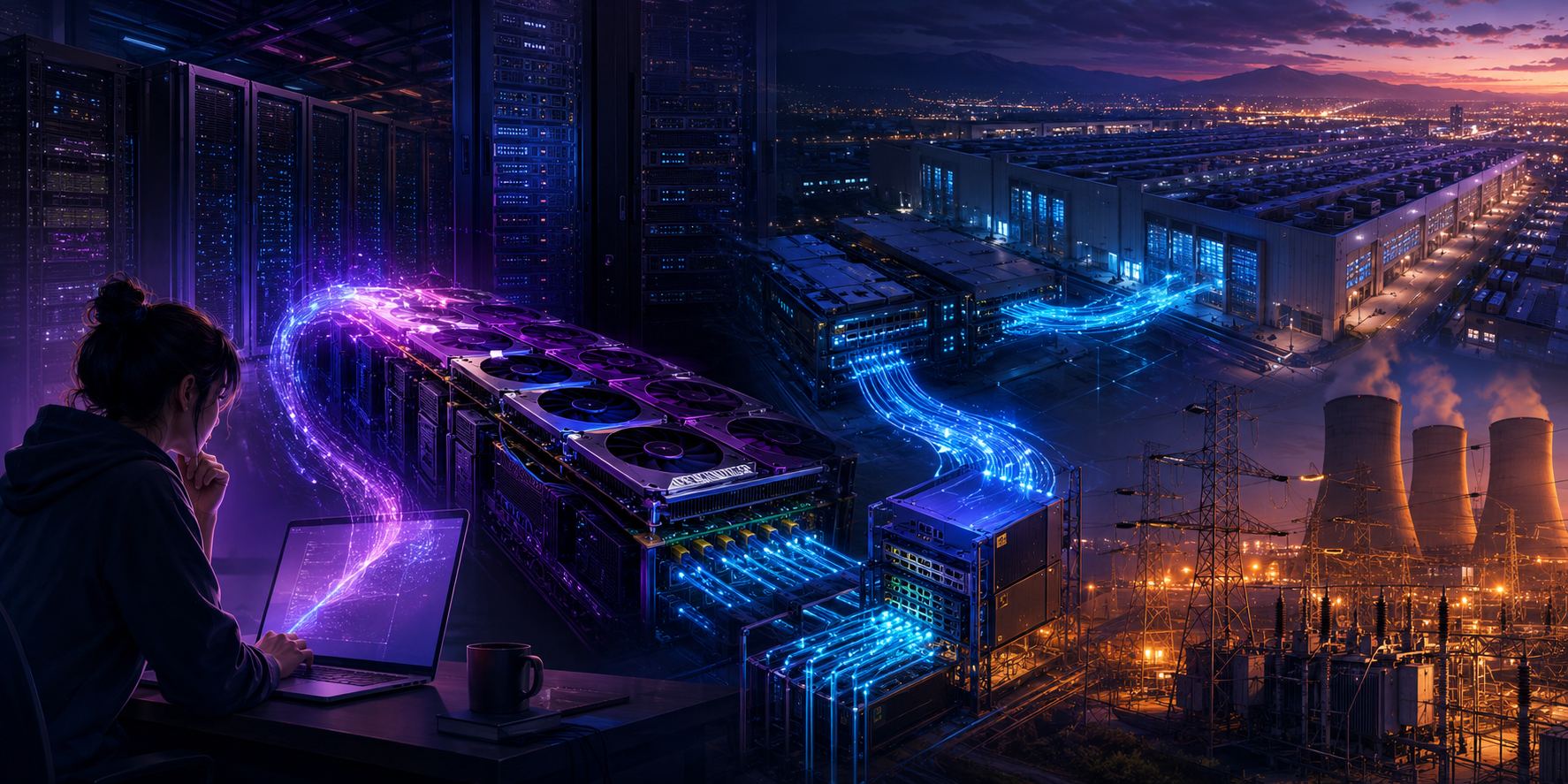
You type a prompt. A few seconds later, an answer appears.
From the user’s side, the transaction feels almost absurdly lightweight: a text box, a handful of tokens, perhaps a monthly subscription. There is no visible factory, no delivery truck and no machine humming on your desk.
But generative AI is one of the most capital-intensive digital services ever built.
Behind that seemingly weightless request sits a physical chain running from inference servers and high-end accelerators to networking fabrics, cooling systems, data centers, substations and power generation. The marginal cost of answering one prompt may be small, and it keeps falling as hardware and software become more efficient. The infrastructure required to make billions of those prompts available on demand is another matter entirely.
That distinction is becoming central to the economics of AI. The AI industry does not simply have a compute problem. It has a capital expenditure problem.
Table of contents
- From your prompt to a GPU
- The GPU is only the beginning
- AI comes with a networking tax
- The data center becomes part of the product
- Then comes the electricity stack
- Big Tech is spending accordingly
- Why “cost per prompt” can be misleading
- The real AI business model question
- AI infrastructure: key questions
From your prompt to a GPU
The journey begins when a user sends text, an image, audio or another input to an AI service. The request reaches a data center, where software routes it toward servers capable of running the required model.
For modern large language models, much of the computational work is handled by specialized accelerators such as GPUs or custom AI chips.
Inference — actually generating the answer — requires the model to repeatedly perform huge volumes of mathematical operations while reading parameters from high-bandwidth memory. Larger models, longer contexts, reasoning workloads, image generation and agentic tasks can all increase the amount of compute required.
This is the first invisible cost.
A sophisticated AI accelerator is not a conventional web server processor. It is expensive hardware surrounded by expensive memory, power delivery and supporting components. Deploying AI at hyperscale means installing these accelerators not by the dozen but across enormous server fleets.
Yet focusing exclusively on the GPU produces a distorted picture of AI economics.
A GPU sitting by itself is not an AI cloud.
The GPU is only the beginning
The accelerator needs a server around it. That server needs memory, storage, CPUs, network interfaces and power supplies. Servers need racks. Racks need power distribution. The machines generate heat, which must be removed continuously.
The International Energy Agency notes that servers account for roughly 60% of electricity demand in modern data centers on average, although the precise figure varies significantly by facility type.
The rest goes into supporting infrastructure: networking, storage, cooling, power conversion and other systems required to keep the compute running.
This matters because AI is pushing power density upward.
Traditional cloud workloads could be distributed across relatively modest-density racks. Modern AI clusters pack far more electrical load into the same physical footprint.
In its 2026 analysis, the International Energy Agency said the power density of AI servers increased elevenfold between 2020 and 2025. It expects another major rise by 2027.
That changes data-center engineering.
Cooling becomes harder. Electrical equipment becomes larger. Power availability becomes a site-selection constraint. What looked like a chip procurement problem turns into an industrial infrastructure project.
AI comes with a networking tax
Large AI systems also need enormous amounts of networking capacity.
A model may be too large, or a workload too demanding, to run efficiently on a single accelerator. Instead, computation is distributed across many chips that must exchange information at extremely high speed.
That makes interconnects critical.
Inside servers and clusters, high-bandwidth links allow accelerators to behave increasingly like components of one massive computing system. Beyond the rack, switches, optical transceivers, fiber and specialized networking equipment connect thousands of processors.
Every additional layer has a cost.
And those costs are not optional extras. If the network cannot move data quickly enough, expensive GPUs can sit underutilized waiting for information to arrive. In AI infrastructure, spending billions on accelerators while underinvesting in networking can defeat the purpose of buying the accelerators in the first place.
The useful economic unit is therefore not necessarily one GPU.
It is closer to an operational unit of compute capacity: accelerators plus memory, networking, power, cooling, buildings and everything necessary to keep that capacity productive.
The data center becomes part of the product
Scale the system again and another cost layer appears: the building itself.
AI companies and cloud providers need land, construction, cooling plants, backup systems, electrical switchgear, transformers, substations and connections to transmission infrastructure.
Some facilities can take years to plan and build. Even when servers improve much faster, the physical infrastructure around them moves on industrial rather than software timelines.
That creates an unusual mismatch.
A new model architecture can appear in months. A new generation of accelerator can significantly change performance within a product cycle. But transmission lines, large transformers, generating facilities and major data centers cannot necessarily be delivered at software speed.
The IEA has highlighted exactly this problem. While a data center can potentially become operational within a few years, parts of the wider energy system require much longer planning and construction periods.
AI therefore encounters something software companies historically spent decades avoiding: physical bottlenecks.
You cannot patch a shortage of transformers with a software update.
Then comes the electricity stack
Every inference request ultimately ends in another transaction that is invisible to the user: electricity consumption.
The scale is becoming substantial.
According to the IEA’s 2026 outlook, global electricity consumption from data centers is projected to rise from about 485 terawatt-hours in 2025 to roughly 950 TWh in 2030. Electricity consumption from AI-focused data centers is expected to grow considerably faster, roughly tripling over the same period.
That does not mean AI will consume the entire grid. The IEA estimates data centers could represent around 3% of global electricity demand in 2030.
But global percentages hide an important problem: data centers are geographically concentrated.
A large AI campus does not request its electricity evenly from the world’s power system. It connects to one regional grid, in one location, sometimes alongside several other large data-center projects.
The result can be intense local pressure on generation capacity, grid connections and electrical equipment.
And the infrastructure chain continues upstream.
More demand can require new substations. Those substations need transformers. Grid operators may require additional transmission. Eventually, increased electricity consumption has to be met through some combination of renewables, natural gas, nuclear power, storage and other sources.
According to the IEA, renewables are expected to provide a large share of additional electricity serving data centers, while natural gas and nuclear generation also play important roles.
The humble chatbot prompt has now traveled remarkably far from the browser.
It began as text.
It ends, economically, somewhere near a power plant.
Big Tech is spending accordingly
The capital expenditure numbers reveal just how physical the AI boom has become.
In April 2026, the IEA estimated that capital expenditure by five large technology companies had already surpassed $400 billion in 2025 and was set to increase by another 75% in 2026.
Not every dollar of that spending is exclusively attributable to generative AI. Hyperscalers operate enormous cloud, logistics and consumer businesses. But AI infrastructure has become one of the defining forces behind the investment cycle.
Individual company spending plans illustrate the scale.
In July 2026, Reuters reported that Amazon had raised its expected annual capital expenditure to approximately $220 billion, as AWS continued expanding AI and cloud capacity.
The industry’s commitments extend beyond assets purchased directly.
Reuters reported in August 2026 that Microsoft, Meta, Oracle, Amazon and Alphabet had collectively committed roughly $1.09 trillion in future lease payments, much of it associated with data-center infrastructure. These future commitments are different from conventional capex and should not simply be added to annual investment figures, but they demonstrate the extraordinary long-term infrastructure obligations accumulating around AI and cloud computing.
This is no longer an industry whose principal inputs are programmers, laptops and office space.
The leading AI platforms increasingly resemble a strange hybrid of software company, semiconductor customer, telecom network and industrial infrastructure operator.
Why “cost per prompt” can be misleading
This is where discussions about the cost of AI often become confused.
There is no universal price tag for one AI prompt.
A short request to a small model is fundamentally different from a long-context reasoning task, an image generation request or an autonomous agent that performs dozens of model calls. Hardware utilization, model architecture, batching, caching, quantization, electricity prices and data-center efficiency all affect the calculation.
More importantly, two different costs are being mixed together.
The first is marginal inference cost: the incremental resources consumed to process an additional request.
The second is capital cost: the enormous infrastructure investment required to ensure the system is available when the request arrives.
Efficiency improvements can dramatically reduce the first while the second continues rising.
That is not a contradiction.
If inference becomes cheaper, developers can afford to put AI into more products. Users may generate more tokens. Applications can use larger contexts. Agents can execute tens or hundreds of inference steps instead of one.
This is a version of a familiar technological phenomenon: cheaper computation creates additional demand for computation.
The IEA’s latest analysis reflects this dynamic. It finds that energy consumption per AI task is declining rapidly, yet total AI-related electricity demand continues to increase because adoption and workload intensity are expanding even faster.
The cheapest prompt can still produce a very expensive infrastructure boom when there are billions of prompts.
The real AI business model question
For investors and technology companies, this leads to a deeper question than whether AI usage is growing.
It almost certainly is.
The question is whether the economic value generated by that usage can justify the infrastructure required to serve it.
Software economics traditionally offer extraordinary operating leverage. Build the product once, distribute additional copies at near-zero cost and let margins expand as revenue scales.
Cloud computing already made that model more capital-intensive.
AI pushes it further.
Every major jump in demand can require accelerators, servers, networks and data-center capacity. Capacity can become obsolete as hardware improves. Electricity can become constrained. Supply chains can delay deployments. Customers may expect model prices to fall even as providers continue spending heavily to improve capabilities.
That does not make the AI infrastructure boom inherently irrational. Massive capital investment has accompanied previous foundational technologies, from railways and electricity grids to telecommunications and the internet.
Infrastructure can create enormous value.
But utilization matters. Pricing matters. Hardware lifetimes matter. Financing costs matter. And ultimately, revenue has to matter.
The industry is effectively making a gigantic wager: that future demand for AI computation will be large enough, valuable enough and persistent enough to absorb the capacity being constructed today.
The user never sees that wager.
They see a blinking cursor.
They type a prompt.
And somewhere behind it, capital starts working.
AI infrastructure: key questions
Does every AI prompt really require a new GPU?
No. AI infrastructure is shared across enormous numbers of requests. The important distinction is that aggregate demand for prompts determines how much total compute capacity providers eventually need.
How much does one AI prompt cost?
There is no single figure. Cost varies with the model, output length, context size, hardware, utilization, batching, caching, electricity costs and other factors.
Why are GPUs not the full cost of AI?
GPUs require servers, high-speed networking, storage, cooling, electrical systems, data-center buildings and grid connections. The complete infrastructure stack is therefore considerably broader than the accelerator itself.
Is AI making data centers consume more electricity?
Yes. The IEA projects global data-center electricity consumption to roughly double between 2025 and 2030, with electricity use at AI-focused data centers rising substantially faster.
Can more efficient AI models solve the energy problem?
Efficiency reduces the resources needed for individual tasks, but total consumption can still rise if AI usage grows faster than efficiency improves.
Why is capital expenditure so important to AI economics?
AI services require enormous upfront investment before customers submit their prompts. Providers therefore need enough utilization and revenue over time to earn attractive returns on infrastructure costing billions of dollars.
Is this article financial advice?
No. This article discusses the economics of AI infrastructure and corporate investment trends for informational purposes only. It is not investment or financial advice.