
Prompt engineering is the practice of writing better instructions for AI systems. It is how users guide chatbots, large language models, image generators, coding assistants, search assistants, and AI agents toward more useful outputs.
The phrase can sound more technical than it needs to. In its worst form, prompt engineering gets sold like a secret spellbook: say the magic words, unlock the machine, become unstoppable before lunch. Reality is less dramatic and more useful.
The simple version is this: prompt engineering is the skill of giving an AI model the right task, context, constraints, examples, and output format.
A weak prompt asks the model to “write something about marketing.” A better prompt explains the audience, goal, format, tone, length, product, constraints, and what a good answer should look like. The model is still the model. It can still be wrong, generic, biased, outdated, or overconfident. But better instructions usually give it a better chance of producing something useful.
Prompt engineering is not about tricking AI. It is about reducing ambiguity. And in a world where more software is controlled through natural language, that skill matters more than it first appears.
Sommaire
- What is prompt engineering?
- How does prompt engineering work?
- What makes a good AI prompt?
- Why does prompt engineering matter now?
- Real-world uses of prompt engineering
- Common mistakes about prompt engineering
- Prompt engineering vs related concepts
- What beginners should remember
- What to Remember (FAQ)
What is prompt engineering?
Prompt engineering is the process of designing prompts that help AI systems produce better results. A prompt is the instruction, question, request, example, or context you give to an AI model.
Prompts can be simple: “Summarize this article in five bullet points.”
They can also be detailed: “Summarize this article for a startup founder who has no technical background. Keep the tone clear and direct. Focus on business impact, risks, and practical next steps. Avoid jargon. End with three questions the founder should ask before using this technology.”
Both are prompts. The second one is engineered because it gives the model more information about the task, audience, tone, format, and success criteria.
Prompt engineering became important because modern AI tools are often controlled through natural language. Instead of clicking through menus or writing code, users describe what they want. That sounds easy, but natural language is messy. Humans imply things. Models do not always infer them correctly. A good prompt makes the implicit explicit.
For a broader explanation of the models behind many prompting workflows, read our guide to LLMs.
How does prompt engineering work?
Prompt engineering works by shaping the information the AI model receives before it generates an output. The model does not simply respond to your intention. It responds to the text, files, examples, tools, instructions, and context it can actually process.
That means a prompt is not just a question. It is a control surface.
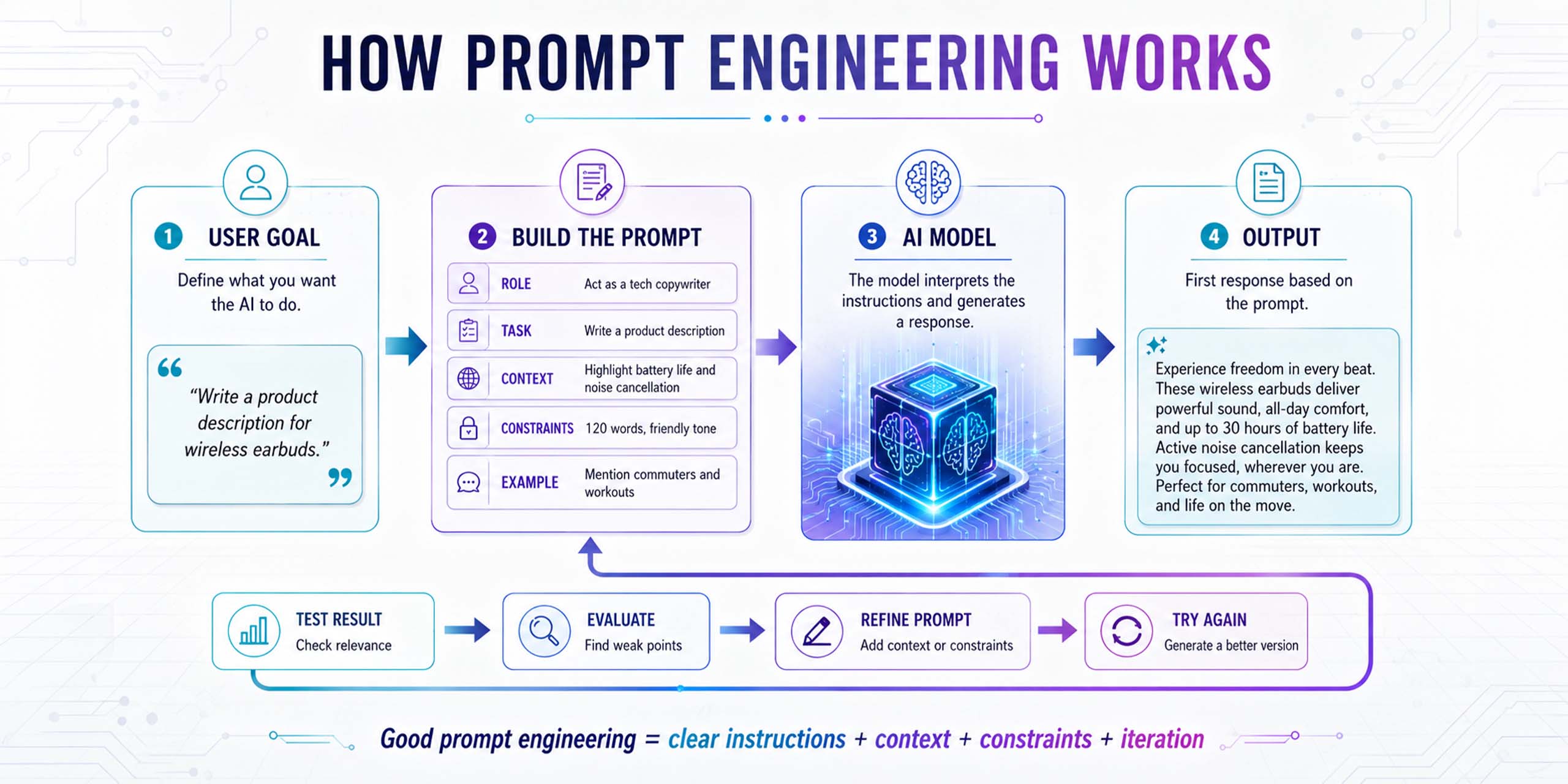
A simplified prompting workflow looks like this:
- Goal: what you want the AI system to accomplish.
- Context: the background information the model needs.
- Instructions: the specific task you want performed.
- Constraints: limits around tone, length, format, sources, style, or scope.
- Examples: samples that show the kind of output you want.
- Output format: the structure the answer should follow, such as a table, checklist, email, JSON object, outline, or short summary.
- Iteration: reviewing the result, correcting it, and refining the prompt if needed.
This matters because AI models are sensitive to framing. Ask for a “professional article” and you may get bland corporate fog. Ask for “a clear editorial explainer for curious non-experts, with concrete examples and no hype,” and the model has a sharper target.
Prompt engineering also includes breaking complex tasks into smaller steps. Instead of asking an AI system to “build a marketing strategy,” you might first ask it to analyze the audience, then identify positioning angles, then draft campaign ideas, then critique them, then turn the best one into a content calendar.
That is not because the model is fragile. It is because complex work usually benefits from structure. Humans also perform better when the task is clear. Shocking, but true.
What makes a good AI prompt?
A good AI prompt is clear, specific, contextual, and testable. It gives the model enough direction to produce a useful answer without burying it under irrelevant detail.
The most important element is the task. What exactly should the model do? Summarize, rewrite, classify, compare, extract, brainstorm, explain, translate, critique, generate, debug, plan, or decide between options? Vague verbs produce vague outputs.
The second element is context. Who is the output for? What is the situation? What information should the model use? What should it ignore? A prompt for a legal team, a 12-year-old student, a developer, a journalist, and a small business owner should not sound the same.
The third element is constraints. These can include word count, tone, reading level, format, language, sources, style, forbidden claims, required sections, or things the model must not assume. Constraints prevent the model from filling gaps in the least helpful way.
The fourth element is examples. If you want a specific format or style, examples can be more powerful than explanations. This is often called few-shot prompting: giving the model one or more examples of the kind of input and output you expect.
The fifth element is review. A prompt is rarely perfect on the first attempt. Strong prompting is iterative. You test the output, notice what failed, adjust the instruction, and try again.
Here is a simple before-and-after:
- Weak prompt: Write a LinkedIn post about AI.
- Better prompt: Write a 180-word LinkedIn post for startup founders explaining why AI tools need clear internal policies. Use a direct, practical tone. Avoid buzzwords. Include one concrete example and end with a question.
The better prompt is not longer for the sake of being longer. It gives the model the missing map.
Why does prompt engineering matter now?
Prompt engineering matters because AI tools are becoming part of everyday work. Large language models, generative AI tools, coding assistants, document analyzers, search assistants, and AI agents all depend on instructions. The quality of those instructions often affects the quality of the result.
This is especially true because AI systems are flexible. The same model can draft emails, explain code, summarize research, write ad copy, classify support tickets, generate product ideas, or help plan a trip. That flexibility is powerful, but it also means the model needs direction. Without direction, it guesses.
Prompt engineering also matters because natural language is becoming an interface for software. Instead of learning every setting in a tool, users increasingly describe what they want: “turn these notes into a client proposal,” “compare these contracts,” “summarize this meeting,” “find risks in this code,” or “make this image darker and more cinematic.”
For businesses, good prompting can reduce wasted time, improve consistency, support internal workflows, and make AI tools more useful for non-technical teams. For creators, it can speed up drafts, moodboards, outlines, edits, and variations. For developers, it can help with debugging, documentation, tests, and code review. For researchers, it can help organize documents, extract themes, and generate structured notes.
But prompt engineering is also changing. As models improve, the skill is less about memorizing clever tricks and more about designing reliable workflows: good context, good examples, good evaluation, and clear human review. In agent systems, the conversation is moving even further toward context engineering: deciding what information, tools, memory, permissions, and feedback loops the AI system should have.
The prompt still matters. It is just no longer the whole game.
Real-world uses of prompt engineering
Prompt engineering is useful wherever people use AI tools to produce, transform, analyze, or organize information.
In writing and editing, prompts can guide tone, structure, audience, length, examples, and editorial constraints. A writer can ask for a rough outline, a sharper intro, a headline list, a rewrite in a different tone, or a critique of weak arguments.
In marketing, prompts can generate campaign angles, social posts, landing page drafts, email sequences, product descriptions, SEO outlines, customer personas, and ad variations. The risk is generic content. The value comes from giving the model brand context, audience details, positioning, and examples of what “good” looks like.
In software development, prompts can ask an AI coding assistant to explain a function, write tests, debug an error, suggest refactors, compare approaches, or document an API. The best prompts include the relevant code, expected behavior, constraints, environment, and failure message.
In research, prompts can summarize documents, extract claims, compare sources, identify contradictions, generate questions, or turn messy notes into a structured brief. For serious research, the model should work from specific sources rather than freewheeling from memory.
In customer support, prompts can help classify tickets, draft replies, summarize conversations, suggest next steps, or adapt a response to a customer’s tone. Good prompting here must include policy, escalation rules, and clear boundaries.
In education, prompts can create explanations, examples, quizzes, study plans, and practice exercises. The best educational prompts specify the learner’s level and ask the model to check understanding rather than simply deliver answers.
In image generation, prompts can describe subject, composition, lighting, camera angle, material, mood, style, aspect ratio, and constraints. Visual prompting is its own skill because small wording changes can have a large effect on the output.
In AI agents, prompts can define goals, tool-use rules, approval steps, error handling, and when the system should stop. For more on that shift from answer generation to action, read our guide to AI agents.
The common thread is simple: a good prompt turns a fuzzy request into a usable brief.
Common mistakes about prompt engineering
The first mistake is believing prompt engineering is magic. It is not. A prompt can improve output, but it cannot make a weak model perfect, fix missing data, guarantee truth, or replace expertise. If the model does not have the right information, it may still guess.
The second mistake is being too vague. “Make this better” can mean shorter, clearer, funnier, more formal, more accurate, more persuasive, less robotic, more detailed, or all of the above. The model needs to know what “better” means.
The third mistake is overloading the prompt. Too much irrelevant context can confuse the task. Good prompting is not about dumping everything into the box. It is about giving the right information at the right time.
The fourth mistake is forgetting the output format. If you want a table, ask for a table. If you want a short email, say so. If you need JSON, a checklist, a press-style article, a technical explanation, or a five-step plan, specify it. Models are flexible, but they are not mind readers.
The fifth mistake is treating the first answer as final. Prompting is an iterative process. The first output often reveals what the prompt failed to specify. That is useful. Adjust and try again.
The sixth mistake is asking for hidden reasoning instead of useful reasoning support. For many tasks, it is better to ask the model to break the problem into steps, state assumptions, compare options, cite sources, or provide a brief rationale than to demand a long internal reasoning trace.
The seventh mistake is ignoring verification. Prompt engineering can improve clarity, but it does not remove hallucinations, bias, outdated information, weak logic, or security risks. Important claims, code, legal text, medical information, financial analysis, and business decisions still need review.
The eighth mistake is assuming one prompt works forever. Models change. Products change. Context windows change. Tool access changes. A prompt that worked beautifully last year may become unnecessary, brittle, or weird later. Prompting is practical craft, not sacred scripture.
Prompt engineering vs related concepts
Prompt engineering overlaps with several AI terms, but they are not the same thing.
Artificial intelligence is the broad field of building systems that perform tasks associated with intelligence, such as learning, reasoning, language, prediction, perception, and decision support.
A prompt is the instruction, question, context, or request given to an AI model.
Prompt engineering is the practice of designing prompts to get better, more reliable, more useful outputs.
A large language model, or LLM, is a language-focused AI model. Prompt engineering is one way users interact with LLMs.
Generative AI creates new content, such as text, images, audio, video, code, or synthetic data. Prompt engineering helps guide what that content should be.
Fine-tuning changes the model itself by training it further on specific data. Prompt engineering does not change the model. It changes the instructions and context given to the model at runtime.
RAG, or retrieval-augmented generation, connects a model to external documents or data sources before generating an answer. Prompt engineering can help shape the answer, but RAG helps provide the information the model should use.
Context engineering is a broader idea. It includes not only the written prompt, but also the documents, tools, memory, examples, retrieval systems, permissions, and feedback loops surrounding the model. As AI agents become more common, context engineering may become more important than individual prompt tricks.
Here is the clean version:
- Prompt: the instruction or request given to an AI system.
- Prompt engineering: designing better prompts for better outputs.
- LLM: a language model that responds to prompts.
- Generative AI: AI that creates new content from prompts or inputs.
- Fine-tuning: changing the model through additional training.
- RAG: giving the model external information to use before answering.
- Context engineering: designing the full environment around the model.
For the broader creative category behind many prompt-based tools, read our guide to generative AI.
What beginners should remember
The most important thing to remember is that prompt engineering is about clarity. It is not about secret words. It is not about bullying the model into genius. It is about giving the AI system a clear task, useful context, practical constraints, and a format it can follow.
A good prompt answers a few basic questions:
- What should the AI do?
- Who is the output for?
- What context should it use?
- What tone, format, or length is required?
- What should it avoid?
- How will the result be checked?
That last question matters. Prompt engineering does not remove the need for human judgment. A model can follow a prompt well and still produce something wrong, bland, risky, or incomplete. The prompt improves the process. It does not guarantee the truth.
The best way to learn prompting is not to memorize 200 templates. It is to practice turning vague intentions into clear briefs. Give the model context. Ask for a specific output. Use examples when needed. Review the result. Refine.
The future of prompting will probably become less about clever one-liners and more about workflows: documents, tools, memory, retrieval, evaluation, and human approval. But the basic skill will remain useful.
If you can explain what you want clearly, you are already halfway to a better result.
What to Remember (FAQ)
What is prompt engineering in simple terms?
Prompt engineering is the practice of writing clear instructions for AI tools so they produce more useful, accurate, and relevant outputs.
What is an AI prompt?
An AI prompt is the question, instruction, context, example, or request you give to an AI model before it generates a response.
Why is prompt engineering important?
Prompt engineering matters because AI models often perform better when they receive clear tasks, useful context, specific constraints, examples, and a defined output format.
Do you need coding skills for prompt engineering?
Not always. Many prompting tasks use plain language. Technical skills can help for coding, automation, APIs, and AI agents, but everyday prompt engineering is mostly about clarity and structure.
What makes a good prompt?
A good prompt explains the task, audience, context, constraints, format, and goal. It gives the AI model enough information to produce a useful result.
Is prompt engineering still useful as AI models improve?
Yes, but it is changing. Better models need fewer tricks, but clear instructions, good context, examples, review, and workflow design still matter.
Sources: OpenAI, Google Cloud, Anthropic