
Generative AI is the branch of artificial intelligence that creates new content. It can write text, generate images, compose music, produce code, synthesize voices, create video, design concepts, summarize documents, and transform one format into another.
That is why it became the most visible face of the AI boom. For many people, generative AI was the first time artificial intelligence stopped feeling like a hidden algorithm buried inside a recommendation feed and started feeling like a tool they could actually talk to, direct, test, and use creatively.
The simple version is this: generative AI is AI that can produce new content based on patterns learned from data and instructions given by a user. It does not create from pure imagination, and it does not understand creativity the way humans do. But it can remix patterns, follow instructions, generate variations, and turn a blank page into a workable first draft in seconds.
That makes it exciting. It also makes it risky, messy, and very easy to misunderstand.
Sommaire
- What is generative AI?
- How does generative AI work?
- Why does generative AI matter now?
- Real-world uses of generative AI
- Common mistakes about generative AI
- Generative AI vs related concepts
- What beginners should remember
- What to Remember (FAQ)
What is generative AI?
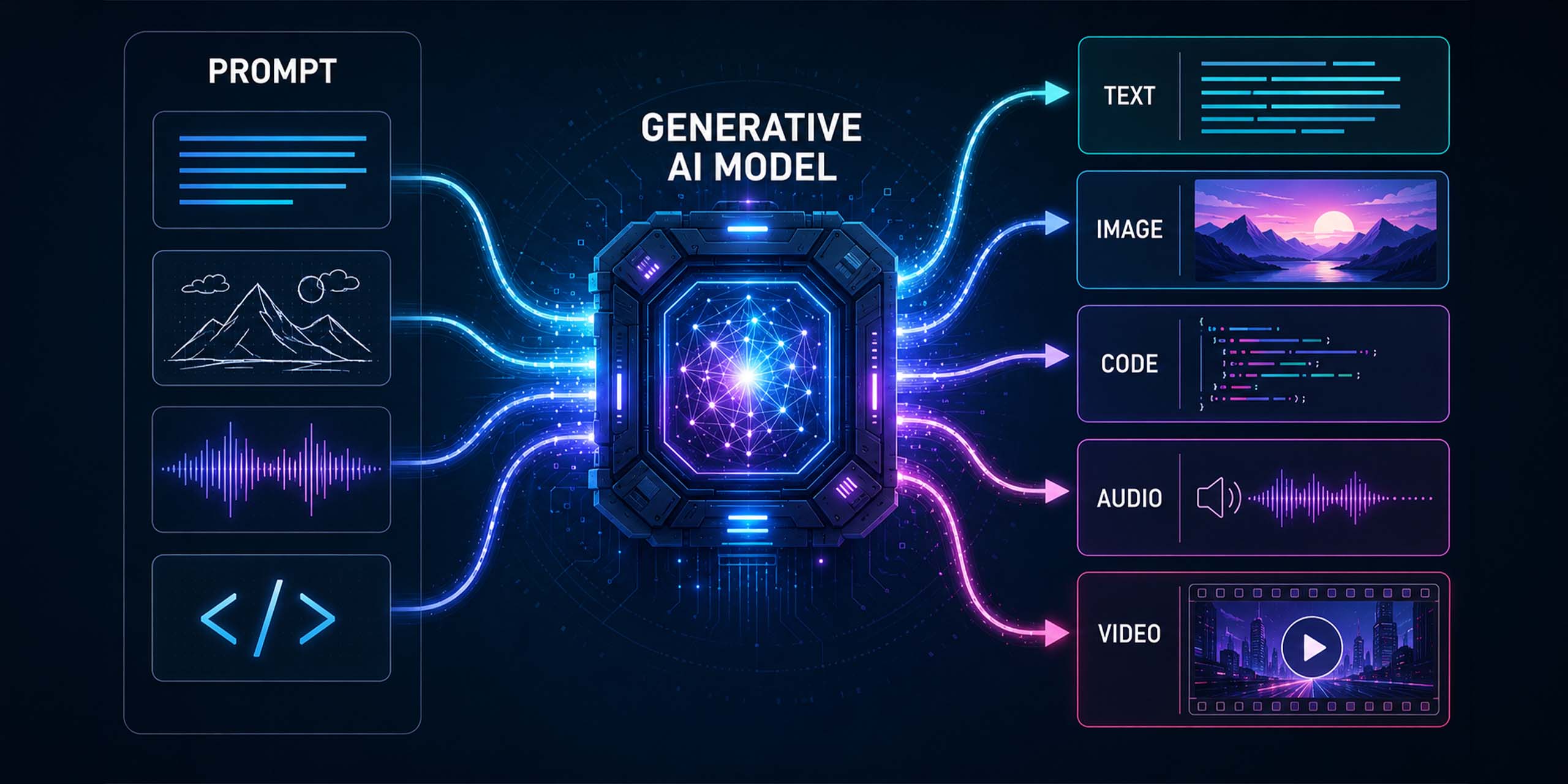
Generative AI is a category of artificial intelligence designed to create new outputs from a prompt, instruction, example, dataset, or combination of inputs.
That output can take many forms:
- Text
- Images
- Code
- Audio
- Video
- Music
- Voice
- 3D assets
- Synthetic data
- Product concepts
The key difference is that generative AI does not only analyze information. It produces something new from it.
A traditional AI model might detect whether an email is spam. A generative AI model might draft a reply to that email. A traditional image model might recognize a dog in a photo. A generative image model might create a new picture of a dog wearing a space helmet in a neon-lit city. A traditional business model might predict which customers are likely to leave. A generative model might draft different retention messages for different customer groups.
That shift is bigger than it first sounds. Older AI systems often worked quietly in the background, making classifications, predictions, rankings, and recommendations. Generative AI moved AI into the foreground. It gives users a visible output they can read, edit, judge, publish, reject, or build on.
This is why it feels more personal than earlier AI. It does not just decide what to show you next. It helps make the thing.
For the broader foundation, see our guide to AI models.
How does generative AI work?
Generative AI works by learning patterns from training data, then using those patterns to generate new outputs. The exact method depends on the type of model, but the basic principle is the same: the system studies examples, learns relationships, and uses those learned relationships to produce something new when prompted.
A text generator learns patterns in language: grammar, structure, style, tone, argument, formatting, and the way ideas usually connect. When you give it a prompt, it generates words or tokens in a sequence that fits the context.
An image generator learns relationships between visual elements: shapes, colors, textures, lighting, objects, camera angles, composition, and styles. When you describe an image, it generates a new visual result based on those learned patterns.
A music generator learns rhythm, melody, harmony, structure, genre conventions, and instrumentation. A code model learns syntax, logic, documentation habits, common frameworks, and software patterns.
A simplified generative AI workflow looks like this:
- Training data: the material used to teach the model patterns.
- Model training: the process where the system learns relationships inside the data.
- Prompt: the user instruction, question, example, or request.
- Generation: the model creates a new output based on the prompt and its learned patterns.
- Review: the user checks, edits, validates, or rejects the result.
Many generative AI tools use large language models for text. Others use diffusion models, transformers, generative adversarial networks, or specialized architectures for images, audio, video, voice, and other media.
Beginners do not need to memorize every architecture. The useful idea is simpler: generative AI learns from examples, then creates new outputs that resemble the kinds of patterns it has learned.
That does not mean the output is copied directly from one source. It also does not mean the output is automatically original, accurate, legal, or good. Generation sits in an uncomfortable space between pattern, prediction, remix, and production. That is exactly why the technology is so powerful — and why the debates around it are not going away.
Why does generative AI matter now?
Generative AI matters because it changes the relationship between humans and software. For decades, most software asked users to click through menus, fill out forms, learn tools, write code, or follow fixed workflows. You had to adapt yourself to the machine.
Generative AI flips part of that relationship. You can describe what you want, ask for variations, refine the output, change the tone, request another format, and move faster from idea to execution. The interface becomes more conversational, and the distance between intention and output gets much shorter.
That matters for businesses, creators, developers, marketers, educators, designers, researchers, and almost anyone working with information. A founder can generate a pitch draft. A marketer can create campaign angles. A developer can get help writing code. A designer can explore visual directions. A journalist can summarize research. A teacher can adapt explanations for different levels. A support team can draft replies. A legal team can summarize long documents before human review.
Generative AI also lowers the cost of experimentation. You can test ten headlines, five visual concepts, three email drafts, or several product descriptions in minutes. Most of those outputs will not be perfect. Some will be bland. Some will be wrong. Some will miss the point completely. But the speed of iteration changes the creative and professional process.
That is the real shift. Generative AI is not only about replacing tasks. It is about making the first draft, first prototype, first sketch, first summary, or first version much faster to create.
The blank page has not disappeared. It just got a very aggressive assistant.
Real-world uses of generative AI
Generative AI is already part of many professional workflows, sometimes in obvious ways and sometimes in quieter ones.
In marketing, it can generate campaign ideas, landing page drafts, email sequences, ad variations, SEO outlines, product descriptions, customer segments, and social media content. The danger is producing generic noise at industrial speed. The value comes when teams use AI to explore angles faster, then add taste, positioning, and strategy.
In design, it can create moodboards, visual concepts, background images, product mockups, style explorations, and creative references. It is especially useful early in the process, when the goal is to explore directions rather than deliver a final polished asset.
In software development, generative AI can create code snippets, explain functions, write tests, draft documentation, suggest refactors, and help developers understand unfamiliar codebases. It can be a serious productivity boost, but only when the output is reviewed by someone who knows what the code is supposed to do.
In media production, it can help write scripts, generate storyboards, clean audio, create subtitles, draft video descriptions, produce concept art, or organize production notes. It does not replace taste or direction. It accelerates the rough work that happens before the final creative decisions.
In business operations, generative AI can summarize meetings, extract action items, draft reports, prepare internal documents, and transform messy notes into structured plans. These are not glamorous use cases, but they are some of the most useful.
In customer support, it can generate reply drafts, summarize conversations, suggest next steps, classify requests, and help support agents answer faster. The best systems keep humans in the loop, especially when a customer is frustrated, vulnerable, or dealing with something complex.
In education, it can explain difficult topics, create quizzes, generate examples, adapt lessons, and support personalized learning. Used well, it can act like a patient tutor. Used lazily, it can become a shortcut that prevents real understanding.
In data and research, it can summarize long documents, extract themes, classify feedback, generate synthetic examples, and help users explore large volumes of information. This becomes much more reliable when the model is working from specific, trusted sources instead of vague memory.
The strongest generative AI workflows usually do not remove humans. They help humans move faster, compare options, and spend more energy on judgment, taste, strategy, and final decisions.
Common mistakes about generative AI
The first mistake is thinking generative AI creates from nothing. It does not create in a vacuum. It generates outputs based on patterns learned from training data, the structure of the model, and instructions provided by the user.
The second mistake is assuming generative AI output is automatically accurate. A model can invent facts, misunderstand context, produce biased content, generate weak code, or create something that sounds convincing but is wrong. This is especially important when using generative AI for research, health, law, finance, engineering, or technical work.
The third mistake is treating the first output as the final output. Generative AI is often best used as a drafting, ideation, remixing, or acceleration tool. The first result is usually a starting point, not a finished product.
The fourth mistake is confusing “new” with “original.” Generative AI can produce new outputs, but that does not always mean the result is creative, unique, legally safe, or free from influence. Copyright, licensing, brand safety, plagiarism risk, and originality still matter.
The fifth mistake is using it without context. A vague prompt usually produces a vague answer. Better results come from clear instructions, examples, constraints, audience details, tone, format, and goals. “Make me a campaign” is weak. “Create three campaign angles for a privacy-first note-taking app aimed at freelance designers, with a calm but sharp tone” gives the model something useful to work with.
The sixth mistake is thinking generative AI is only for content creators. Writing and image generation are the obvious use cases, but generative AI is also useful for coding, analysis, automation, research, product development, support, training, documentation, operations, and internal knowledge work.
The seventh mistake is ignoring responsibility. If an AI-generated output harms a brand, misleads users, exposes private data, or spreads false information, “the model wrote it” is not a serious defense. The person or organization using the tool still owns the final decision.
Generative AI vs related concepts
Generative AI is connected to several AI terms, but it is not the same thing as all of them.
Artificial intelligence is the broad field of building systems that perform tasks normally associated with intelligence, such as recognizing language, detecting patterns, making predictions, planning, or solving problems. Generative AI is one category inside that field.
An AI model is a trained system that produces outputs from inputs. A generative AI model is a specific kind of model designed to create new content.
A large language model, or LLM, is a language-focused AI model. Many LLMs are generative because they can create text, but generative AI also includes image, audio, video, music, voice, and code systems.
A chatbot is a conversational interface. It may be powered by generative AI, but it is not the model itself. The same generative model could power a writing app, a code assistant, a search feature, or a customer support tool.
An AI agent can use generative AI, but it also needs goals, tools, instructions, memory, and the ability to take steps or actions. A generative model can produce language or media. An agent uses models and tools to move through a task.
Here is the clean version:
- AI: the broad field.
- AI model: a trained system that produces outputs from inputs.
- LLM: an AI model focused on language.
- Generative AI: AI that creates new content.
- Chatbot: a conversation interface.
- AI agent: a system that uses models and tools to work toward goals.
For a deeper explanation of language-focused models, see our guide to LLMs.
What beginners should remember
The most important thing to remember is simple: generative AI creates. It can create text, images, code, audio, video, summaries, designs, ideas, and structured documents.
But creation does not mean truth.
A generative AI system can be useful and wrong at the same time. It can save time while still needing review. It can produce polished content that still contains factual errors. It can generate impressive visuals that still fail a brand brief. It can write code that looks correct but breaks in production.
The best way to use generative AI is to treat it as a powerful creative and productivity partner, not as an automatic authority. Give it strong context. Ask for specific formats. Request alternatives. Check important claims. Edit the output. Add human judgment.
Generative AI is not replacing taste, strategy, expertise, or responsibility. At least, not if you care about the final result.
What it does change is speed. It lets people move from a blank page to a workable first version faster than before. In creative work, business work, coding, research, and communication, that first version can be the hardest part to start.
Generative AI does not remove the need to think. It changes where the thinking begins.
What to Remember (FAQ)
What is generative AI in simple terms?
Generative AI is artificial intelligence that can create new content, such as text, images, code, audio, video, music, or summaries, based on a prompt or input.
Is ChatGPT generative AI?
Yes. ChatGPT is a generative AI product because it can create text-based responses from user prompts. It is powered by large language models.
What are examples of generative AI?
Examples include AI chatbots, image generators, code assistants, voice generators, music tools, video generators, writing assistants, and design tools.
What is the difference between AI and generative AI?
AI is the broad field of systems that perform intelligent tasks. Generative AI is a specific type of AI that creates new content rather than only analyzing, predicting, or classifying data.
Can generative AI be wrong?
Yes. Generative AI can produce false information, biased outputs, weak code, inaccurate summaries, or misleading content. Important results should always be reviewed.
Why is generative AI useful for businesses?
Generative AI can speed up writing, coding, design, research, customer support, documentation, training, marketing, and internal operations by helping teams create drafts and prototypes faster.
Sources: IBM, Google Cloud, NIST