
Machine learning is one of the core ideas behind modern artificial intelligence. It powers recommendation systems, fraud detection, speech recognition, image analysis, spam filters, search ranking, predictive tools, and many of the AI features now appearing inside business software.
The phrase can sound technical, and sometimes it deserves to. Machine learning can involve statistics, data engineering, model training, optimization, evaluation, and all the quiet mathematical machinery that makes the magic trick work. But the basic idea is much easier to grasp.
The simple version is this: machine learning is a way to train software to learn patterns from data instead of programming every rule by hand.
That is the shift. Traditional software follows explicit instructions written by developers. Machine learning systems are trained on examples, then use what they learned to make predictions, classify information, generate outputs, detect patterns, or support decisions when they see new data.
Machine learning is not all of artificial intelligence. It is one of the most important approaches inside AI. If artificial intelligence is the broad field, machine learning is the part that asks: what if machines could improve at a task by learning from data?
Sommaire
- What is machine learning?
- How does machine learning work?
- The main types of machine learning
- Why does machine learning matter now?
- Real-world uses of machine learning
- Common mistakes about machine learning
- Machine learning vs related concepts
- What beginners should remember
- What to Remember (FAQ)
What is machine learning?
Machine learning, often shortened to ML, is a branch of artificial intelligence focused on systems that learn from data. Instead of telling a computer every possible rule for solving a task, developers give it examples and train a model to detect patterns.
A simple example is spam detection. A traditional system might rely on manually written rules: block messages with certain words, suspicious links, or strange formatting. A machine learning system can study large numbers of emails labeled as spam or legitimate, learn patterns from them, and estimate whether a new email looks suspicious.
The same principle can apply to images, numbers, text, audio, user behavior, transactions, documents, sensor data, or code. A machine learning model can learn to classify photos, predict demand, recommend products, detect fraud, identify objects, rank search results, or estimate risk.
That does not mean the machine “learns” like a human. It does not understand the world through experience, memory, emotion, or common sense. It learns in a technical sense: by adjusting internal patterns so its outputs become more useful for a specific task.
This is why data matters so much. Machine learning systems are shaped by the examples they learn from. If the data is relevant, well-prepared, and representative, the model has a better chance of being useful. If the data is messy, biased, incomplete, or outdated, the model can inherit those problems and produce weak or harmful results.
For the broader foundation, read our guide to artificial intelligence.
How does machine learning work?
Machine learning usually starts with a task. The task might be “predict which customers are likely to cancel,” “identify defective products in images,” “recommend the next video,” or “detect unusual financial transactions.”
Once the task is clear, the system needs data. That data may come from past behavior, labeled examples, business records, images, documents, logs, sensors, customer interactions, or public datasets. The model studies that data during training and adjusts itself so it becomes better at producing the desired output.
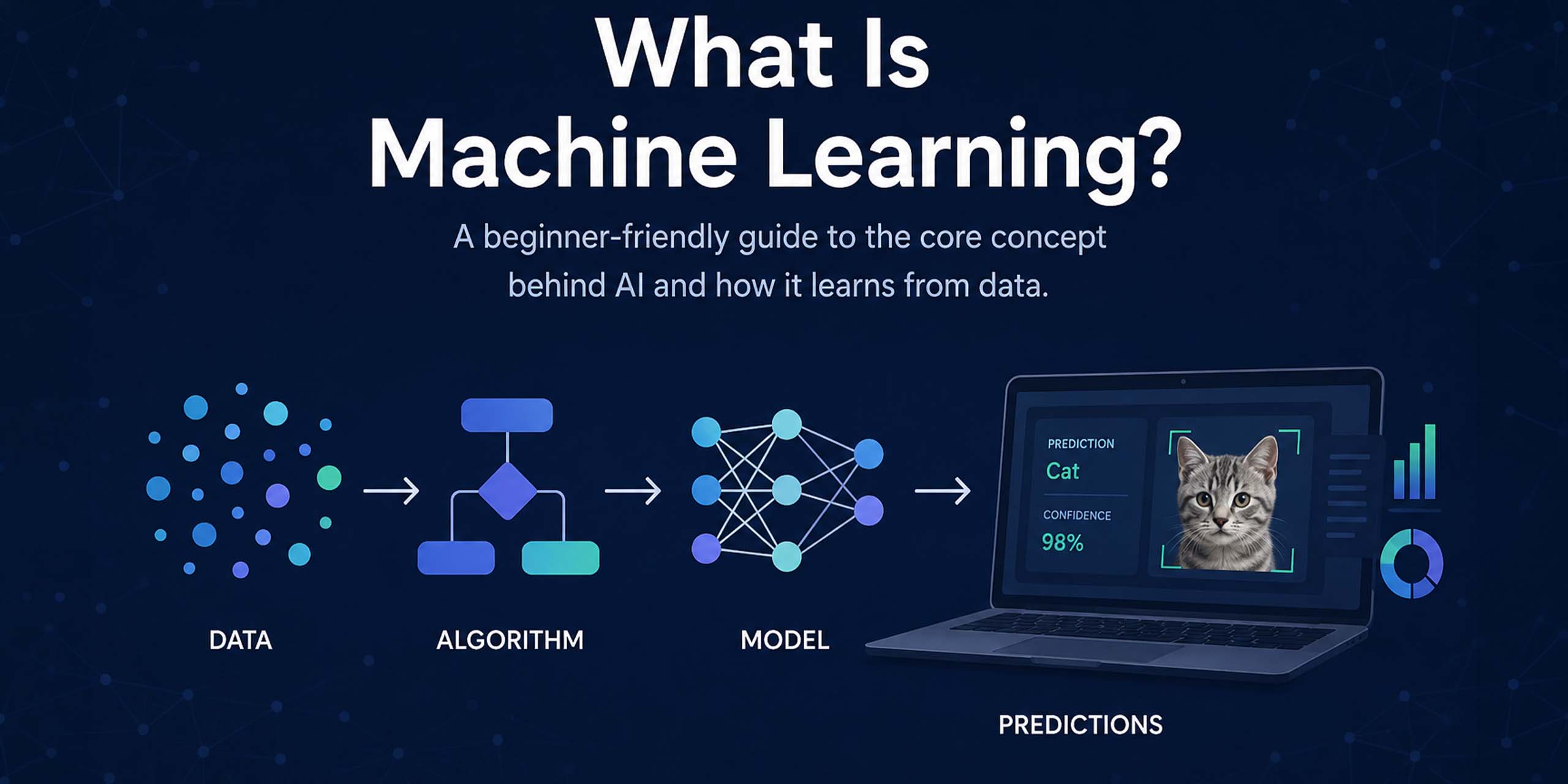
A simplified machine learning workflow looks like this:
- Data collection: gathering examples relevant to the task.
- Data preparation: cleaning, labeling, organizing, and transforming that data.
- Training: teaching the model to detect useful patterns.
- Evaluation: testing how well the model performs on data it has not seen before.
- Deployment: putting the model into a real product, workflow, or system.
- Monitoring: checking whether the model remains accurate, fair, safe, and useful over time.
That evaluation step is crucial. A model can perform well on the data it studied and still fail on new data. This is one of the classic machine learning problems: the system may memorize patterns from training examples without generalizing well to the real world.
Imagine a model trained to recognize dogs in photos. If most of its training images show dogs outdoors in daylight, it may struggle with indoor photos, unusual breeds, poor lighting, or dogs partly hidden behind objects. The model has not learned “dogness” in a human way. It has learned patterns that may or may not transfer.
Good machine learning is not just “feed data into a machine and let it figure things out.” It requires a clear task, good data, careful evaluation, and people who understand what failure would look like.
The main types of machine learning
Machine learning is usually divided into a few broad types. The names can sound academic, but the differences are practical.
Supervised learning uses labeled examples. The model learns from data where the correct answer is already known. If you train a system on photos labeled “cat” or “dog,” or transactions labeled “fraud” or “not fraud,” you are using supervised learning. This is common for classification and prediction tasks.
Unsupervised learning looks for patterns in data without pre-written labels. It might group customers by behavior, cluster similar documents, identify unusual activity, or discover hidden structures in a dataset. It is useful when you do not already know the categories you are looking for.
Reinforcement learning trains systems through rewards and penalties. The model learns by trying actions and receiving feedback. This approach is often discussed in robotics, game-playing systems, optimization, and environments where a system must learn which actions lead to better outcomes over time.
Generative AI is sometimes discussed separately, but it is deeply connected to machine learning. Generative models learn patterns from data, then create new outputs such as text, images, audio, video, code, or synthetic data. For more on that creative layer, read our guide to generative AI.
These categories are useful, but real systems can blend ideas. A modern AI product may combine supervised learning, deep learning, generative models, retrieval systems, rules, human review, and ordinary software engineering. The neat textbook labels help you understand the map. The real world is usually messier.
Why does machine learning matter now?
Machine learning matters because it is one of the engines behind the AI boom. Generative AI may get the headlines, but machine learning has been shaping digital products for years. It decides what appears in feeds, what gets recommended, what looks suspicious, what gets ranked, and what deserves attention.
The reason ML became so important is simple: modern life creates huge amounts of data. Every search, purchase, click, upload, transaction, delivery, sensor reading, and support ticket can become a signal. Machine learning gives companies and developers a way to turn those signals into predictions, decisions, and automation.
That does not automatically make every use good. A model can optimize for engagement and push people toward worse content. A risk model can reproduce unfair patterns. A recommendation system can trap users in a narrow bubble. A hiring or credit system can make harmful decisions if it is trained on biased data. Machine learning is powerful because it scales pattern detection. That also means it can scale mistakes.
For businesses, ML matters because it can help with forecasting, personalization, fraud detection, operations, support, pricing, logistics, security, and product recommendations. For developers, it provides tools for building systems that adapt to data instead of relying only on rigid rules. For users, it quietly shapes much of the digital environment.
Machine learning is not new, but its impact has become much more visible because it now sits behind both everyday automation and the latest generation of AI tools. The current AI wave did not appear from nowhere. Machine learning laid much of the groundwork.
Real-world uses of machine learning
Machine learning is strongest when a task involves patterns, predictions, classification, ranking, or large volumes of information.
In ecommerce, ML helps recommend products, rank search results, detect fraud, forecast demand, personalize offers, and predict customer behavior. Every “you might also like” box has a model-shaped shadow behind it.
In media and entertainment, machine learning helps recommend videos, music, games, articles, and shows. It can also support moderation, subtitle generation, audio cleanup, visual effects workflows, and audience analysis.
In finance, ML can detect suspicious transactions, support credit scoring, identify risk, monitor compliance, classify documents, and analyze market signals. These use cases need serious oversight because the consequences can affect people’s money, access, and opportunities.
In healthcare, machine learning can help analyze medical images, detect patterns in patient data, support research, and reduce administrative work. It can be useful, but it must be validated carefully. In medicine, a model is not “good enough” because it looks impressive in a demo.
In cybersecurity, ML can flag anomalies, classify threats, detect suspicious behavior, filter alerts, and help analysts prioritize risks. Security teams deal with too much data for manual review alone, which makes pattern detection especially valuable.
In marketing, machine learning can segment audiences, predict churn, personalize campaigns, analyze performance, optimize timing, and support automated testing. The smart use is not blasting more content at people. It is understanding which signal actually matters.
In logistics and operations, ML can forecast demand, optimize routes, predict equipment maintenance, manage inventory, and improve scheduling. These uses are often less flashy than chatbots, but they can save real money and time.
In software products, machine learning can power search, recommendations, content moderation, voice recognition, image tagging, personalization, and smart assistance. Many users interact with ML constantly without ever seeing the term.
Common mistakes about machine learning
The first mistake is thinking machine learning and AI are the same thing. Machine learning is part of AI, not the whole field. AI also includes rule-based systems, search algorithms, planning systems, robotics, symbolic methods, generative systems, agents, and other approaches.
The second mistake is assuming machine learning is automatically smarter than rules. Sometimes a simple rule-based system is cheaper, clearer, safer, and easier to maintain. If the task is stable and the rules are obvious, machine learning may be overkill. Not every problem needs a model wearing sunglasses indoors.
The third mistake is believing more data always means better results. More relevant, high-quality data can help. More messy, biased, duplicated, outdated, or irrelevant data can make things worse. Data quantity is not a substitute for data quality.
The fourth mistake is trusting a model because it performed well once. Machine learning systems can drift over time. Customer behavior changes. Fraud patterns evolve. New products appear. Language shifts. A model that worked last year may become less reliable if the world around it changes.
The fifth mistake is ignoring explainability. Some models are easy to interpret. Others are more opaque. In low-stakes recommendation systems, that may be acceptable. In healthcare, finance, hiring, insurance, or legal contexts, people need to understand why a system made or supported a decision.
The sixth mistake is treating machine learning as neutral. Models reflect data, design choices, optimization goals, and deployment contexts. If a system is trained on biased data or optimized for the wrong metric, it can produce harmful outcomes at scale.
Machine learning is not objective just because it involves math. Math can be very good at giving bad assumptions a confident suit.
Machine learning vs related concepts
Machine learning sits in the middle of many AI terms, so it is worth separating the concepts clearly.
Artificial intelligence is the broad field. It covers systems designed to perform tasks associated with intelligence, such as learning, reasoning, perception, language, planning, prediction, and decision support.
Machine learning is one approach inside AI. It focuses on systems that learn patterns from data rather than relying only on rules written by humans.
Deep learning is a subset of machine learning based on neural networks with multiple layers. It has been especially important for modern image recognition, speech processing, language models, and generative AI. For now, think of deep learning as machine learning with more layered pattern detection.
An AI model is the trained system produced through a process such as machine learning. The model is what receives a new input and produces an output, such as a prediction, label, recommendation, or generated response. For a deeper explanation, read our guide to AI models.
A large language model, or LLM, is a type of AI model focused on language. Many modern LLMs are built using machine learning and deep learning techniques.
Generative AI creates new content. It often relies on machine learning models trained on large datasets, but not all machine learning is generative. Many ML systems only predict, rank, classify, or detect.
Here is the clean version:
- AI: the broad field.
- Machine learning: AI systems that learn patterns from data.
- Deep learning: machine learning based on multi-layer neural networks.
- AI model: a trained system that produces outputs from inputs.
- LLM: an AI model focused on language.
- Generative AI: AI that creates new content.
Once that hierarchy is clear, the AI conversation becomes much less foggy. Machine learning is not the whole story, but it is one of the main reasons modern AI works at all.
What beginners should remember
The most important thing to remember is that machine learning is about learning patterns from data. Instead of writing every rule manually, developers train a model on examples, then use that model to make predictions, classifications, recommendations, or other outputs on new inputs.
That makes ML extremely useful for tasks where the rules are too complex, too subtle, or too large to write by hand. It is why machine learning is used in recommendations, fraud detection, image recognition, forecasting, cybersecurity, speech recognition, personalization, and many modern AI tools.
But machine learning is not magic. It needs good data, clear goals, careful evaluation, monitoring, and human responsibility. A model can be accurate in one context and wrong in another. It can detect useful patterns or reproduce harmful ones. It can make work faster or hide bad decisions behind technical language.
The best question is not “Can we use machine learning here?”
The better question is: what pattern are we trying to learn, from what data, for what decision, with what risk if the model gets it wrong?
That is where useful machine learning begins. Not with the buzzword, but with the problem.
What to Remember (FAQ)
What is machine learning in simple terms?
Machine learning is a way to train software to learn patterns from data so it can make predictions, classify information, recommend items, detect patterns, or generate outputs.
Is machine learning the same as AI?
No. Artificial intelligence is the broad field. Machine learning is one important approach inside AI where systems learn from data instead of relying only on hand-written rules.
What is an example of machine learning?
A spam filter is a simple example. It can learn from emails labeled as spam or legitimate, then predict whether a new email looks suspicious.
What are the main types of machine learning?
The main types are supervised learning, unsupervised learning, reinforcement learning, and generative approaches. Each learns from data or feedback in a different way.
Is machine learning the same as deep learning?
No. Deep learning is a subset of machine learning that uses neural networks with multiple layers. It is especially important for modern AI systems such as image recognition and large language models.
Why is machine learning important?
Machine learning matters because it helps software detect patterns, make predictions, personalize experiences, automate decisions, and analyze large amounts of data faster than humans could manually.
Sources: IBM, Google Developers, AWS