
Artificial intelligence, or AI, is one of those phrases that now appears everywhere: in search engines, phones, business tools, creative apps, games, cars, hospitals, marketing platforms, cybersecurity systems, and half the software updates nobody asked for.
The problem is that “AI” has become so broad that it can mean almost anything depending on who is using the word. Sometimes it means a chatbot. Sometimes it means a recommendation algorithm. Sometimes it means a model that detects fraud, generates images, writes code, recognizes speech, or helps a robot understand its environment.
The simple version is this: artificial intelligence is a field of technology focused on building systems that can perform tasks usually associated with human intelligence. That can include understanding language, recognizing patterns, making predictions, generating content, solving problems, planning actions, or adapting to new information.
AI is not one single technology. It is a family of methods, models, systems, and tools. Some are flashy, like generative AI chatbots. Others are almost invisible, quietly deciding what you see, what gets flagged, what gets recommended, or what needs human attention.
That is why understanding AI matters. Not because every tool with an “AI-powered” badge is revolutionary — many are not — but because the technology is becoming part of the basic machinery of digital life.
Sommaire
- What is artificial intelligence?
- How does artificial intelligence work?
- Why does AI matter now?
- Real-world uses of artificial intelligence
- Common mistakes about AI
- AI vs related concepts
- What beginners should remember
- What to Remember (FAQ)
What is artificial intelligence?
Artificial intelligence is the broad field of creating computer systems that can perform tasks we normally associate with intelligence. These tasks can include learning from examples, recognizing images, understanding language, making recommendations, detecting anomalies, generating content, planning steps, or helping people make decisions.
That definition sounds wide because AI really is wide. A spam filter can use AI. A medical imaging system can use AI. A game character can use AI. A voice assistant can use AI. A large language model can use AI. A fraud detection system can use AI. They do not all work the same way, and they are not equally advanced, but they belong to the same broader family.
The important shift is that AI systems are not always programmed with every rule written by hand. In many modern systems, especially those based on machine learning, the software learns patterns from data. Instead of telling the system every possible rule for identifying spam, developers train it on examples of spam and legitimate emails. Instead of manually listing every visual clue for recognizing a cat, an image model learns from many labeled images.
That does not make AI magical. It makes it statistical, data-driven, and dependent on design choices. AI systems are shaped by the data they learn from, the goals they are optimized for, the people who build them, and the context in which they are used.
A useful way to think about AI is this: it is not “human intelligence inside a machine.” It is software that can process information, detect patterns, and produce outputs that sometimes look intelligent from the outside.
For a deeper look at the technical engine behind many AI systems, read our guide to AI models.
How does artificial intelligence work?
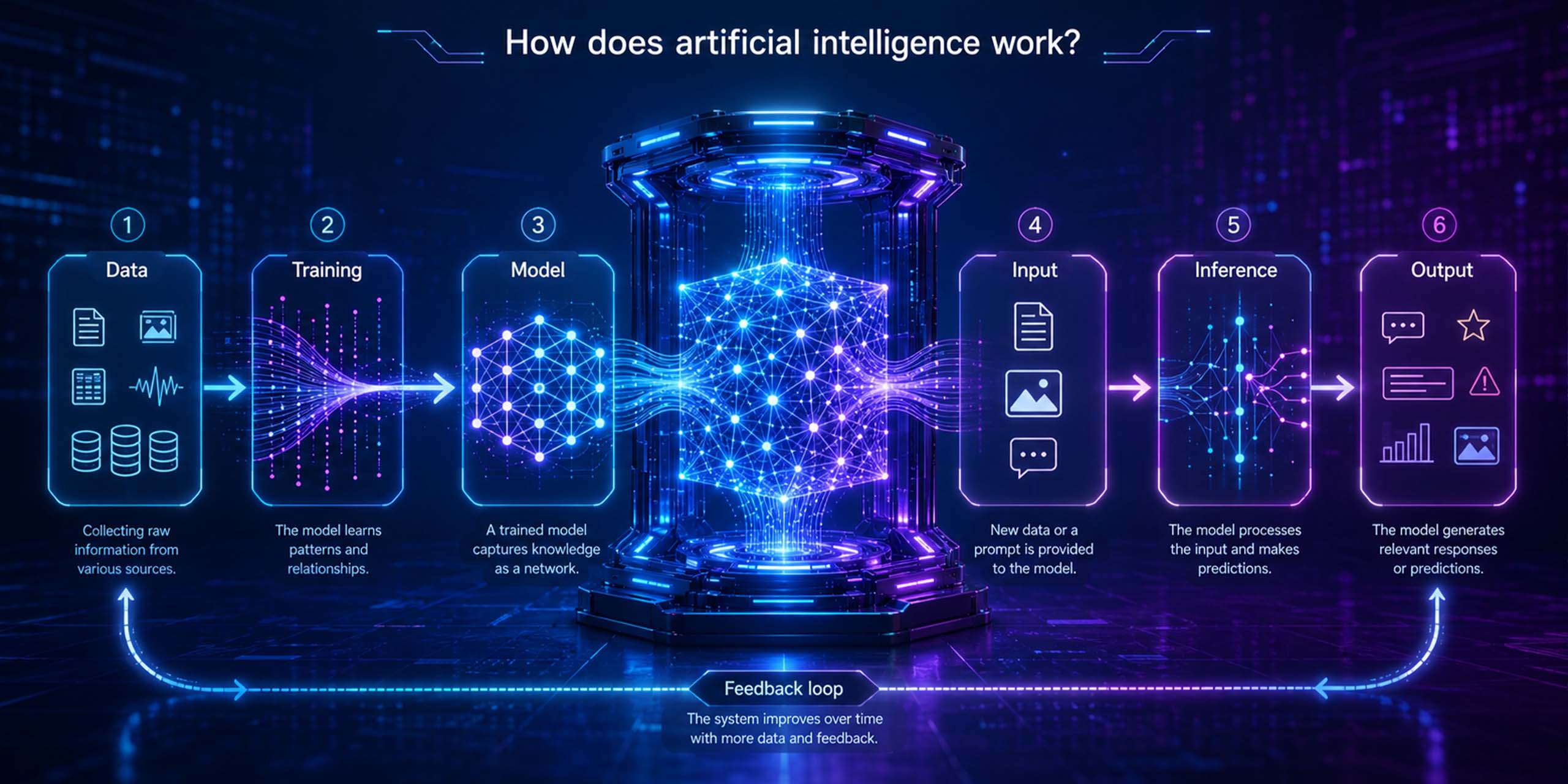
AI works in different ways depending on the system, but most modern AI follows a familiar pattern: data goes in, the system learns or applies patterns, and an output comes out.
In traditional software, a developer writes explicit instructions: if this happens, do that. That still matters. Plenty of AI products include normal software logic around the AI part. But the distinctive feature of many AI systems is that they can learn from examples rather than relying only on hand-written rules.
A simplified AI workflow looks like this:
- Data: the examples, documents, images, numbers, sounds, behaviors, or records the system learns from or analyzes.
- Training: the process where a model learns patterns from that data.
- Model: the trained system that can process new inputs.
- Input: the new question, image, request, transaction, document, or signal given to the system.
- Inference: the moment when the trained model produces an output.
- Output: the result, such as a prediction, recommendation, answer, label, image, summary, warning, or action.
Take a recommendation system. It may study what users watch, skip, like, share, or buy. Over time, it learns patterns about behavior and similarity. When you open the app, it predicts what you might want next. That prediction may feel personal, but it is not the system “knowing” you like a friend. It is pattern matching at scale.
A language model works differently, but the principle is related. It learns patterns in text and uses them to generate language-like outputs. That is why a large language model can draft an email, explain a concept, summarize a report, or help write code. If you want the specific version of this idea, read our guide to LLMs.
Not all AI is generative. Some AI creates new content. Some classifies information. Some predicts risk. Some ranks search results. Some detects suspicious behavior. Some controls robots. Some simply helps humans make faster decisions.
That variety is the point. AI is not one machine. It is a toolkit.
Why does AI matter now?
AI matters now because it has moved from specialist systems into everyday tools. For years, most people encountered AI indirectly through recommendations, spam filters, navigation apps, voice recognition, ad targeting, fraud detection, and search ranking. Useful, yes, but mostly hidden.
Generative AI changed the public perception. Suddenly, people could type a sentence and get text, code, images, summaries, plans, or explanations in return. AI stopped feeling like infrastructure and started feeling like an interface.
That shift matters because it lowers the barrier to using advanced software. You no longer need to know every menu, every formula, or every programming language to get something done. In more and more tools, you can describe what you want in natural language and let the system help you draft, analyze, generate, compare, or organize the result.
For businesses, that means faster content production, better document processing, more automated support, stronger data analysis, quicker prototyping, and new product features. For creators, it means faster ideation, moodboards, editing support, scripting help, and translation. For developers, it means code assistance, testing, documentation, and debugging support. For regular users, it means software that feels less like a dashboard and more like a conversation.
But the stakes are not only positive. AI can produce false information, amplify bias, increase surveillance, automate low-quality content, weaken privacy, create security risks, and make work more dependent on systems people do not fully understand. The more AI becomes part of infrastructure, the more trust, transparency, accountability, and human oversight matter.
That is the grown-up version of the AI conversation: not “AI will save everything” or “AI will destroy everything,” but “AI is becoming powerful enough that design, governance, and usage choices matter.”
Real-world uses of artificial intelligence
Artificial intelligence is already used across most major digital industries. Some uses are obvious. Others are so embedded that people barely notice them.
In search and recommendation systems, AI helps rank results, personalize feeds, suggest videos, surface products, match music, and predict what users may want next. This is one of the oldest everyday forms of AI, even if most people did not call it that.
In marketing and ecommerce, AI can segment audiences, personalize product recommendations, generate campaign drafts, analyze customer behavior, write product descriptions, and detect unusual activity. Used well, it helps teams move faster. Used badly, it produces endless generic content nobody needed.
In software development, AI tools can explain code, generate functions, write tests, suggest fixes, draft documentation, and help developers understand unfamiliar codebases. These systems are not replacements for engineering judgment, but they can remove a lot of friction from repetitive technical work.
In cybersecurity, AI can detect anomalies, classify threats, flag suspicious behavior, prioritize alerts, and help analysts deal with overwhelming amounts of data. This is a strong use case because security work often involves pattern detection at a scale humans cannot manage alone.
In healthcare, AI can help analyze medical images, support research, organize records, detect patterns, and reduce administrative workload. This is also an area where caution matters. Medical AI needs validation, oversight, and clear responsibility because mistakes can have serious consequences.
In finance, AI is used for fraud detection, credit scoring, risk modeling, compliance checks, market analysis, and automated reporting. The same strengths apply: speed, scale, and pattern detection. The same risks apply too: bias, opacity, and overconfidence.
In media, design, and entertainment, AI can generate images, write drafts, clean audio, translate subtitles, create concept art, support editing workflows, and recommend content. The creative questions here are especially tense because AI touches originality, labor, copyright, and taste all at once.
In business operations, AI can summarize meetings, extract action items, process documents, route requests, update databases, and support internal knowledge tools. These use cases are less glamorous than image generation, but often more useful day to day.
The common thread is simple: AI is most useful when it handles pattern-heavy work, repetitive tasks, large volumes of information, or early drafts that humans can then evaluate.
Common mistakes about AI
The first mistake is treating AI as one thing. AI is a broad category. A chess engine, a spam filter, a recommendation system, a self-driving car component, an image generator, and a chatbot can all involve AI, but they are not the same kind of system.
The second mistake is assuming AI understands the world like a human. Most AI systems do not have lived experience, common sense, responsibility, emotion, intention, or judgment. They process information and generate outputs based on learned patterns, rules, goals, or probabilities. That can be useful without being human-like.
The third mistake is trusting fluent output too easily. A generated answer can sound polished and still be wrong. A summary can omit the important part. A chart explanation can miss the real cause. A code suggestion can look plausible and break when tested. AI can be useful and unreliable at the same time.
The fourth mistake is thinking bigger always means better. A large general-purpose model may be impressive, but it can also be slower, more expensive, harder to control, and unnecessary for a narrow task. Sometimes the smarter choice is a smaller model, a rule-based tool, a database query, or no AI at all. A little anti-hype goes a long way.
The fifth mistake is ignoring data. AI systems depend heavily on data quality, context, and incentives. If the data is biased, incomplete, outdated, badly labeled, or irrelevant, the output can reflect those problems. “AI-powered” does not magically clean up bad inputs.
The sixth mistake is using AI without responsibility. If an organization uses AI to make or support decisions about customers, employees, money, health, security, or legal issues, it needs clear human oversight, documentation, testing, privacy controls, and accountability.
The tool may be artificial. The consequences are not.
AI vs related concepts
AI is often used as a catch-all term, which is convenient in conversation and terrible for clarity. The clean way to understand it is to separate the field from the techniques, models, interfaces, and products built inside it.
Artificial intelligence is the broad field. It covers systems designed to perform tasks associated with intelligence, such as learning, perception, language, reasoning, prediction, planning, and decision support.
Machine learning is one major approach inside AI. Instead of programming every rule manually, developers train systems on data so they can learn patterns and improve at a task.
Deep learning is a subset of machine learning that uses neural networks with multiple layers. It has been especially important for modern image recognition, speech processing, language models, and generative systems.
An AI model is a trained system that produces outputs from inputs. It might classify images, generate text, detect fraud, recommend products, or predict risk.
Generative AI is AI that creates new content, such as text, images, audio, video, music, code, or synthetic data. For more on that creative layer, read our guide to generative AI.
An LLM, or large language model, is an AI model focused on language. It can generate, summarize, translate, explain, classify, and restructure text.
An AI agent is a system that uses models and tools to work toward a goal. A chatbot might answer a question. An agent may plan steps, use software, check progress, and take action. For a deeper explanation, see our guide to AI agents.
Here is the clean version:
- AI: the broad field.
- Machine learning: AI systems that learn patterns from data.
- Deep learning: machine learning based on multi-layer neural networks.
- AI model: a trained system that produces outputs from inputs.
- LLM: an AI model focused on language.
- Generative AI: AI that creates new content.
- AI agent: AI connected to tools, goals, and actions.
Once those distinctions are clear, AI stops looking like one giant fog machine and starts looking like a map.
What beginners should remember
The most important thing to remember is that artificial intelligence is not a single product. It is a broad field of systems that process information in ways that can look intelligent: learning, predicting, generating, recognizing, ranking, recommending, planning, and acting.
Some AI is simple and narrow. Some is large and flexible. Some creates content. Some only classifies or predicts. Some runs quietly in the background. Some sits in a chat window and answers questions. Some is impressive. Some is overmarketed. Some is both.
The right question is not “Is this AI?” That question is often too vague to be useful.
The better questions are:
- What task is this system trying to perform?
- What data does it rely on?
- What kind of output does it produce?
- How accurate does it need to be?
- Who checks the result?
- What happens if it gets something wrong?
That is where the real understanding begins. AI is not magic, and it is not just hype. It is a powerful set of technologies that can make software more adaptive, more conversational, more creative, and more automated.
Used well, AI can help people work faster, explore ideas, analyze information, and build better tools. Used carelessly, it can scale mistakes, bias, noise, surveillance, and bad decisions.
So the point is not to worship AI or dismiss it. The point is to understand what it does, where it helps, where it fails, and when a human still needs to stay firmly in the loop.
What to Remember (FAQ)
What is artificial intelligence in simple terms?
Artificial intelligence is technology that allows computer systems to perform tasks usually associated with human intelligence, such as learning, recognizing patterns, generating content, making predictions, or supporting decisions.
Is AI the same as machine learning?
No. AI is the broad field. Machine learning is one major approach inside AI where systems learn patterns from data instead of relying only on hand-written rules.
Is generative AI the same as artificial intelligence?
No. Generative AI is one type of AI that creates new content, such as text, images, code, audio, or video. Many AI systems do not generate content; they classify, rank, predict, or detect patterns.
Does AI understand things like a human?
Not in the human sense. Most AI systems process patterns in data and produce outputs based on training, rules, context, or probabilities. They can be useful without having human understanding or judgment.
Can AI make mistakes?
Yes. AI can produce false information, biased results, weak recommendations, flawed code, or misleading outputs. Important AI results should be reviewed, especially in high-stakes areas.
Why is AI important now?
AI is becoming part of everyday software, business workflows, creative tools, search, cybersecurity, healthcare, finance, and automation. It matters because it changes how people use information, build products, and interact with technology.
Sources: NIST, IBM, Google Cloud