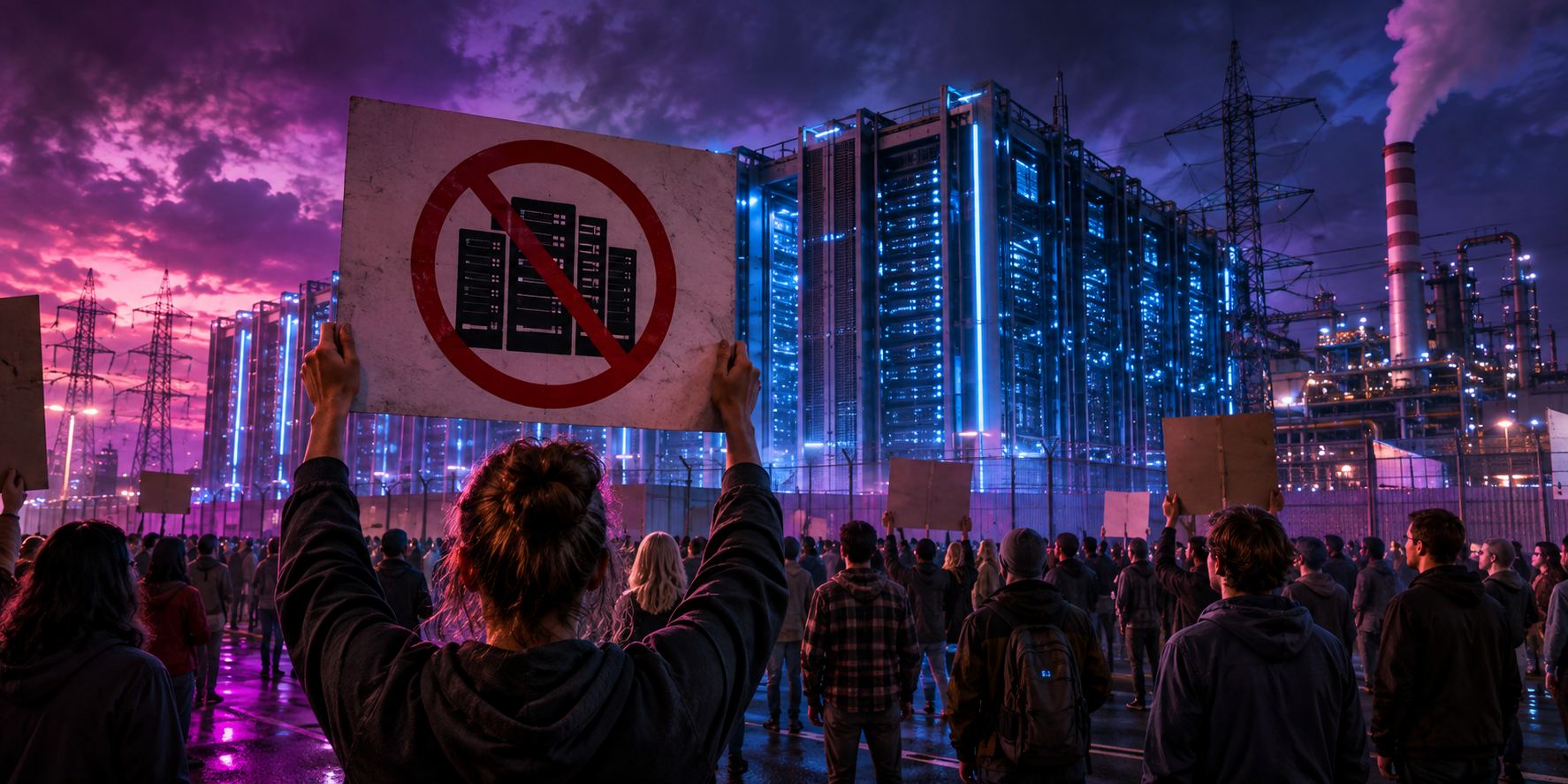
AI companies have spent the past few years worrying about access to GPUs, electricity, capital and enough physical infrastructure to keep increasingly powerful models running. The next constraint may be harder to order from a supplier.
It may be permission.
Anthropic is reportedly preparing to identify negative public sentiment toward artificial intelligence and data centers as a risk factor in its eventual IPO prospectus. CNBC reported on August 21, citing people familiar with the matter, that the Claude developer expects public opposition to feature among the risks presented to prospective investors.
That detail remains prospective. Anthropic has not yet published the final prospectus language, so the precise wording could still change. What is confirmed is that the company confidentially submitted a draft Form S-1 to the SEC on June 1, 2026. Anthropic said at the time that the number of shares and offering price had not been determined.
The distinction matters because reported IPO valuations are also just that: reported. Anthropic’s latest confirmed private financing valued the company at $965 billion after a $65 billion funding round announced in May. Estimates for a future public-market valuation have ranged significantly higher, but no IPO price has been formally set.
Still, the reported risk disclosure is important beyond Anthropic.
If an AI company preparing for the public markets believes community resistance to the physical infrastructure behind AI belongs alongside competition, margins and access to compute in an investor risk section, then public acceptance is no longer just a political communications problem.
It is becoming an economic input.
Table of contents
- When public opposition becomes a financial risk
- AI growth increasingly depends on physical infrastructure
- Power, water and permits can all slow deployment
- How local backlash can reach margins and valuations
- What the Anthropic case says about AI’s maturity
- The scarce resource may be permission to build
- AI data centers: key questions
When public opposition becomes a financial risk
Technology companies routinely warn investors about regulation, litigation, competitors, cybersecurity incidents and supply-chain failures. Public resistance to the infrastructure supporting a software product is a more unusual variable.
But frontier AI is not really a software-only business.
Every additional wave of model training and inference ultimately depends on physical assets: servers, networking equipment, cooling systems, substations, transmission infrastructure and enormous quantities of reliable electricity.
That changes the nature of the constraint.
A consumer software company can often serve another million users without asking a county government for permission to pour concrete. An AI infrastructure developer may need zoning approval, utility agreements, transmission upgrades and years of construction before a new cluster comes online.
And increasingly, the communities hosting those projects are asking what they receive in return.
Opposition can focus on electricity prices, water consumption, noise, tax incentives, land use, construction disruption or the perception that a giant industrial facility creates fewer permanent local jobs than its physical scale suggests.
Those objections do not need to stop every project to become financially relevant. They only need to make capacity slower, less predictable or more expensive to deploy.
That is enough to affect the economics.
AI growth increasingly depends on physical infrastructure
The AI boom initially made GPU scarcity the industry’s defining bottleneck. Companies competed for Nvidia accelerators and the manufacturing capacity needed to produce them.
The constraint has progressively expanded outward.
Owning GPUs is not useful without somewhere to install them. A data center is not useful without electricity. Electricity is not useful without sufficient grid interconnection. And none of it matters if the facility cannot clear planning, permitting and community opposition.
The scale of the power requirement is already substantial.
The International Energy Agency estimated that data centers consumed around 415 terawatt-hours of electricity globally in 2024, roughly 1.5% of worldwide electricity consumption. Its base case projects consumption rising to around 945 TWh by 2030, with AI among the main drivers.
The problem is not simply the global total. Data centers are geographically concentrated.
According to the IEA, nearly half of US data-center capacity is located in five regional clusters. That concentration can turn what looks manageable at the national level into a major load problem for a particular utility, city or transmission network.
The agency has estimated that roughly 20% of planned data-center projects could face delays unless grid-integration bottlenecks are addressed.
That is the physical reality behind increasingly abstract discussions about AI demand.
Model developers can theoretically scale inference almost instantly. The electricity system cannot.
Transmission lines, generators and substations operate on infrastructure timelines, not software release cycles.
Power, water and permits can all slow deployment
The data-center bottleneck is really several bottlenecks stacked on top of one another.
Electricity is the most obvious.
AI servers pack enormous computational density into relatively small spaces. That creates high and continuous power requirements, sometimes comparable to major industrial facilities.
The US Department of Energy warned in late 2024 that domestic data-center electricity demand could double or triple by 2028. That means utilities must decide where new generation comes from, who pays for grid upgrades and whether existing customers could end up subsidizing infrastructure built primarily for large technology companies.
Those questions are increasingly political.
Pennsylvania offered a particularly clear example in August 2026. Governor Josh Shapiro imposed new requirements on data-center development, including energy planning, environmental standards and stronger local oversight, while removing projects from the state’s expedited permitting process.
Water adds another local constraint.
Many facilities use water as part of their cooling systems, although the amount varies enormously depending on climate, cooling technology and facility design. Operators can reduce consumption through closed-loop cooling and other approaches, but proposed projects may still face scrutiny in regions where water is scarce or politically sensitive.
Then there is permitting itself.
A large data center may require land-use approvals, environmental reviews, utility coordination and supporting infrastructure before construction can begin. Political resistance can introduce additional hearings, litigation, revised requirements or outright moratoriums.
From the perspective of an AI company purchasing compute capacity, those local processes may feel far removed from the model layer.
Financially, they are not.
Every delayed campus potentially means fewer accelerators available at the moment demand exists for them.
How local backlash can reach margins and valuations
The connection between a town-hall meeting and an AI company’s valuation is not as indirect as it sounds.
Suppose an AI provider expects usage to increase rapidly over the next several years. To serve that demand, it contracts for new data-center capacity.
If those facilities arrive on schedule, the company can add compute, support additional customers and spread its fixed costs across a larger revenue base.
Now introduce delays.
A permitting dispute pushes construction back six months. Grid upgrades cost more than expected. Developers must redesign cooling infrastructure. A utility demands additional investment before guaranteeing the required power. Another jurisdiction introduces a moratorium.
Individually, none of these events necessarily breaks the business.
Collectively, they can change its economics.
Capacity becomes more expensive. Deployment schedules become less certain. Companies may have to secure infrastructure in less efficient locations or pay premiums for already available compute.
That can pressure gross margins, particularly in an industry where serving every additional token carries a real computational cost.
It can also constrain revenue.
If demand for an AI service rises faster than available infrastructure, the company may be unable to monetize all of that demand without raising prices, limiting usage or prioritizing particular customers.
The valuation consequence follows naturally.
High-growth AI companies are often valued partly on expectations that today’s extraordinary capital expenditure will produce much larger future revenue streams. If infrastructure takes longer to deploy, those future cash flows move further away or become less certain.
The market does not need data-center construction to stop entirely for valuations to react.
A higher probability of delays is enough to justify a higher risk premium.
That is why community opposition can move from the political section of a newspaper to the risk section of a prospectus.
What the Anthropic case says about AI’s maturity
Anthropic is useful here as a catalyst because the company’s reported disclosure represents a broader change in how the AI industry is being evaluated.
The company has already reached a scale where infrastructure availability matters directly to its growth story. Anthropic said in May that its annualized revenue run rate had crossed $47 billion while announcing its $65 billion Series H financing.
At that size, investors are no longer evaluating only whether Claude is technically competitive.
They are evaluating whether the infrastructure required to sustain that growth can actually be built.
CNBC’s reporting says Anthropic executives have been questioned in preliminary investor meetings about competition, margin pressure from open-source models and what would happen if data-center construction slowed.
That list is revealing.
Model quality, competitive pricing and construction schedules now occupy the same strategic conversation.
This is what industry maturation looks like. The abstractions disappear.
During the first phase of generative AI, investors could focus on benchmark performance, user adoption and GPU access. As the sector scales, the financial model increasingly reaches down into power markets, land policy, cooling technology and municipal politics.
AI economics is becoming infrastructure economics.
The scarce resource may be permission to build
The technology industry has a habit of treating physical constraints as engineering problems waiting to be optimized.
Sometimes they are.
More efficient chips can reduce energy per computation. Better cooling can reduce water consumption. New power contracts can bring additional generation online. Flexible workloads can shift demand across regions or times of day.
Public permission works differently.
It cannot simply be manufactured faster.
A community may decide that a proposed data center offers enough economic benefit to justify its demands on local infrastructure. Another may decide the opposite. Governments may impose conditions designed to ensure developers absorb grid costs rather than passing them to households.
The result is a new kind of competitive advantage.
AI companies and infrastructure developers that can secure power, land and local approval reliably may be able to expand faster than rivals, even if those rivals have access to the same GPUs and similar amounts of capital.
That makes social license a potentially scarce asset.
The phrase sounds soft compared with megawatts, chips or billions of dollars in capital expenditure. Economically, it can be just as concrete.
A facility that cannot receive approval generates exactly zero compute.
That is what makes the reported Anthropic disclosure notable.
It suggests the AI industry is approaching the point where public acceptance is not merely something companies manage after deciding where to build. It is something investors may need to model before assigning a value to future growth.
For years, the race was about who could obtain enough chips.
Then it became about who could secure enough electricity.
The next race may be about who can convince enough communities to say yes.
AI data centers: key questions
Has Anthropic officially confirmed that AI backlash will appear in its IPO prospectus?
No. CNBC reported that public opposition to AI and data centers is expected to appear as a risk factor, citing people familiar with the matter. Anthropic’s final public prospectus has not yet been released.
Has Anthropic officially filed for an IPO?
Anthropic confirmed that it confidentially submitted a draft Form S-1 to the SEC on June 1, 2026. The company said the offering would depend on market conditions and that the number of shares and price had not yet been determined.
Why do AI companies need so many data centers?
Training and operating large AI models requires large clusters of accelerators, networking hardware, storage, cooling and continuous electricity. Growing AI usage therefore requires additional physical compute capacity.
Why can local opposition affect an AI company’s finances?
Opposition can delay permits, increase infrastructure requirements, raise construction costs or prevent projects entirely. That can make compute capacity slower and more expensive to deploy, potentially affecting revenue growth and margins.
Is electricity the only infrastructure constraint?
No. Grid connections, land, water, cooling systems, transmission capacity, permitting and local political support can all affect where and how quickly new facilities are built.
What is Anthropic’s confirmed valuation?
Anthropic announced a $65 billion funding round in May 2026 at a $965 billion post-money valuation. Any valuation attached to a future IPO remains prospective until pricing is formally established.
Is this financial advice?
No. This article analyzes industry economics and reported IPO developments and should not be considered investment advice.