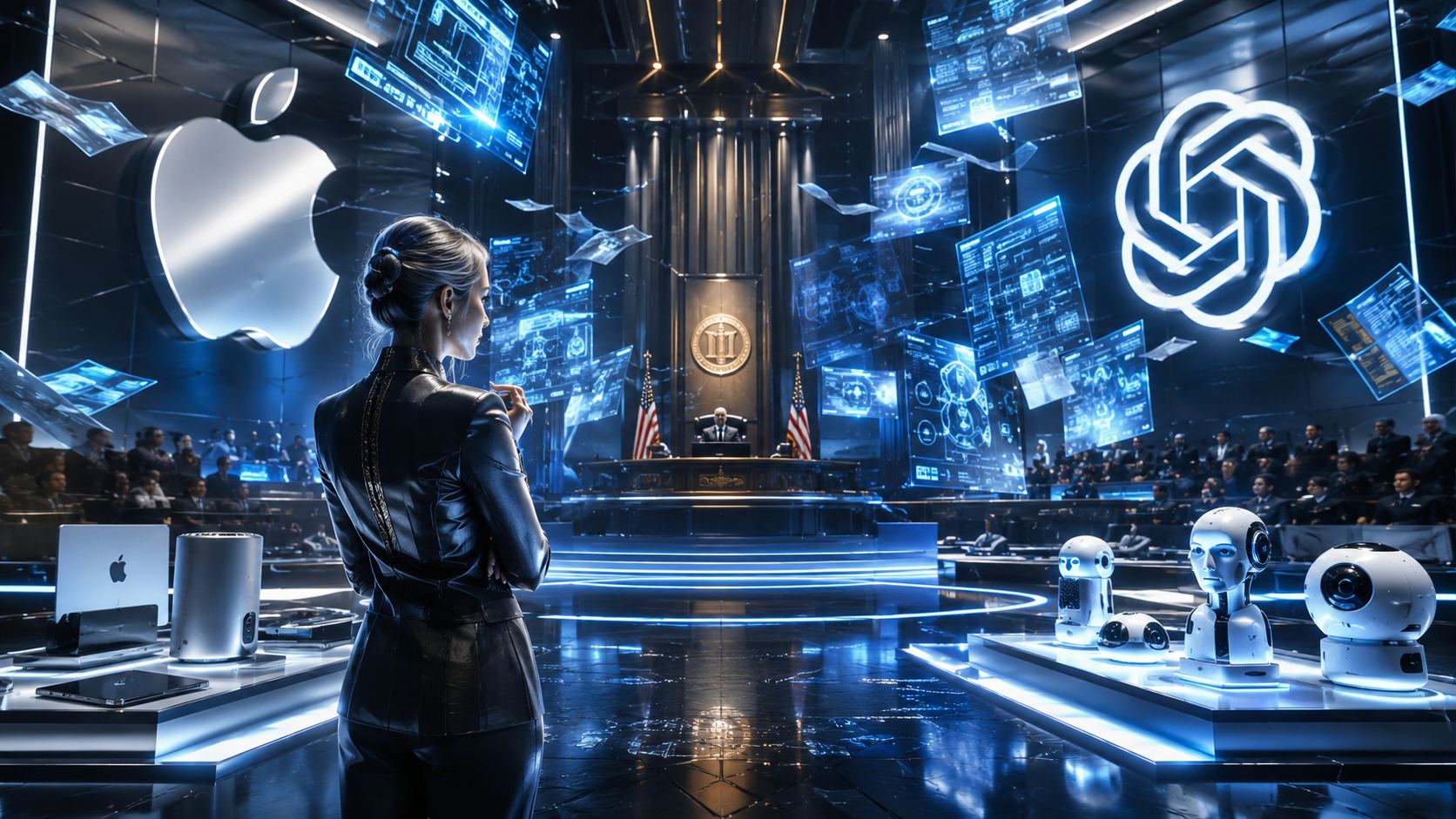
Apple and OpenAI may still be partners on the iPhone, but their relationship has just entered a much more hostile phase.
Apple has filed a lawsuit against OpenAI, its hardware subsidiary io Products and two former Apple employees, accusing them of misappropriating trade secrets to accelerate the development of new AI-powered consumer devices.
The complaint, filed in the U.S. District Court for the Northern District of California, describes what Apple considers a coordinated campaign to obtain confidential information about unreleased products, engineering processes, components and manufacturing techniques.
OpenAI denies the allegations. None of Apple’s claims have been proven in court.
Table of contents
- Apple takes OpenAI to court
- OpenAI’s hardware ambitions raise the stakes
- Apple’s allegations against Tang Tan
- The accusations involving Chang Liu
- A disputed metal-finishing technique
- What the lawsuit could mean for OpenAI’s hardware strategy
- Apple and OpenAI lawsuit: key questions
Apple takes OpenAI to court
Apple filed its lawsuit on July 10, 2026, accusing OpenAI and two former Apple employees of trade secret misappropriation and breach of contract.
The defendants include Tang Tan, OpenAI’s Chief Hardware Officer, and Chang Liu, a former senior electrical systems engineer at Apple who later joined OpenAI.
According to Apple, the alleged misconduct was not limited to employees carrying knowledge from one company to another. The iPhone maker claims confidential documents, internal project information and technical materials were deliberately obtained or transferred for OpenAI’s benefit.
Apple characterizes the alleged behavior as a coordinated pattern of misconduct at an institutional level. OpenAI has rejected that description.
“We have no interest in other companies’ trade secrets. We remain focused on building innovative technologies that empower people around the world,” OpenAI spokesperson Drew Pusateri said in a statement reported by Reuters.
The case remains at an early stage, and OpenAI has not been found liable for any of the alleged conduct.
OpenAI’s hardware ambitions raise the stakes
The lawsuit arrives as OpenAI attempts to expand beyond software, subscriptions and large language models.
Its hardware strategy accelerated through its relationship with io, the product company created by a group of former Apple designers and executives, including Jony Ive, Tang Tan, Evans Hankey and Scott Cannon.
Ive is one of the most influential industrial designers in Apple’s history, having played a central role in the development of products including the iMac, iPod, iPhone and Apple Watch.
Tang Tan also spent approximately 25 years at Apple, where he held senior responsibilities involving product design for major devices. He later became a leading figure in OpenAI’s hardware operation.
OpenAI has not publicly revealed the full specifications of its planned consumer device. However, the company’s investment in industrial design talent suggests that it wants to create a new category of AI-native hardware rather than simply place ChatGPT inside a conventional smartphone or smart speaker.
That ambition makes Apple’s allegations particularly serious. The dispute is not just about former employees changing jobs. It concerns the technical knowledge, manufacturing expertise and product-development processes required to compete in premium consumer electronics.
Apple’s allegations against Tang Tan
Apple claims Tang Tan improperly sought confidential information from current and former employees during OpenAI’s recruitment and hardware-development efforts.
According to the complaint, Tan allegedly used confidential Apple project codenames during job interviews and asked candidates to provide information about unreleased products.
Apple also alleges that candidates were encouraged to bring proprietary components, design materials or other confidential information into interviews.
The company further claims Tan advised departing employees on ways to avoid triggering Apple’s internal security systems while taking information with them.
These remain allegations presented by Apple. OpenAI and the individual defendants will have the opportunity to challenge them through the legal process.
The distinction matters. Recruiting experienced engineers from a competitor is legal and common across Silicon Valley. Using or soliciting protected trade secrets is not.
The case will therefore depend partly on whether Apple can demonstrate that specific confidential materials were taken, requested or used, rather than relying solely on the movement of employees between the two companies.
The accusations involving Chang Liu
Apple’s allegations against Chang Liu focus on his departure from the company in January 2026 and his subsequent access to internal systems.
According to the lawsuit, Liu left Apple without returning his work computer or completing the company’s standard exit procedures.
Apple claims he later discovered that his credentials still allowed him to access part of its internal network because of an authentication flaw. He allegedly used that access to download dozens of confidential files.
The materials reportedly included engineering specifications, technical documents and information about products that had not yet been announced.
Apple also alleges that Liu helped a former colleague he was attempting to recruit avoid detection while copying company files.
The alleged post-employment access could become one of the most important elements of the case. Unlike general knowledge or professional experience retained by an employee, downloading internal documents after leaving a company may provide clearer evidence of unauthorized access if Apple can substantiate its account.
A disputed metal-finishing technique
The complaint also extends beyond Apple’s former employees.
Apple alleges that OpenAI obtained access to a proprietary metal-finishing technique through one of Apple’s manufacturing partners. According to the company, the supplier was misled about the purpose of the request.
Finishing processes may appear less glamorous than AI models or futuristic product concepts, but they can be commercially significant. Techniques involving materials, coatings, textures and manufacturing tolerances contribute directly to the appearance, durability and cost of premium electronic devices.
Apple claims it contacted OpenAI about its concerns in February 2026 but did not receive a response.
The allegation illustrates why hardware competition operates differently from the software-centric AI race. Building a mass-market device requires expertise across industrial design, materials, electrical engineering, manufacturing, supply chains and quality control.
Those capabilities take years to develop, making proprietary production knowledge especially valuable.
What the lawsuit could mean for OpenAI’s hardware strategy
Apple is presenting the case as a direct challenge to the foundations of OpenAI’s emerging hardware business.
In particularly aggressive language, the company argues that OpenAI’s hardware operation has become dependent on misappropriated trade secrets. OpenAI firmly denies having any interest in competitors’ confidential information.
If Apple can prove its claims, it could seek financial damages and court orders restricting the use of disputed materials. Depending on the evidence and the remedies requested, the litigation could also force OpenAI to review parts of its development process or isolate work connected to specific employees and documents.
That does not mean the lawsuit will automatically stop OpenAI’s hardware project. Trade secret cases can take years, and courts generally require detailed evidence linking protected information to specific acts of acquisition, disclosure or use.
The dispute nevertheless creates a serious complication for a company attempting to enter one of the technology industry’s most difficult markets.
OpenAI has expertise in artificial intelligence, enormous brand recognition and access to prominent designers. Apple has decades of experience turning prototypes into products manufactured at global scale.
The lawsuit shows that the next phase of the AI race will not be fought exclusively through models, benchmarks and cloud infrastructure. Industrial design, physical components, manufacturing relationships and employee knowledge are becoming part of the battlefield.
For Apple and OpenAI, the transition from partners to hardware rivals may have arrived before OpenAI’s first major device has even reached consumers.
Apple and OpenAI lawsuit: key questions
Why is Apple suing OpenAI?
Apple alleges that OpenAI and two former Apple employees misappropriated confidential information to support the development of AI hardware.
Who are the former Apple employees named in the case?
The lawsuit names OpenAI hardware chief Tang Tan and former Apple electrical systems engineer Chang Liu.
What information does Apple claim was taken?
Apple alleges that the disputed materials include technical specifications, engineering documents, unreleased product information, hardware components and manufacturing knowledge.
Has OpenAI admitted wrongdoing?
No. OpenAI denies having any interest in other companies’ trade secrets and says it remains focused on developing its own technologies.
Have Apple’s allegations been proven?
No. The claims are allegations contained in a newly filed lawsuit and have not yet been established in court.
Could the lawsuit delay OpenAI’s hardware device?
It could create legal and operational complications, particularly if Apple seeks an injunction. The actual effect will depend on the evidence, court decisions and the parts of OpenAI’s development work connected to the disputed information.
Are Apple and OpenAI still partners?
Apple integrated ChatGPT into parts of its Apple Intelligence ecosystem, but the lawsuit marks a major deterioration in the relationship as OpenAI expands into consumer hardware.