
Antimatter has long belonged to the realm of science fiction. A mirror version of ordinary matter capable of annihilating everything it touches sounds more like futuristic fantasy than laboratory science. Yet over the past three decades, CERN has transformed antimatter from a theoretical curiosity into one of the most sophisticated research fields in modern physics.
The European laboratory on the French-Swiss border now routinely produces, traps, studies, and even transports antimatter with astonishing precision. Far from building doomsday weapons, physicists are pursuing one of the deepest questions in cosmology: why does anything exist at all?
The birth of antimatter
Imagine having a perfect twin. Every feature is identical—except that the instant you shake hands, both of you disappear in a flash of pure energy.
That thought experiment is surprisingly close to reality.
In 1928, British physicist Paul Dirac developed equations that predicted the existence of particles identical to ordinary matter but carrying the opposite electric charge. Every fundamental particle, from electrons to protons, should have a corresponding antiparticle with the same mass but reversed charge.
The prediction seemed almost absurd at the time. Yet only a few years later, the positron—the electron’s antimatter counterpart—was experimentally discovered, confirming Dirac’s revolutionary theory.
From that moment, antimatter became one of the pillars of modern particle physics.
The Big Bang paradox
Antimatter is fascinating not simply because it exists, but because it exposes one of the greatest unsolved mysteries in science.
According to the Standard Model and current cosmological theories, the Big Bang should have produced almost identical amounts of matter and antimatter.
If that had happened perfectly, every particle would eventually have met its opposite.
Matter and antimatter annihilate each other on contact, converting their entire mass into energy according to Einstein’s famous equation, E = mc².
The result?
A Universe filled with radiation—but no stars, no galaxies, no planets, and certainly no humans.
Instead, our Universe is overwhelmingly made of matter.
Somehow, an incredibly tiny excess of matter survived. Physicists estimate that only about one extra matter particle remained for every billion matter-antimatter pairs created in the early Universe.
That microscopic imbalance eventually became everything we see today.
Scientists call this phenomenon baryon asymmetry, and understanding it remains one of the biggest goals of modern physics.
Why CERN manufactures antimatter
There is one major obstacle to studying antimatter.
It barely exists naturally on Earth.
Tiny amounts are produced by cosmic rays interacting with Earth’s atmosphere, but they disappear almost instantly after encountering ordinary matter.
To perform meaningful experiments, physicists must manufacture antimatter themselves.
This is precisely where CERN has become the world’s leading center of expertise.
Using powerful particle accelerators, researchers create antiprotons by smashing high-energy proton beams into metallic targets. These antiprotons are then slowed, cooled, and combined with positrons to create antihydrogen atoms.
Producing antimatter is already an extraordinary achievement.
Keeping it alive is even harder.
Engineering the impossible
Because antimatter annihilates instantly upon touching ordinary matter, it can never be stored inside a conventional container.
Instead, CERN scientists use sophisticated electromagnetic traps operating in ultra-high vacuum environments.
These devices suspend charged antiparticles without allowing them to contact any physical surface.
Over the past thirty years, engineers and physicists have steadily improved these techniques.
What once lasted only fractions of a second has evolved into experiments capable of trapping antimatter for minutes, hours, and even longer under carefully controlled conditions.
One of the most remarkable engineering milestones came when CERN successfully transported trapped antimatter between facilities around Geneva using specially designed equipment.
The idea of moving antimatter by truck may sound like science fiction, but it represents decades of advances in cryogenics, vacuum engineering, precision magnets, and particle physics.
The quantities involved remain extraordinarily tiny—far too small to pose any danger—but they are invaluable for scientific research.
The hunt for the Universe’s missing symmetry
Why invest so much effort into producing a substance that immediately destroys itself?
Because every trapped atom of antimatter is another opportunity to compare it with ordinary matter.
Experiments at CERN investigate whether antihydrogen behaves exactly like hydrogen, whether gravity affects antimatter in the same way as matter, and whether even the slightest differences could explain why our Universe survived after the Big Bang.
So far, observations have confirmed that antimatter behaves remarkably similarly to ordinary matter, placing increasingly strict limits on possible new physics.
That may sound disappointing, but every precise measurement narrows the search for answers.
The deeper physicists probe antimatter, the closer they come to understanding why the cosmos contains galaxies instead of nothing at all.
More than ninety years after Dirac first imagined antimatter, CERN continues to transform one of physics’ strangest predictions into a practical scientific reality—one magnetic trap, one antihydrogen atom, and one experiment at a time.
For more information about CERN’s antimatter research, visit the official CERN antimatter portal: CERN – Antimatter.
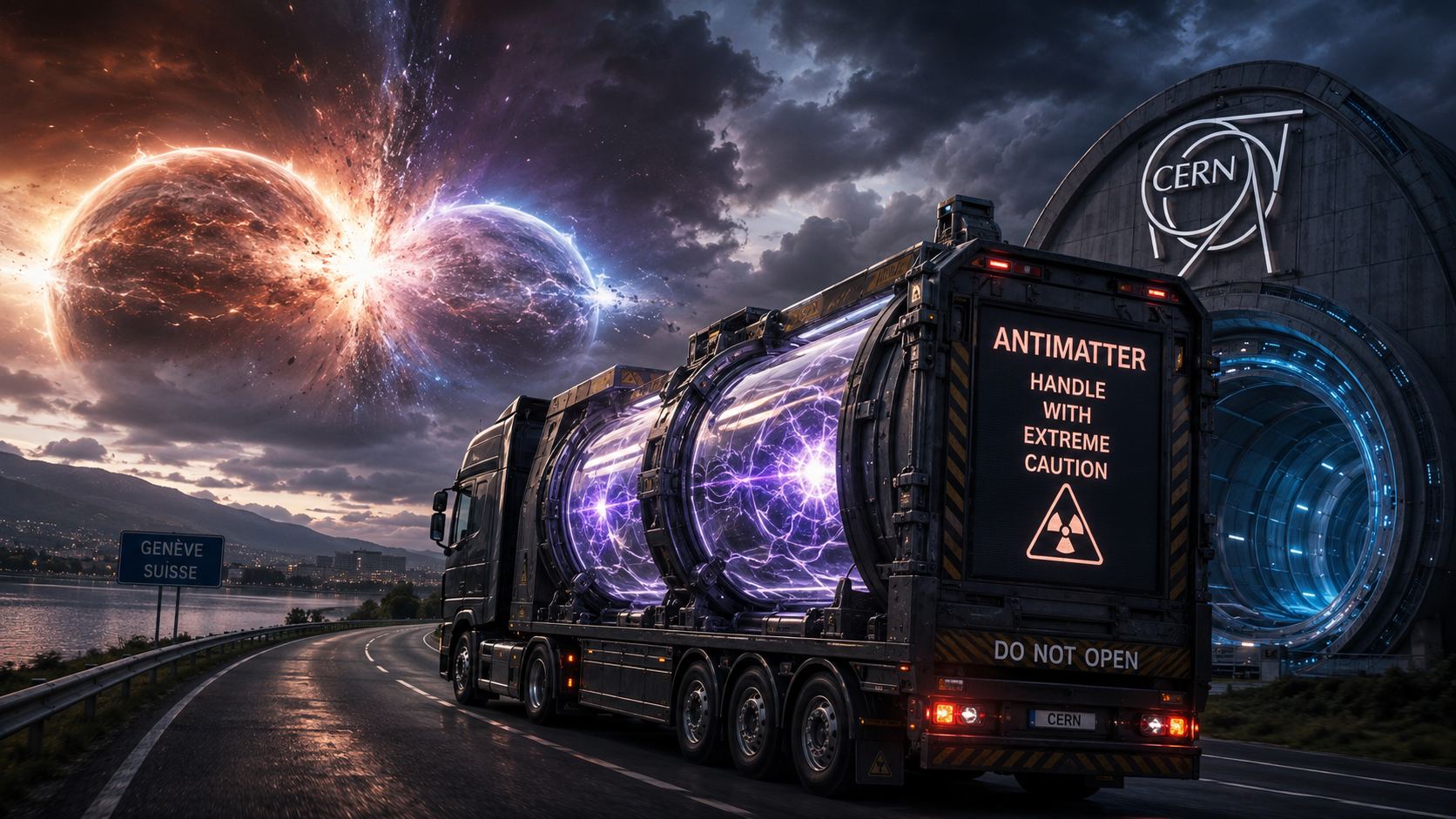
CERN is unlocking the secrets of antimatter.
Antimatter: key questions
What is antimatter?
Antimatter consists of particles that have the same mass as ordinary matter but opposite electric charge. When matter and antimatter meet, they annihilate into energy.
Why is antimatter important?
Studying antimatter could help explain why the observable Universe is made almost entirely of matter despite the Big Bang supposedly creating equal amounts of both.
Does antimatter exist naturally?
Yes, but only in extremely small quantities. It is produced by certain radioactive processes and by cosmic rays interacting with Earth’s atmosphere.
Why does CERN produce antimatter?
CERN manufactures antimatter so scientists can perform highly controlled experiments to test the laws of physics and investigate fundamental cosmic mysteries.
Is transporting antimatter dangerous?
No. The quantities transported for research are incredibly small and contain far less energy than is often portrayed in popular culture.