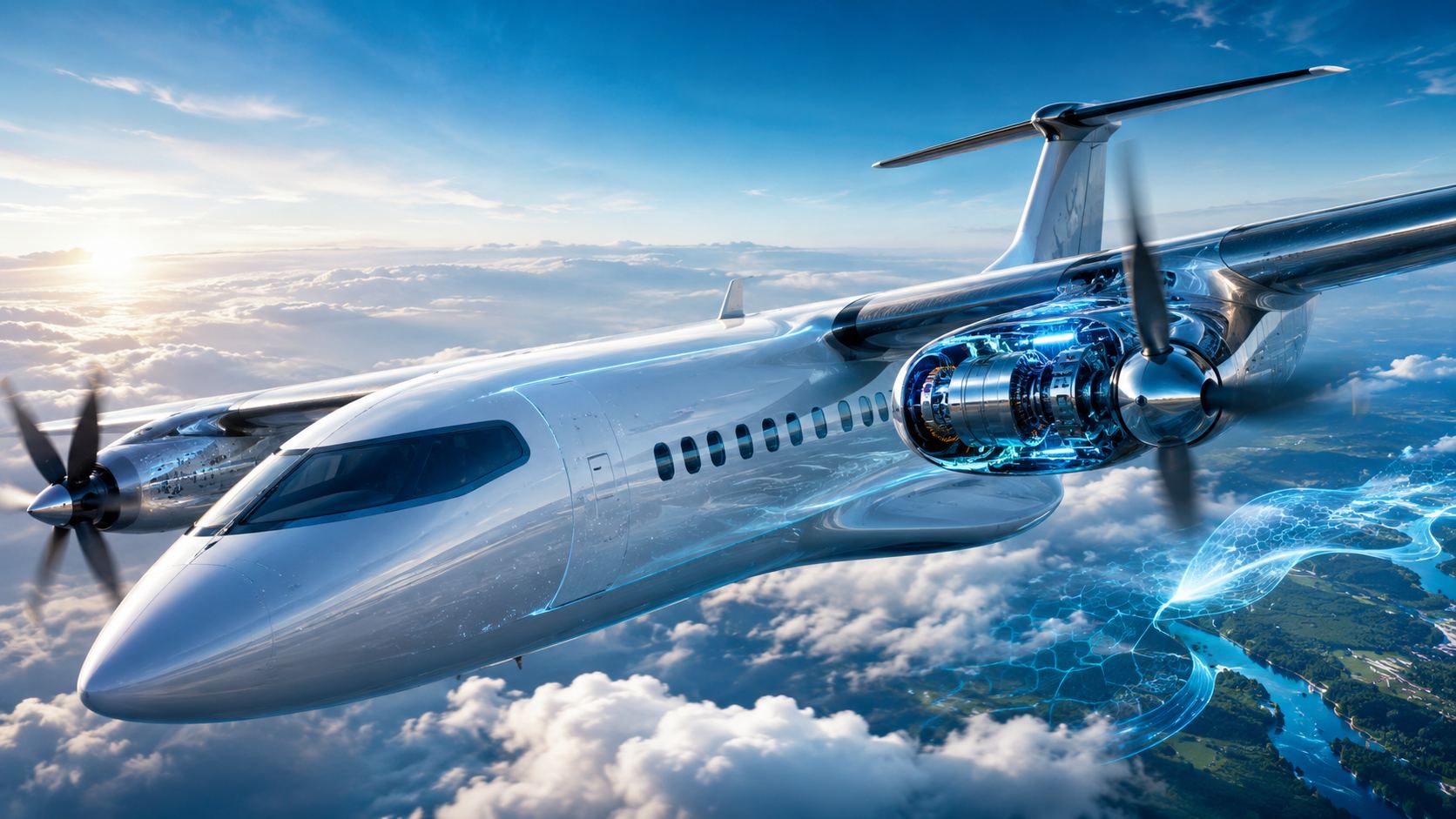
The aviation industry has spent years chasing a brutally simple equation: more power, less weight, fewer emissions. Fraunhofer IISB may have just moved that equation in the right direction.
Researchers at the German Fraunhofer Institute for Integrated Systems and Device Technology IISB have developed a compact electric aircraft motor designed for hybrid-electric regional aviation. The numbers are the kind that make engineers pause: 750 kW of rated power, roughly 1,000 horsepower, packed into a machine weighing just 94 kg.
That gives the motor a power density of around 8 kW per kilogram, a key figure in aviation, where every extra kilogram becomes a problem. The prototype was developed as part of AMBER, a European Clean Aviation project focused on hydrogen fuel cell hybrid-electric propulsion for regional aircraft.
This is not the end of kerosene-powered aviation. It is not a magic battery breakthrough. But it is a serious step toward aircraft that use electric propulsion where it makes sense: as part of a hybrid system built for shorter regional routes.
- What Fraunhofer built
- Why power density matters
- Inside the hybrid aviation system
- Cleaner regional flights, not sci-fi airliners
- Why this still is not easy
- Fraunhofer electric aircraft motor: key questions
What Fraunhofer built
Fraunhofer IISB describes the machine as a 750 kW permanent-magnet traction motor for hybrid-electric regional aircraft. According to the institute, it runs at 21,000 rpm and reaches its 8 kW/kg power density using NO15 electrical steel, hairpin windings optimized for high current density, and direct oil spray cooling.
In plain English: this is a compact, high-speed electric motor designed to deliver a serious amount of power without becoming too heavy or too hot.
The motor was developed from concept definition through CAD design, manufacturing, assembly, and validation at Fraunhofer IISB under aerospace standards. That matters because aviation is not the same game as building a flashy EV drivetrain. In aircraft, reliability, redundancy, thermal stability, and certification discipline are not optional extras.
One of the most important design choices is the four-section distributed stator winding. The architecture is intended to improve fault tolerance, meaning the motor is not treated as a single fragile block. For aviation, that kind of redundancy is not just elegant engineering. It is survival logic.
The official Fraunhofer IISB release describes the motor as part of its contribution to AMBER, a Clean Aviation project developing a roughly 2 MW hydrogen fuel cell hybrid-electric propulsion system with partners including Avio Aero and GE Aerospace: Fraunhofer IISB.
Why power density matters
Electric aviation has one enemy that keeps showing up in every serious conversation: weight.
Cars can absorb heavy batteries and drivetrains more easily because they roll on the ground. Aircraft have no such luxury. Every kilogram must earn its place. That is why power density, not just raw horsepower, is the headline here.
A 750 kW electric motor is already powerful. But the more important detail is that Fraunhofer’s prototype reaches that output at just 94 kg. That is the kind of number that makes hybrid-electric propulsion more plausible for regional aircraft, where weight constraints are brutal but route lengths are more manageable than long-haul aviation.
The 98% efficiency figure reported around the project is also important, though it should be understood in context. High motor efficiency does not automatically make an entire aircraft clean. The full system still depends on how hydrogen is produced, how the fuel cell performs, how the turboprop is integrated, and how the aircraft is operated.
Still, a highly efficient, high-power, lightweight electric machine is one of the missing pieces aviation needs before hybrid propulsion can move from PowerPoint promise to real-world hardware.
Inside the hybrid aviation system
The AMBER project is not trying to put a giant battery-electric airliner into commercial service tomorrow. Its target is more realistic: a megawatt-class hybrid-electric propulsion system for regional aviation, powered in part by hydrogen fuel cells.
The idea is to combine an electric motor with a conventional turboprop architecture and hydrogen fuel cell support. In this setup, electric propulsion can assist the aircraft during power-hungry phases of flight while reducing fuel burn and emissions across a regional mission profile.
Clean Aviation describes AMBER as a demonstrator intended to mature, integrate, and validate key technologies for a roughly 2 MW hybrid-electric propulsion system powered by hydrogen fuel cells: Clean Aviation.
That wording is important. AMBER is a demonstrator. It is about proving and validating technologies, not announcing that hydrogen-electric regional aircraft are ready to board passengers next week.
Still, demonstrators are how aviation changes. The industry does not usually leap. It tests, certifies, iterates, and then spends years arguing with physics, regulators, suppliers, and airline economics.
Cleaner regional flights, not sci-fi airliners
The most likely early use case for this kind of technology is regional aviation: aircraft carrying dozens of passengers over shorter distances, not wide-body jets crossing oceans.
That is where hybrid-electric systems may make the most practical sense first. Regional routes are short enough for alternative propulsion architectures to matter, but still large enough to demand serious power. A 50-to-70-seat aircraft profile is exactly the kind of segment where reducing fuel burn could have a meaningful impact if the technology scales and certifies.
The project’s broader goal is to cut fuel use and greenhouse gas emissions compared with current regional aircraft concepts. Some project descriptions point to reductions of at least 50% versus 2020 state-of-the-art regional aircraft, while broader clean aviation roadmaps often frame hybridization as a path toward major CO₂ reductions rather than immediate zero-emission flight.
That distinction matters. A hybrid aircraft is not automatically a zero-emission aircraft. Hydrogen fuel cells can reduce in-flight emissions, but lifecycle impact depends heavily on the hydrogen supply chain. If the hydrogen is produced using fossil-heavy energy, the climate case weakens. If it is produced with low-carbon electricity, the picture improves significantly.
So yes, this motor is exciting. No, it does not single-handedly decarbonize aviation.
Why this still is not easy
The hard part now is not making a prototype look good in a lab. The hard part is turning that prototype into certified, durable, maintainable aviation hardware.
Aircraft components face extreme demands: vibration, temperature variation, long operating cycles, fault tolerance, maintenance constraints, and certification processes that can take years. A motor can be brilliant on paper and still face a long road before commercial deployment.
There is also the system-level challenge. A hybrid aircraft is not just an electric motor bolted onto a turboprop. It needs power electronics, thermal management, fuel cell integration, hydrogen storage, control software, safety systems, and a propulsion architecture that makes sense for airlines.
That is why Fraunhofer’s achievement should be seen for what it is: an important engineering milestone, not a finished revolution.
The upside is that the milestone is genuinely meaningful. A 94 kg electric motor delivering 750 kW helps answer one of aviation’s most painful questions: can electric propulsion reach aircraft-grade power without becoming too heavy to fly?
Fraunhofer IISB’s answer is increasingly convincing. The sky is not clean yet, but the hardware is getting more serious.
Fraunhofer electric aircraft motor: key questions
What did Fraunhofer IISB develop?
Fraunhofer IISB developed a 750 kW permanent-magnet electric motor for hybrid-electric regional aircraft. It weighs 94 kg and reaches a power density of around 8 kW/kg.
Is this motor already flying in commercial aircraft?
No. It is a prototype developed and validated under aerospace standards as part of the AMBER research project. Commercial aviation deployment would still require further integration, testing, and certification.
Why is the 94 kg weight important?
Weight is one of the biggest obstacles to electric aviation. A lighter high-power motor makes hybrid-electric propulsion more realistic for regional aircraft.
What is the AMBER project?
AMBER is a European Clean Aviation project focused on developing and validating a megawatt-class hybrid-electric propulsion system powered by hydrogen fuel cells for regional aircraft.
Does this make aircraft zero-emission?
Not by itself. The motor can help reduce fuel burn and emissions in a hybrid system, but the total climate impact depends on the full aircraft architecture and how the hydrogen is produced.
What kind of aircraft could use this technology?
The most relevant target is regional aircraft, typically used for shorter routes and carrying dozens of passengers. Long-haul electric aviation remains a much harder challenge.