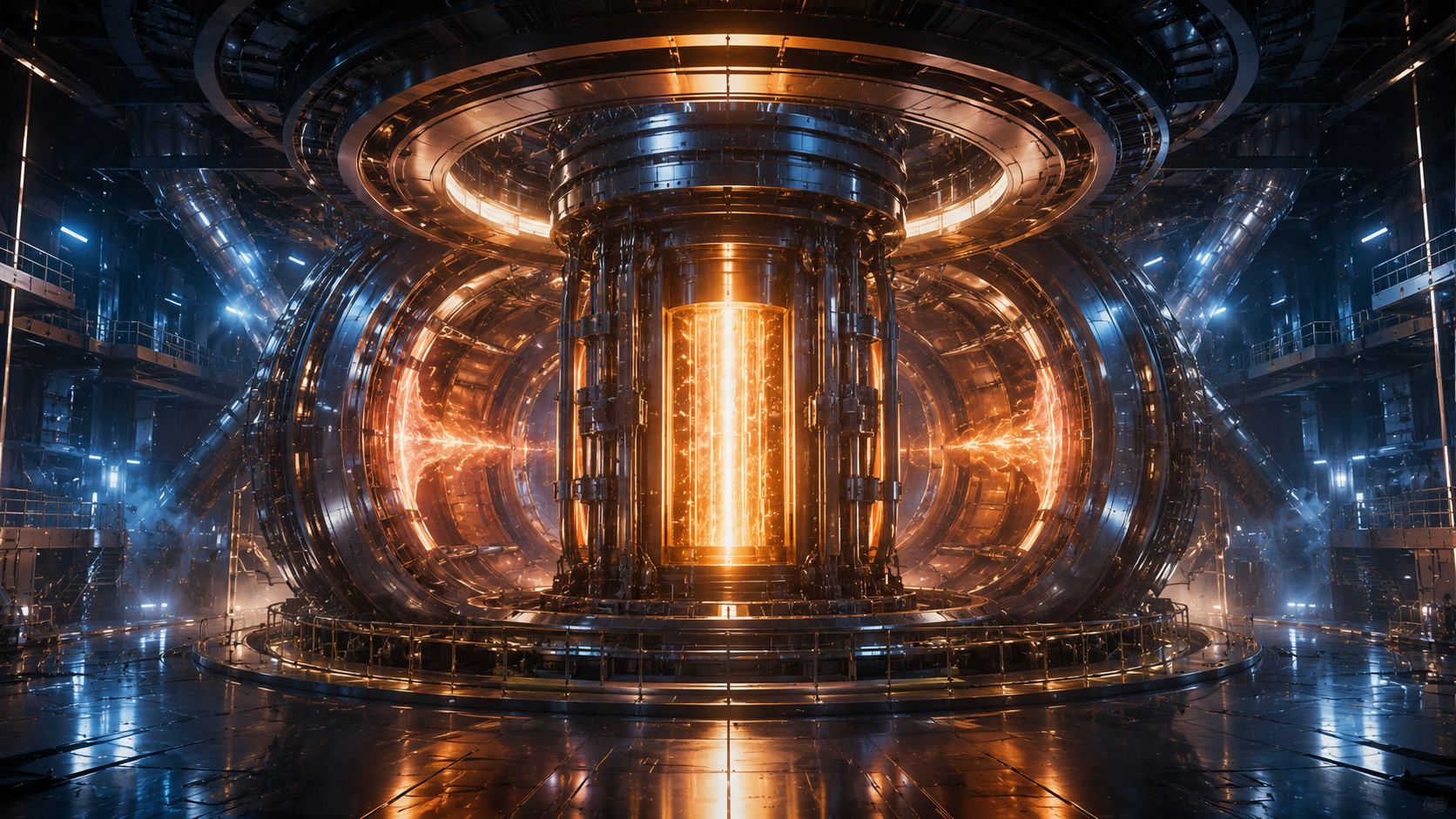
The dream of recreating the power of the Sun on Earth has just taken one of its biggest steps forward.
On June 23, 2026, engineers at the ITER fusion project in Cadarache, southern France, successfully installed the sixth and final module of the reactor’s central solenoid. While it may look like just another massive industrial component, this superconducting magnet is widely considered the electromagnetic heart of the world’s most ambitious fusion experiment.
If ITER succeeds, it could demonstrate that controlled nuclear fusion—the same process powering the stars—can become a viable source of nearly carbon-free energy for future generations.
Table of contents
- The magnetic heart of ITER
- A 15-year engineering marathon
- Why this milestone matters
- What happens next for ITER?
- ITER: key questions
The magnetic heart of ITER
The central solenoid is far more than a giant magnet. It is the component responsible for inducing the electrical current inside the plasma made from hydrogen isotopes, allowing the fusion reaction to ignite and remain stable inside the tokamak.
Without it, the reactor simply cannot operate.
Standing approximately 18 meters tall and weighing close to 1,000 tonnes once fully equipped, the central solenoid is the world’s largest pulsed superconducting electromagnet. At peak performance, it will generate a magnetic field of 13 teslas, storing roughly 6.4 gigajoules of magnetic energy. ITER famously compares this force to being powerful enough to lift an aircraft carrier out of the water. :contentReference[oaicite:0]{index=0}
A 15-year engineering marathon
Reaching this milestone required more than a decade of international cooperation.
The magnet contains over 43 kilometers of niobium-tin superconducting cable, manufactured in Japan before being assembled into six giant modules by U.S. company General Atomics. These modules operate at just 4.5 kelvin (around -269°C), only a few degrees above absolute zero, where superconductivity becomes possible.
Installing the final 110-tonne module was an engineering feat in itself. According to ITER, the component had to be lowered into place with clearances of only a few centimeters, demanding extraordinary precision from the assembly teams. :contentReference[oaicite:1]{index=1}
As ITER Director-General Pietro Barabaschi noted, the project remains a rare example of large-scale scientific collaboration that continues despite today’s geopolitical tensions.
Why this milestone matters
ITER is not designed to produce electricity.
Instead, its mission is to prove that controlled fusion can generate substantially more energy than is required to sustain the plasma, paving the way for future commercial fusion power plants.
Unlike nuclear fission, fusion does not rely on splitting heavy atoms. It combines light hydrogen isotopes under extreme temperatures, producing helium and enormous amounts of energy while generating no greenhouse gas emissions during operation and significantly less long-lived radioactive waste than conventional nuclear reactors.
Whether fusion eventually becomes commercially viable remains one of the biggest scientific questions of the century. But every completed component reduces the technological uncertainty surrounding the project.
What happens next for ITER?
Completing the central solenoid stack does not mean ITER is ready to switch on.
Engineers must still install the magnet’s support structure, complete its pre-compression system, and continue assembling the remaining reactor components inside the tokamak.
Under the project’s current roadmap, ITER aims to begin its initial operational phase in 2034, with the first plasma experiments expected to follow in 2035. Those dates represent a revised schedule compared with earlier plans, but reflect a more comprehensive initial operating configuration. :contentReference[oaicite:2]{index=2}
For now, June 23, 2026 stands as one of the project’s defining milestones. After decades of design, manufacturing and international coordination, the magnetic heart of humanity’s most ambitious fusion reactor is finally standing at full height.
For additional technical details, see ITER’s official announcement:
Standing Tall – ITER Organization.
ITER: key questions
What is the ITER central solenoid?
It is the massive superconducting magnet that initiates and helps control the plasma current inside the ITER tokamak.
Why is this milestone important?
Completing the six-module stack marks one of the most significant assembly milestones of the entire ITER project and brings the reactor closer to operation.
Will ITER generate electricity?
No. ITER is a research reactor designed to demonstrate the scientific and engineering feasibility of large-scale fusion rather than produce electricity for the grid.
When will ITER start operating?
According to the current roadmap, initial operations are planned for 2034, followed by first plasma experiments in 2035.