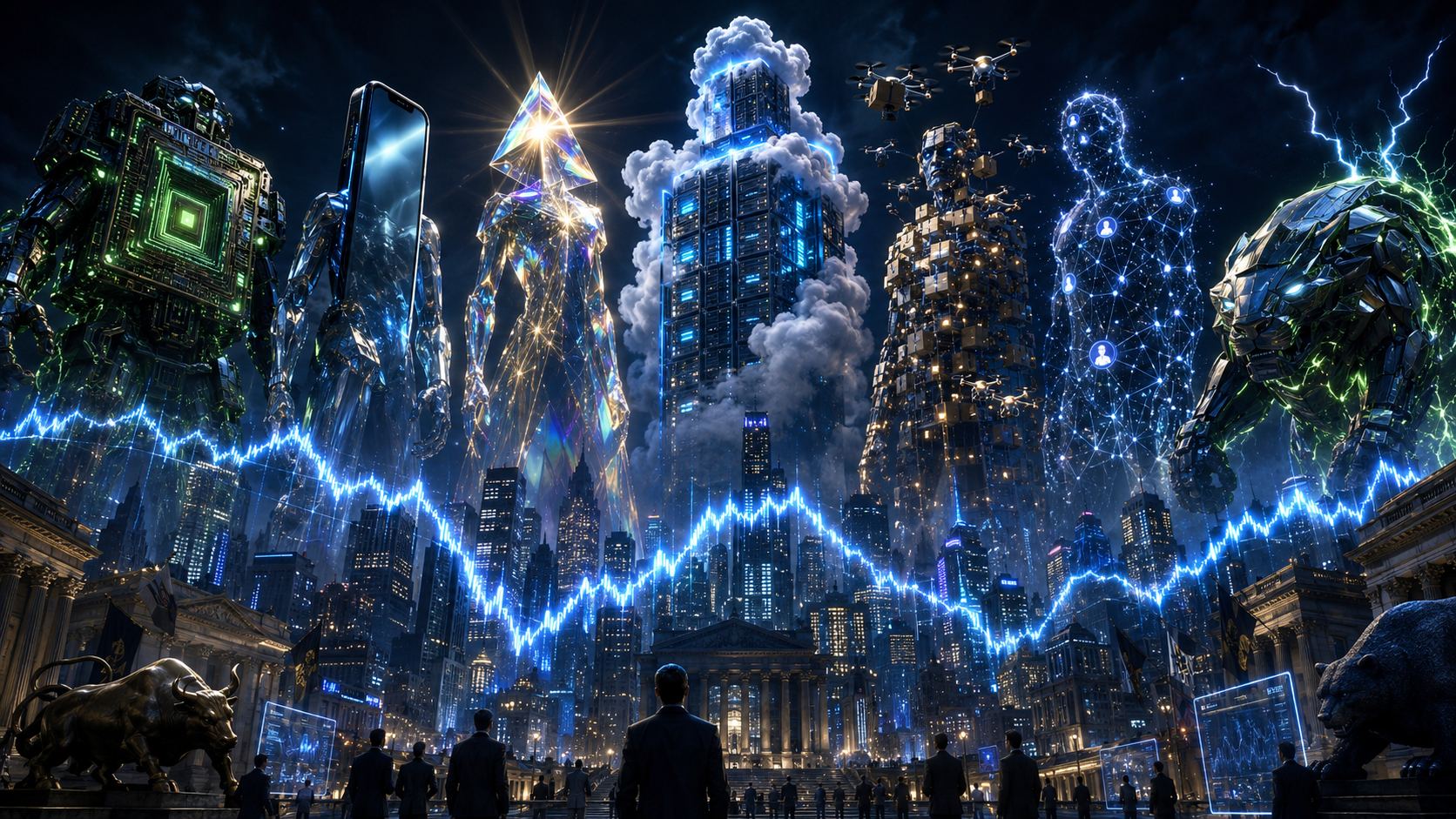
The Magnificent 7 are not just a catchy Wall Street nickname. They are the seven tech-heavy giants that have helped define the modern US stock market: NVIDIA, Apple, Alphabet, Microsoft, Amazon, Meta Platforms, and Tesla. Together, they sit at the intersection of artificial intelligence, cloud computing, online advertising, consumer hardware, e-commerce, entertainment, and electric vehicles. In other words: they are not only stocks.
They are infrastructure, platforms, attention machines, and, increasingly, AI factories. As of the latest market data available on June 6, 2026, NVIDIA, Apple, Alphabet, Microsoft, Amazon, Meta, and Tesla together represent roughly $22.7 trillion in market value, based on live equity data. That is a staggering amount of capital concentrated in just seven companies, and it explains why the “Mag 7” can move the S&P 500 almost like a boss fight in a video game.
What are the Magnificent 7?
The Magnificent 7, often shortened to Mag 7, refers to seven major US-listed companies: NVIDIA, Apple, Alphabet, Microsoft, Amazon, Meta Platforms, and Tesla. The label became popular because these companies drove a large share of US equity market gains during the recent Big Tech boom.
They are not identical businesses, but they share several traits: massive scale, global brands, strong balance sheets, dominant platforms, and exposure to long-term technology trends.
NVIDIA is the AI chip kingpin. Apple controls one of the most profitable consumer hardware ecosystems on Earth. Alphabet owns Google, YouTube, Android, and a growing cloud business. Microsoft sits at the center of enterprise software, cloud, gaming, and AI through Azure, Copilot, and its OpenAI partnership. Amazon combines e-commerce, logistics, advertising, streaming, and AWS. Meta owns Facebook, Instagram, WhatsApp, Threads, and a growing AI advertising machine. Tesla remains the market’s most famous EV and autonomy bet.
For a regularly updated market-cap reference, sites such as Slickcharts’ Magnificent Seven tracker and CompaniesMarketCap provide useful snapshots.
Why they dominate the market
The Mag 7 dominate because they sit where the money, the data, and the infrastructure meet. These companies are not only selling products. They are shaping the operating systems of modern digital life. Search, smartphones, cloud servers, GPUs, marketplaces, social feeds, app stores, video platforms, digital ads, AI assistants, EVs, and enterprise software all flow through them in one way or another. That gives them a rare combination of revenue scale and narrative power.
When investors want exposure to AI, NVIDIA and Microsoft often become default names. When they want exposure to digital advertising, Alphabet and Meta are impossible to ignore. When they want consumer tech, Apple remains the gravity well. When they want e-commerce and cloud, Amazon is still the monster in the dungeon. When they want EVs and autonomy speculation, Tesla remains the high-volatility icon.
The result is simple: when the Magnificent 7 rally, index investors usually feel it. When they sell off together, the market feels heavier fast.
Magnificent 7 stocks: latest snapshot
Based on live equity data available on June 6, 2026, the seven companies remain among the largest and most watched stocks in the world. The figures below are approximate and can change quickly during market hours.
| Ticker | Company | Core exposure | Approx. market cap | P/E ratio |
|---|---|---|---|---|
| NVDA | NVIDIA | AI chips, data centers, accelerated computing | $5.0T | 31.2 |
| AAPL | Apple | iPhone, services, consumer ecosystem | $4.5T | 37.2 |
| GOOGL | Alphabet | Search, YouTube, Android, cloud, AI | $4.5T | 28.1 |
| MSFT | Microsoft | Cloud, enterprise software, AI, gaming | $3.1T | 24.8 |
| AMZN | Amazon | E-commerce, AWS, ads, logistics, streaming | $2.7T | 29.4 |
| META | Meta Platforms | Social media, ads, AI, messaging, VR | $1.5T | 21.6 |
| TSLA | Tesla | EVs, batteries, autonomy, robotics | $1.4T | 358.7 |
The original snapshot placed the group at roughly similar levels, with NVIDIA, Apple, and Alphabet leading the pack, followed by Microsoft, Amazon, Tesla, and Meta. The key point has not changed: this is still a market structure where a handful of companies carry enormous weight. Tesla remains the outlier on valuation. Its P/E ratio is dramatically higher than the rest of the group, which reflects how much future growth, autonomy, robotics, and optionality investors continue to price into the stock.
AI, cloud, ads and EVs: the real engine
The Magnificent 7 are often discussed as one block, but the drivers are different. NVIDIA is the purest AI infrastructure play in the group. Its GPUs and accelerated computing platforms are central to the data-center buildout powering generative AI. That makes it less of a traditional “chip stock” and more of a toll booth on the AI boom.
Microsoft and Amazon are cloud giants, with Azure and AWS positioned as the compute layers for enterprise AI. Alphabet is fighting on multiple fronts: search, Gemini, YouTube, Google Cloud, Android, and AI infrastructure. Meta is using AI to improve advertising, recommendations, content generation, and messaging products. Apple’s AI story is more complicated. The company has unmatched distribution through the iPhone, but investors continue to watch whether it can turn on-device AI and services into a new growth chapter.
Apple does not need to win the chatbot race in the same way as OpenAI or Google; it needs to make AI feel native inside its ecosystem. Tesla is the oddest member of the team. It is not a cloud or advertising company. It is a hardware, energy, software, autonomy, and robotics story wrapped in one of the market’s most polarizing stocks. Bulls see Tesla as an AI and robotics platform. Bears see an automaker trading at a tech multiple. Both sides can point to real evidence, which is why the stock remains a volatility machine.
The concentration risk investors cannot ignore
The Mag 7 have made many portfolios look smarter than they really were. That is great on the way up. It is less fun when the same seven names drag an index lower. This is the central risk: concentration. A standard S&P 500 ETF may look diversified because it holds hundreds of companies. But market-cap weighting means the biggest stocks receive the biggest allocations.
When a small number of giants become extremely large, passive investors can end up with more Big Tech exposure than they realize. That does not automatically make the Mag 7 “bad” investments. These are serious companies with serious cash flows, serious moats, and serious strategic importance.
But size cuts both ways. The larger the expectations, the harder it becomes to surprise the market. Even great companies can become painful stocks if investors overpay or if growth slows.
There is also regulatory risk. Big Tech is under pressure from antitrust authorities, privacy regulators, competition watchdogs, and governments trying to understand the geopolitical consequences of AI infrastructure. The bigger these companies become, the more visible the target on their back.
What it means for regular investors
For regular investors, the Magnificent 7 are best understood as both an opportunity and a warning label. The opportunity is obvious: these companies are deeply connected to long-term trends that probably will not disappear next quarter. AI, cloud computing, digital advertising, software, e-commerce, EVs, and connected devices are structural parts of the economy.
The warning label is just as important: owning the market often means owning a lot of the Mag 7 already. Anyone buying broad US index funds may already have meaningful exposure to these companies without buying a single individual share. That is why many investors pair Big Tech exposure with diversification, dollar-cost averaging, and a clear view of risk.
DCA can help reduce the pressure of trying to perfectly time entries, but it does not eliminate valuation risk or concentration risk. Diversification can help, but it also means accepting that the next phase of returns may come from outside the seven-stock spotlight. The Magnificent 7 are still the market’s main characters. But even main characters can have bad seasons.
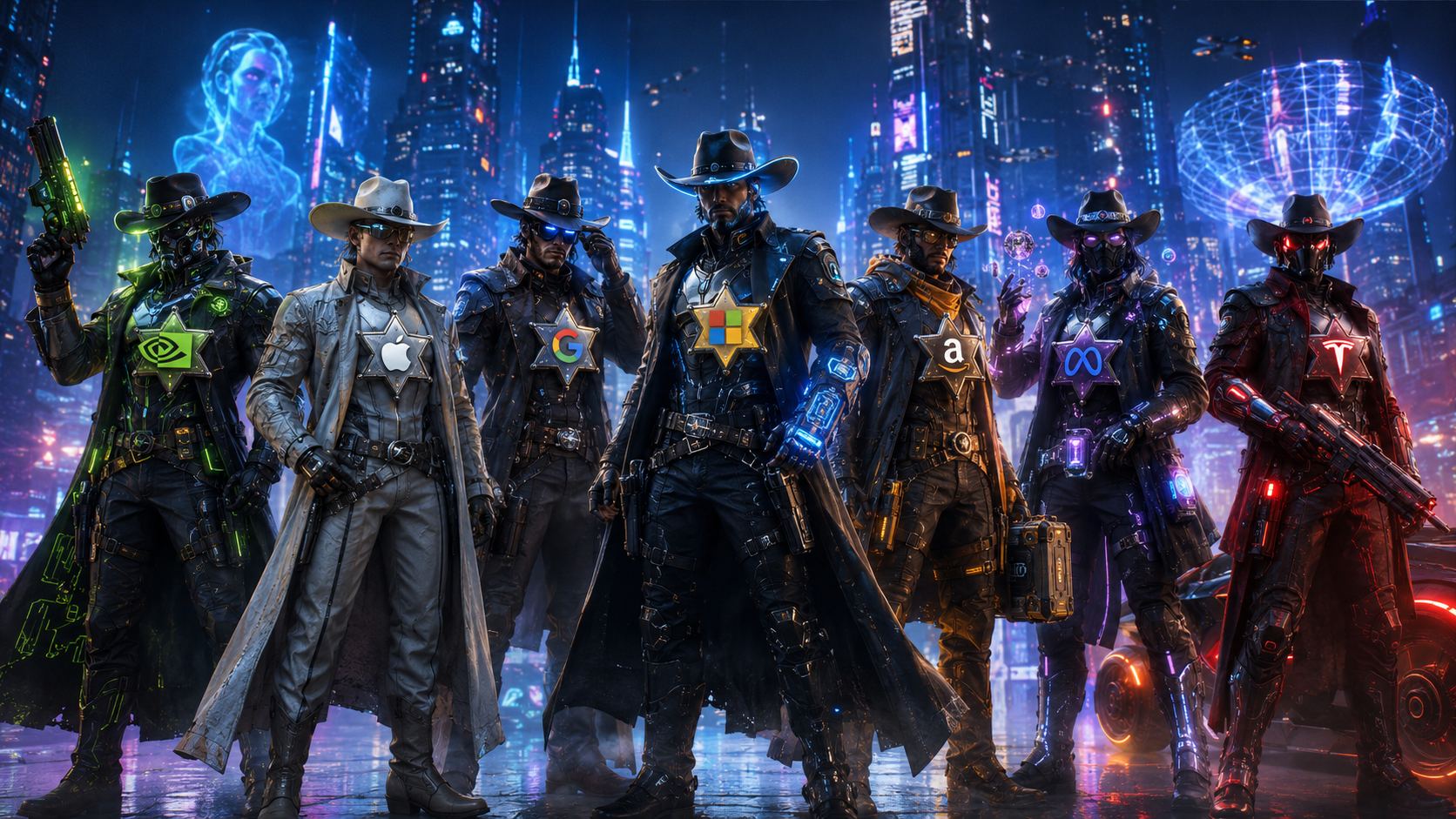
The Magnificent 7 can make passive portfolios look unstoppable when they rally, but their size also creates serious concentration risk inside major indexes.
Magnificent 7: key questions
Which stocks are in the Magnificent 7?
The Magnificent 7 are NVIDIA, Apple, Alphabet, Microsoft, Amazon, Meta Platforms, and Tesla.
Why are they called the Magnificent 7?
The nickname refers to their huge market influence and their role in driving a large share of US stock market gains during the recent Big Tech boom.
Are the Magnificent 7 all technology companies?
Not officially. NVIDIA, Apple, and Microsoft are usually classified as technology stocks, Alphabet and Meta as communication services, and Amazon and Tesla as consumer discretionary or cyclical names. In practice, all seven are heavily tied to technology.
Why do the Magnificent 7 matter for the S&P 500?
Because they are so large, their performance can heavily influence market-cap-weighted indexes such as the S&P 500. When they rise or fall together, the broader market often moves with them.
Is NVIDIA the biggest Magnificent 7 stock?
As of the latest available market data on June 6, 2026, NVIDIA was the largest of the group by market capitalization, followed by Apple and Alphabet.
Is Tesla the riskiest Magnificent 7 stock?
Tesla is often viewed as one of the most volatile Mag 7 names because its valuation depends heavily on future expectations around EV growth, autonomy, robotics, and software.
Should investors buy the Magnificent 7?
That depends on personal goals, risk tolerance, time horizon, and existing exposure. Many investors already own these stocks through broad index funds.
Is this financial advice?
No. This article is for informational and editorial purposes only. It is not financial advice, investment advice, or a recommendation to buy or sell any stock.