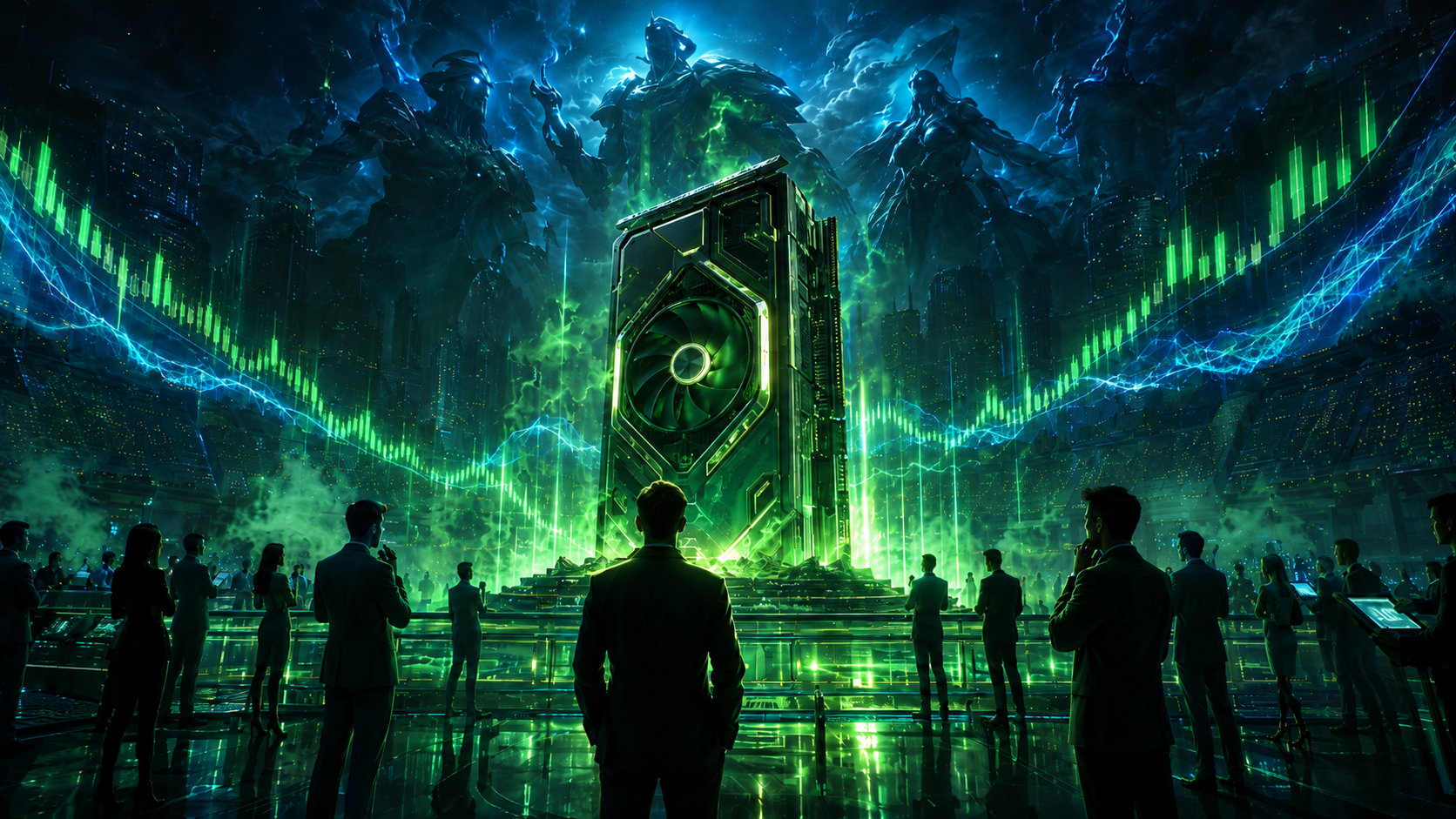
Nvidia just delivered the kind of quarter most companies would frame, hang in the lobby, and quietly use to intimidate competitors. Revenue jumped 85% year over year to $81.62 billion, beating expectations of roughly $78.86 billion. AI demand is still roaring. The company’s guidance remained enormous. On paper, this was not a stumble. It was a blockbuster.
And yet the stock’s after-hours reaction was muted, even slightly negative in some trading. That is the part that confuses newer investors. If the company smashed expectations, why didn’t the stock go full Avengers: Endgame portal scene?
Because markets do not simply react to good news. They react to good news versus what was already priced in. With Nvidia, Wall Street is no longer buying a single movie ticket. It has already paid for the sequel, the trilogy, the Disney+ spin-off, and the cinematic universe. A monster quarter can still feel like a side quest when the market has been preparing for the final boss.
The boss fight was already priced in
Nvidia’s numbers were huge. But Nvidia is not being judged like an ordinary semiconductor company anymore. It is being judged like the central processor of the AI economy.
That changes the rules.
When a company is priced for greatness, “great” becomes the baseline. Investors had already spent months rewarding Nvidia for the belief that AI infrastructure spending would keep expanding, hyperscalers would keep buying accelerators, and Nvidia would keep converting that demand into massive revenue growth. By the time earnings arrived, the market was not asking, “Is Nvidia doing well?” It was asking, “Is Nvidia doing even better than the very aggressive version of doing well we already assumed?”
That is the boss fight.
In video game terms, Nvidia did not fail the level. It cleared the arena. But players had already watched the trailer, studied the boss mechanics, maxed out their gear, and expected a secret final phase. A regular victory screen was never going to be enough.
This is the key distinction between company performance and stock performance. A company can execute brilliantly while its stock barely reacts because the market had already anticipated the brilliance. Earnings are not graded on an absolute scale. They are graded against expectations, positioning, valuation, and whatever investors were hoping management would say next.
Nvidia’s revenue beat was real. But the stock reaction showed that the surprise factor was smaller than the headline numbers suggested.
AI demand is the new infinity stone
The core of Nvidia’s story remains brutally simple: AI demand is still the Infinity Stone powering the whole narrative.
Cloud giants, AI labs, enterprises, and sovereign infrastructure projects are all racing to secure compute. Training frontier models is expensive. Running them at scale is also expensive. And as AI moves from demos to production, the need for chips, networking, systems, and software does not disappear. It mutates.
That is why Nvidia’s data center business has become the main event. Gaming still matters to the brand. Automotive and visualization still have strategic value. But for Wall Street, the AI data center engine is the arc reactor.
Nvidia is no longer seen as just a GPU seller. It is increasingly treated as a full-stack AI infrastructure company: chips, systems, networking, software, and developer ecosystem. That makes the company far more powerful than a traditional component supplier. It also makes the investment case more demanding.
The market wants evidence that demand is not just strong, but durable. It wants to know whether AI spending is spreading beyond a handful of hyperscalers. It wants to understand whether inference workloads can become a huge recurring compute driver. It wants to know whether custom chips from Amazon, Google, Microsoft, Meta, AMD, and others will chip away at Nvidia’s dominance or simply expand the overall market.
For now, the demand picture still looks massive. Nvidia’s latest results and outlook continue to point to enormous AI infrastructure spending, with major outlets such as Reuters highlighting the company’s strong revenue, data center growth, and above-consensus guidance.
But the more powerful the AI story becomes, the more Wall Street asks a dangerous question: what could possibly make it even bigger?
Guidance is the real final boss
Earnings headlines focus on the past quarter. Investors focus on the next one.
That is why guidance is the real final boss. Revenue up 85% year over year is spectacular, but for a growth stock with Nvidia’s profile, the market immediately looks forward. What does management expect next quarter? Are margins holding? Is supply available? Are customers still spending aggressively? Is demand accelerating, stabilizing, or quietly slowing beneath the surface?
Nvidia’s guidance remained extremely strong. The company signaled another massive quarter ahead, reinforcing the idea that AI demand has not hit a wall. But when expectations are already high, even strong guidance can be interpreted through a colder lens.
Did guidance beat enough? Did management raise the ceiling or simply confirm the existing story? Did the outlook suggest a fresh acceleration, or just continued excellence? Those questions matter because the valuation already assumes a lot of future success.
That is where growth stocks become tricky. A mature, slower-growing company may rally on a modest beat because investors had low expectations. A mega-cap growth leader can post outrageous numbers and still get a shrug because the market expected outrageous numbers plus a boss-melting special attack.
This does not mean Nvidia’s quarter was weak. It means the stock had entered the report with a high difficulty setting.
When great is not enough
Nvidia is not alone in this trap. The biggest tech winners often reach a point where excellence becomes the minimum subscription tier.
Apple can sell hundreds of millions of devices and still get punished if iPhone growth looks soft. Microsoft can print cloud revenue and still face questions about AI monetization. Amazon can dominate e-commerce and cloud infrastructure but still be judged on margins, capital expenditure, and AWS growth rates. Meta can deliver huge profits and still get interrogated over AI spending.
Mega-cap stocks are not just companies. They are expectation machines.
Once a company becomes a market darling, investors stop rewarding it for being good. They reward it for being better than the market’s already optimistic model. That model includes revenue growth, earnings power, margins, capital allocation, competitive position, and long-term narrative.
For Nvidia, the narrative is especially intense because it sits at the center of the AI trade. It is not merely participating in the trend. It is one of the primary companies monetizing it at scale. That gives Nvidia exceptional strategic importance, but it also means every earnings report becomes a referendum on the entire AI spending cycle.
This is why a muted reaction after a huge quarter should not automatically be read as irrational. Sometimes the market is not saying “this was bad.” It is saying “we already paid for this.”
There is a difference.
A stock price is not a scoreboard of corporate virtue. It is a constantly changing negotiation over future cash flows, risk, and expectations. Nvidia can be a phenomenal business and still experience flat or negative reactions after strong results if the setup going into earnings was too crowded, too optimistic, or too expensive.
So what?
For investors, the lesson is not “ignore earnings.” It is “read earnings like a market player, not a fan.”
Start with the numbers. Did revenue, earnings, margins, and segment performance beat consensus? In Nvidia’s case, the headline revenue beat was clear: $81.62 billion versus expectations around $78.86 billion, with growth still powered by AI demand.
Then check expectations. Was the market already positioned for a beat? Had analysts been raising estimates before the report? Was the stock running into earnings? A company can beat published consensus while failing to beat the whisper number investors actually had in mind.
Next, look at valuation. A stock trading at a premium multiple needs more than good execution. It needs evidence that future growth can justify the price investors are paying today. High expectations are not a moral problem. They are a math problem.
Then study guidance. For Nvidia, the next-quarter outlook matters more than the victory lap on the previous quarter. Investors want to know whether demand remains strong, whether supply can keep up, whether margins stay healthy, and whether the AI buildout is still accelerating.
Finally, watch the market reaction without worshipping it. A muted after-hours move does not automatically mean the quarter was bad. It can mean expectations were extreme. It can mean investors are rotating to other AI infrastructure names. It can mean positioning was crowded. It can also mean the market is waiting for the earnings call, analyst revisions, or the next trading session before choosing a direction.
The actionable frame is simple: do not ask only whether Nvidia won the fight. Ask whether the market had already priced in the win, the rematch, and the post-credit scene.
That is the Nvidia paradox. The company can deliver Endgame-level numbers, and Wall Street can still ask what comes after Thanos.
Nvidia earnings: key questions
Why did Nvidia’s stock barely react after strong earnings?
Because the market had already priced in very strong results. Stocks move based on surprises versus expectations, not just whether the company performed well.
Was Nvidia’s quarter actually weak?
No. Revenue rose 85% year over year to $81.62 billion, beating expectations. The muted stock reaction was more about valuation, positioning, and high expectations than weak execution.
Why is AI demand so important for Nvidia?
AI demand drives Nvidia’s data center business, which has become the central pillar of its growth story. Investors are watching whether AI infrastructure spending can keep expanding at scale.
Why does guidance matter more than past results?
Guidance tells investors what management expects next. For high-growth stocks, future revenue, margins, and demand signals often matter more than the quarter that just ended.
What should investors check before reacting to earnings?
Check the headline numbers, analyst expectations, valuation, guidance, margin trends, and market positioning. A strong company result can still disappoint a stock if expectations were too high.
Is this financial advice?
No. This article is for information and analysis only. It is not financial advice, investment advice, or a recommendation to buy or sell Nvidia shares.