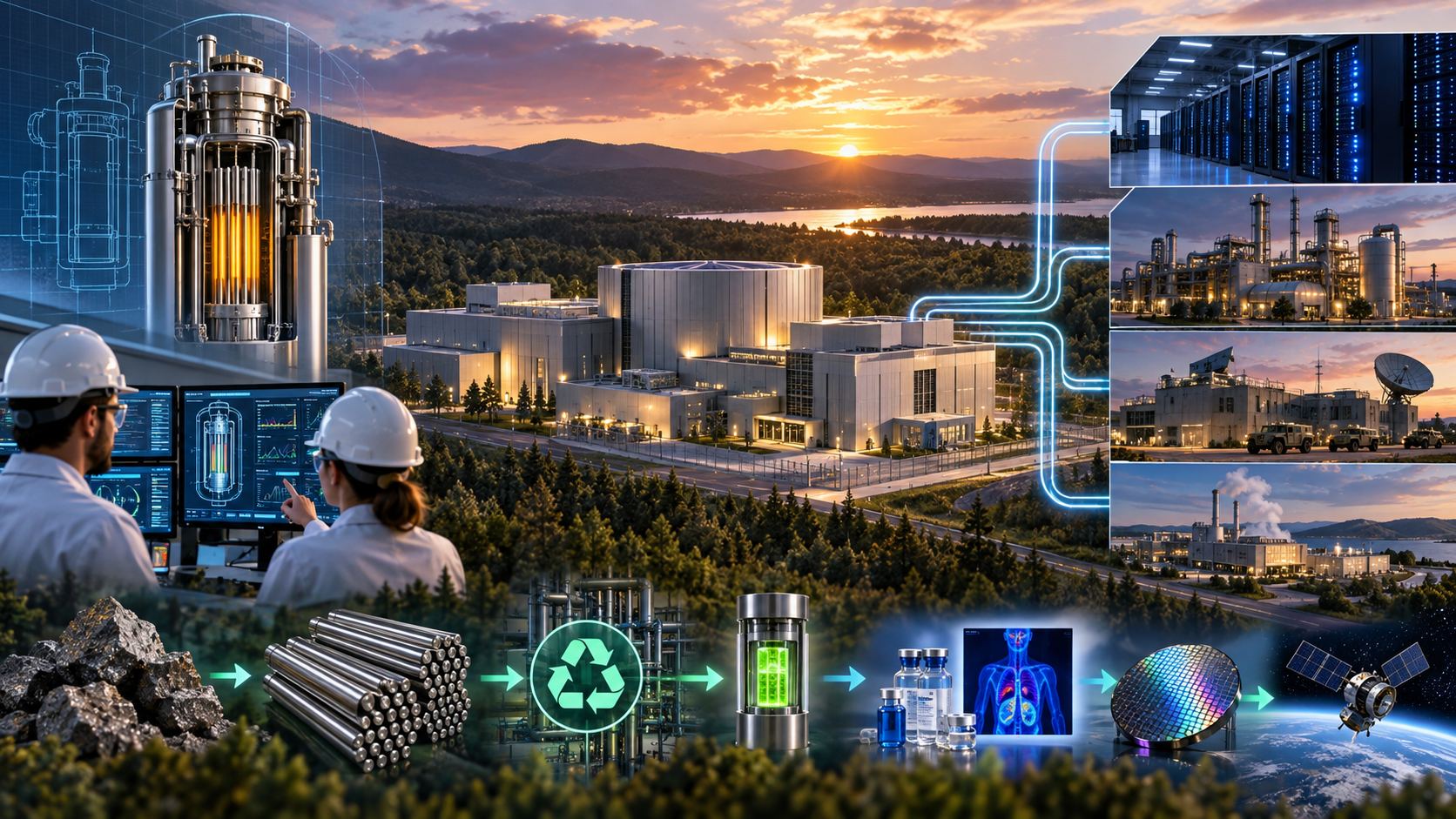
Oklo is usually described as an advanced nuclear reactor developer. That description misses the part of the company that most directly determines whether its economics can work: Oklo intends to own the plants it builds and sell the electricity itself.
That is a meaningful departure from the familiar nuclear model in which a reactor vendor supplies technology to a utility, gets paid for engineering and equipment, and leaves the owner to finance and operate the plant. Oklo wants to remain involved across almost the entire chain — reactor design, construction, fuel, plant ownership and operations — then earn recurring revenue by selling electricity and heat under long-term contracts.
Its Aurora powerhouses are designed as relatively small, metal-fueled fast reactors producing roughly 15 to 75 megawatts of electricity, with larger versions possible later. The company is targeting data centers, industrial sites, military facilities and other customers that value reliable power around the clock.
The opportunity is easy to see in an era when AI infrastructure is consuming enormous amounts of electricity. The harder part is execution. As of September 2026, no commercial Aurora powerhouse is producing electricity, and Oklo still has to turn licensing progress, customer agreements, fuel plans and construction work into operating nuclear assets.
That makes Oklo less like a conventional reactor supplier and increasingly like an aspiring vertically integrated nuclear power company.
Table of Contents
- What does Oklo actually do?
- How the Aurora powerhouse works
- Why Oklo wants to build, own and operate its reactors
- How Oklo plans to make money from power purchase agreements
- Who pays before the reactors start generating electricity?
- Why nuclear fuel is part of the business model
- Why Oklo also has an isotope business
- Licensing remains one of the biggest hurdles
- What has to happen for the Oklo model to work?
- Oklo: key questions
What does Oklo actually do?
Oklo is developing advanced nuclear reactors, but the company increasingly describes itself through three connected businesses: power, nuclear fuel and radioisotopes.
Power is the centerpiece.
Oklo’s planned Aurora powerhouses would generate electricity and usable heat. Instead of primarily licensing the reactor design to utilities, Oklo plans to develop and operate the plants itself and charge customers for the energy they consume.
Fuel sits behind that power business. Advanced reactors need specialized nuclear fuel, and the United States does not yet have a mature commercial supply chain capable of supporting every proposed advanced-reactor deployment. Oklo is therefore working on fuel fabrication, securing outside supplies and developing technology to recycle used nuclear fuel.
The isotope business adds another layer. Radioisotopes have valuable applications in medicine, semiconductor manufacturing, research, space and defense. Oklo expanded into this market by acquiring Atomic Alchemy in 2025.
These businesses are supposed to reinforce one another rather than operate as unrelated side projects. Reactor deployments create demand for fuel. Fuel processing could eventually recover valuable isotopes. Nuclear operating experience can be reused across power and isotope facilities.
The important word, however, is supposed. Much of this integrated system is still being built.
Oklo reported just $1.21 million in revenue during the first half of 2026, coming from engineering and consulting, manufacturing and fabrication, and other services. Its proposed long-term power business has not yet begun generating electricity revenue.
The company therefore already has some commercial activity, but the economic engine described in its strategy still lies ahead.
How the Aurora powerhouse works
Aurora is Oklo’s family of advanced fast reactors.
Most operating commercial reactors in the United States are light-water reactors. They use ordinary water both to cool the reactor and to slow neutrons released during fission.
A fast reactor works differently. It maintains a population of higher-energy neutrons rather than deliberately slowing them down. Oklo’s current Aurora design is a liquid-metal-cooled, metal-fueled fast reactor, with the Nuclear Regulatory Commission describing proposed Aurora units as having a maximum output of 75 MWe.
The underlying fast-reactor concept is not new. Oklo frequently points to the Experimental Breeder Reactor-II, or EBR-II, which operated for roughly three decades at Idaho National Laboratory and supplied electricity while supporting research into fast reactors and fuel recycling.
That historical experience matters, but it should not be confused with commercial validation of Aurora itself. Oklo is building a new product around an established family of reactor physics, not restarting an already mass-produced power plant.
Aurora is also designed to use several potential fuel sources, including high-assay low-enriched uranium, usually shortened to HALEU.
HALEU contains more uranium-235 than the fuel generally used by today’s commercial U.S. reactor fleet while remaining below the 20% enrichment threshold for highly enriched uranium. The Department of Energy defines HALEU as uranium enriched above 5% and below 20% uranium-235.
That higher concentration can help advanced-reactor developers build smaller cores, operate for longer cycles and improve fuel utilization.
For Oklo, however, HALEU is not merely a technical specification. Its availability directly affects how quickly the company can build a fleet.
Why Oklo wants to build, own and operate its reactors
The most distinctive part of the Oklo business model is not necessarily the reactor.
It is ownership.
A traditional reactor vendor can make money by selling engineering services, equipment, intellectual property or complete reactor systems to a utility. The utility then carries much of the financial and operating responsibility for the resulting power station.
Oklo’s preferred structure keeps those responsibilities inside the company.
It plans to become the designer, builder, owner and operator of its powerhouses. The customer buys electricity rather than buying a nuclear plant.
For a data-center operator, industrial company or military installation, that can be attractive. Running a nuclear reactor is considerably more complicated than signing a long-term energy contract. A customer may want reliable nuclear electricity without developing an internal organization capable of licensing, fueling, staffing and maintaining a reactor.
Oklo wants to provide that abstraction layer.
The company still has to deal with nuclear regulation, construction and fuel. The customer simply gets power under agreed commercial terms.
Keeping ownership also changes the economics for Oklo. Selling a reactor can create a large but relatively discrete payment. Owning it potentially creates years or decades of recurring electricity revenue.
If later Aurora plants become cheaper to construct and operate as Oklo gains experience, the company would also retain much of that improvement rather than passing all of it to a plant owner.
There is an uncomfortable mirror image to that advantage.
If construction becomes more expensive, licensing takes longer than expected or a plant performs poorly, Oklo is not simply the technology supplier watching somebody else’s project struggle.
It owns the asset.
The build-own-operate model therefore gives Oklo more potential upside from successful reactors precisely because it leaves the company exposed to more of the downside when projects go wrong.
How Oklo plans to make money from power purchase agreements
Once an Aurora plant is operating, Oklo expects most power revenue to come through power purchase agreements, or PPAs.
A PPA is a long-term commercial agreement under which a customer commits to buying electricity according to negotiated terms. Similar structures are already common in renewable energy, where corporate customers may agree to purchase power from a solar or wind project for many years.
Applying the model to nuclear changes the technology, but not the basic commercial logic.
The power plant represents a large upfront investment. Once operating, it produces electricity that can be sold over a long period. A contracted customer provides greater revenue visibility than relying entirely on fluctuating wholesale electricity prices.
That visibility can matter for financing as well. Banks and infrastructure investors generally have an easier time evaluating a project when a credible customer has committed to buying its output.
Oklo’s agreement with Meta illustrates how the model could evolve beyond a conventional PPA.
In January 2026, the companies announced plans supporting a 1.2-gigawatt nuclear energy campus in Pike County, Ohio. The agreement includes a mechanism allowing Meta to prepay for power, with Oklo using funding to help secure nuclear fuel and advance the first phase of development.
Oklo has said the first phase could begin operating as early as 2030, with capacity potentially expanding incrementally toward 1.2 GW by 2034.
That structure addresses one of the awkward problems facing new electricity generation for AI: technology companies need enormous amounts of additional power, yet somebody has to finance that generation years before the servers consume its first kilowatt-hour.
Customer prepayments can move some capital forward.
Oklo has also announced a much larger framework with data-center operator Switch covering as much as 12 GW through 2044. That agreement demonstrates substantial commercial interest, but its status matters: the original Master Power Agreement was announced as non-binding, with individual binding agreements expected as specific projects progress.
The same distinction applies elsewhere in Oklo’s commercial pipeline. Letters of intent, master agreements, customer interest and operating PPAs are not interchangeable.
Gigawatts announced on paper become economically meaningful only when projects are financed, licensed, constructed and connected to customers.
Who pays before the reactors start generating electricity?
This question sits underneath the entire Oklo strategy.
A nuclear plant requires money long before it produces revenue. Engineers have to be hired. Sites need preparation. Components must be ordered. Fuel must be acquired. Regulatory work continues for years. Construction bills arrive before electricity bills can be sent.
Future operating Aurora plants are supposed to finance themselves through power sales.
Early projects cannot.
For now, Oklo’s development is supported by its corporate balance sheet, capital raised from investors, commercial arrangements such as the Meta prepayment structure, government-backed research or cost-sharing programs in some areas, and potentially project-level financing as deployments mature.
Long-term PPAs could eventually make project financing considerably more important. Rather than funding every future reactor entirely with corporate equity, Oklo could seek financing tied to individual power projects and their contracted cash flows.
This is one reason the build-own-operate model looks attractive on a spreadsheet. An operating fleet would consist of long-lived infrastructure producing recurring revenue.
The transition from reactor startup to infrastructure owner is the difficult part.
Oklo itself acknowledges that its first powerhouses are likely to include unique costs and face the possibility of unexpected expenses and construction delays. The company expects later units to benefit from what it learns during the first deployments.
That is essentially the industrial scaling thesis: build the first units, learn what was expensive, standardize the process and repeat it more efficiently.
Whether nuclear construction can follow that curve quickly enough will be one of the defining tests of the company.
Why nuclear fuel is part of the business model
A reactor without fuel is a very expensive building.
That makes fuel supply particularly important to companies developing advanced reactors. HALEU remains available in limited commercial quantities in the United States, even as multiple reactor developers expect to need it.
Oklo has several approaches to the problem.
Its first Aurora project at Idaho National Laboratory has access to recovered material originating from EBR-II fuel. The company is also building an Aurora Fuel Fabrication Facility in Idaho to produce the initial fuel assemblies.
For larger deployments, outside suppliers remain important. In June 2026, Oklo signed a letter of intent with Centrus Energy covering enough domestically produced HALEU to support multiple years of fuel requirements for up to five Aurora powerhouses, with deliveries expected to begin in 2029.
That agreement was still subject to negotiation of definitive commercial terms when announced, so it should not be treated as completed fuel procurement for an entire Oklo fleet.
The longer-term strategy is considerably more ambitious.
Oklo wants to recycle used nuclear fuel and manufacture new fuel from recovered material. Fast reactors can potentially use energy remaining in material discharged from conventional reactors, where substantial quantities of potentially useful heavy elements remain after the fuel leaves the reactor.
The company is developing an Advanced Fuel Center in Tennessee around this concept.
Vertical integration could offer several benefits if it works at commercial scale. Oklo could reduce dependence on third-party fuel markets, potentially recover more economic value from nuclear material and develop fuel-related businesses alongside electricity generation.
It could also make the company considerably more complex.
Operating nuclear power plants is already a demanding business. Adding fuel fabrication and commercial-scale recycling introduces another set of facilities, regulations, capital requirements and technical challenges.
Oklo is effectively betting that controlling more of the nuclear lifecycle will eventually create an advantage large enough to justify building more of that lifecycle itself.
Why Oklo also has an isotope business
Radioisotopes may look like an unusual addition to a company best known for power reactors, but the connection is fairly direct.
Nuclear reactors and fuel-processing facilities can produce or recover isotopes useful in medical treatments, industrial processes, scientific research, semiconductor manufacturing, space systems and defense.
Oklo accelerated its entry into this market when it acquired Atomic Alchemy in 2025.
The isotope business could give the company revenue opportunities that do not depend on waiting for an entire fleet of Aurora powerhouses. It also provides experience with reactor construction, nuclear operations, materials handling and regulatory processes that can overlap with the larger power strategy.
The most visible example arrived in Texas.
In August 2026, Oklo’s Groves Isotope Test Reactor achieved first criticality. Criticality means the reactor has established a controlled, self-sustaining nuclear chain reaction.
That was a genuine reactor milestone, but the scale and purpose matter.
Groves is a low-power test reactor intended to support the company’s isotope program. It is not an Aurora commercial power reactor, and reaching criticality at Groves does not demonstrate that a 75 MWe Aurora plant can yet be built and operated economically.
What it does provide is real experience.
Oklo had to construct the facility, establish an operating organization, qualify personnel, obtain authorization, procure equipment and fuel, and bring a nuclear system to criticality.
For a company whose wider thesis depends heavily on repeatable nuclear execution, that experience is relevant even if it should not be mistaken for validation of the entire power business.
Licensing remains one of the biggest hurdles
Advanced nuclear companies cannot iterate on commercial reactors the way software companies push updates.
Regulation determines what gets built, where it gets built and under which conditions it can operate.
Oklo learned that early.
The company submitted a combined license application for an earlier Aurora design to the U.S. Nuclear Regulatory Commission in 2020. In January 2022, the NRC denied the application without prejudice, citing insufficient information needed to continue its review.
Without prejudice is an important qualification: the decision did not permanently reject Aurora technology. It allowed Oklo to return with additional information.
The company subsequently resumed extensive engagement with the regulator.
As of September 2026, the NRC lists Oklo’s current Aurora project in pre-application activities. The reactor now described by the regulator is a liquid-metal-cooled, metal-fueled fast reactor with output up to 75 MWe.
The first Aurora project at Idaho National Laboratory is also moving through a Department of Energy authorization pathway under the Reactor Pilot Program. DOE approved its Preliminary Documented Safety Analysis in June 2026, following an earlier Nuclear Safety Design Agreement.
These pathways can help Oklo build operating data and demonstrate nuclear systems under federal oversight.
They do not remove regulation from the commercial model.
Future deployments still need the applicable authorizations and licenses for their sites and activities. A successful federally authorized demonstration is therefore useful evidence for later deployment, not a blanket permission slip to construct Aurora powerhouses wherever customers want them.
For Oklo, regulatory execution is effectively part of the product.
A company promising customers electricity rather than reactor blueprints cannot finish its job when the design is complete. It has to navigate the process all the way to an operating power station.
What has to happen for the Oklo model to work?
The appeal of Oklo’s model comes from what an operating fleet could look like.
A standardized series of relatively small nuclear plants sells dependable electricity under long-term contracts. Customers avoid becoming nuclear operators themselves. Oklo retains the economics of ownership. Later units become cheaper and faster to deploy as engineering, procurement, licensing and construction become increasingly repeatable.
Fuel recycling could strengthen supply and add value elsewhere in the nuclear cycle. Isotope production adds another commercial market. Large electricity consumers help support projects before completion.
That is the architecture.
The economics have not yet been demonstrated.
Oklo said in its 2026 filings that it was still evaluating its overall cost and potential pricing structure. It also warned that early projects could encounter unexpected costs and construction delays.
Those caveats matter because recurring revenue alone does not make an infrastructure business attractive.
The price of electricity has to cover the cost of building the plant, financing it, supplying nuclear fuel, maintaining equipment, employing operators, satisfying regulatory requirements and eventually handling decommissioning obligations — while still producing an acceptable return on capital.
A PPA can lock in revenue.
It cannot rescue a plant that costs far more to build than expected.
The build-own-operate strategy therefore concentrates the entire Oklo thesis into one demanding question: can the company turn advanced-reactor technology into standardized infrastructure that it can build repeatedly at economics customers are willing to support?
If it can, ownership becomes powerful. Each completed powerhouse potentially adds another long-duration stream of electricity revenue, while fuel and isotope operations create additional opportunities around the same nuclear capabilities.
If it cannot, vertical integration becomes a burden rather than an advantage. The company would be carrying the costs and risks of reactor development, construction, ownership, fuel and operations simultaneously.
That is why Oklo is more interesting than a simple bet on a new reactor design.
The company is trying to build the reactor vendor, the independent power producer and part of the nuclear fuel supply chain inside the same organization.
Aurora is the technology that makes the plan possible.
Repeatable deployment is what would make it a business.
Oklo: key questions
What is Oklo?
Oklo is a U.S. advanced nuclear company developing small fast reactors, nuclear fuel fabrication and recycling capabilities, and radioisotope production. Its main power product is the Aurora powerhouse.
Does Oklo plan to sell nuclear reactors?
Its preferred model is to retain ownership of Aurora powerhouses and sell electricity and heat to customers through long-term agreements. The company has indicated that other commercial structures may become possible as its technology matures.
What is the Oklo Aurora powerhouse?
Aurora is Oklo’s advanced fast-reactor product line. Current designs are intended to produce roughly 15 to 75 MWe, with the possibility of larger versions in the future.
What fuel does Aurora use?
Aurora is being designed to use several qualified fuel sources, including HALEU and potentially recycled or down-blended nuclear material. Oklo is developing its own fuel capabilities while also working with external suppliers.
How does Oklo expect to make money?
The primary long-term model is recurring revenue from electricity and heat sales under power purchase agreements. Oklo is also developing potential revenue from nuclear fuel activities, radioisotopes and related engineering or manufacturing services.
Does Oklo already generate electricity revenue?
No commercial Aurora powerhouse was operating as of September 2026. Oklo reported $1.21 million in revenue for the first half of 2026, primarily from engineering and consulting, manufacturing and fabrication, and other services rather than Aurora electricity sales.
What is the Oklo agreement with Meta?
Oklo and Meta are supporting development of a nuclear energy campus in Ohio that could eventually reach 1.2 GW. Their agreement includes a mechanism for Meta to prepay for power and provide funding that can help Oklo secure fuel and advance early project development.
Has an Oklo reactor ever reached criticality?
Yes. The Groves Isotope Test Reactor in Texas reached first criticality in August 2026. Groves is a low-power reactor supporting Oklo’s isotope business, however, and should not be confused with a commercial Aurora electricity-generating powerhouse.
Has the Aurora powerhouse received commercial approval?
Oklo is still progressing through regulatory processes. The first Aurora project in Idaho is advancing through a Department of Energy authorization pathway, while the NRC continues pre-application work with Oklo on the Aurora powerhouse.
Why does Oklo want to recycle nuclear fuel?
Fuel recycling could give fast reactors access to additional energy remaining in used nuclear material while diversifying Oklo’s long-term fuel supply. Commercial-scale recycling remains another major technical, regulatory and industrial project that the company still has to execute.
Sources: Oklo regulatory filings with the U.S. Securities and Exchange Commission; U.S. Nuclear Regulatory Commission; U.S. Department of Energy.