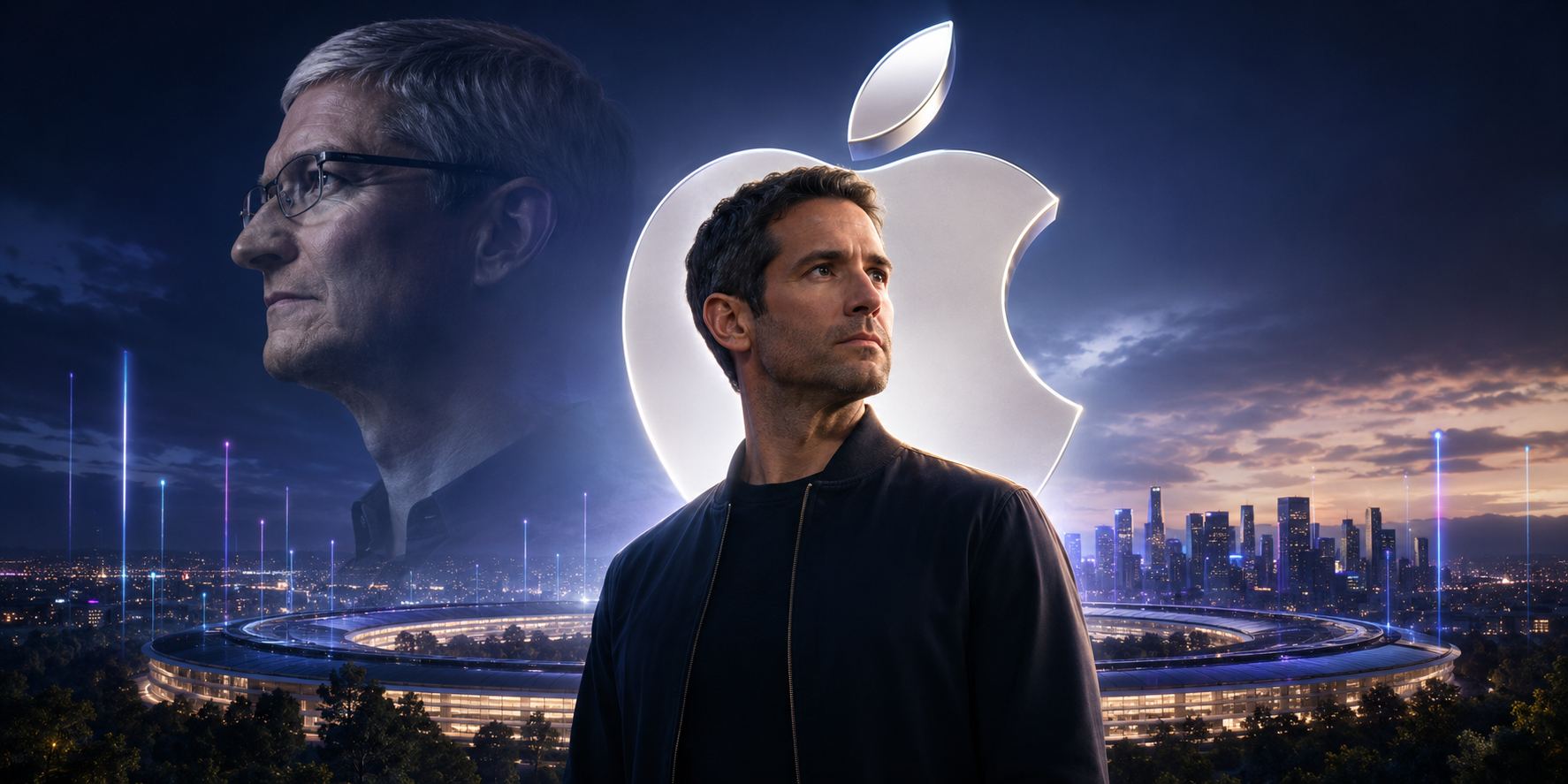
John Ternus takes over as Apple CEO on September 1, 2026, and the most striking thing about the transition is how little needs fixing on day one.
When Tim Cook succeeded Steve Jobs in 2011, Apple was already extraordinarily successful. But Cook still had to answer a question hanging over the company: could Apple remain Apple without the founder whose taste, personality and product instincts had become inseparable from it?
The Apple CEO succession from Cook to Ternus begins from almost the opposite position.
Ternus inherits a company worth more than $4.5 trillion, according to Reuters, with annual revenue of $416 billion and more than 2.5 billion active devices across its installed base. Apple says Services alone has grown into a business generating more than $100 billion in annual revenue. The company that once had to prove it could outlive Steve Jobs has spent 15 years demonstrating exactly that.
The market record is even harder to follow. According to the figures supplied for this transition, Apple shares gained more than 2,000% during Cook’s tenure. As Ternus takes over, the stock is still up roughly 36% over the previous year despite sitting about 8% below its July high.
That leaves Apple’s new CEO with an unusual problem. He does not have to save Apple. He has to establish what success means when the company he inherits is already operating near the limits of corporate scale.
Table of Contents
- This Apple CEO succession is not 2011 all over again
- Cook leaves more than an extraordinary stock chart
- Ternus inherits the problem of scale
- Apple still needs another technological cycle
- Investors cannot use Cook’s scoreboard forever
- Apple after Cook does not need another Steve Jobs
- Apple CEO succession: key questions
This Apple CEO succession is not 2011 all over again
The comparison between Ternus and Cook is inevitable. The comparison between their starting positions is more useful.
Cook became CEO in August 2011, less than two months before Jobs died. The iPhone had already transformed Apple and the iPad was rapidly establishing another major category, but the company’s modern identity was still closely tied to the man who had returned in 1997 and rebuilt it.
Cook therefore inherited a successful company with an unresolved institutional question. Apple’s products worked. Its economics worked. Nobody knew whether the organization could keep working at the same level without Jobs.
Fifteen years later, that question looks almost quaint.
Apple says annual revenue increased from $108 billion in fiscal 2011 to more than $416 billion in fiscal 2025. Its market capitalization went from roughly $350 billion when Cook became CEO to more than $4 trillion by the time Apple announced the succession, while Reuters puts its value above $4.5 trillion as Ternus formally takes over.
Cook also leaves Apple as executive chairman rather than disappearing from the company. Apple says he will remain involved in certain areas, including relationships with policymakers around the world. This is a planned internal transfer of power, approved unanimously by the board, with considerably more continuity than the transition forced upon Apple by Jobs’s illness.
Ternus does not have to demonstrate that Apple can survive its founder.
He has to demonstrate that a mature Apple can create another era.
Cook leaves more than an extraordinary stock chart
Cook’s stock-market record is spectacular enough to distort the way his tenure is remembered.
A share-price gain above 2,000% is an outcome. It is not a corporate strategy.
The more useful measure of Cook’s Apple is what happened underneath the chart. He turned the product momentum of the Jobs years into a vastly larger economic system built around hardware, services, custom silicon, an enormous installed base and one of the most sophisticated global supply chains in consumer technology.
Services became a business producing more than $100 billion in annual revenue. Apple Watch and AirPods created major businesses beyond the company’s traditional Mac, iPhone and iPad lines. Apple brought more of its core technology under its own control through custom chips, culminating in the Mac’s transition away from Intel processors. The active installed base passed 2.5 billion devices.
The company also learned to make substantially more money from relationships that begin with a hardware purchase. An iPhone customer can subsequently pay for apps, cloud storage, entertainment and other services while adding AirPods, an Apple Watch, a Mac or another Apple device.
Cook did not invent the Apple ecosystem. He turned it into an industrial system.
That distinction matters because it changes what Ternus is receiving. He is not inheriting a collection of promising products that still need to become a coherent business. He is taking control of a machine whose parts reinforce one another at enormous scale.
Preserving that machine is part of the job. It may also be what makes changing Apple so difficult.
Ternus inherits the problem of scale
There is an awkward feature of taking over one of the most successful companies in history: ordinary corporate victories start looking very small.
A startup can create a billion-dollar business and transform itself. Apple can create a billion-dollar business and barely alter its income statement.
The same arithmetic applies to growth. Expanding a $20 billion company by 10% requires $2 billion in additional revenue. Adding 10% to Apple’s fiscal 2025 revenue base would mean finding more than $40 billion.
That is why Ternus’s task cannot simply be reduced to launching good products.
Apple already launches good products. Its existing franchises generate extraordinary amounts of cash. The iPhone remains central to the business, Services continues to expand, custom silicon gives Apple deep control over the performance of its devices, and its installed base gives the company a distribution advantage few technology businesses can replicate.
Ternus’s background fits the preservation side of that equation. He joined Apple in 2001 and rose to become senior vice president of Hardware Engineering. Apple credits him with leadership across major hardware programs and emphasizes his technical knowledge, product focus and work on areas including reliability, durability, materials and hardware design.
But Apple did not promote a hardware engineer merely to keep shipping the same hardware forever.
The harder part of the job is finding growth that is large enough to matter without destabilizing the businesses that made Apple so valuable in the first place.
Apple still needs another technological cycle
This is where the succession becomes more interesting than a ceremonial changing of the guard.
Ternus takes over while artificial intelligence is changing the economics and competitive priorities of the technology industry. Apple’s position in that transition is complicated. The company has enormous advantages in devices, silicon, software distribution and installed users, but Reuters notes that its AI features have lagged rivals and that delays to the planned overhaul of Siri have added to concerns about its position.
Apple also spent years developing an electric vehicle before abandoning the project in 2024. Vision Pro demonstrated substantial technical ambition but has not produced the kind of commercial scale that would make spatial computing an obvious successor to the iPhone.
None of that means Apple needs to manufacture another iPhone-sized revolution immediately.
It does mean Ternus eventually needs an answer to a question Cook never completely resolved: what becomes Apple’s next major technological growth cycle?
AI is the obvious candidate because it could change how users interact with software, devices and digital services. Yet Apple’s opportunity does not necessarily look like the strategies being pursued by companies building enormous cloud models and data centers.
Apple already owns something those companies spend billions trying to reach: devices in the hands and pockets of billions of people.
That creates several possible paths. AI could make existing Apple products more valuable. It could create new interfaces between hardware and software. It could increase the strategic importance of Apple’s custom silicon. It could eventually support device categories that make little sense without intelligent software capable of understanding context, voice, images and the physical environment.
The problem is that none of those possibilities automatically becomes a business large enough to define an Apple CEO’s tenure.
Investors cannot use Cook’s scoreboard forever
Cook’s performance creates a seductive but misleading benchmark for his successor.
If Apple shares gained more than 2,000% during Cook’s tenure, the obvious temptation is to ask what Ternus can deliver next. But repeating Cook’s stock performance from a starting valuation above $4 trillion would require Apple to become a company worth many tens of trillions of dollars.
That is not a sensible baseline for evaluating management.
It also exposes a distinction that often disappears when a famous CEO steps down: a great company, a great CEO and a great stock are not necessarily the same thing at the same moment.
Ternus could run Apple extremely well while producing lower shareholder returns than Cook. Apple could grow revenue and earnings while its valuation contracts. The company could launch commercially successful products that still fail to become large enough to transform a business already generating hundreds of billions of dollars per year.
The reverse is also true. A rising stock price during Ternus’s first year would tell investors very little about whether he has established the technological direction of Apple for the next decade.
The current market setup makes that distinction particularly relevant. With the shares roughly 36% higher than a year ago despite their retreat from the July peak, Ternus is not receiving the easy optics of a turnaround. Expectations are already embedded in the price.
The market will grade him every trading day.
His actual test will take years.
Apple after Cook does not need another Steve Jobs
Every discussion about Apple’s leadership eventually drifts toward the same question: where is the next Steve Jobs?
After Cook’s tenure, that may be the wrong question twice over.
Cook succeeded precisely because he did not try to reproduce Jobs. His Apple became more operationally formidable, more geographically expansive, more services-driven and vastly larger. He transformed the company by amplifying strengths that were different from those associated with his predecessor.
Ternus now has to make a similar distinction for himself.
The safest version of his tenure would preserve the machine Cook built: protect the iPhone franchise, expand Services, keep improving Apple silicon, manage the supply chain and gradually integrate new technologies into products people already understand.
The risk is that safety becomes strategy.
AI illustrates the tension particularly well. The rest of Big Tech is committing extraordinary amounts of capital to the infrastructure behind generative AI, a dynamic Geek’n’Destroy recently examined in its analysis of the capital expenditure hidden behind every AI prompt. Apple does not necessarily need to copy that model, but Ternus does need to decide where his company belongs in a technology cycle capable of changing computing itself.
That decision may not produce a single dramatic product launch. The Ternus era could emerge through a series of choices about AI, silicon, devices, services, manufacturing and interfaces that only look like a coherent strategy in retrospect.
Cook inherited Steve Jobs’s Apple and proved it could scale without him.
Ternus inherits Tim Cook’s Apple already at scale.
His job is to decide what comes after scale.
Apple CEO succession: key questions
When does John Ternus become Apple CEO?
John Ternus becomes Apple’s CEO on September 1, 2026. Apple announced the succession in April after its board unanimously approved the transition.
What happens to Tim Cook after the Apple CEO succession?
Cook becomes executive chairman of Apple’s board. The company says he will remain involved in certain areas, including relationships with policymakers around the world.
How large did Apple become under Tim Cook?
Apple says annual revenue increased from $108 billion in fiscal 2011 to more than $416 billion in fiscal 2025. Its market capitalization grew from roughly $350 billion when Cook became CEO to more than $4 trillion by the time Apple announced his successor.
How did Apple stock perform under Tim Cook?
According to the figures supplied for the transition, Apple shares gained more than 2,000% during Cook’s tenure. Stock performance depends on the exact measurement dates and methodology used and should not be treated as a direct measure of corporate performance.
Who is John Ternus?
Ternus joined Apple in 2001 and rose to become senior vice president of Hardware Engineering. Apple selected him through a long-term internal succession process rather than recruiting an external CEO.
What is the biggest challenge facing John Ternus?
His central strategic challenge is preserving Apple’s highly profitable existing businesses while establishing new sources of growth large enough to matter at the company’s current scale. Artificial intelligence is one of the most immediate areas where that tension is visible.
Does John Ternus need to match Tim Cook’s stock returns to succeed?
No. Ternus begins with Apple valued above $4 trillion, compared with roughly $350 billion when Cook became CEO. Evaluating his tenure will require separating Apple’s operational performance, technological direction and stock-market returns.
Is this financial advice?
No. This article is editorial analysis for informational purposes only and does not constitute investment, trading or personalized financial advice.