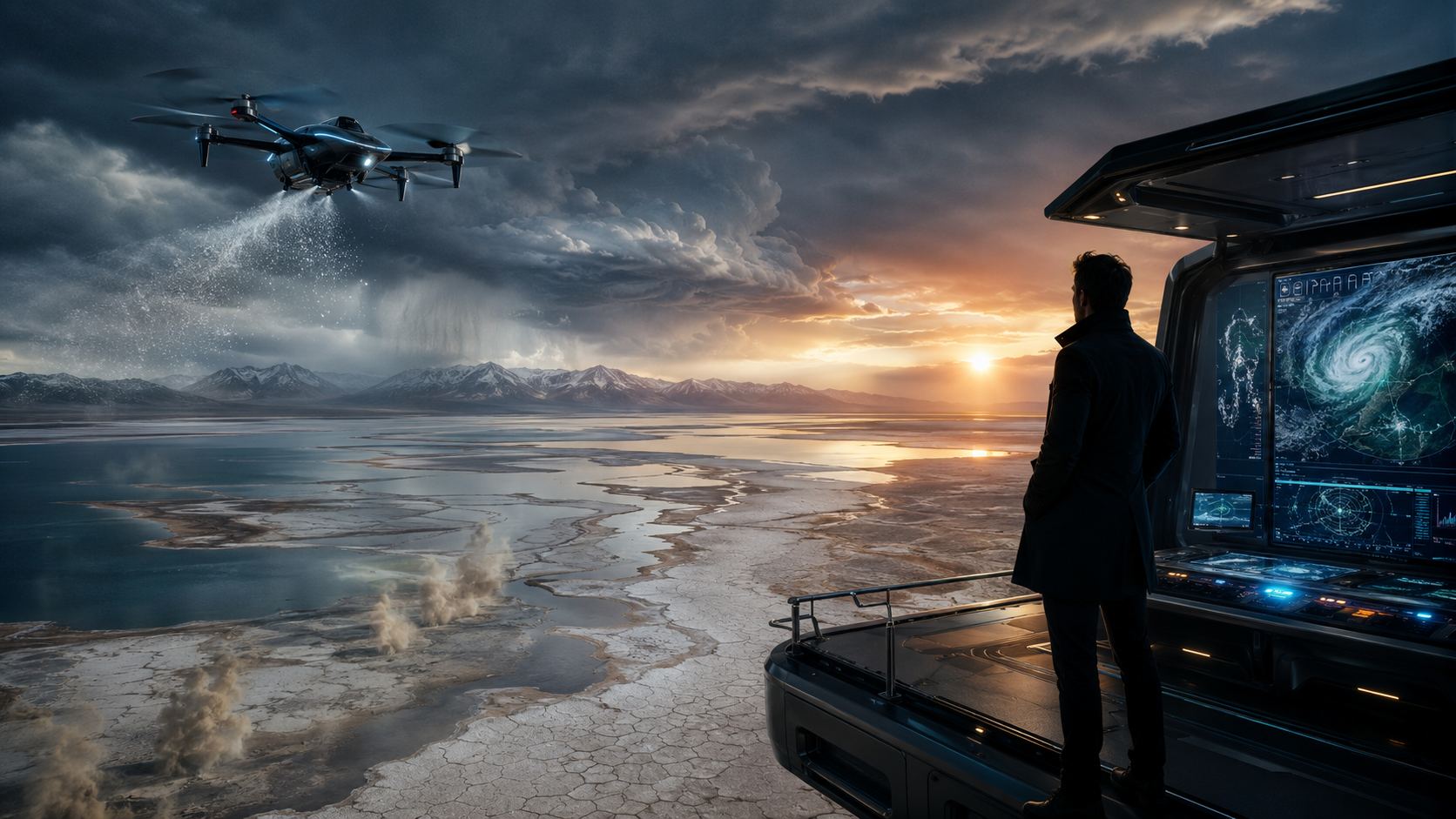
The American West has a water problem. Utah has a ticking time bomb.
The Great Salt Lake, the largest saline lake in the Western Hemisphere, has been shrinking for decades. As its water disappears, the exposed lakebed becomes a source of toxic dust laced with arsenic and heavy metals. For the 2.5 million people living around the Salt Lake City region, this is not an abstract climate story. It is air, lungs, crops, wildlife, and a lake system that is running out of runway.
Into that crisis walks Augustus Doricko, the young founder of Rainmaker, a California startup trying to drag cloud seeding out of its Cold War-era reputation and into the drone-and-AI age. The pitch is brutally simple: find the right clouds, inject silver iodide, squeeze out more snow, and send more water downstream.
It sounds like sci-fi. It is actually an 80-year-old technology with better hardware, better sensors, and a much bigger PR problem.
- The Great Salt Lake crisis is no longer slow-moving
- What Rainmaker is actually doing in the clouds
- Why Utah is betting on cloud seeding
- The hard part: proving it really works
- Cloud seeding is colliding with chemtrails paranoia
- Why making it snow will not save the lake alone
- The real water future is less waste, not magic rain
- Cloud seeding and the Great Salt Lake: key questions
The Great Salt Lake crisis is no longer slow-moving
The Great Salt Lake has already crossed the line from environmental concern to public-health emergency. A BYU-led emergency report states that the lake has lost 73% of its water and 60% of its surface area, with excessive human water use driving the collapse.
In 2022, the lake hit a record low. The Utah Division of Water Resources recorded the lake’s average daily value at 4,188.5 feet at the South Arm Causeway gauge in November of that year, the lowest level in the modern record.
The danger is not just that the lake gets smaller. The danger is what the lake leaves behind.
As water retreats, more lakebed is exposed to wind. That dry playa contains arsenic, lead, mercury, cadmium, and other metals accumulated through decades of mining, industry, agriculture, and natural processes. Researchers at the University of Utah have warned that arsenic and other metals in parts of the lakebed exceed EPA residential and industrial standards.
That matters because Salt Lake City already lives with difficult air. A shrinking lake adds another layer: dust storms carrying pollutants into communities along the Wasatch Front.
The lake is also a major economic and ecological engine. It supports wetlands, mineral extraction, brine shrimp, migratory birds, and snow patterns that feed the region’s hydrology. Losing it would not be one disaster. It would be a stack of disasters.
What Rainmaker is actually doing in the clouds
Rainmaker is not inventing cloud seeding. The basic idea dates back to the 1940s: introduce tiny particles into clouds so water vapor or supercooled droplets can freeze, grow, and fall as snow or rain.
The classic seeding agent is silver iodide. It has a crystalline structure that can help ice form under the right conditions. No suitable cloud, no result. Cloud seeding is not a weather-control joystick. It is more like trying to nudge a storm that is already ready to produce precipitation.
Rainmaker’s twist is operational. Instead of relying mainly on piloted aircraft or ground generators, the company uses drones, weather stations, radar, and software to target clouds more precisely.
Its Elijah drone is designed to fly into cold, icy cloud environments where cloud seeding can work. Around the Bear River basin, Rainmaker has also deployed sensors and radar systems feeding into Prophet, its AI system for identifying seedable clouds and separating natural snowfall from precipitation that may have been induced.
That distinction is the whole game. Cloud seeding has always had a measurement problem: when snow falls after a seeding mission, skeptics can reasonably ask whether it would have fallen anyway.
Rainmaker wants to answer that with radar signatures, drone flight paths, satellite data, and repeatable patterns.
Why Utah is betting on cloud seeding
Utah has been cloud seeding in some form since the 1950s, but the scale and urgency have changed.
In September 2025, Governor Spencer Cox and Utah leaders signed the Great Salt Lake 2034 Charter, setting 2034 as a target year for healthier lake levels. That date is not random: Utah is set to host the Winter Olympics and Paralympics that year.
The same announcement included $200 million in private-sector commitments, split between Great Salt Lake Rising and Ducks Unlimited, aimed at projects that deliver water to the lake and improve habitat.
Rainmaker has become one of the flashiest pieces of that broader strategy. Its target is the Bear River basin, the most important tributary system feeding the Great Salt Lake. More snowpack there means more spring runoff, and more runoff means more water that could eventually reach the lake.
The startup also operates beyond Utah. According to local reporting and Rainmaker’s own public statements, it has been active in Utah, Idaho, Oregon, California, and Colorado.
That geographic spread says a lot. The West is not short of markets for water technology. It is short of water.
The hard part: proving it really works
On April 27, 2026, Rainmaker announced what it called a breakthrough: 82 “unambiguous seeding signatures” in Oregon and Utah, corresponding to about 143 million gallons of freshwater.
The company framed it as proof that drone-based cloud seeding can create measurable precipitation. Deseret News reported that Utah Department of Natural Resources executive director Joel Ferry called that type of validation “critical,” because public spending on cloud seeding needs scientific proof.
That is the key tension. Rainmaker’s claims are promising, but cloud seeding is still a field where independent verification matters enormously. Weather is noisy. Storm systems are chaotic. There is no simple laboratory control group floating next to every seeded cloud.
The U.S. Government Accountability Office has described cloud seeding’s benefits as difficult to verify, and the EPA’s geoengineering FAQ notes that cloud seeding is a local weather modification technique, separate from solar geoengineering, with research still needed on effectiveness and broader impacts.
That does not mean Rainmaker is wrong. It means the company is operating in the zone where technology, statistics, public money, and politics all collide.
For a startup, “we made it snow” is a killer headline. For a state government, the question is harsher: did it produce enough additional water, at a low enough cost, with enough certainty, to justify scaling?
Cloud seeding is colliding with chemtrails paranoia
Rainmaker’s other problem is not technical. It is cultural.
Cloud seeding has become a magnet for chemtrails conspiracy theories. In that worldview, ordinary aircraft contrails are not condensation trails but secret chemical sprays used to control the weather, poison people, or manipulate society.
The EPA is explicit: contrails are line-shaped exhaust clouds formed under specific atmospheric conditions, and the federal government says it is not aware of contrails ever being intentionally formed over the United States for weather modification or geoengineering.
That has not stopped the paranoia from spilling into politics. In 2025, after deadly Texas floods, online conspiracy accounts tried to blame cloud seeding, including Rainmaker’s operations, despite the enormous mismatch between what cloud seeding can plausibly do and the scale of the rainfall involved.
The result is ugly and predictable. A niche weather technology gets flattened into “they are spraying the sky.” Scientists and program managers become targets. Lawmakers find an easy outrage machine. A real debate about water, drought, regulation, and risk gets buried under screenshots and algorithmic panic.
There are legitimate questions about cloud seeding. Who gets the water? What happens downwind? How should flights be regulated? How do we measure results? What are acceptable environmental limits for seeding agents?
Those questions are serious. Chemtrails discourse is not.
Why making it snow will not save the lake alone
Here is the cold shower: even if Rainmaker’s drones work extremely well, cloud seeding alone will not rescue the Great Salt Lake.
The lake’s deficit is too large. The BYU-led emergency report points to an average shortfall of about 1.2 million acre-feet per year since 2020. Other estimates cited by Utah policymakers suggest hundreds of thousands of additional acre-feet per year are needed for a realistic recovery path.
Cloud seeding can be useful at the margins. A 5%, 10%, or even 15% precipitation boost during suitable storms could be valuable in a dry basin. But that is not the same as solving overconsumption.
The brutal reality is that the Great Salt Lake is shrinking because humans divert too much water before it reaches the lake. Agriculture is the dominant user in the watershed, especially irrigation for alfalfa and hay. Oregon State University highlighted a 2025 study arguing that reducing irrigation for livestock feed crops is necessary to stabilize the lake, noting that roughly 80% of agricultural water use goes to alfalfa and hay.
That makes the politics harder. Cutting water use is not just a technical fix. It touches farms, rural economies, property rights, food systems, and Utah’s identity.
Rainmaker can help increase supply. Utah still has to deal with demand.
The real water future is less waste, not magic rain
The most realistic future is not one silver bullet. It is a stack: better cloud seeding, smarter irrigation, water leasing, crop changes, lake-friendly policy, and hard conversations about what should be grown where.
Drip irrigation is the obvious example. Israel helped pioneer large-scale drip systems that deliver water directly to plant roots, reducing evaporation and waste. The technology is now used globally because it turns water efficiency from a slogan into hardware.
That matters for Utah because the cheapest water is often the water you stop wasting. If farms can produce more per liter, or shift away from the thirstiest crops in the most stressed basins, the lake has a better shot.
Genetically improved drought-tolerant crops could also play a role. So could voluntary water markets, conservation payments, secondary water metering, invasive plant removal, and changes to municipal landscaping.
Rainmaker fits into that future as a weather-tech accelerator, not a savior. Its drones may make a measurable difference in specific storms. Its AI may help identify the right clouds. Its data may finally give cloud seeding the validation it has lacked for decades.
But the Great Salt Lake does not need a myth. It needs water.
And that means Utah’s real test is not whether a startup can make it snow. It is whether a fast-growing state can stop treating a terminal lake like an infinite drain.
Cloud seeding and the Great Salt Lake: key questions
What is cloud seeding?
Cloud seeding is a weather modification technique that introduces particles, often silver iodide, into suitable clouds to encourage rain or snow formation.
Can Rainmaker control the weather?
No. Cloud seeding can only attempt to enhance precipitation in clouds that already have the right conditions. It cannot create major storms from clear skies.
Why is Utah interested in Rainmaker?
Utah wants more snowpack in key basins, especially the Bear River basin, because runoff from those areas can help feed the Great Salt Lake.
Is the Great Salt Lake really in danger?
Yes. Scientific assessments say the lake has lost most of its water volume and a large share of its surface area, exposing lakebed that can produce toxic dust.
Are chemtrails real?
No credible evidence supports the chemtrails conspiracy theory. The EPA describes contrails as condensation trails from aircraft exhaust under cold atmospheric conditions.
Will cloud seeding save the Great Salt Lake?
Not by itself. It may help increase water supply during suitable storms, but researchers say large reductions in water consumption are also needed.
Is silver iodide dangerous?
Current research generally suggests silver iodide used in cloud seeding has not shown major environmental or health concerns at existing levels, but broader use still requires monitoring.
What is the bigger solution?
The bigger solution is water management: reduced waste, more efficient irrigation, crop changes, water leasing, conservation, and policies that leave more water flowing to the lake.