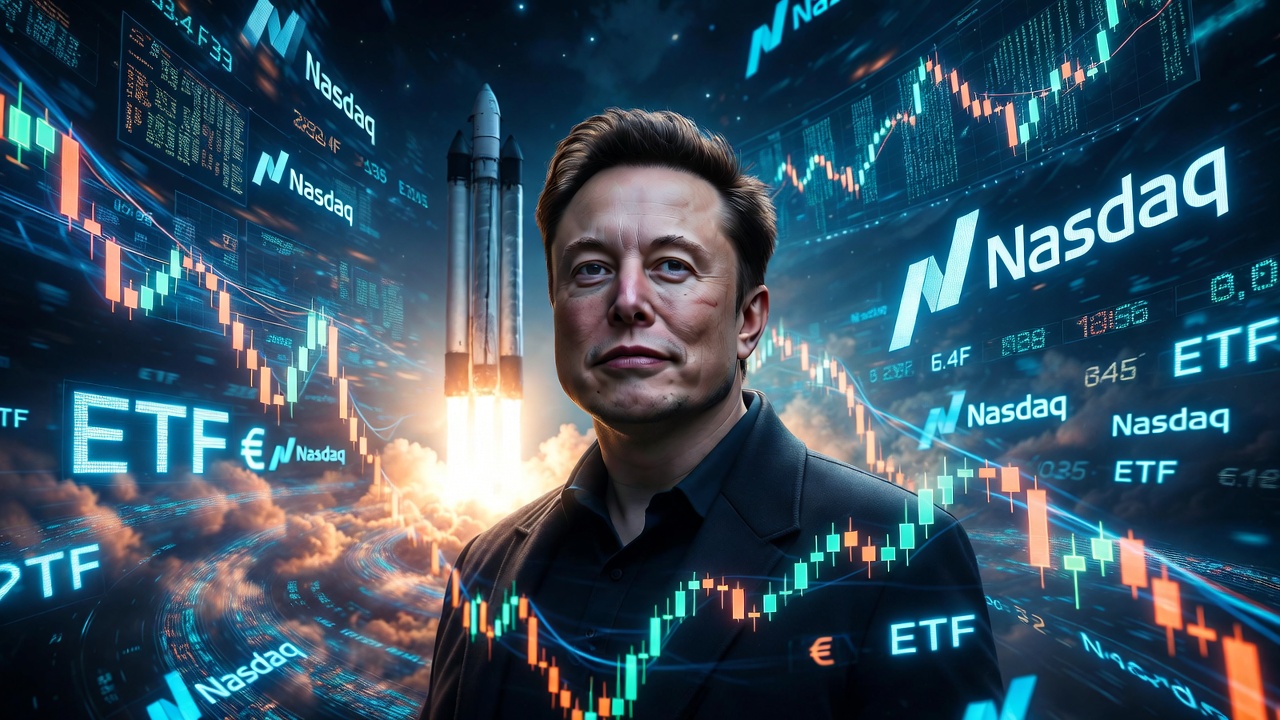
SpaceX may build rockets, but its next big launch is happening inside your brokerage account.
Not because millions of retail investors suddenly opened a trading app and decided to buy the stock. Not because every fund manager ran a fresh valuation model on Starship, Starlink, launch margins, satellite internet, or Elon Musk risk. The stranger version is more interesting: millions of ETF investors may end up buying SpaceX without ever clicking a button.
That is the quiet power of index inclusion. According to Reuters, SpaceX is set to join the Nasdaq 100 shortly after its IPO, with analysts estimating billions of dollars in passive inflows as index-tracking funds rebalance. For a company already surrounded by IPO mythology, that second market event may matter more than the first.
Welcome to the invisible machinery of modern markets. Less Wolf of Wall Street, more The Matrix. Less stock-picking poetry, more Moneyball.
- The second launch is the important one
- Meet the silent army of buyers
- The passive revolution
- Can index inclusion create a price floor?
- So… should investors chase the trade?
- SpaceX and index inclusion: key questions
The second launch is the important one
IPO day is built for television. The bell rings. Executives smile. The ticker flashes. Everyone argues about whether the stock “popped” or “flopped.”
But IPO day is often just the first launch. The second launch happens when a stock becomes unavoidable.
That is what index inclusion does. When a company enters the Nasdaq 100, it stops being merely a stock investors can choose to buy. It becomes part of a machine. Funds that track the index must adjust. ETFs benchmarked to the Nasdaq 100 must hold the new constituent. Portfolio managers who are judged against the index suddenly have a new reference point.
For SpaceX, that matters because the company is not a normal IPO story. It sits at the intersection of space infrastructure, satellite broadband, defense contracts, reusable rockets, and speculative dreams about off-world industry. Investors already have enough narrative fuel to light up a small moon.
But narrative demand is optional. Index demand is mechanical.
That is the difference.
Meet the silent army of buyers
The most important buyers in the market are not always loud hedge fund managers on financial TV. Sometimes they are teachers, engineers, freelancers, retirement savers, and bored office workers who bought a Nasdaq 100 ETF years ago and forgot about it.
Take Invesco QQQ. Invesco describes QQQ as a passively managed ETF that tracks the Nasdaq 100, giving investors exposure to the 100 largest non-financial companies listed on Nasdaq. The key phrase is passively managed. QQQ is not supposed to wake up and ask whether SpaceX is overvalued. It is not supposed to have feelings about rockets. It is not supposed to care whether Starlink margins look beautiful or whether Starship delays become a cash furnace.
It tracks the index.
So when the index changes, the ETF changes. That means buying the new entrant and adjusting the rest of the portfolio.
Multiply that by QQQ, QQQM, institutional products, mutual funds, separately managed accounts, derivatives hedging, and benchmark-aware managers, and the “silent army” starts to look less silent. It is not one investor making a bold call. It is a system executing instructions.
This is why index inclusion can create a market event bigger than an earnings beat. Earnings require interpretation. Index buying requires execution.
The passive revolution
For decades, Wall Street sold itself as a giant talent contest. Smart analysts, sharper traders, better models. Then passive investing walked in wearing plain clothes and changed the game.
The Moneyball comparison works because the revolution was not obvious at first. Baseball scouts used to obsess over what players looked like. The data nerds found hidden metrics that actually predicted wins. In markets, investors used to obsess over star fund managers. Then low-cost index funds showed that most active managers struggled to beat broad benchmarks after fees.
The result is one of the biggest shifts in financial history: trillions of dollars now move according to index rules.
That changes price discovery. In theory, a stock price reflects the market’s collective view of a company’s future cash flows. In practice, modern prices also reflect flows, rules, liquidity, benchmark construction, ETF mechanics, and rebalancing schedules.
That does not mean fundamentals are dead. It means fundamentals are no longer the only force in the room.
This is the Matrix moment. The average investor sees tickers moving up and down. The market mechanic sees the code behind the screen: index eligibility, float adjustment, ETF creations, authorized participants, options hedging, and benchmark risk.
SpaceX entering the Nasdaq 100 is not just a badge of prestige. It plugs the company into that code.
Can index inclusion create a price floor?
Index inclusion often helps a stock in three ways.
First, it can create immediate demand. Funds that track the index need exposure. That can push volume higher around the inclusion date.
Second, it can improve liquidity. More shares trade, spreads can tighten, and large investors may find it easier to build or exit positions without moving the price as violently.
Third, it can broaden ownership. A stock once held mainly by IPO buyers, growth funds, and space-curious investors becomes embedded in retirement accounts and ETF portfolios.
But investors should not confuse a buying wave with a magic shield.
History is full of index inclusion effects, but the outcome is never guaranteed. Tesla’s addition to the S&P 500 in 2020 became a textbook example of huge index-related demand arriving after a massive run-up. Some stocks benefit from inclusion and keep climbing because fundamentals continue to support the story. Others enjoy the flow, then fade when valuation catches up with reality.
Liquidity can reduce some forms of volatility, but it cannot delete business risk. A company can be in every major index and still disappoint investors. Index funds buy because rules tell them to buy. They do not underwrite rocket economics. They do not solve launch failures. They do not make debt cheaper forever. They do not guarantee profit margins.
A price floor can appear when passive ownership is large and long-term holders are sticky. But floors crack when fundamentals deteriorate, rates move, risk appetite vanishes, or early buyers decide the story got too expensive.
Index inclusion is a force. It is not a force field.
So… should investors chase the trade?
The practical question is not “Will index funds buy SpaceX?” If the company enters the Nasdaq 100, the answer is yes, mechanically.
The better question is: how much of that buying is already priced in?
Markets are not stupid. When an inclusion is expected, traders often buy ahead of the event. That can pull future demand into today’s price. By the time the actual rebalance arrives, the easy part of the trade may already be gone.
Retail investors should separate three things.
Mechanical demand is the index effect. It can support volume and create short-term pressure.
Market narrative is the SpaceX premium. Rockets, Starlink, defense, Mars, AI infrastructure, Elon Musk, scarcity, and cultural gravity all live here.
Long-term investment value is the hard part. That depends on revenue growth, margins, capital intensity, competition, regulation, execution, and whether the company can turn technological dominance into durable cash flow.
The danger is buying a long-term story for a short-term catalyst price.
For investors, the useful “so what?” is simple: watch flows, but do not worship them. Index inclusion tells you a stock has become important enough for the machine to buy. It does not tell you what the business is worth.
SpaceX joining the Nasdaq 100 would be a massive symbolic and mechanical moment. It would mean the company has moved from private-market legend to public-market infrastructure. But the smartest investors will treat the index effect as one input, not the thesis.
Because in modern markets, the machines matter.
But gravity still exists.
SpaceX and index inclusion: key questions
Why does Nasdaq 100 inclusion matter for SpaceX?
Because index-tracking ETFs and funds must adjust their holdings when SpaceX enters the index, potentially creating automatic demand for the stock.
What is QQQ?
QQQ is a major ETF from Invesco that tracks the Nasdaq 100, giving investors exposure to large non-financial companies listed on Nasdaq.
Does index inclusion guarantee SpaceX stock will rise?
No. Inclusion can create buying pressure and improve liquidity, but future returns still depend on valuation, execution, fundamentals, and market conditions.
Why can index buying move a stock more than earnings?
Earnings require investors to interpret results. Index inclusion can force funds to buy mechanically, regardless of opinion or valuation.
Should retail investors buy SpaceX just because it joins the Nasdaq 100?
Not automatically. Investors should separate short-term mechanical demand from the long-term business case and avoid treating passive flows as financial advice.
Is this financial advice?
No. This article is for information and analysis only. Investors should do their own research or consult a qualified financial adviser before making investment decisions.