SpaceX spent June proving that Wall Street was willing to fund Elon Musk’s next act. Now comes the harder part: building the industrial machine behind it.
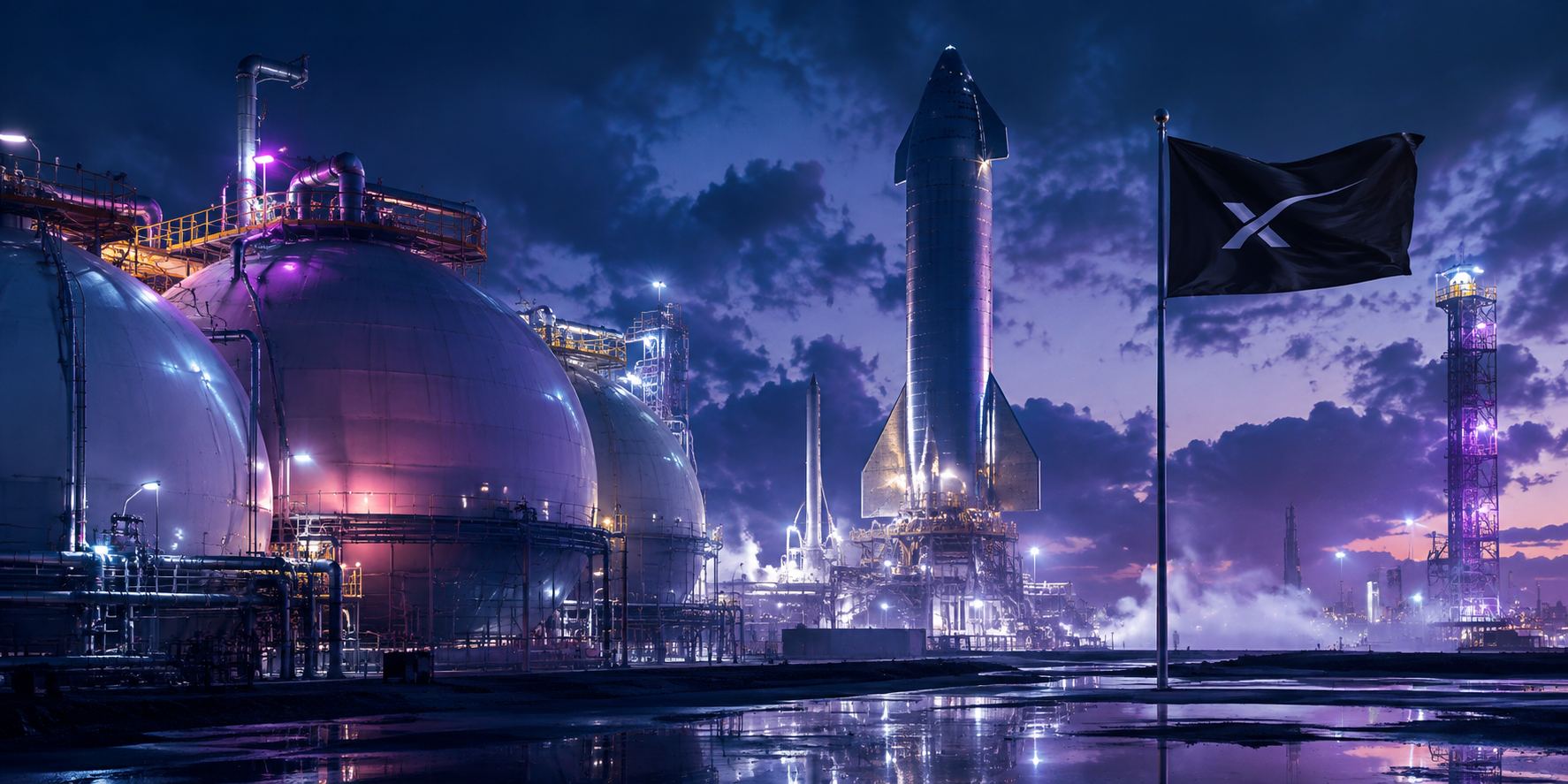
The company’s new $100 billion Starbase Louisiana project is designed to operate on a scale that looks less like a conventional launch site and more like a vertically integrated industrial city. SpaceX plans launch infrastructure, power generation, deep-water shipping and, crucially, on-site methane production for Starship.
That last piece could turn an aerospace story into a very large energy-infrastructure story.
According to a report from BFM Business, French engineering group Technip Energies is in contention for a contract worth roughly $10 billion linked to fuel production for Starship at the Louisiana complex, with Elon Musk expected to select the winning bidder on September 1.
The reported award has not yet been publicly confirmed by SpaceX or Technip Energies. But the broader industrial logic is already visible: if SpaceX wants Starship launches by the thousands, somebody has to feed the rockets.
Table of contents
- From IPO story to infrastructure story
- Why Starship turns methane into a strategic resource
- Why Technip Energies makes sense
- Louisiana is becoming part spaceport, part energy complex
- The new economics of SpaceX
- Who actually supplies the rockets?
- What this means for SPCX investors
- SpaceX, Starship and Technip Energies: key questions
From IPO story to infrastructure story
For months, SpaceX was one of the biggest stories in global capital markets.
The company completed its blockbuster IPO in June 2026, selling shares at $135 apiece under the SPCX ticker. After the underwriters exercised their full option, SpaceX said the offering generated approximately $85.7 billion in gross proceeds.
That was the financial event.
What is happening in Louisiana may prove more important for understanding what SpaceX actually intends to become.
The company announced in August that it plans to invest $100 billion in Starbase Louisiana, a sprawling 125,000-acre complex at Pecan Island. According to Reuters, construction is scheduled to begin in 2027, with a first launch targeted for 2029.
This is not simply another pad from which to fire rockets.
The project is expected to include vehicle processing, power generation, deep-water shipping infrastructure and methane production. SpaceX ultimately wants the site to support thousands of Starship flights per year.
At that point, rocket fuel stops being a procurement detail. It becomes industrial infrastructure.
Why Starship turns methane into a strategic resource
Starship is powered by SpaceX’s Raptor engines, which burn liquid methane and liquid oxygen.
Methane is important to Musk’s architecture for several reasons. It can support high-performance reusable engines, and its chemistry also fits SpaceX’s much longer-term Mars ambitions, where the company hopes propellant could eventually be manufactured from local resources.
But before anyone builds a methane plant on Mars, SpaceX needs enormous amounts of propellant on Earth.
A launch system designed for occasional missions can rely on a relatively conventional fuel supply chain. A reusable transportation system targeting extremely high launch frequencies has a different problem entirely.
If SpaceX eventually operates Starship at the scale it describes, it will need reliable access to propellant at a volume, cost and cadence that increasingly resembles heavy industry.
That explains why the Louisiana site matters.
SpaceX is not merely putting tanks next to a launchpad. The company is designing a site where energy supply, propellant production, logistics and launch operations can be integrated.
It is the same vertical-integration instinct that shaped much of SpaceX’s rocket manufacturing strategy, pushed further upstream.
Why Technip Energies makes sense
This is where Technip Energies enters the picture.
The French engineering group is hardly a household name outside energy and industrial circles, but LNG infrastructure is one of its core businesses.
Technip Energies says it has delivered more than 20% of the world’s operating LNG capacity. It is already deeply involved in Louisiana: in May 2026, the company received full notice to proceed on a major engineering, procurement and construction contract for Commonwealth LNG’s 9.5 million-tonne-per-year export facility in Cameron Parish.
That project uses six liquefaction trains based on Technip Energies’ modular SnapLNG technology.
In other words, if SpaceX needs a company capable of designing and delivering very large methane-related infrastructure on the Gulf Coast, Technip Energies has a résumé that fits the job.
The reported roughly $10 billion SpaceX contract would nevertheless be on another level.
For context, Technip Energies reported a record backlog of €25 billion at the end of the first half of 2026, after €12.7 billion of order intake during the period.
A SpaceX award anywhere near the reported size would therefore be strategically significant, even for a company accustomed to multibillion-dollar energy projects.
Until an official announcement is made, however, the contract value, precise scope and identity of the winning contractor should be treated as unconfirmed.
Louisiana is becoming part spaceport, part energy complex
There is a reason SpaceX picked Louisiana.
The Gulf Coast already contains one of the densest concentrations of energy infrastructure in the world: natural-gas pipelines, LNG terminals, petrochemical plants, ports and experienced industrial contractors.
Natural gas access was specifically cited as one of the strategic advantages of the new site.
That changes how Starbase Louisiana should be viewed.
SpaceX’s existing identity was built around aerospace engineering: Falcon 9, Dragon, Starlink and increasingly Starship. Louisiana pushes the company deeper into another industrial ecosystem — energy.
The site is expected to combine ten launch and landing pads across five launch complexes with propellant infrastructure, power generation and maritime logistics.
SpaceX is effectively trying to remove external constraints from the launch equation.
If rockets can be manufactured rapidly but fuel cannot arrive rapidly enough, fuel becomes the bottleneck. If electricity becomes scarce, power becomes the bottleneck. If enormous vehicles and components cannot move efficiently, logistics becomes the bottleneck.
Starbase Louisiana appears designed to attack several of those constraints at once.
That is classic Musk industrial strategy: identify the limiting factor, then pull it inside the system.
The new economics of SpaceX
The timing is especially interesting because SpaceX no longer has the same capital constraint it once did.
Its June IPO raised approximately $85.7 billion in gross proceeds after the underwriters exercised their full overallotment option. SpaceX’s SEC filings put net IPO proceeds at roughly $85.675 billion.
Meanwhile, Starlink has transformed the economics of the company.
SpaceX reported $18.67 billion in revenue for 2025, with Starlink representing a major driver of the business. The satellite network gives SpaceX something rocket companies historically struggled to obtain: a large recurring revenue engine connected directly to its launch infrastructure.
But the company still reported a net loss for 2025 as investment in rockets and AI-related projects remained enormous.
That distinction matters.
SpaceX is not entering an era where capital expenditure disappears. It is entering an era where its ambitions require capital expenditure on a completely different scale.
The Louisiana project makes the point almost comically clear.
The biggest question surrounding SpaceX after its IPO may no longer be whether investors will give Musk enough money.
It may be whether the industrial economy can build everything SpaceX wants quickly enough.
Who actually supplies the rockets?
The SpaceX story is usually told through its most visible objects: rockets, satellites, launch towers and spectacular test flights.
The next phase may be defined by things that are considerably less photogenic.
Compressors. Heat exchangers. Pipelines. Cryogenic equipment. Power plants. Storage systems. Ports. Gas processing. Construction engineering.
If Starship becomes a transportation platform rather than an experimental rocket, its supply chain expands accordingly.
That creates an unusual intersection between New Space and old-school heavy industry.
Companies with decades of experience building LNG facilities, energy infrastructure and massive engineering projects could become essential participants in Musk’s vision of high-frequency spaceflight.
Technip Energies is an especially interesting example because its expertise sits almost perfectly at that intersection.
SpaceX can design Raptor.
But somebody still has to build the industrial system that keeps Raptor fed.
What this means for SPCX investors
For SPCX shareholders, the Louisiana project offers both an opportunity and a warning.
The opportunity is obvious: SpaceX is attempting to build infrastructure capable of supporting launch volumes dramatically beyond anything the space industry has historically seen.
If Starship achieves the economics SpaceX is targeting, that infrastructure could support Starlink expansion, lunar missions, commercial payloads and the company’s increasingly aggressive plans for computing infrastructure in orbit.
The warning is equally important.
Building a reusable rocket is difficult. Building an entire industrial ecosystem around thousands of annual launches is another order of execution risk.
Starbase Louisiana carries enormous capital requirements, engineering complexity, regulatory exposure and environmental scrutiny. The site is located in ecologically sensitive coastal wetlands, and the project has already attracted concern from environmental groups.
The reported Technip Energies contract highlights another reality: SpaceX’s future depends on suppliers far beyond the traditional aerospace industry.
Investors watching SPCX therefore need to look beyond launch counts and Starlink subscriber numbers.
The next constraints could come from energy, construction, permitting, logistics or the availability of industrial equipment.
SpaceX may have conquered Wall Street in June.
Now it has to conquer the supply chain.
SpaceX, Starship and Technip Energies: key questions
Is Technip Energies definitely getting the SpaceX contract?
Not yet. BFM Business reports that Technip Energies is competing for a contract worth roughly $10 billion, but SpaceX and Technip Energies had not publicly confirmed an award at the time of writing.
What would the contract be for?
The reported contract concerns fuel-production infrastructure associated with Starship at SpaceX’s new Louisiana complex. The exact technical and commercial scope remains unconfirmed.
Why does Starship use methane?
SpaceX’s Raptor engines use liquid methane and liquid oxygen. Methane works with the company’s reusable-engine architecture and is also central to its long-term concept of producing rocket propellant on Mars.
What is Starbase Louisiana?
It is SpaceX’s planned 125,000-acre Louisiana complex, announced with an expected investment of $100 billion. It is designed to include Starship launch infrastructure, propellant production, power generation and logistics facilities.
When could Starship launch from Louisiana?
SpaceX is targeting construction from 2027 and a first launch from the Louisiana site in 2029, although large infrastructure and aerospace projects can face schedule changes.
Why would Technip Energies be relevant to SpaceX?
Technip Energies is a major engineering contractor with extensive LNG expertise. It says it has delivered more than 20% of the world’s operating LNG capacity and is already executing a major LNG project in Louisiana.
What is the SpaceX stock ticker?
SpaceX began trading in June 2026 under the Nasdaq ticker SPCX after pricing its IPO at $135 per share.
Is this article financial advice?
No. This article is for informational purposes only and does not constitute investment advice or a recommendation to buy, sell or hold SpaceX, Technip Energies or any other security.