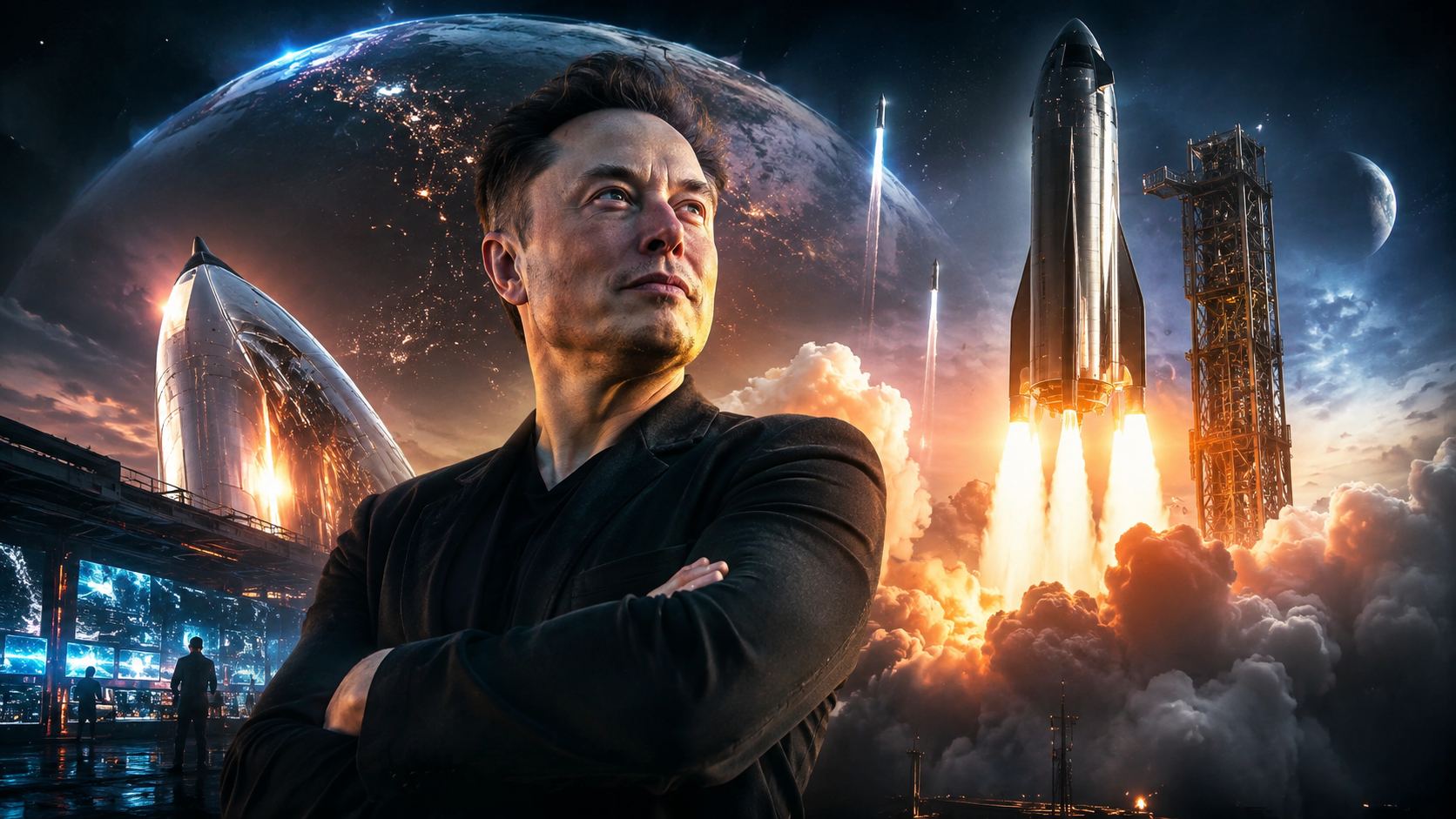
For decades, rocket launches were judged by engineers. Did the engines ignite? Did the booster land? Did the payload reach orbit? Today, those questions still matter—but they’re no longer the only scoreboard.
SpaceX enters Starship Flight 13 in an unfamiliar position. The company that revolutionized commercial launch services and turned reusable rockets into reality is now facing an equally demanding audience: financial markets.
After briefly becoming one of the world’s most valuable publicly traded companies following its record-breaking IPO, SpaceX shares have now fallen below their $135 IPO reference price for the first time. The decline doesn’t erase the company’s technological leadership, but it changes the narrative heading into tonight’s Starship launch. Suddenly, Flight 13 isn’t just another engineering milestone—it’s a test of investor confidence. Reuters and multiple financial outlets report that the launch is now viewed as one of the company’s next major catalysts after a sharp post-IPO pullback. Reuters
Table of contents
- From Moonshot to Reality Check
- Why Flight 13 Matters So Much
- Engineering vs. Expectations
- The Space Race Is Becoming Wall Street’s Race
- So what?
- Starship Flight 13: key questions
From Moonshot to Reality Check
Only a month ago, SpaceX looked unstoppable.
Its historic IPO became the largest ever, investors rushed into the stock, and Elon Musk’s aerospace empire briefly reached valuations that placed it among the world’s most valuable companies. The excitement wasn’t just about rockets. It was about Starlink, future lunar missions, Mars ambitions, and the idea that SpaceX had become the infrastructure company for humanity’s expansion into space.
Then reality arrived.
Shares slipped below the IPO reference price, erasing the symbolic gains that accompanied one of the biggest public listings in history. The move doesn’t necessarily signal a broken business. Analysts largely attribute the decline to profit-taking, lofty expectations, broader market conditions, and investors reassessing just how quickly SpaceX can monetize its long-term vision. But symbolism matters on Wall Street, and breaking below the IPO price is exactly the kind of headline investors notice. :contentReference[oaicite:0]{index=0}
That timing makes Flight 13 unusually important.
Why Flight 13 Matters So Much
SpaceX plans to open a 90-minute launch window beginning at 5:45 p.m. CDT (22:45 UTC) for Starship Flight 13. On paper, it’s another developmental test of the world’s most powerful launch system. In practice, it’s becoming something much larger. :contentReference[oaicite:1]{index=1}
Unlike earlier Starship launches, Flight 13 arrives after SpaceX became a publicly traded company.
That changes everything.
Public markets crave milestones because they create stories. A successful test reinforces the narrative that Starship is steadily progressing toward operational missions, larger Starlink deployments, NASA’s Artemis program, and eventually Mars. A major setback, meanwhile, risks reinforcing concerns that the commercialization timeline remains uncertain.
Of course, one launch doesn’t determine the value of a company as large as SpaceX.
But investors rarely react only to fundamentals. They react to momentum, expectations, and confidence.
Flight 13 therefore carries financial pressure that earlier Starship tests simply didn’t have.
Engineering vs. Expectations
Engineers and investors often watch the same rocket for entirely different reasons.
For aerospace teams, a partially successful mission can still represent enormous progress. Collecting flight data, validating software updates, testing heat shield performance, or improving booster recovery can justify calling a launch a success even if the vehicle doesn’t complete every objective.
Markets tend to be less nuanced.
Investors frequently translate launches into binary outcomes: success or failure.
That’s an uncomfortable mismatch.
Rocket development has always embraced rapid iteration. SpaceX itself popularized the philosophy of testing aggressively, learning quickly, and accepting spectacular failures as part of innovation. Engineers celebrate data. Markets punish uncertainty.
It’s a bit like comparing Kerbal Space Program to a quarterly earnings report.
Anyone who has played Kerbal knows that exploding rockets are often the fastest way to learn. Every failed staging sequence or catastrophic landing teaches players something useful for the next attempt.
Wall Street, however, doesn’t always reward expensive learning experiences.
The same disconnect appears in Christopher Nolan’s Interstellar. The film invites audiences to dream about humanity’s future among the stars, emphasizing courage, exploration, and impossible engineering challenges. Financial markets, by contrast, ask much colder questions: How long until this generates revenue? What’s the execution risk? How much capital will it consume?
Space exploration inspires emotion.
Capital markets price probabilities.
The Space Race Is Becoming Wall Street’s Race
Perhaps the biggest story isn’t Flight 13 itself.
It’s what Flight 13 represents.
For decades, aerospace companies were largely government contractors judged by multi-year procurement cycles. Today’s commercial space leaders increasingly resemble Big Tech companies.
Investors evaluate recurring revenue from Starlink subscriptions, launch cadence, satellite deployment, AI infrastructure ambitions, cash burn, debt financing, future earnings, and growth projections—not unlike how they assess cloud providers or semiconductor firms.
Space is no longer just about reaching orbit.
It’s about recurring business models.
That transformation also explains why launches now move markets. Each successful mission potentially validates future revenue streams, while each setback raises questions about execution and timelines.
The rocket has become a quarterly report.
So what?
Whether Flight 13 succeeds spectacularly or encounters new challenges, one reality is becoming increasingly clear.
Commercial space has entered a new era where engineering achievements and financial expectations are permanently intertwined.
That’s exciting—but also dangerous.
Investors attracted by the romance of Mars missions should remember that public markets rarely reward dreams on their own. They reward execution, predictable growth, and evidence that ambitious visions can become sustainable businesses.
SpaceX remains the industry’s dominant launch provider, and Starship still represents one of the boldest engineering projects ever attempted. But after going public, every launch now carries two payloads.
One climbs toward orbit.
The other carries billions of dollars’ worth of market expectations.
Starship Flight 13: key questions
Why is Flight 13 receiving so much attention?
It is the first major Starship test conducted after SpaceX became a public company and comes as the stock trades around its IPO reference price, making investor sentiment especially sensitive.
Does one launch determine SpaceX’s valuation?
No. SpaceX‘s long-term value depends on multiple businesses, including Starlink, launch services, government contracts, and future commercial opportunities. However, major test flights can influence short-term market sentiment.
Why do investors react so strongly to test launches?
Successful tests can strengthen confidence in future revenue opportunities, while failures may raise concerns about development timelines, execution risk, and capital requirements.
Is investing in commercial space companies risky?
Yes. Space companies often require significant capital investment, long development cycles, and face technological as well as regulatory uncertainty.
Is this article financial advice?
No. This article is for informational purposes only and should not be considered investment or financial advice. Investors should conduct their own research before making investment decisions.